Lokalise’s 2021 pitch deck is a concise, 11-slide presentation that successfully secured $50M in Series B funding. Rather than relying on complex market projections, the deck leans into proven traction and clear product-market fit. By Slide 3, the company establishes massive scale with 2,300 customers across 80+ countries and a team that grew from 20 to over 150 employees in just two years. The narrative centers on moving localization away from static spreadsheets and toward an integrated, developer-focused automation platform. A detailed case study of Withings provides the 'aha' moment, demo…
Key takeaways
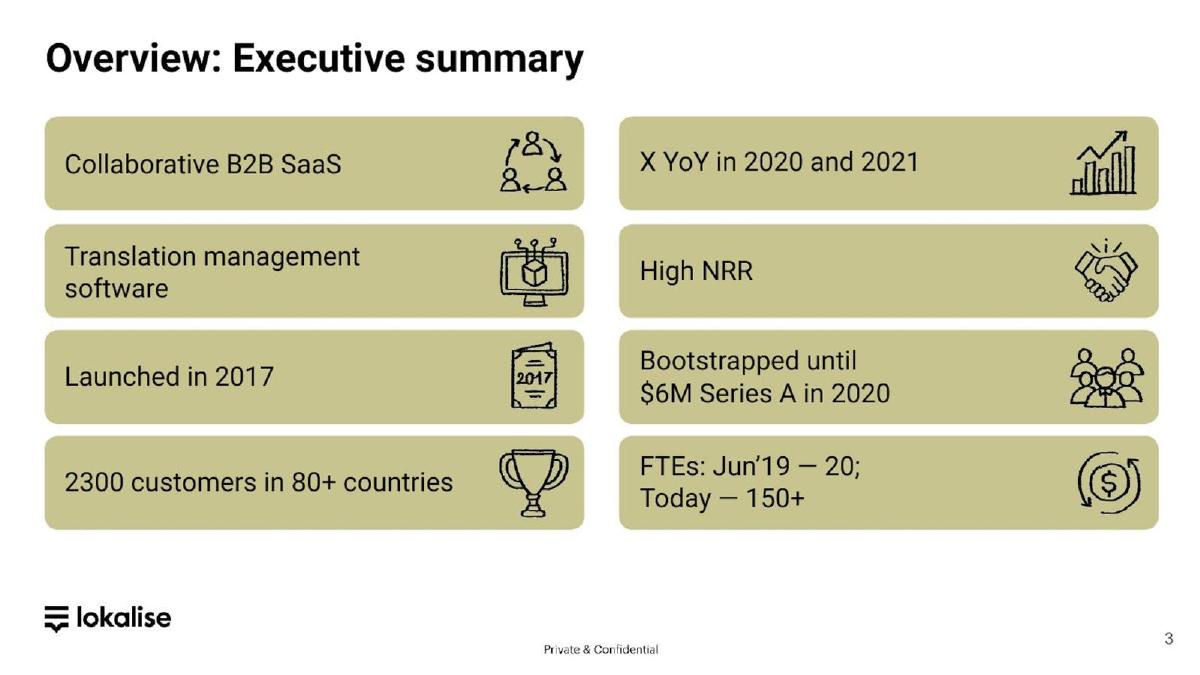
- The deck highlights a massive customer base of 2,300 clients across 80+ countries as of 2021 (Slide 3).
- Lokalise emphasizes its transition from a bootstrapped startup to a venture-backed scale-up, noting a $6M Series A in 2020 (Slide 3).
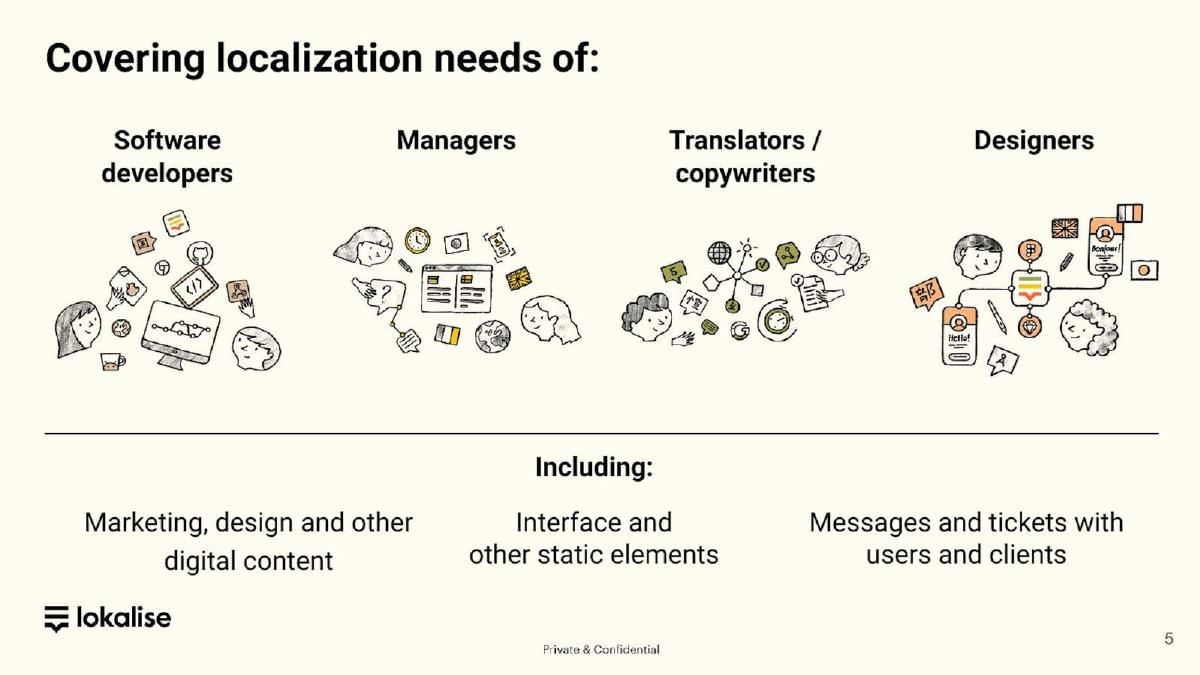
- The company identifies four distinct user personas: software developers, managers, translators/copywriters, and designers (Slide 5).
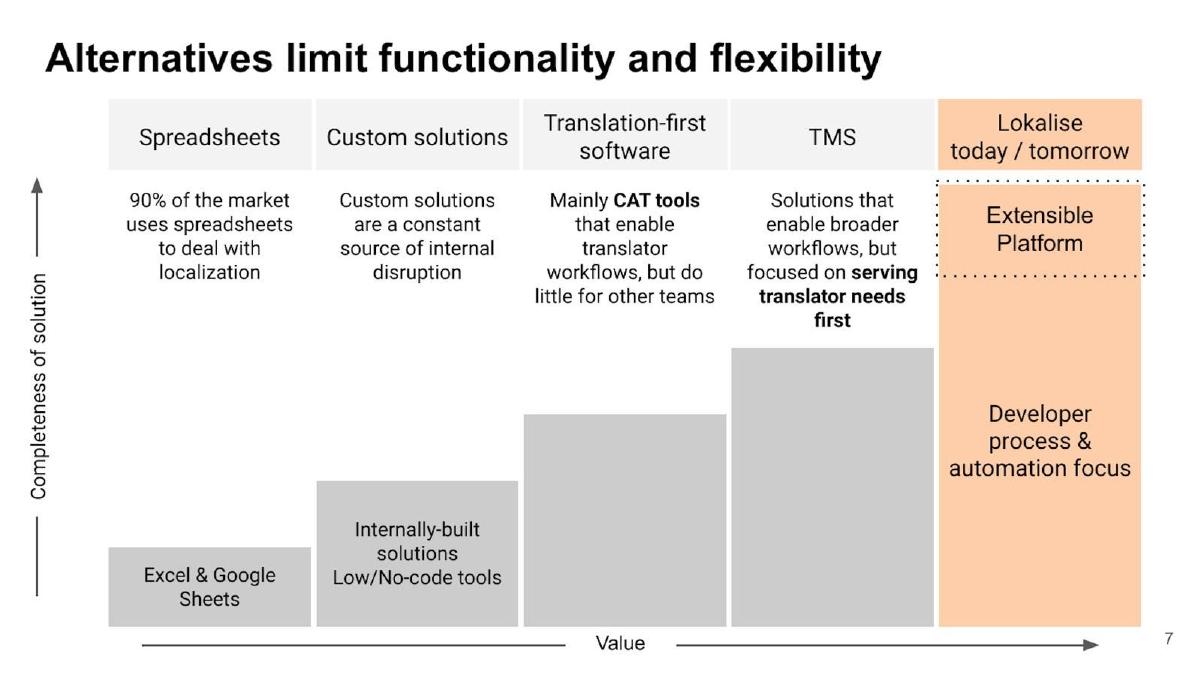
- A competitive landscape chart positions Lokalise as the only 'Extensible Platform' with a 'Developer process & automation focus' compared to legacy TMS (Slide 7).
- The deck claims that 90% of the market still uses spreadsheets to manage localization, representing a significant displacement opportunity (Slide 7).
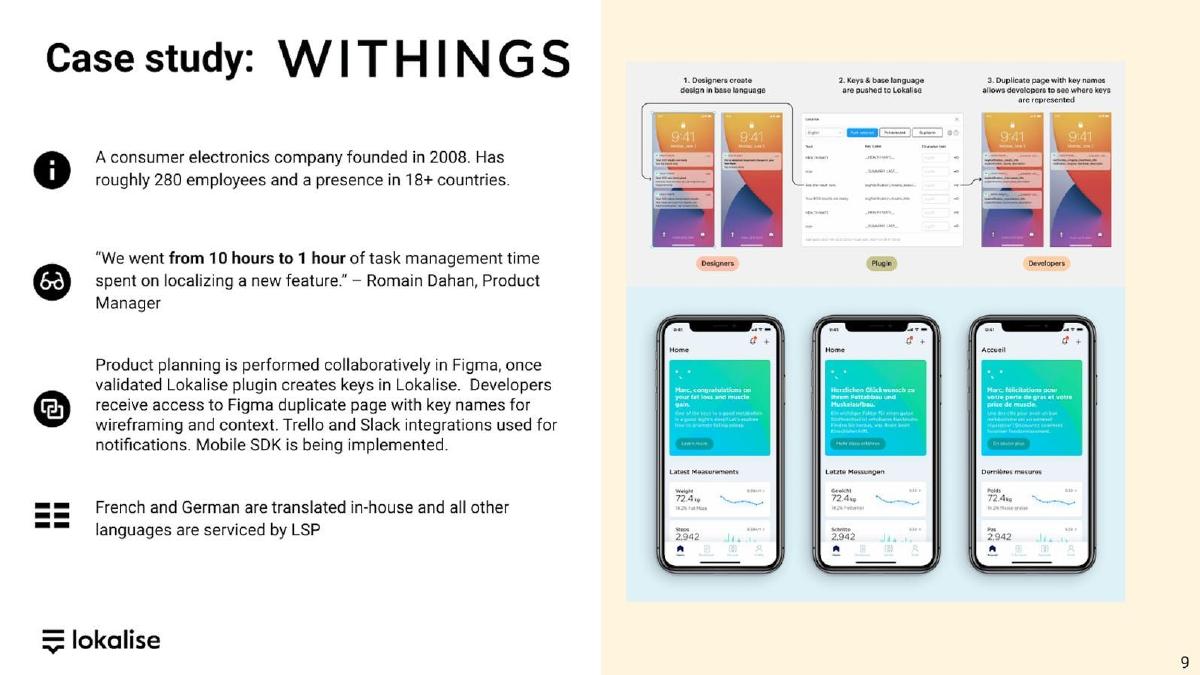
- A case study for Withings quantifies the value proposition, showing task management time dropping from 10 hours to 1 hour (Slide 9).
- The presentation omits a traditional 'Team' slide, focusing instead on the product's utility and organizational growth (Slides 1-11).
- The deck lacks a specific 'Ask' slide detailing the $50M round reported by Business Insider, functioning more as a business overview (Slides 1-11).
Introduction: The $50M Series B Narrative
Lokalise, an enterprise software platform specializing in localization and translation management, raised $50M in a Series B round in 2021. Headquartered in North America, the company used this 11-slide deck to communicate its rapid transition from a bootstrapped entity to a dominant player in the B2B SaaS space. The deck is notable for its clean aesthetic, hand-drawn illustrations, and a heavy emphasis on workflow integration over simple translation services.
Slide 1-2: Brand Identity and Visual Consistency
The opening slides are minimalist, featuring the Lokalise logo and the year 2021. The use of hand-drawn, whimsical illustrations (a person interacting with various language and code icons) immediately signals that this is a modern, design-forward SaaS company. While these slides contain no data, they establish the brand's voice: approachable yet professional.
Slide 3: The Executive Summary
Slide 3 is the most data-dense slide in the deck, serving as a 'traction teaser.' It lists eight key highlights that define the company's status at the time of the Series B. Key figures include 2300 customers in 80+ countries and a massive jump in headcount from 20 FTEs in June 2019 to 150+ today . The slide also notes that the company was bootstrapped until a $6M Series A in 2020 , which is a powerful signal to investors of capital efficiency. The mention of 'High NRR' (Net Revenue Retention) suggests a 'sticky' product that grows within existing accounts, though the specific percentage is omitted.
Slide 4: Visual Transition
Slide 4 continues the visual theme established in the intro, using the same illustration style to maintain flow. In a short deck, these transition slides act as a 'breather' between data-heavy sections.
Slide 5: The Multi-Persona Solution
On Slide 5, Lokalise defines its user base. This is a critical slide for enterprise software because it proves the tool isn't just for one department. They list Software developers, Managers, Translators / copywriters, and Designers . By showing how the platform covers 'Marketing, design and other digital content' as well as 'Interface and other static elements,' they position Lokalise as a horizontal platform that touches every part of a digital product's lifecycle.
Slide 6: Visual Transition
Similar to Slide 4, this slide serves as a visual placeholder, reinforcing the brand identity before moving into the competitive analysis.
Slide 7: Alternatives and Market Positioning
Slide 7 is a classic 'step' chart showing the evolution of the market. It categorizes competitors into four buckets: Spreadsheets (90% of the market), Custom solutions (internal disruption), Translation-first software (CAT tools), and TMS (focused on translators). Lokalise positions itself at the top of the stairs as the 'Lokalise today / tomorrow' solution. The key differentiator cited is an 'Extensible Platform' with a 'Developer process & automation focus.' This is a strategic pivot; they aren't competing on the quality of translation, but on the efficiency of the engineering workflow.
Slide 8: Visual Transition
Another branded transition slide leading into the evidence-based portion of the pitch.
Slide 9: The Withings Case Study
Slide 9 provides the social proof and ROI evidence required for a Series B. Using Withings (a consumer electronics company founded in 2008) as the subject, the slide delivers a powerful quote from a Product Manager: 'We went from 10 hours to 1 hour of task management time spent on localizing a new feature.' The slide also details the technical stack, mentioning integrations with Figma, Trello, and Slack , and the implementation of a Mobile SDK . This slide proves the 'Developer focus' claimed on Slide 7 is a reality, not just a marketing slogan.
Slide 10: Visual Transition
The final transition slide, maintaining the cohesive hand-drawn art style.
Slide 11: The Conclusion
The deck ends with a 'Thank you' and an illustration of a bird in a basket attached to a balloon, floating through space. There is no contact information, no 'Ask' amount, and no team summary on this final slide.
What Works in the Lokalise Deck
1. Extreme Clarity on Persona: Many localization tools market themselves to translators. Lokalise correctly identifies that in a modern SaaS company, the bottleneck is often the developer or the designer. By highlighting these personas on Slide 5, they appeal to the 'buyer' (usually a CTO or Head of Product) rather than just the 'user' (a translator).
2. The Power of the 10x Improvement: The Withings case study on Slide 9 is the strongest part of the deck. Claiming a 90% reduction in time (10 hours to 1 hour) is the 'holy grail' of B2B SaaS value propositions. It makes the software feel like a necessity rather than a luxury.
3. Capital Efficiency Narrative: Mentioning on Slide 3 that they were bootstrapped until $6M in 2020 is a subtle but effective way to tell investors that the founders know how to manage a balance sheet. It suggests that the $50M they are currently raising will be deployed with similar discipline.
What is Missing from the Lokalise Deck
1. The Team Slide: For a $50M round, investors typically want to see the pedigree of the leadership team. This deck completely omits the founders' backgrounds, their previous exits, or the strength of their engineering leadership. While the traction (2,300 customers) speaks for itself, the lack of a team slide is a notable departure from standard pitch formats.
2. Financial Specifics: While 'High NRR' and 'X YoY' are mentioned on Slide 3, the actual numbers are missing. In a Series B, investors usually expect to see a cohort analysis, CAC (Customer Acquisition Cost) vs. LTV (Lifetime Value) ratios, and a clear path to $100M ARR. This deck functions more as a high-level narrative than a financial deep dive.
3. The Competitive Landscape: Slide 7 mentions 'TMS' and 'CAT tools' generally, but it does not name specific competitors like Smartling, Phrase, or Memsource. While focusing on the 'spreadsheet' as the primary enemy is a common tactic, sophisticated investors would want to know how Lokalise wins against other modern, API-first competitors.
Founder Takeaways: What to Copy
Use Headcount as a Proxy for Momentum: If your revenue numbers are confidential, follow Lokalise’s lead on Slide 3 and show your FTE (Full-Time Equivalent) growth. Moving from 20 to 150 employees in two years is a visible, undeniable sign of a company that is scaling rapidly.
Focus on Workflow, Not Just Output: Lokalise doesn't just say 'we translate text.' They show how they fit into Figma and Slack (Slide 9). Founders should focus their decks on how their tool integrates into the customer's existing 'daily habit' rather than trying to be a standalone destination.
Design for the 'Aha' Moment: The Withings case study is successful because it uses a specific, measurable metric. When creating your own case study slide, avoid vague praise like 'they loved the tool.' Instead, use the 'X hours to Y hours' format to make the ROI undeniable.
Frequently asked questions
- How does Lokalise differentiate itself from traditional Translation Management Systems (TMS)?
- According to Slide 7, traditional TMS solutions focus primarily on serving translator needs. Lokalise positions itself as an 'Extensible Platform' that prioritizes developer processes and automation. This allows the software to integrate directly into the product development lifecycle rather than being a siloed tool used only after the design and code are finalized.
- What specific metrics does Lokalise use to prove traction?
- Lokalise uses three primary pillars of traction on Slide 3: customer volume (2,300 customers in 80+ countries), retention (stated as 'High NRR'), and organizational scale (growing from 20 to 150+ employees). They also mention 'X YoY' growth in 2020 and 2021, though the specific multiplier is redacted in this version of the deck.
- Which departments within a company does Lokalise target?
- Slide 5 explicitly covers the needs of four groups: Software developers, Managers, Translators/Copywriters, and Designers. By addressing all four, Lokalise moves localization from a back-office task to a collaborative workflow that includes marketing, design, and technical interface elements.
- What is the primary 'problem' Lokalise solves according to the deck?
- The deck identifies two main problems. First, Slide 7 notes that 90% of the market is stuck using spreadsheets, which lack functionality. Second, Slide 9 highlights the inefficiency of manual task management, showing that their platform can reduce the time spent on localizing new features by 90% (from 10 hours to 1 hour).
- Is there a breakdown of how the $50M Series B funds will be used?
- No. The 11 slides provided do not include a 'Use of Funds' or 'The Ask' slide. This is common in high-profile Series B decks where the terms may be pre-negotiated or the deck is used as a high-level overview for late-stage investors who already have access to a full data room.