Long Journey Ventures Fund I raised $35M in 2019 by positioning its General Partners—Lee Jacobs, Cyan Banister, and Arielle Zuckerberg—as 'experienced builders and investors' with a 'world class angel track record.' The deck is a masterclass in social proof, citing early-stage involvement in decacorns like Uber, SpaceX, and Notion (Slide 3). Rather than relying on a long-standing firm history, the fund emphasizes its 'unparalleled networks' (Slide 4) and specific value-add pillars: fundraising, growth, recruiting, and product strategy (Slide 5). The deck includes detailed case studies for com…
Key takeaways
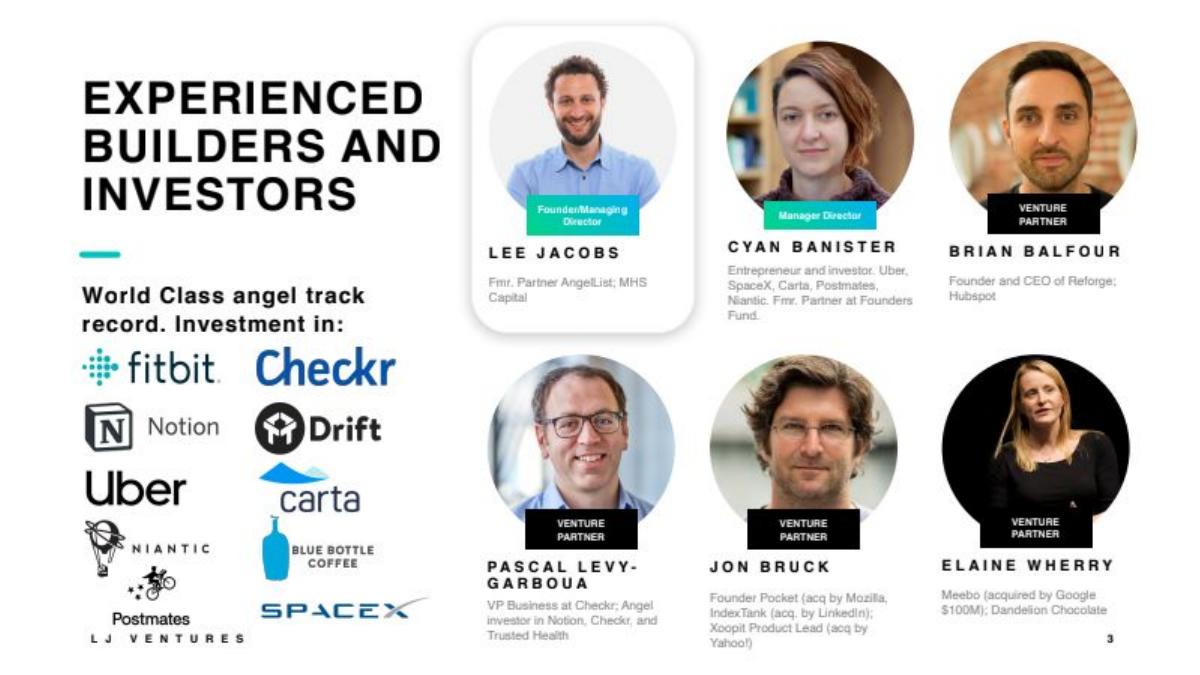
- The deck highlights a collective angel track record including Fitbit, Uber, SpaceX, and Notion on Slide 3.
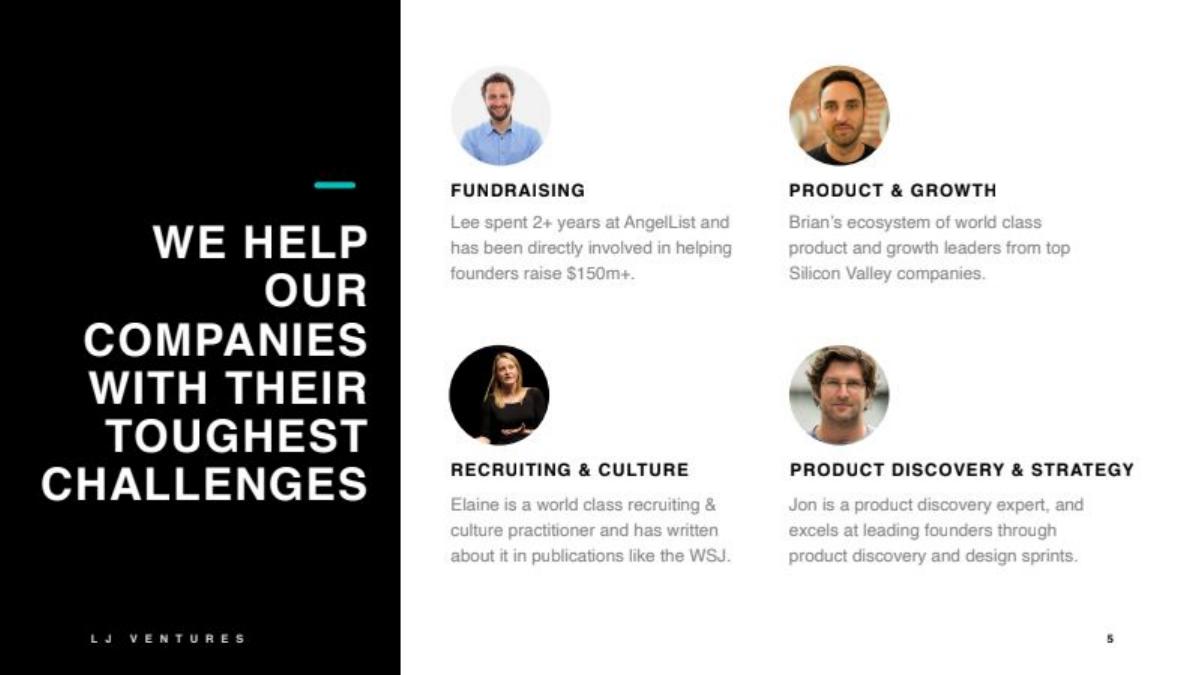
- Partners are positioned by specific functional expertise: Lee (Fundraising), Brian (Growth), Elaine (Recruiting), and Jon (Product) on Slide 5.
- Case studies for Loom and Crusoe explicitly detail how the partners facilitated introductions to lead investors like Kleiner Perkins and Bain Capital on Slides 7 and 8.
- The fund claims that 4 of every 5 investments made in 2016 raised follow-on capital, citing co-investors like Founders Fund and a16z on Slide 14.
- Investment criteria target 35-40 core investments with check sizes between $400k and $700k on Slide 16.
- The deck lists high-profile LPs including Marc Andreessen and Peter Thiel to establish institutional credibility on Slide 20.
- A pilot fund invested approximately $10M between 2016-19 to prove the strategy before the $35M raise on Slide 12.
- Sector diversification is shown via a pie chart on Slide 25, with B2B SaaS representing the largest share at 33.0%.
Long Journey Ventures Fund I: The Power of the Individual Track Record
Raising a first-time venture fund is notoriously difficult because, by definition, the firm lacks a joint track record. Long Journey Ventures solved this in their 2019 deck by aggregating the massive individual successes of its partners. The deck functions as a bridge, taking the 'angel' identities of Lee Jacobs and Cyan Banister and institutionalizing them into a $35M vehicle. This teardown examines how they used social proof, network maps, and specific case studies to convince LPs that their past performance was repeatable.
Slides 1-2: The Foundation
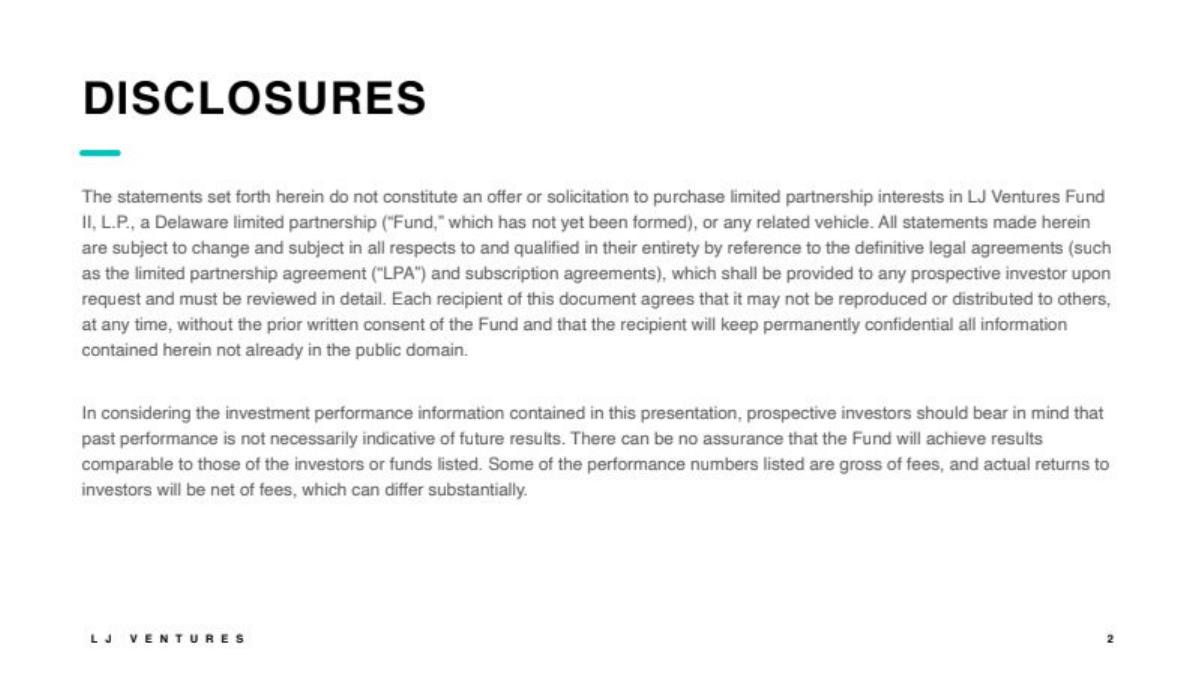
The deck opens with a minimalist title slide (Slide 1) and a standard legal disclosure (Slide 2). The disclosure is notable for mentioning 'LJ Ventures Fund II, L.P.,' suggesting this deck may have been updated or used during a rolling close or transition period, though the catalogue identifies this as the Fund I raise. It sets the professional tone required for institutional fundraising.
Slides 3-6: The Team and Network Advantage
Slide 3 is the 'hook.' It features the logos of Fitbit, Checkr, Notion, Drift, Uber, Carta, Niantic, Blue Bottle Coffee, Postmates, and SpaceX. By labeling these as 'World Class angel track record' investments, the partners immediately bypass the 'first-time fund' stigma. The team bios emphasize operational roles at AngelList, Founders Fund, and Reforge, positioning them as insiders rather than just financiers.
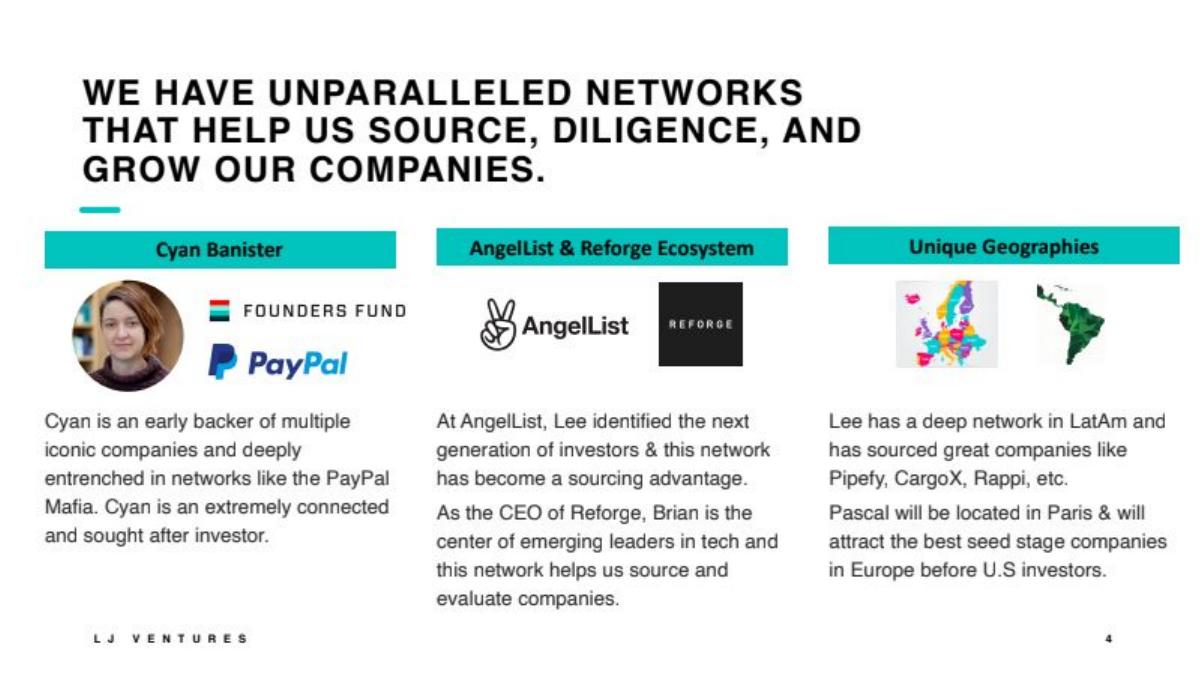
Slide 4 breaks down their 'Unparalleled Networks.' It maps Cyan Banister to the 'PayPal Mafia' and Founders Fund, Lee Jacobs to the AngelList ecosystem and Latin America (sourcing Rappi and Pipefy), and Brian Balfour to Reforge. This slide is critical because it explains how they get into competitive deals—a primary concern for LPs in a crowded seed market.
Slide 5 defines their 'Value Add' pillars. Instead of saying they 'help founders,' they assign specific domains to partners: Lee for Fundraising ($150m+ raised for founders), Brian for Product & Growth, Elaine for Recruiting & Culture, and Jon for Product Discovery. This gives LPs a clear picture of the firm's post-investment utility.
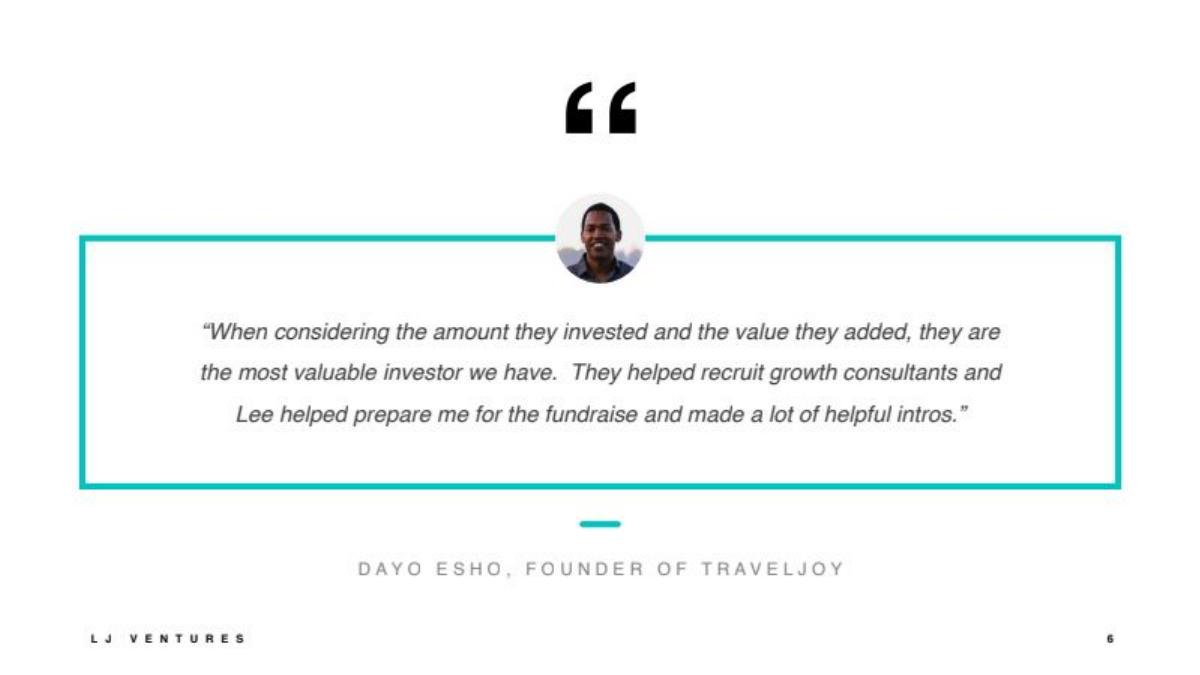
Slide 6 provides the first piece of founder social proof with a quote from Dayo Esho of TravelJoy, specifically crediting Lee Jacobs for help with fundraising and recruiting growth consultants.
Slides 7-11: Proving the Process Through Case Studies
The middle section of the deck (Slides 7, 8, 9, and 11) uses a consistent visual timeline to show the fund's impact on portfolio companies. Slide 7 (Loom) shows an investment at Seed+ followed by strategic support that led to a $30M Series B from Sequoia. Slide 8 (Crusoe) highlights an investment when the company had only '1 installation,' followed by introductions that resulted in '2 lead term sheets' and a $30M Series A led by Bain Capital.
Slide 9 (Pipefy) emphasizes hiring and recruiting, noting that the partners helped recruit an independent board member and a growth team member before a $45M Series B from Insight Partners. Slide 11 (Compound) shows a commitment at the 'white paper stage,' leading to a $25M Series A led by a16z. These slides are designed to prove that the partners aren't just picking winners; they are actively manufacturing the conditions for follow-on rounds from top-tier firms.
Slides 12-15: The Quantitative Track Record
Slide 12 introduces the 'Pilot Fund,' which invested approximately $10M between 2016 and 2019. While the specific figures in the table are redacted in this version, the headline 'It’s working' and the presence of columns for MOIC (Multiple of Invested Capital) indicate a transition from angel investing to a managed portfolio approach.
Slide 13 visualizes their co-investment history. It shows they have co-invested with Founders Fund 6 times, a16z 5 times, and Sequoia 3 times. For an LP, this is a proxy for quality; if the best firms in the world are consistently buying what Long Journey is selling, the 'selection' risk is mitigated.
Slides 14 and 15 provide a list of companies that raised follow-on capital. The claim that '4 of every 5 investments made in 2016 raised follow-on capital' is a powerful metric for a seed fund. The list includes Grove Collaborative ($125M Series D), Wonderschool ($30M Series A+), and Blue Bottle Coffee (Exit to Nestle).
Slides 16-19: Strategy and Current Portfolio
Slide 16 outlines the 'Investment Criteria.' They are generalists targeting 35-40 core investments of $400k-$700k. They explicitly mention gravitating toward founders with 'perseverance and grit (i.e. immigrants).' This gives the fund a specific cultural identity.
Slide 18 showcases 'New Fund Portfolio Highlights,' including companies like Wingspan, Puzzl, and Popshop Live. This demonstrates that the fund is already active and winning deals with co-investors like Benchmark and Bloomberg Beta. Slide 19 updates the 'Momentum' of the collective angel portfolio, citing Postmates' $2.65B sale and Notion's 156x markup. Citing a '6x (at fund level) in 2 years' for the Compound position (Slide 19) provides a recent, high-velocity win to excite LPs.
Slides 20-22: The Close
Slide 20 lists 'World Class LPs,' featuring Marc Andreessen and Peter Thiel. Having the founders of the world's most successful VC firms as LPs is the ultimate endorsement. Slide 21 details the terms: $30M target, 10-year life, 2% fee, and 20% carry. Slide 24 (labeled out of order) and Slide 25 provide additional data on 'Great Access' (opportunistic SPV investments in Checkr and Rappi) and a sector breakdown showing a heavy lean toward B2B SaaS (33%) and Healthcare/CPG (11% each).
What Long Journey Ventures Fund I Does Well
Aggregated Social Proof: The deck uses logos and names (Andreessen, Thiel, Sequoia) as a shield against the perceived risk of a new fund. · Specific Value-Add: By mapping partners to specific business functions (Slide 5) and then proving those functions in case studies (Slides 7-9), they avoid the 'founder friendly' clichés. · Follow-on Rate: The '4 out of 5' follow-on metric (Slide 14) is the most important data point for a seed fund, as it proves their companies are attractive to the next stage of capital.
What is Missing
Detailed Unit Economics: While they mention MOIC, the specific net returns and distributions to date (DPI) are not detailed in this public version of the deck. · Operating Budget: There is no breakdown of how the 2% management fee will be spent across the team of six people mentioned on Slide 3. · Pipeline Data: While they show past successes, they don't show the current 'top of funnel' or how many deals they evaluate to reach their 35-40 core investments.
What Other Founders (and GPs) Should Copy
The Timeline Case Study: The format used on Slides 7-9 is excellent. It shows the entry point, the specific help provided, and the institutional validation that followed. · The Co-Investor Table: Slide 13 is a simple but effective way to show that you belong in the 'top tier' by association. · The 'Momentum' Slide: Slide 19 is a great way to show that your portfolio is currently 'hot,' even if exits haven't fully realized yet.
Frequently asked questions
- What is the primary investment strategy of Long Journey Ventures?
- According to Slide 16, the fund is a generalist firm that makes 35-40 core investments per fund. They target check sizes between $400,000 and $700,000. They prioritize founders with whom they have long-standing relationships and specifically look for 'perseverance and grit,' citing immigrants as an example of the founder profile they gravitate toward.
- How does the fund prove its 'value-add' to prospective LPs?
- The deck uses specific company timelines (Slides 7, 8, 9, and 11) to show exactly where the partners intervened. For example, Slide 7 shows how they invested in Loom at the Seed+ stage and helped the company leverage 'Reforge content' to design a monetization strategy before Kleiner Perkins led the Series A. This moves beyond vague promises of 'help' into documented milestones.
- Who are the key people involved in the fund?
- Slide 3 lists Lee Jacobs (Founder/Managing Director), Cyan Banister (Managing Director), and Venture Partners Brian Balfour, Pascal Levy-Garboua, Jon Bruck, and Elaine Wherry. The catalogue listing also notes Arielle Zuckerberg as a GP. The team combines experience from AngelList, Founders Fund, Reforge, and companies like Checkr and Google.
- What kind of returns or track record did they show for Fund I?
- Since this was Fund I, they used a 'Pilot Fund' track record from 2016-2019 (Slide 12) which invested approximately $10M. They also highlighted 'Momentum' in their angel portfolios on Slide 19, citing Postmates' $2.65B sale to Uber and Notion's 156x markup from the seed stage to validate their selection ability.
- What are the fund's economic terms for LPs?
- Slide 21 outlines the 'Summary of Terms.' The target fund size was $30M (though the catalogue notes they raised $35M). The fund life is 10 years with a 2-year extension option. The investment period is 5 years, with an average management fee of approximately 2% and a standard 20% carried interest.