Method Financial’s 12-slide pre-seed deck is a masterclass in identifying a specific, unaddressed infrastructure gap: the lack of standardized rails for debt repayment. By positioning themselves as the developer-friendly solution to a market where 99% of Americans use 'archaic methods' (Slide 2), the founders successfully raised $2.5M. The deck relies on high-contrast visuals and a clear 'Before vs. After' narrative, moving from the pain of 10,000+ fragmented lenders (Slide 3) to a unified API supporting 95% of lenders (Slide 5). While the deck is light on detailed financial projections and a…
Key takeaways
- The deck identifies a massive fragmentation problem with over 10,000 different lenders in the US (Slide 3).
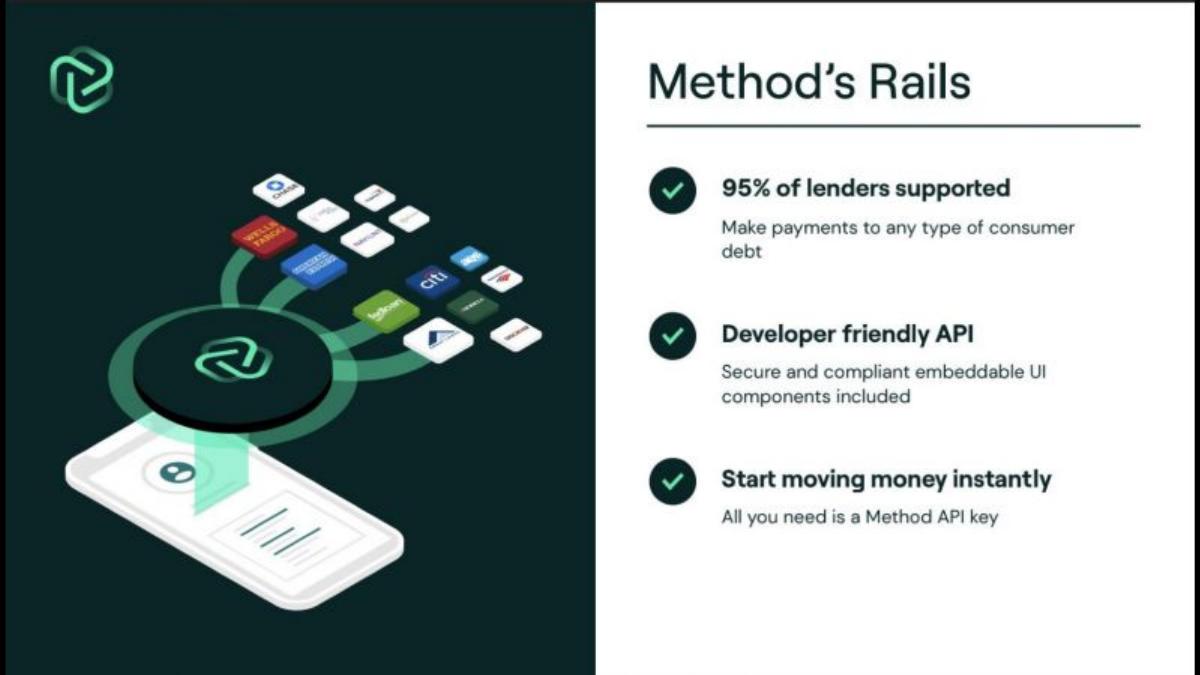
- Method claims to support 95% of lenders, allowing payments to any type of consumer debt (Slide 5).
- The product is positioned as a developer-friendly API that eliminates the need for 6-month integration timelines (Slide 3, Slide 5).
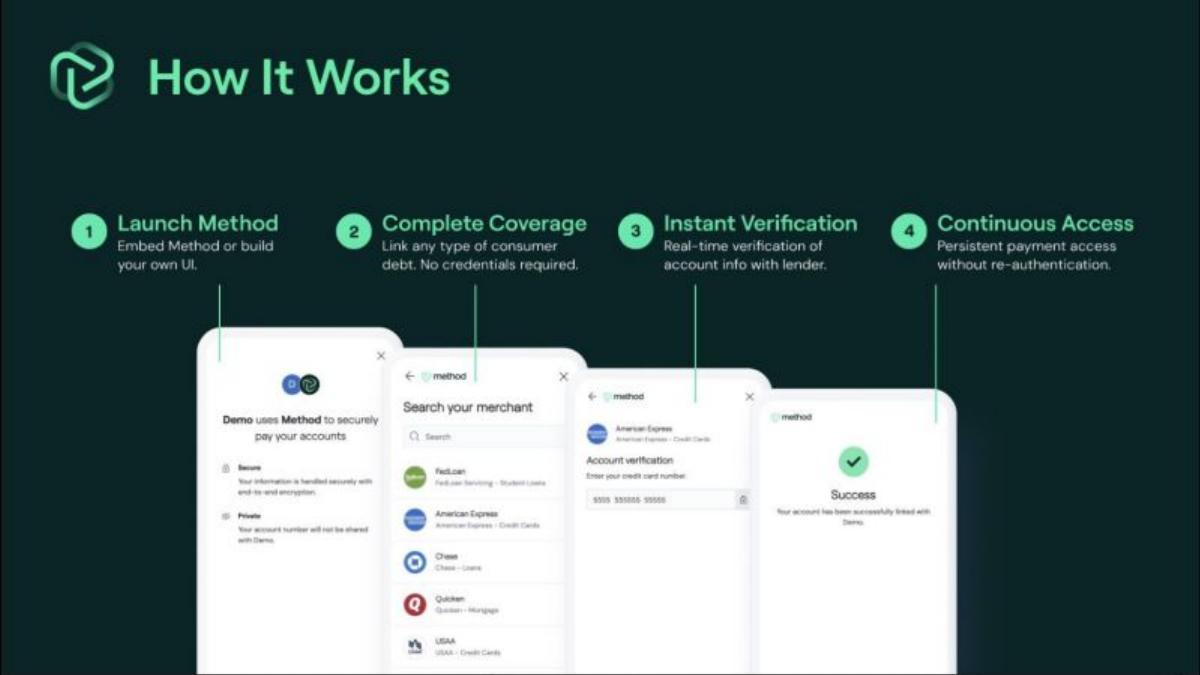
- The user flow emphasizes 'no credentials required' for linking consumer debt, reducing friction (Slide 6).
- Early traction is demonstrated by 4 live customers and 6 LOIs valued at $250k MRR (Slide 9).
- The market opportunity is calculated at $6.5B based on a $0.65 fee per debt repayment across 10B annual repayments (Slide 10).
- The founding team leverages strong pedigree with Y Combinator, University of Texas, and Box logos (Slide 11).
- The deck omits a formal 'use of funds' or 'ask' slide, focusing entirely on the problem-solution fit.
The Infrastructure Play: Method Financial Teardown
Method Financial entered the fintech space with a very specific value proposition: debt repayment is broken because the 'rails' don't exist. This 12-slide deck, used for their 2022 pre-seed round, follows a classic narrative arc that prioritizes problem-solution clarity over complex financial modeling. It is a 'developer-first' deck that speaks the language of APIs and integrations.
Slides 1-2: The Hook and the Archaic Reality
Slide 1 introduces the company as an 'Embedded debt repayment API.' This is a precise category definition. It doesn't call itself a 'financial wellness platform' or a 'debt management app'; it identifies as infrastructure. The logo is a stylized knot or link, reinforcing the idea of connectivity.
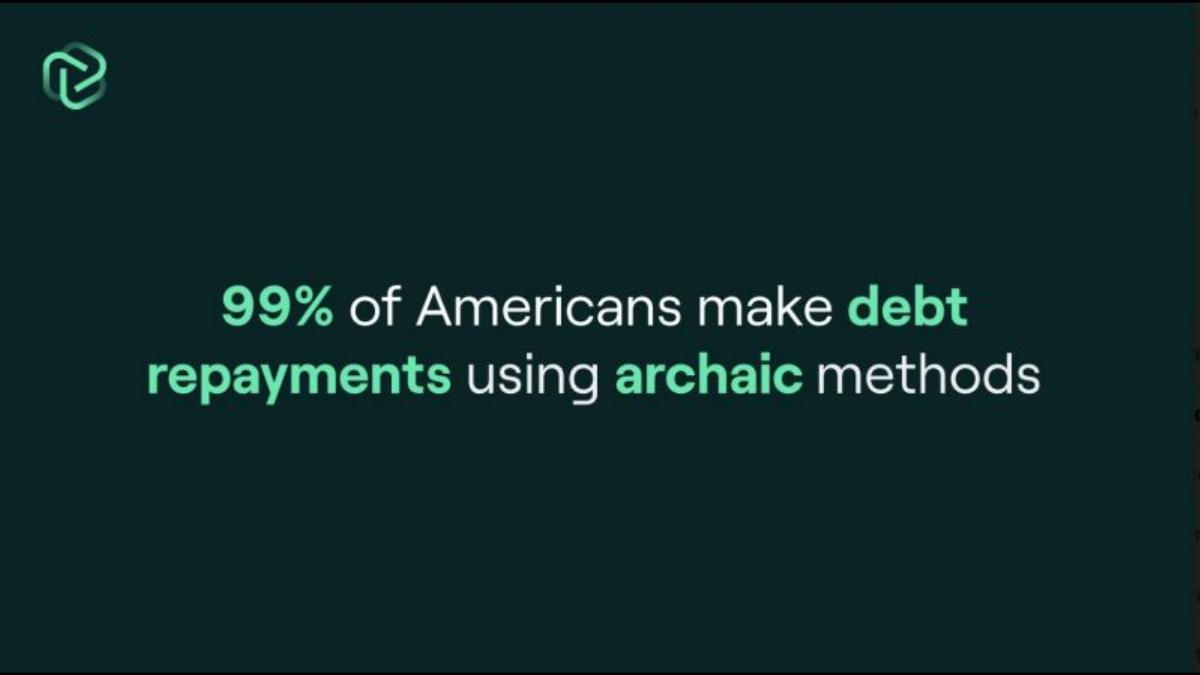
Slide 2 delivers a staggering statistic: '99% of Americans make debt repayments using archaic methods.' By using the word 'archaic,' the founders immediately frame the current state of the industry as obsolete. This sets the stage for a disruptive technology to enter the frame.
Slides 3-4: The Fragmented Problem
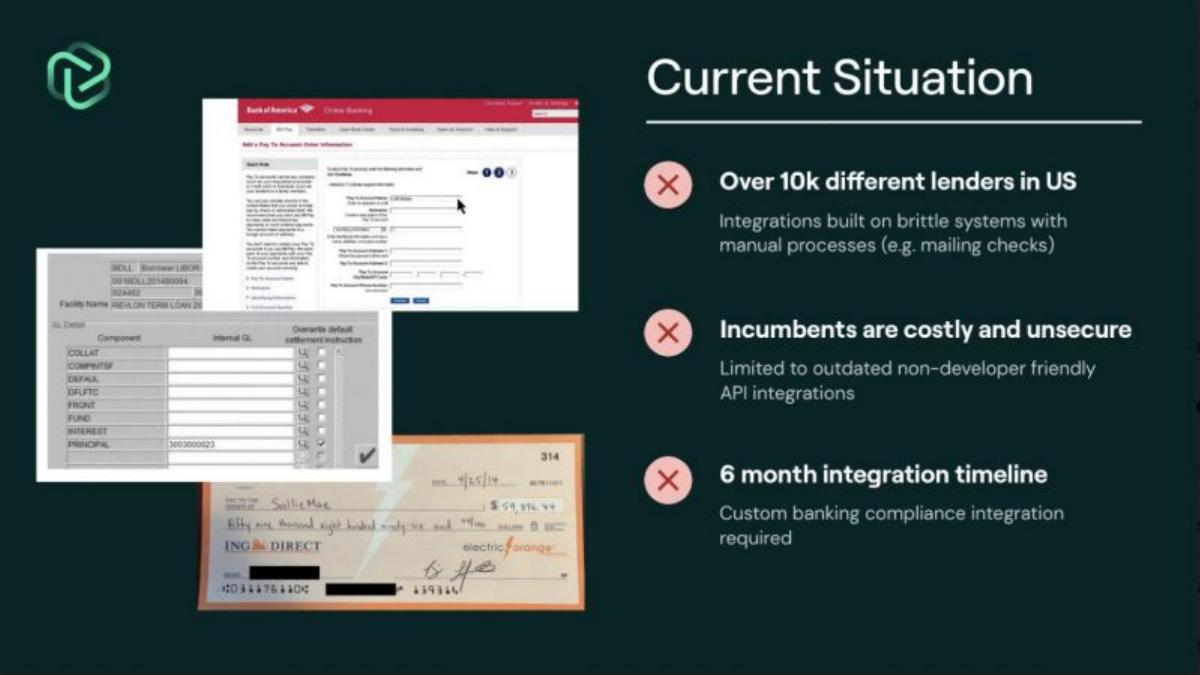
Slide 3, titled 'Current Situation,' uses visual evidence to drive home the pain. It shows a screenshot of a legacy Bank of America bill pay screen, a complex internal ledger, and a physical check made out to Sallie Mae for $59,896.44. The text highlights three critical failure points: 10k+ different lenders in the US leading to brittle systems, costly and unsecure incumbents, and a 6-month integration timeline requiring custom banking compliance.
Slide 4 acts as a bridge: 'Holistic financial management is taking off and debt repayment rails don’t exist.' This slide identifies the 'Why Now?' factor. As more fintech apps try to offer comprehensive wealth management, they are hitting a wall because they cannot easily facilitate the movement of money toward debt.
Slides 5-6: The Solution and User Experience
Slide 5 introduces 'Method’s Rails.' This is the 'After' to Slide 3's 'Before.' The company claims 95% lender support, a developer-friendly API with embeddable UI components, and the ability to 'start moving money instantly.' The visual shows a Method 'hub' connecting a mobile device to a cloud of major bank logos.
Slide 6, 'How It Works,' breaks the technical process into four simple steps for the end-user: Launch Method, Complete Coverage (linking debt with no credentials), Instant Verification, and Continuous Access. The inclusion of mobile mockups showing a 'Search your merchant' screen and a 'Success' notification makes the abstract API concept feel like a tangible product.
Slides 7-8: Use Cases and Product Breadth
Slide 7, 'Current Solutions' (which likely refers to current applications of their API), lists three primary use cases: Debt Repayment, Mortgage Underwriting (tradeline paydown for closings), and Balance Transfers. This slide is important because it shows that Method isn't just a 'bill pay' button; it is a tool for complex financial maneuvers like mortgage closings and credit optimization.
Slide 8 is a placeholder or transition slide that was not fully utilized in this version of the deck, or it serves to emphasize the simplicity of the 'Current Solutions' presented in the previous slide.
Slides 9-10: Traction and Market Math
Slide 9 provides the 'Proof of Life.' The headline '4 live customers & 6 LOIs' is strong for a pre-seed stage. The slide notes a launch in May and 6 LOIs valued at $250k MRR. Interestingly, the 'Revenue: $x MRR' line is redacted or left as a variable, suggesting this deck may have been used across different stages of their early fundraising or that they were still in the very early days of monetization. They also highlight being the '#3 Product of the Day' on Product Hunt, a common signal for developer-focused startups.
Slide 10 tackles the 'Market Opportunity.' Instead of a standard TAM/SAM/SOM pyramid, Method uses a simple multiplication formula: $0.65 per debt repayment multiplied by 10 billion debt repayments per year, resulting in a $6.5B market. This 'bottom-up' calculation is often more persuasive to investors than top-down industry reports because it shows exactly how the company intends to make money.
Slides 11-12: The Team and Closing
Slide 11 introduces the founders, Jose Bethancourt and Marco del Carmen. The slide is minimalist, relying on the 'Y' logo (Y Combinator) to do the heavy lifting for credibility. Marco’s background at Box provides the necessary 'enterprise/infrastructure' pedigree. Slide 12 is a simple contact slide with an email and website.
What Method Financial Does Well
The deck excels at narrowing the focus . It does not try to solve 'finance'; it tries to solve 'debt repayment rails.' By focusing on the 10,000+ lenders and the 6-month integration time, they make the problem feel incredibly specific and the solution feel like a mandatory utility for other fintechs. The 'no credentials required' claim on Slide 6 is a major technical differentiator that addresses a common friction point in fintech (user reluctance to share passwords).
What is Missing from the Deck
The most notable omission is a Competitor Slide . While they mention 'incumbents' generally, they don't address other data aggregators or payment processors who might be moving into this space. There is also no Financial Projection slide beyond the market math. Investors usually want to see a 3-5 year roadmap of how that $250k MRR in LOIs converts into actual GAAP revenue. Finally, there is no 'The Ask' slide. We know from the catalogue that they raised $2.5M, but the deck doesn't state how much they were looking for or what the specific milestones for the next 18 months would be.
What Founders Should Copy
Founders building infrastructure should copy the Market Opportunity Formula on Slide 10. Showing the unit price ($0.65) multiplied by the volume (10B) is much more effective than saying 'The fintech market is $200B.' It shows you understand your pricing power. Additionally, the 'Current Situation' visuals on Slide 3 are excellent. Using real screenshots of ugly, legacy software makes the 'pain' visceral for an investor who might not deal with debt repayment daily.
Frequently asked questions
- How much did Method Financial raise with this deck?
- According to the catalogue listing, Method Financial raised $2.5M in a pre-seed round in 2022. The deck itself focuses on the product and traction rather than the specific terms of the raise.
- What is Method Financial's core business model?
- The business model is a transaction-based API fee. Slide 10 explicitly calculates the market opportunity using a figure of $0.65 per debt repayment. They sell this infrastructure to other fintechs and financial institutions.
- What lenders does Method Financial support?
- Slide 5 states that Method supports 95% of lenders. Visuals on Slide 5 and Slide 6 show logos for major institutions including Chase, Wells Fargo, American Express, Citi, FedLoan, and Discover.
- What was the company's traction at the time of the pitch?
- Slide 9 reports that the company launched in May and had 4 live customers. Additionally, they secured 6 Letters of Intent (LOIs) valued at $250,000 in Monthly Recurring Revenue (MRR).
- Who are the founders of Method Financial?
- As shown on Slide 11, the company was co-founded by Jose Bethancourt (CEO) and Marco del Carmen (CTO). Both founders are alumni of Y Combinator, with additional experience from Box and the University of Texas.