Meya’s 14-slide deck from 2015 is a quintessential example of a 'traction-first' seed pitch. Eschewing the typical 20-slide narrative arc, Meya focuses heavily on its early financial performance—specifically its $10K MRR and 25% month-over-month growth. The deck effectively balances a massive market problem (the $100B contact center industry) with a highly technical solution (a proprietary bot language and framework). By showcasing a logo wall that includes Mercedes-Benz and Vodafone, the company proved enterprise readiness early. While it lacks a formal 'Ask' slide or detailed financial proj…
Key takeaways
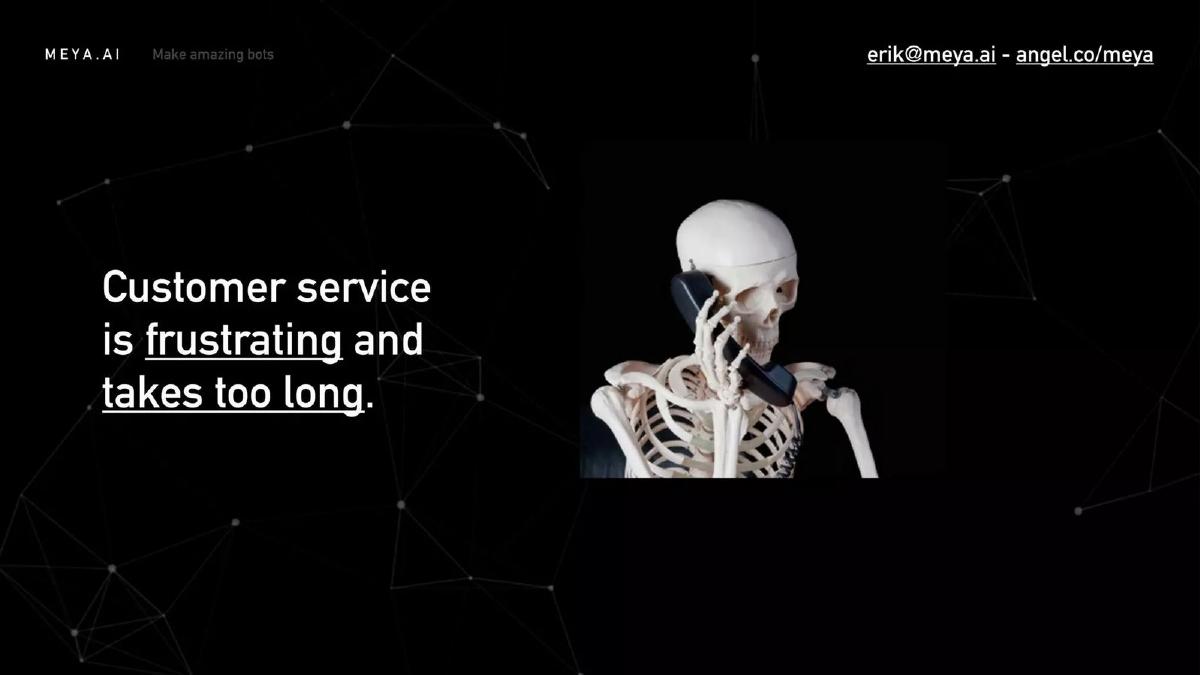
- The deck leads with a clear, visceral problem: customer service is frustrating and slow, illustrated by a skeleton on a phone (Slide 2).
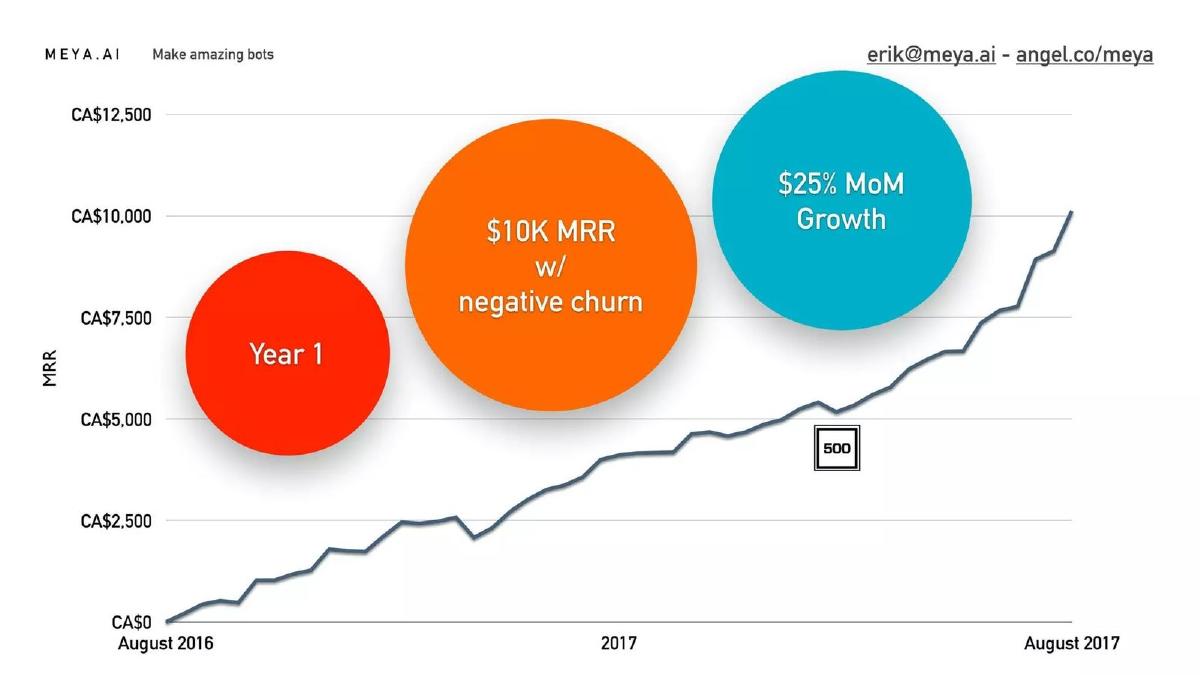
- Traction is the centerpiece, showing a growth curve from August 2016 to August 2017 reaching over CA$10,000 MRR (Slide 5).
- The company highlights a critical SaaS metric: negative churn, indicating that existing customers are expanding their spend over time (Slide 5).
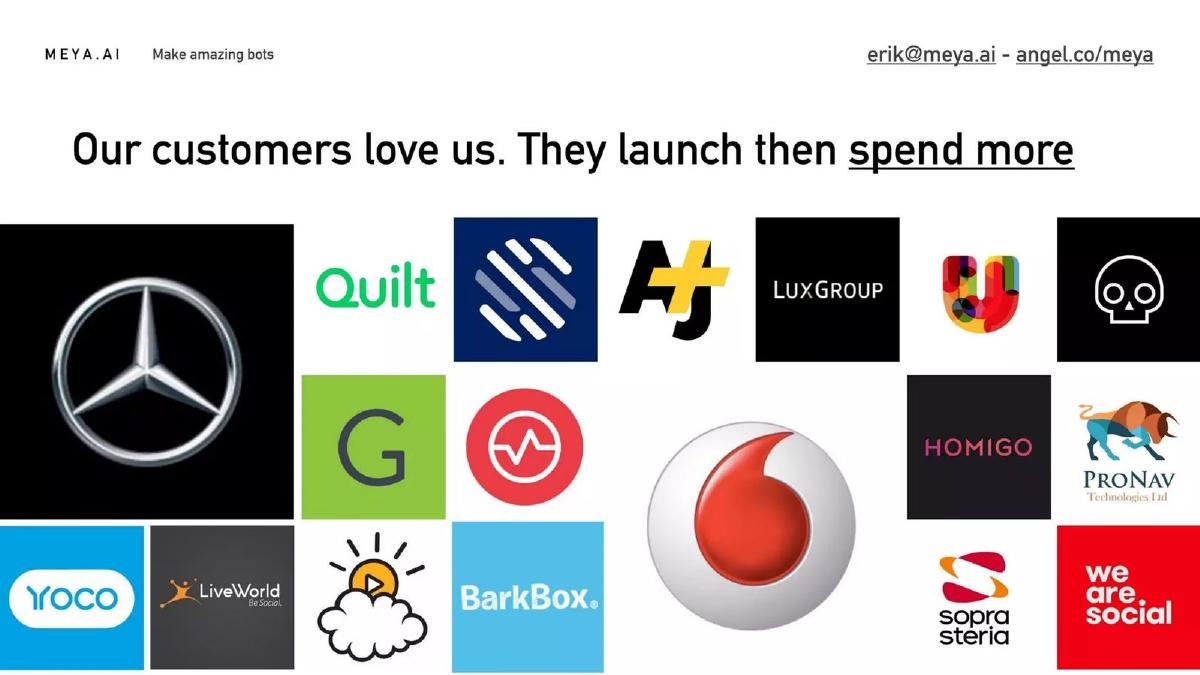
- Social proof is established through a diverse logo wall featuring major brands like Mercedes, Vodafone, and BarkBox (Slide 6).
- The technical moat is defined as a 'new bot language and framework' rather than just a simple interface (Slide 10).
- Market size is pegged at $100B for contact centers alone, employing 5M people worldwide (Slide 12).
- The team slide emphasizes 'experienced tech founders with prior exit' and includes the 500 Startups logo (Slide 13).
- The deck completely omits a specific funding ask, valuation, or use-of-funds breakdown (Slide 14).
The Anatomy of a High-Signal Seed Deck
Meya’s 2015 pitch deck is a masterclass in restraint. At only 14 slides, it manages to communicate traction, technical defensibility, and market scale without the fluff that often plagues early-stage pitches. This was the era of the 'chatbot revolution,' and while many companies were pitching vague visions of AI, Meya pitched a developer tool with real revenue and expansion metrics.
Slides 1-4: The Hook and the Promise
The deck opens with a minimalist title slide ( Slide 1 ) featuring the Meya.ai logo and a contact email. It immediately moves into the problem statement on Slide 2 : 'Customer service is frustrating and takes too long.' The use of a skeleton holding a telephone receiver is a rare moment of humor in a professional deck, but it effectively underscores the pain point of wait times in traditional support.
Slide 3 and Slide 4 are 'transition' slides. Slide 3 simply states, 'We fix this,' while Slide 4 provides the mission statement: 'We make it easy to create amazing customer service using our bot building platform.' These slides are designed to be flipped through quickly during a verbal presentation, keeping the focus on the speaker while establishing the core value proposition.
Slides 5-6: The Traction Powerhouse
Slide 5 is arguably the most important slide in the deck. It displays an MRR (Monthly Recurring Revenue) chart from August 2016 to August 2017. The chart shows a steady climb reaching over CA$10,000. More importantly, it highlights three key data points in large bubbles: 'Year 1,' '$10K MRR w/ negative churn,' and '$25% MoM Growth.' For a Seed-stage investor, 'negative churn' is the ultimate signal. It means the product is so sticky that existing customers are paying more every month, offsetting any losses from customers leaving.
Slide 6 provides the social proof to back up the revenue. The logo wall is impressive for a Seed round, featuring Mercedes-Benz, Vodafone, BarkBox, and Quilt. The headline, 'Our customers love us. They launch then spend more,' reinforces the negative churn narrative from the previous slide. This isn't just a list of logos; it's a list of expansion stories.
Slides 7-11: Product and Technical Moat
After establishing that the business works, Meya moves into the 'how.' Slide 7 asks the rhetorical question, 'But why do they choose us?' Slide 8 shows a side-by-side comparison of a conversational interface on a mobile device, using Comcast as a demo case. This visualizes the end product: a clean, automated chat experience.
Slide 9 is a logo wall of integrations, including Slack, Messenger, Twitter, Telegram, GitHub, and Zendesk. This demonstrates that Meya isn't a silo; it's a platform that sits in the middle of a company's existing tech stack. Slide 10 then introduces the technical defensibility: 'We’ve invented a new bot language and framework that makes it easy.' By positioning themselves as the creators of a 'language,' they appeal to the developer persona and suggest a deeper level of customization than drag-and-drop competitors.
Slide 11 summarizes the product's flexibility: 'We can turn any workflow into a conversational interface.' This broadens the use case beyond just 'customer service' to any internal or external business process.
Slides 12-14: Market, Team, and Conclusion
Slide 12 addresses the Total Addressable Market (TAM). It identifies contact centers as a '$100B industry' employing '5M people worldwide.' The punchline—'Humans don't scale. Meya does'—is a classic venture capital thesis: replacing expensive, unscalable human labor with high-margin software.
Slide 13 introduces the team. Erik Kalviainen (CEO) and Amanie Ismail (COO) are described as 'experienced tech founders with prior exit.' The inclusion of the University of Waterloo, Google, and 500 Startups logos provides institutional credibility. This slide tells investors that the founders have the technical chops and the business experience to execute the vision.
The deck concludes on Slide 14 with a call to action: 'Come say hi + learn more about Meya.' It repeats the key metrics from Slide 5 ($10K MRR, negative churn, 25% MoM growth) to ensure those figures are the last thing the investor sees.
What Works
Metric Focus: Leading with negative churn and 25% MoM growth is a very strong move. It shifts the conversation from 'what if' to 'how fast can we grow.' · Visual Simplicity: The deck uses high-contrast colors and very little text. This makes it highly readable and ensures the key facts (like the $100B market) stand out. · Developer Positioning: By mentioning a 'new bot language,' Meya avoids being categorized as a simple 'no-code' tool, which was a crowded and lower-value segment in 2015. · Logo Density: The mix of blue-chip enterprise (Mercedes) and high-growth startups (BarkBox) proves the platform's versatility.
What is Missing
The Ask: There is no slide detailing how much money they are raising or what the specific milestones for the next 18 months are. · Unit Economics: While they mention MRR and churn, they don't provide Customer Acquisition Cost (CAC) or Lifetime Value (LTV) estimates. · Competitive Landscape: The deck assumes the investor knows the bot space. It doesn't explicitly explain how Meya beats incumbents like Zendesk or other bot platforms like Chatfuel. · Product Deep Dive: For a 'Bot Studio,' there are no screenshots of the actual IDE (Integrated Development Environment) or the code editor mentioned in the company's self-description.
What a Founder Should Copy
The 'Traction Bubble' Slide: Use Slide 5 as a template. Don't just show a graph; highlight the 2-3 most impressive metrics in large, easy-to-read bubbles. · The Problem Visual: Slide 2 is a great example of using a single, striking image to represent a complex problem. It's more memorable than a bulleted list of 'pain points.' · The 'Why Us' Transition: Using a slide like Slide 7 to bridge the gap between 'we have traction' and 'here is the tech' creates a logical flow that keeps the audience engaged. · Pedigree by Association: If you have been part of an accelerator or worked at a major tech firm, put those logos on your team slide. It acts as a shorthand for quality.
Frequently asked questions
- How did Meya demonstrate product-market fit with so few slides?
- Meya used Slide 5 and Slide 6 to do the heavy lifting. Slide 5 showed a consistent upward MRR trajectory with 25% MoM growth, but the 'killer' metric was negative churn. This proved that once a company integrated Meya, they didn't just stay; they increased their usage. Slide 6 backed this up with a logo wall of enterprise-grade clients, proving the product could handle the requirements of large-scale organizations like Mercedes-Benz.
- What is the significance of the 'new bot language' mentioned in the deck?
- In 2015, the market was flooded with simple 'if-this-then-that' bot builders. By claiming to have invented a 'new bot language and framework' on Slide 10, Meya positioned itself as a developer-centric platform rather than a no-code toy. This suggested a higher barrier to entry for competitors and a more flexible, 'sophisticated' tool for engineers, which is a stronger defensive moat for a Seed-stage startup.
- Why is the market slide focused on contact centers?
- While bots can be used for many things, Meya narrowed its focus to the $100B contact center industry (Slide 12). This is a strategic move to show a clear path to revenue. By highlighting that 5M people are employed in these centers and stating 'Humans don't scale,' they presented their bot studio as a direct efficiency play for a massive, existing labor cost.
- Is the lack of an 'Ask' slide a mistake?
- In a deck used for a demo day or as a teaser for a first meeting, omitting the 'Ask' is common. It allows the founder to tailor the investment amount and valuation to the specific investor or current round dynamics. However, for a standalone pitch deck, it usually helps to include a slide detailing how the $1M will be spent (e.g., hiring, R&D, sales) to show operational maturity.
- How does the founder's pedigree impact this specific deck?
- Slide 13 is vital because it offsets the brevity of the rest of the deck. By stating the founders have a 'prior exit' and showing the 500 Startups and Google logos, they signaled to investors that they are 'safe hands.' Investors are more likely to accept a 14-slide deck with minimal financial detail if the founders have a proven track record of building and selling companies.