Stilta’s pitch deck is remarkably lean, consisting of only seven slides to secure a $10.5M Seed round. The narrative is driven by extreme velocity, highlighting a jump from $0 to significant MRR in just five weeks following a February launch. The deck positions the company at the intersection of 'Innovation' and 'Law,' specifically targeting the inefficiencies of patent litigation where single cases cost up to $3.5M. By emphasizing 'agentic' AI—software that can autonomously navigate complex, traceable evidence—Stilta differentiates itself from generic LLM wrappers. The team slide is a powerh…
Key takeaways
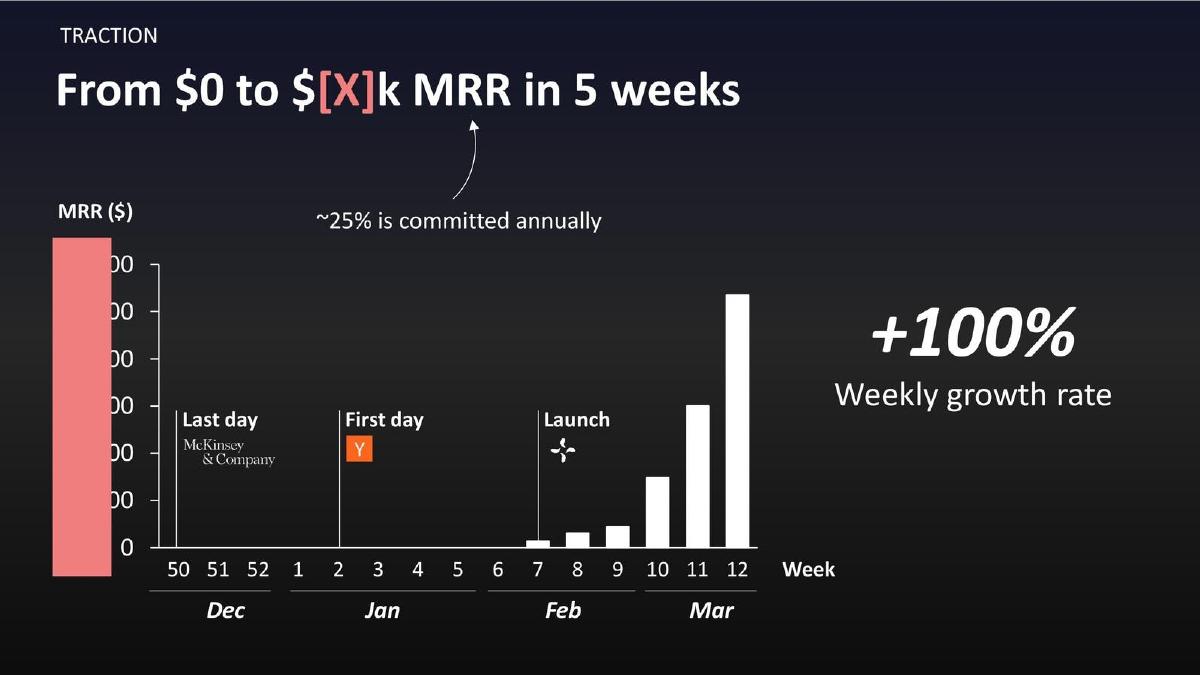
- The deck leads with a traction slide showing a 100% weekly growth rate over a 5-week period (Slide 2).
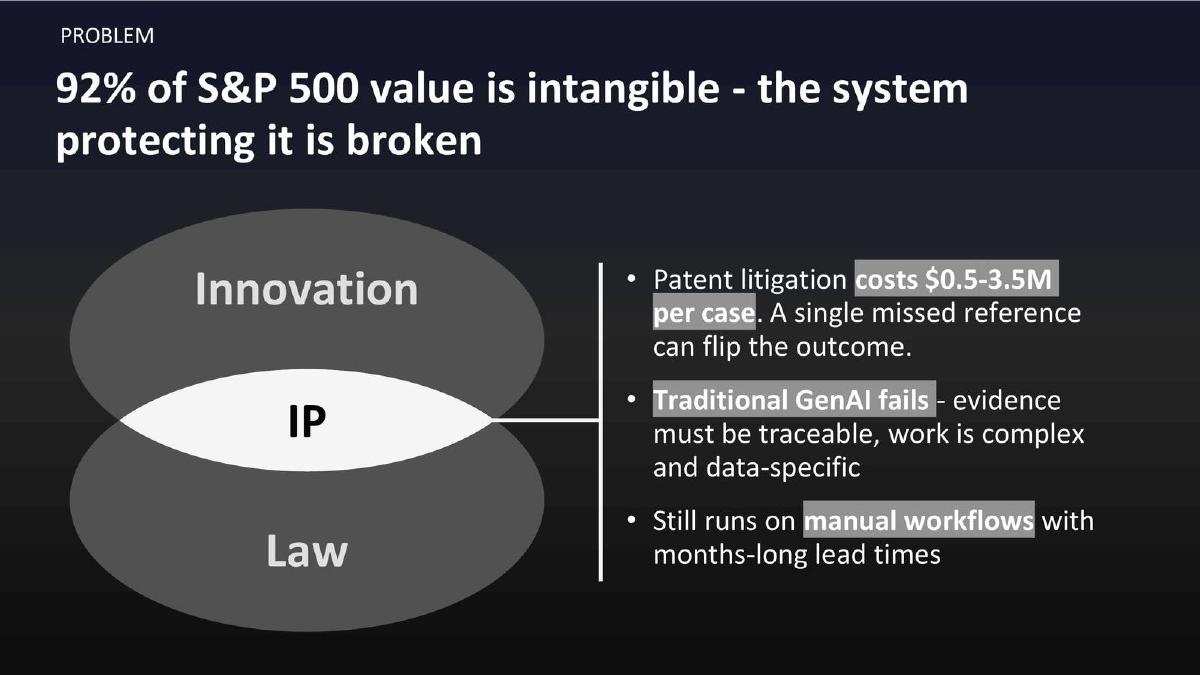
- The problem is framed through the lens of asset value, noting that 92% of S&P 500 value is intangible (Slide 3).
- Stilta highlights the high cost of failure in their niche, citing patent litigation costs between $0.5M and $3.5M per case (Slide 3).
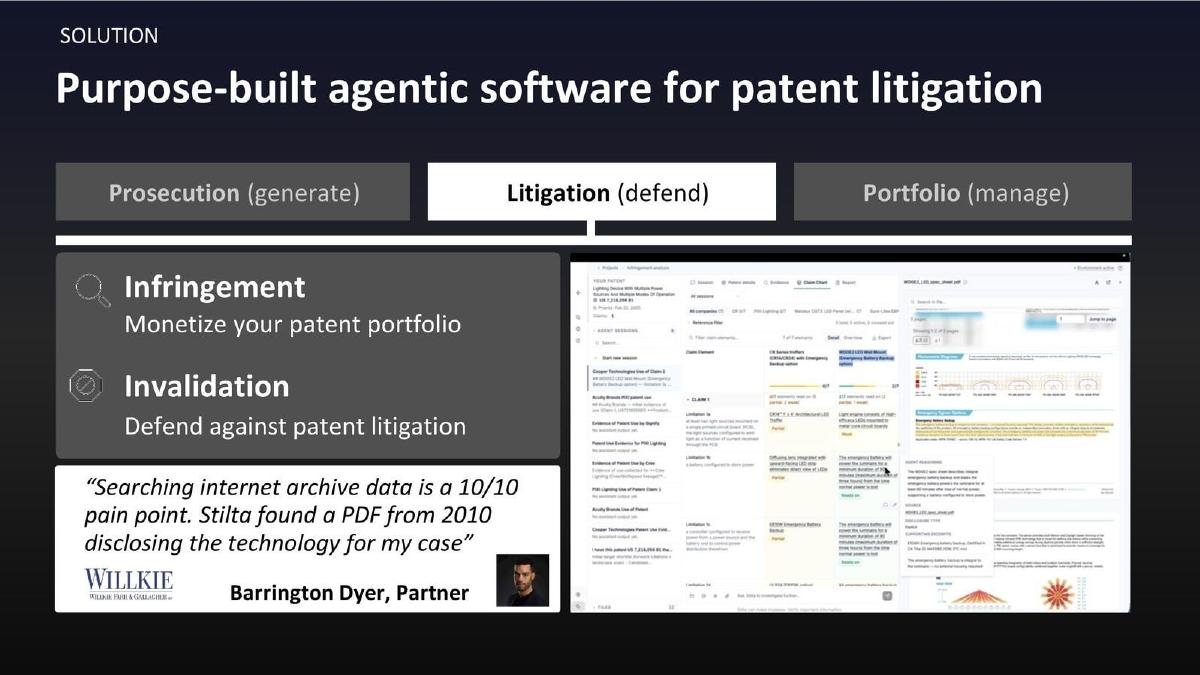
- The product is categorized as 'agentic software,' specifically designed for infringement monetization and litigation defense (Slide 4).
- Social proof is established early via a testimonial from a Partner at Willkie Farr & Gallagher (Slide 4).
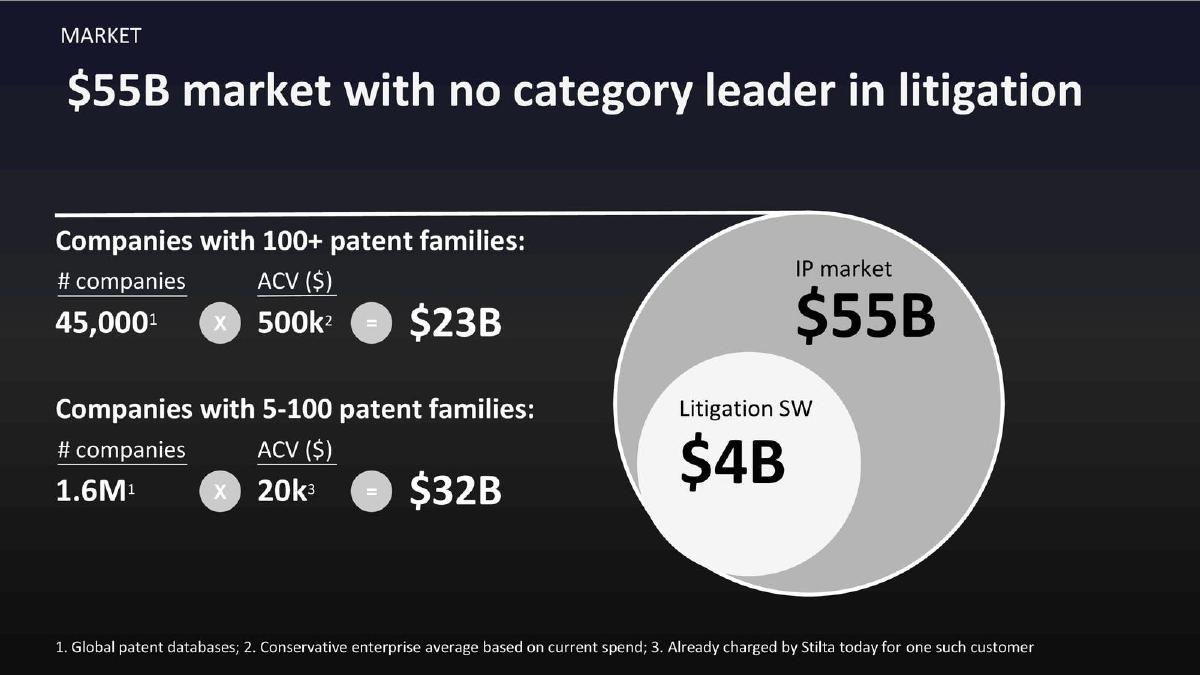
- Market sizing is broken down by patent family volume, projecting a $23B opportunity from 45,000 companies with 100+ patent families (Slide 5).
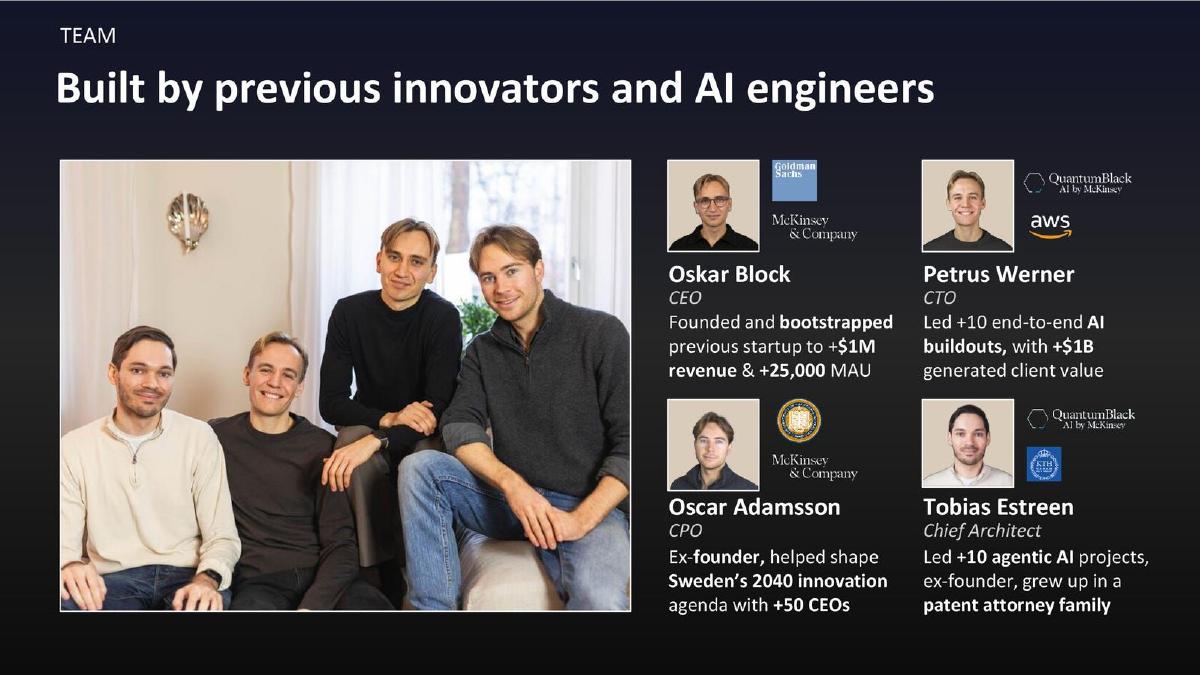
- The team features deep technical roots, including a Chief Architect who 'grew up in a patent attorney family' (Slide 6).
- The fundraising ask is explicitly tied to building an 'operating system for IP' and expanding beyond litigation (Slide 7).
The 7-Slide Sprint: How Stilta Raised $10.5M
Stilta’s pitch deck is a masterclass in high-velocity fundraising. In an era where decks are often bloated with 20+ slides of market theory, Stilta uses just seven slides to articulate a compelling case for a $10.5M Seed round. The deck, reported by Business Insider as the vehicle for their 2024 raise, focuses on three pillars: immediate revenue momentum, a high-stakes problem, and an elite technical team. By positioning themselves as 'Agentic AI for Patents,' they move beyond the 'AI wrapper' stigma and into the realm of mission-critical enterprise software.
Slide 1: The Hook
The title slide is minimalist, featuring the Stilta logo and the tagline “Agentic AI software for patents.” The use of the word 'Agentic' is a deliberate choice. It signals to investors that this is not a simple chatbot, but a system capable of executing multi-step workflows. In the 2024 AI landscape, 'agents' represent the next frontier of utility, and Stilta claims this territory immediately.
Slide 2: Traction as a Weapon
Most decks save traction for the end. Stilta puts it on Slide 2. The headline, “From $0 to $[X]k MRR in 5 weeks,” is the core of their pitch. The bar chart shows a steep hockey-stick curve starting in February (Week 7) and accelerating through March (Week 12). They highlight a “+100% Weekly growth rate” and note that “~25% is committed annually.” This slide serves to silence any questions about market demand. It proves that the founders didn't just build a tool; they built something the market was desperate to buy the moment it launched.
Slide 3: The $3.5M Problem
Slide 3 defines the 'Problem' by linking it to macro-economic value. They state that “92% of S&P 500 value is intangible,” yet the systems protecting that value are broken. The slide lists three critical pain points:
Patent litigation costs $0.5-3.5M per case. · Traditional GenAI fails because evidence must be traceable and work is data-specific. · Manual workflows lead to months-long lead times.
By anchoring the problem in the multi-million dollar cost of a single case, Stilta sets the stage for high-ticket enterprise pricing.
Slide 4: The Agentic Solution
The 'Solution' slide introduces the product interface and its three core pillars: Prosecution (generate), Litigation (defend), and Portfolio (manage). The slide focuses heavily on the 'Litigation' aspect, showing a detailed product screenshot of an infringement analysis. A key element here is the testimonial from Barrington Dyer, a Partner at Willkie Farr & Gallagher , who calls the pain point a “10/10” and credits Stilta with finding a specific 2010 PDF that changed a case. This is high-value social proof that validates the software's efficacy in a real-world legal setting.
Slide 5: Bottom-Up Market Sizing
Stilta avoids the 'trillion-dollar market' trap by providing a specific, bottom-up calculation on Slide 5. They identify two primary segments:
45,000 companies with 100+ patent families, targeted at a $500k ACV , representing a $23B opportunity. · 1.6M companies with 5-100 patent families, targeted at a $20k ACV , representing a $32B opportunity.
They cite that the $20k ACV is “Already charged by Stilta today for one such customer,” which grounds their projections in reality rather than speculation. The total IP market is pegged at $55B, with a specific $4B niche for Litigation Software.
Slide 6: The Pedigree Team
The team slide (Slide 6) is designed to project competence and reliability. The four founders—Oskar Block (CEO), Petrus Werner (CTO), Oscar Adamsson (CPO), and Tobias Estreen (Chief Architect)—boast backgrounds at McKinsey & Company, Goldman Sachs, AWS, and QuantumBlack. The slide highlights specific achievements, such as leading “+10 agentic AI projects” and generating “+$1B in client value.” A subtle but important detail is mentioned for Tobias Estreen: he “grew up in a patent attorney family,” suggesting a lifelong, intuitive understanding of the domain they are disrupting.
Slide 7: The Series A Roadmap
The final slide, 'Ask,' outlines the plan for the $10.5M Seed round (noted as raising $[X]M in the slide text). The goals are clear: “Hit +$[X] in ARR by end of 2026” and maintain “+[X]% m/m growth.” The use of funds is split between accelerating Go-To-Market (GTM) efforts—specifically hiring patent attorneys to bridge the gap between tech and law—and expanding the engineering team to move “beyond litigation” into the broader IP operating system.
What Stilta Does Exceptionally Well
The primary strength of this deck is its urgency . By showing a 100% weekly growth rate over a 5-week period, the founders create a 'fear of missing out' (FOMO) for investors. They aren't asking for money to see if the product works; they are asking for money to keep up with the demand they've already triggered. Additionally, the deck is highly verticalized . It doesn't claim to solve 'legal tech' broadly; it focuses intensely on the high-value, high-pain niche of patent litigation, which allows for the $500k ACV projections that make the venture math work.
What is Missing from the Stilta Deck
Despite its success, the deck leaves several stones unturned. There is no competitor slide . While the traction suggests they are winning, investors will eventually want to know how they stack up against incumbents like CPA Global or newer AI entrants. There is also no mention of unit economics beyond the ACV. We don't see the Cost of Goods Sold (COGS) for running these 'agentic' workflows, which can be computationally expensive. Finally, the deck lacks a 'Why Now' slide. While the rise of LLMs is the implicit answer, a slide dedicated to the recent shifts in patent law or AI capabilities would have strengthened the narrative.
Founder Takeaways: The Stilta Blueprint
Founders should look at Stilta as a template for Traction-First storytelling . If you have a product that is exploding, you don't need 20 slides. You need to show the graph, explain why the problem is expensive, and prove you have the team to scale it. Specific ACV modeling is another takeaway; by breaking the market down by 'patent families,' Stilta shows they understand their customer's internal metrics. Lastly, the use of hyper-specific testimonials (citing a specific 2010 PDF) is far more effective than generic 'this software is great' quotes. It proves the tool solves the 'needle in a haystack' problem inherent in legal discovery.
Frequently asked questions
- Why is the traction slide placed so early in the deck?
- Stilta uses Slide 2 to immediately validate the business model. By showing a 100% weekly growth rate and a jump from $0 to a significant MRR in just five weeks, they eliminate the investor's doubt regarding product-market fit. In a crowded AI market, showing that customers are already paying for the solution is the strongest possible opening.
- What does 'agentic AI' mean in the context of this deck?
- As described on Slide 4, agentic software refers to AI that doesn't just generate text but performs complex workflows like infringement analysis and invalidation defense. The deck emphasizes that 'Traditional GenAI fails' because legal work requires traceable evidence and complex data handling, which Stilta's agents are purpose-built to manage.
- How does Stilta justify a $500,000 ACV?
- Slide 5 breaks down the market by company size. For the 45,000 companies with over 100 patent families, Stilta estimates a $500k Annual Contract Value (ACV). This is justified by the massive cost of patent litigation ($0.5M-$3.5M per case) mentioned on Slide 3; if the software prevents one loss or identifies one infringement, it pays for itself multiple times over.
- Is the lack of a competitor slide a red flag?
- In this specific case, no. Because the deck is only 7 slides and focuses on a very high-growth 5-week window, the founders are signaling that they are moving faster than the market. However, for a Series A, investors would typically expect a more detailed breakdown of how they differ from legacy IP tools like Clarivate or LexisNexis.
- What is the significance of the team's background?
- The team (Slide 6) combines elite corporate experience (McKinsey, Goldman Sachs) with deep AI engineering (QuantumBlack, AWS). This 'bi-lingual' capability—understanding both high-level business strategy and low-level AI architecture—is critical for selling expensive software to conservative legal departments and C-suite executives.