Stayflexi's Seed round pitch deck, which helped raise $1.6M in 2021, focuses on modernizing the hospitality industry by addressing issues like inflexible check-in/check-out times and unsold amenities. The deck introduces Stayflexi as a 'Modern Operating System for Hotels & Vacation Rentals' (Slide 1), emphasizing the 'Post-COVID World' (Slide 4) trends driving demand for flexible and contactless services. It details a comprehensive 'Product stack' (Slide 6) covering both management and sales engines, and showcases early 'What we've achieved' (Slide 7) with 10k+ rooms and 650 properties, along…
Key takeaways
- The deck immediately establishes credibility on Slide 1 by stating 'backed by Y Combinator'.
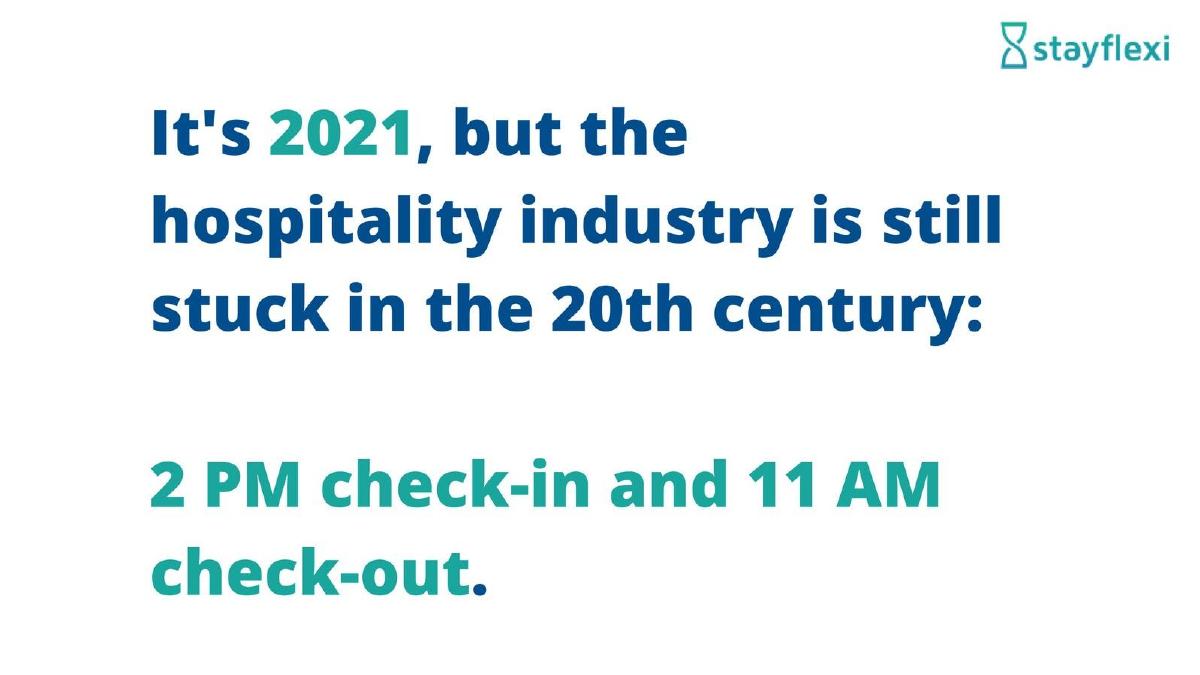
- Slide 2 effectively frames the core problem by highlighting the hospitality industry's '20th century' practices, specifically '2 PM check-in and 11 AM check-out'.
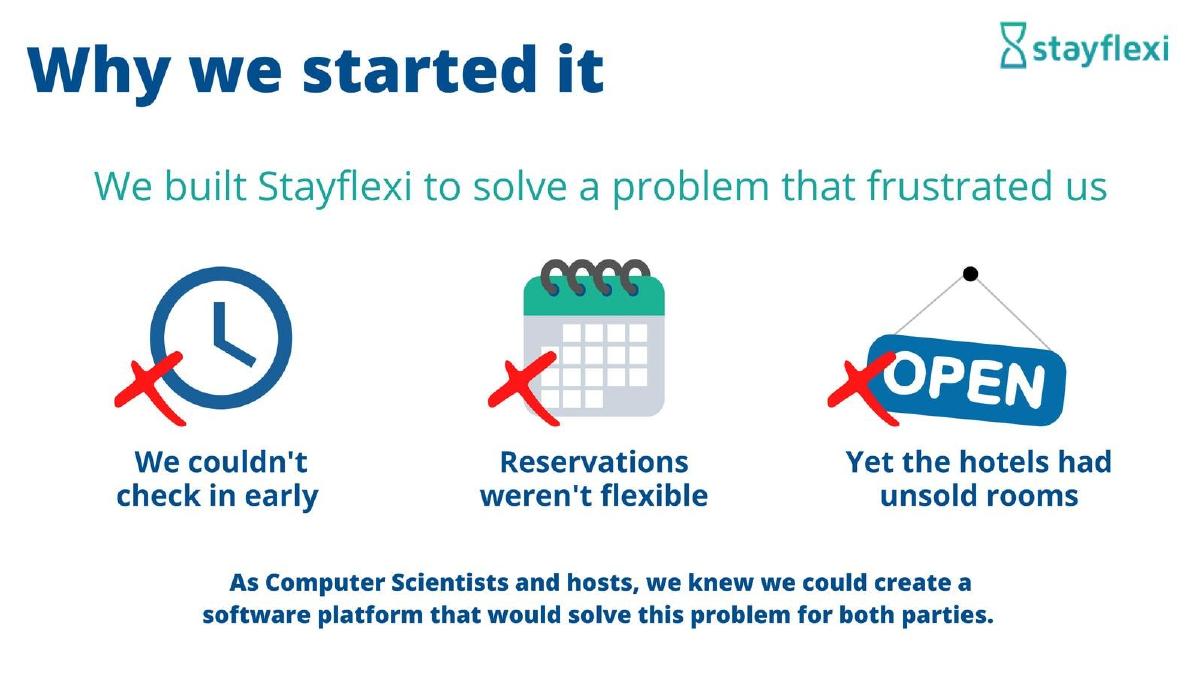
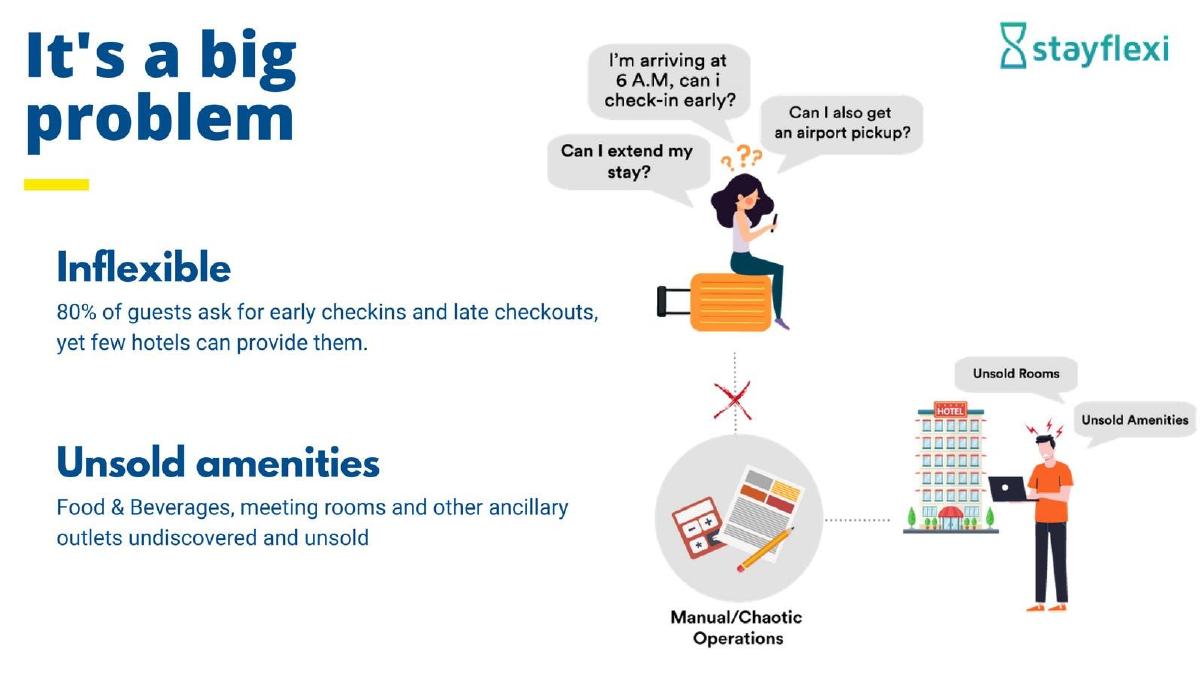
- The problem is further elaborated on Slide 3, citing that '80% of guests ask for early checkins and late checkouts, yet few hotels can provide them,' leading to 'Unsold Rooms' and 'Unsold amenities'.
- Slide 4 connects the solution to current trends, emphasizing the 'POST-COVID WORLD' and factors like 'Flexible working' and 'End-to-end digitization'.
- The 'How it works' slide (Slide 5) uses a clear visual to demonstrate guest and host benefits, quantifying a single booking's impact as adding '$300 of revenue, and save 30 minutes of hotel staff time'.
- Traction is presented on Slide 7, showing '10k+ rooms', '650 properties', and '30% MoM growth', with a bar chart illustrating property growth from 'Jan- 2020' to 'Feb - 2021'.
- The deck includes an 'Opportunity' slide (Slide 8) that mentions 'Funding $1.6M' and a goal of reaching '3,000+ Properties' in 'US & India', but it does not explicitly state the round or how the funds will be used.
- Crucially, the deck does not include a dedicated team slide, which is a significant omission for a Seed-stage company.
Stayflexi Pitch Deck Teardown: Hospitality OS for Flexible Operations
Stayflexi, a hospitality software provider, raised a $1.6M Seed round in 2021, as reported by Business Insider. Headquartered in N. America, the company operates in the Hospitality industry, offering hotel and vacation rental software designed to enable flexible check-in/check-out and amenity booking, aiming to increase revenue and automate operations for its clients. This teardown analyzes the 16-slide pitch deck used by Stayflexi to secure its Seed funding, examining its structure, content, and effectiveness in conveying its value proposition and potential.
The deck effectively highlights the inefficiencies within the traditional hospitality sector and positions Stayflexi as a modern solution. It clearly articulates the problem, presents a comprehensive product, and showcases early traction. However, like many Seed-stage decks, it also has notable omissions, particularly around team details and financial projections, which are critical for investor evaluation.
Slide 1: Stayflexi pitch deck
The first slide serves as the title slide for the pitch deck. It prominently displays the company name, 'Stayflexi,' in a large, teal font. Below the company name, a yellow underline is present, followed by the tagline: 'Modern Operating System for Hotels & Vacation Rentals.' In the bottom left corner, a small orange square with a white 'Y' indicates 'backed by Y Combinator,' providing immediate credibility. The top right corner features a stylized hourglass or infinity symbol, which appears to be the company's logo. This slide effectively introduces the company and its core offering while leveraging the Y Combinator affiliation to signal early validation.
Slide 2: Stayflexi pitch deck
This slide presents a bold problem statement. The main text reads: 'It's 2021, but the hospitality industry is still stuck in the 20th century:'. Below this, in a slightly smaller but equally bold font, it specifies the core issue: '2 PM check-in and 11 AM check-out.' The company logo is present in the top right corner. This slide immediately captures attention by highlighting an outdated industry practice that many consumers find inconvenient, setting the stage for Stayflexi's solution.
Slide 3: Stayflexi pitch deck
Titled 'It's a big problem,' this slide elaborates on the issues introduced on the previous slide. It breaks down the problem into two main categories: 'Inflexible' and 'Unsold amenities.' Under 'Inflexible,' it states: '80% of guests ask for early checkins and late checkouts, yet few hotels can provide them.' Under 'Unsold amenities,' it notes: 'Food & Beverages, meeting rooms and other ancillary outlets undiscovered and unsold.' The right side of the slide features an illustration. A guest with luggage is shown asking questions like 'I'm arriving at 6 A.M, can i check-in early?' and 'Can I extend my stay?' Below this, a red 'X' indicates that these requests often lead to 'Manual/Chaotic Operations,' which in turn result in 'Unsold Rooms' and 'Unsold Amenities' for a frustrated hotel manager. The company logo is in the top right corner. This slide effectively quantifies the problem and visually demonstrates its impact on both guests and hotels.
Slide 4: Stayflexi pitch deck
This slide, 'Why it matters now,' connects Stayflexi's solution to current market trends. It features a large text block on the left: 'POST-COVID WORLD' accompanied by abstract geometric shapes (a square, a circle, and a striped square). On the right, three numbered points explain the relevance: 1. 'Flexible working is pushing daycations and hybrid work+live models.' 2. 'End-to-end digitization to provide safe & contactless services like self-check-ins, self-upgrades.' 3. 'Alternative income is driving 5X more vacation rentals in next 3 years (fueled by Airbnb).' The company logo is in the top right. This slide positions Stayflexi as a timely solution addressing shifts in consumer behavior and industry needs accelerated by recent global events.
Slide 5: Stayflexi pitch deck
Titled 'How it works,' this slide illustrates the user experience and benefits of Stayflexi. A secondary header states, 'Happy guest, happy host.' The left side shows a computer screen displaying a 'Dashboard' with metrics like '23 Rooms,' '40 Dinners,' '20 Safaris,' and '10 Parkings,' along with a 'Reservation Grid' showing guest names and durations. The right side depicts a timeline of a guest's journey: 'Reserves on booking site,' 'Does Self Check-In from Whatsapp,' 'Self-Upgrades room,' 'Places in-room orders,' 'Contactless early arrivall,' 'Extends stay for additional hours,' and 'Does Self-Checkout.' A smiling guest's face is linked to the 'Self-Upgrades room' and 'Places in-room orders' steps. At the bottom, a key benefit is quantified: 'This booking alone would add $300 of revenue, and save 30 minutes of hotel staff time.' The company logo is in the top right. This slide provides a clear, visual walkthrough of the product's functionality and its tangible value proposition.
Slide 6: Stayflexi pitch deck
This slide, 'Product stack,' provides an architectural overview of Stayflexi's offering. It shows 'Stayflexi OS' at the top, branching into two main components: 'Management Engine' and 'Sales Engine.' Under 'Management Engine,' the following modules are listed: 'Reservations Management,' 'Channels Management,' 'Inventory Management,' 'Payments Management,' 'Shops/POS,' 'Housekeeping Management,' 'Accounting,' 'Revenue Management,' and 'Staff Management.' Under 'Sales Engine,' the modules include: 'Direct Website Sales,' 'Booking Extensions,' 'Pre-Check-In Purchases,' 'In-Room Purchases,' 'Contactless Check-Ins,' and 'Contactless Payments.' The company logo is in the top right. This slide demonstrates the comprehensive nature of Stayflexi's platform, covering both operational and revenue-generating aspects for hospitality businesses.
Slide 7: Stayflexi pitch deck
Titled 'What we've achieved,' this slide presents key traction metrics. On the left, it states: 'Stayflexi is being used in:' followed by bullet points: '10k+ rooms' and '650 properties.' Below these, it highlights '30% MoM growth.' The right side features a bar chart titled 'Properties,' showing growth over time. The bars indicate: 'Jan- 2020': 60 properties, 'May - 2020': an unlabeled value (visually around 150), 'Sep - 2020': an unlabeled value (visually around 300), and 'Feb - 2021': 650 properties. The company logo is in the top right. This slide provides concrete evidence of market adoption and growth, which is crucial for a Seed-stage company.
Slide 8: Stayflexi pitch deck
This slide is labeled 'Opportunity.' It features two blue circles connected by an arrow. The left circle states 'Funding $1.6M.' The arrow points to a larger right circle that states '3,000+ Properties.' Below the larger circle, it specifies 'US & India.' The company logo is in the top right. This slide indicates the amount of funding sought or already raised (given the publisher's report of $1.6M raised) and the target number of properties the company aims to reach with that funding, along with its target geographical markets. It serves as a high-level vision for scaling the business.
Slide 9: Stayflexi pitch deck
The content for this slide is listed as 'Stayflexi pitch deck'. Without an image or specific text, it is not possible to describe the content of this slide. It likely continues the narrative of the pitch, potentially covering market size, competition, or business model, but this cannot be confirmed from the provided information.
Slide 10: Stayflexi pitch deck
The content for this slide is listed as 'Stayflexi pitch deck'. Without an image or specific text, it is not possible to describe the content of this slide. It would typically follow the flow of a pitch deck, potentially detailing the business model, go-to-market strategy, or competitive advantages.
Slide 11: Stayflexi pitch deck
The content for this slide is listed as 'Stayflexi pitch deck'. Without an image or specific text, it is not possible to describe the content of this slide. Common elements at this stage of a deck include team introductions, financial projections, or a more detailed market analysis.
Slide 12: Stayflexi pitch deck
The content for this slide is listed as 'Stayflexi pitch deck'. Without an image or specific text, it is not possible to describe the content of this slide. This could be a slide on competitive landscape, future roadmap, or a deeper dive into unit economics.
Slide 13: Stayflexi pitch deck
The content for this slide is listed as 'Stayflexi pitch deck'. Without an image or specific text, it is not possible to describe the content of this slide. It might cover the use of funds, investment terms, or a summary of the opportunity.
Slide 14: Stayflexi pitch deck
The content for this slide is listed as 'Stayflexi pitch deck'. Without an image or specific text, it is not possible to describe the content of this slide. This could be a concluding slide, a call to action, or a contact slide.
Slide 15: Stayflexi pitch deck
The content for this slide is listed as 'Stayflexi pitch deck'. Without an image or specific text, it is not possible to describe the content of this slide. Often, the penultimate slide is a summary or a reiteration of the ask.
Slide 16: Stayflexi pitch deck
The content for this slide is listed as 'Stayflexi pitch deck'. Without an image or specific text, it is not possible to describe the content of this slide. The final slide is typically a thank you or contact information slide.
What Works Well
Stayflexi's pitch deck demonstrates several strengths that likely contributed to its successful Seed round. The immediate establishment of credibility on Slide 1 with 'backed by Y Combinator' is a powerful signal to investors, indicating early validation and a rigorous selection process. This sets a positive tone from the outset.
The problem statement is exceptionally clear and relatable. Slide 2, 'It's 2021, but the hospitality industry is still stuck in the 20th century: 2 PM check-in and 11 AM check-out,' uses a concise and impactful statement to highlight a common pain point. Slide 3 further elaborates on this by quantifying the inflexibility ('80% of guests ask for early checkins and late checkouts') and identifying 'Unsold amenities' as a direct consequence of 'Manual/Chaotic Operations.' The visual representation on Slide 3 effectively conveys the frustration of both guests and hoteliers, making the problem tangible and urgent.
The deck skillfully connects Stayflexi's solution to current market dynamics. Slide 4, 'Why it matters now,' leverages the 'POST-COVID WORLD' narrative to underscore the increased demand for flexible working, contactless services, and alternative income streams through vacation rentals. This demonstrates an understanding of macro trends and positions Stayflexi as a timely and relevant solution, rather than just a niche offering.
The 'How it works' slide (Slide 5) is particularly effective in illustrating the value proposition. By showing a guest's journey and quantifying the benefits ('add $300 of revenue, and save 30 minutes of hotel staff time' for a single booking), it provides concrete evidence of the product's impact. This tangible ROI is highly appealing to potential customers and, by extension, to investors looking for scalable business models.
The 'Product stack' on Slide 6 clearly outlines the comprehensive nature of the Stayflexi OS. By segmenting it into 'Management Engine' and 'Sales Engine' with detailed sub-modules, the slide communicates the breadth and depth of the platform. This reassures investors that Stayflexi is building a robust, end-to-end solution, not just a single feature.
Finally, the traction presented on Slide 7, 'What we've achieved,' is compelling for a Seed-stage company. Reporting '10k+ rooms,' '650 properties,' and '30% MoM growth' with a supporting bar chart provides strong evidence of early market fit and execution. The consistent growth shown in the chart from Jan-2020 to Feb-2021 demonstrates positive momentum leading up to their funding round.
What Is Missing
Despite its strengths, Stayflexi's pitch deck, based on the provided slides, has several notable omissions that are typically crucial for a Seed-stage investment decision. The most significant absence is a dedicated team slide. For early-stage companies, the team's experience, expertise, and passion are often the primary drivers for investor confidence. Without this, investors are left to infer the team's capabilities, which can be a considerable drawback.
Another critical missing component is detailed financial projections. While Slide 5 quantifies the revenue and time savings per booking, the deck does not include a slide outlining projected revenue, profitability, or key financial milestones over the next 3-5 years. This makes it difficult for investors to assess the potential return on investment and the company's long-term financial viability.
Similarly, there is no explicit discussion of unit economics. Understanding the cost of acquiring a customer (CAC), customer lifetime value (LTV), and the gross margins associated with each property or room managed by Stayflexi would provide deeper insight into the business model's scalability and profitability. While '30% MoM growth' is positive, the underlying economics are essential.
The deck also lacks a comprehensive market size analysis. While Slide 4 touches on trends driving vacation rentals, it doesn't quantify the total addressable market (TAM), serviceable available market (SAM), or serviceable obtainable market (SOM) for Stayflexi's specific offering. A clear understanding of the market opportunity beyond the number of target properties (Slide 8) would strengthen the investment case.
While Slide 8 mentions 'Funding $1.6M' and a goal of '3,000+ Properties,' it does not explicitly state the 'ask' – the specific amount of funding being sought, the valuation, or how the funds will be specifically utilized beyond a general growth target. A detailed use of funds slide would provide clarity on how the investment will fuel specific growth initiatives, product development, or market expansion.
Finally, there is no dedicated slide addressing the competitive landscape. Understanding who Stayflexi's direct and indirect competitors are, and what their unique differentiators are, is vital for investors to assess market positioning and barriers to entry. While the product stack implies comprehensive features, a direct comparison or statement of competitive advantage would be beneficial.
What Founders Should Copy
Founders can learn valuable lessons from Stayflexi's pitch deck, particularly in how to frame a problem and showcase early traction. Firstly, the clarity and impact of the problem statement on Slide 2 and its detailed elaboration on Slide 3 are excellent examples. Founders should strive to articulate a common, relatable pain point that is easily understood and quantified. Using statistics like '80% of guests ask for early checkins' adds weight to the problem's significance.
The strategy of connecting the solution to broader market trends, as seen on Slide 4 ('Why it matters now' and 'POST-COVID WORLD'), is highly effective. Founders should identify macro-level shifts and explain how their product is not just solving a problem but also capitalizing on significant, ongoing market transformations. This demonstrates foresight and market relevance.
The 'How it works' slide (Slide 5) provides a strong template for demonstrating value. Founders should aim to visually walk through the user experience and, crucially, quantify the tangible benefits for their customers. Showing a clear ROI, such as '$300 of revenue, and save 30 minutes of hotel staff time,' makes the value proposition undeniable and helps investors understand the economic impact of the solution.
Presenting a comprehensive 'Product stack' (Slide 6) is also a good practice for SaaS or platform companies. Breaking down the product into core engines and specific modules helps investors grasp the breadth of the offering and the underlying technology. This signals that the company is building a robust, scalable platform rather than a single-feature app.
Lastly, the presentation of traction on Slide 7 is exemplary for a Seed round. Founders should clearly state key metrics like number of users, properties, or rooms, and demonstrate growth with a clear percentage (e.g., '30% MoM growth') and a visual chart. Showing consistent growth over time provides compelling evidence of market acceptance and execution capabilities. Even if the numbers are small, consistent growth is a powerful indicator for early-stage investors.
While the omissions are notable, the strengths in problem framing, market relevance, value quantification, and traction presentation offer valuable takeaways for any founder preparing a Seed-stage pitch deck.
Frequently asked questions
- What is Stayflexi's core offering according to the pitch deck?
- According to Slide 1, Stayflexi offers a 'Modern Operating System for Hotels & Vacation Rentals'. This system aims to address inflexibility in hospitality operations, such as fixed check-in/check-out times, and helps hotels increase revenue by better managing amenities and guest requests. It digitizes operations for a more flexible and contactless experience.
- What specific problems does Stayflexi identify in the hospitality industry?
- Stayflexi identifies two main problems on Slide 3: 'Inflexible' operations, where '80% of guests ask for early checkins and late checkouts, yet few hotels can provide them,' and 'Unsold amenities,' where 'Food & Beverages, meeting rooms and other ancillary outlets' remain 'undiscovered and unsold.' These issues are attributed to 'Manual/Chaotic Operations'.
- What traction metrics does Stayflexi present in its deck?
- On Slide 7, Stayflexi reports being used in '10k+ rooms' and '650 properties'. The slide also states '30% MoM growth' and includes a bar chart showing property growth from 60 in Jan-2020 to 650 in Feb-2021. These metrics indicate early adoption and growth.
- What key information is missing from Stayflexi's pitch deck?
- The provided slides for Stayflexi's pitch deck omit several key pieces of information. There is no dedicated team slide, no detailed financial projections or unit economics, no explicit market size analysis beyond the problem statement, and no clear 'ask' or use of funds beyond a funding amount mentioned on an 'Opportunity' slide (Slide 8).
- How does Stayflexi connect its solution to the 'Post-COVID WORLD'?
- Slide 4, titled 'Why it matters now', connects Stayflexi's solution to the 'POST-COVID WORLD' by listing three trends: 'Flexible working is pushing daycations and hybrid work+live models,' 'End-to-end digitization to provide safe & contactless services like self-check-ins, self-upgrades,' and 'Alternative income is driving 5X more vacation rentals in next 3 years (fueled by Airbnb)'.