StationMD’s pitch deck is a masterclass in the 'cost-avoidance' narrative, moving away from the generic telehealth promise of convenience toward the specific financial relief of reducing ER visits for high-needs populations. By focusing on individuals with intellectual and developmental disabilities (I/DD), the company targets a 'high-value area with low penetration,' as stated on slide 9. The deck effectively uses a process flow on slide 7 to illustrate how a single medical concern can escalate into a $100,000 hospital stay, and how StationMD intercepts this path to treat 90% of patients in…
Key takeaways
- The company positions itself in the 'Highest $ per Case' segment of the market, which currently has 'Low Penetration' by competitors (Slide 9).
- StationMD claims to treat more than 90% of its patients in place, preventing escalation to emergency services (Slide 7).
- The deck identifies four stages of avoidable expense, ranging from $500 for transport to over $100,000 for prolonged hospital stays (Slide 7).
- A case study with an MCO involving 1,100 members over 10 months resulted in $2.1 million saved (Slide 13).
- The leadership team is composed of three founding physicians with a combined 30+ years of emergency medicine experience (Slide 3).
- The competitive map places StationMD in a unique quadrant defined by 'High-Cost Patients' and 'Specialized Facility Focused' care (Slide 11).
- The patient base is heavily concentrated in group homes, representing the largest segment of their 30,000 patients (Slide 13).
- The deck omits a specific funding ask, valuation, or detailed use-of-funds breakdown within the 14 slides provided.
StationMD Pitch Deck Teardown
StationMD is a specialized telehealth provider focusing on a demographic that the broader healthcare system often struggles to serve efficiently: individuals with intellectual and developmental disabilities (I/DD). As reported by Business Insider, the company raised a $3.2M Venture round in 2024. Their 14-slide deck is a focused argument for cost containment in high-acuity populations.
Slide 1: Title and Mission
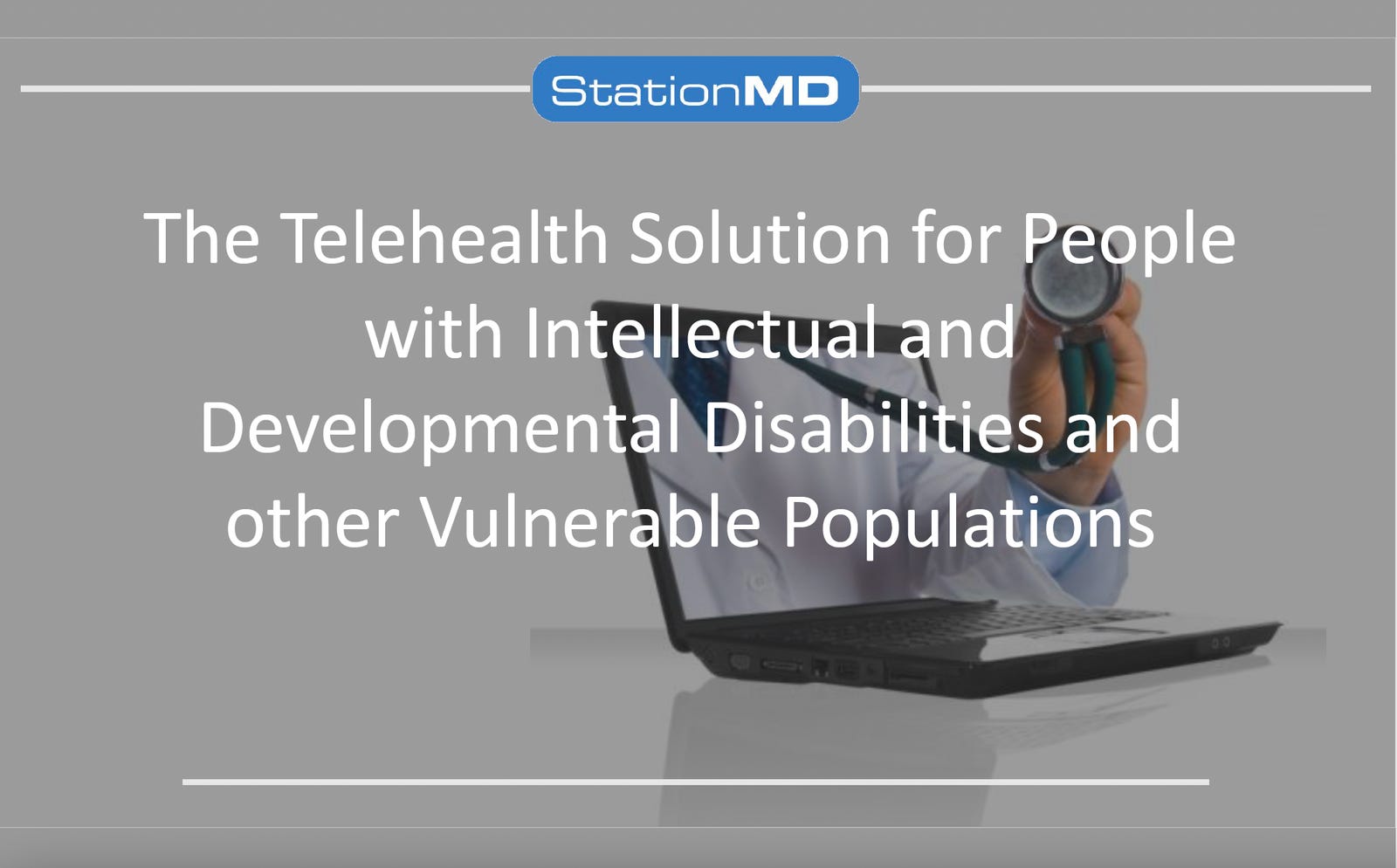
The opening slide establishes the company's identity as 'The Telehealth Solution for People with Intellectual and Developmental Disabilities and other Vulnerable Populations.' The imagery of a doctor visible through a laptop screen is standard for the industry, but the text immediately carves out a niche. By specifying 'vulnerable populations,' StationMD signals that they are not a general-purpose Teladoc clone, but a specialized clinical service.
Slide 3: Leadership Team
Slide 3 introduces the leadership, emphasizing a mix of clinical and operational experience. The team is led by three founding physicians: Dr. Matthew Kaufman (CEO), Dr. Deven Unadkat (CMO), and Dr. Maulik Trivedi (CSO). The slide highlights their background in emergency medicine and health innovation. Supporting them are Florence DiBella (VP Finance) and Bruce Kulback (CIO/CISCO), both credited with 25 years of experience in their respective fields. This slide serves to validate the company’s ability to handle the complex medical needs of their target demographic.
Slide 5: The Problem with the ER
This slide breaks down the 'Suboptimal Care' and 'Excessive Costs' associated with traditional ER visits for I/DD patients. It uses a simple additive logic: Patient trauma + Unspecialized care = Suboptimal Care; Unnecessary tests + Unnecessary hospitalizations = Excessive costs. This slide is critical because it frames the ER not just as an expensive option, but as a clinically inferior one for this specific population due to the 'disruption of routine' and 'exposure to infection.'
Slide 7: Avoiding Expense Escalation
Slide 7 is the core of the StationMD value proposition. It visualizes the 'Typical Process Without StationMD,' showing a chain of events starting with a medical concern and ending in hospital complications that can cost over $100,000. StationMD positions itself at the very beginning of this chain, claiming to interrupt the process and treat 'more than 90% of patients in place.' The slide lists specific avoidable expenses at each stage: $500-$1,000 for transport, $500-$1,500 for ER over-testing, and $5,000-$20,000 for avoidable admissions.
Slide 9: Market Positioning
StationMD uses an inverted pyramid to show where they sit in the market. They target the 'Very Sick' and 'Highest $ per Case' segment, which they note has 'Low Penetration.' This is contrasted against 'Most telemedicine firms' which focus on 'basic cases and low $' where there is already 'High Penetration.' This slide effectively argues that while their total addressable market in terms of patient count might be smaller than general telehealth, the value per patient is significantly higher and the competition is lower.
Slide 11: Competitive Map
The competitive map on slide 11 uses two axes: 'Consumer Focused' vs. 'Specialized Facility Focused' and 'Low-Cost Patient' vs. 'High-Cost Patients.' StationMD places itself in the top-right quadrant. Competitors like Teladoc and Amwell are grouped in the bottom-left (Consumer/Low-Cost). Even other high-cost providers like Landmark and Cityblock are placed lower on the 'Specialized Facility' axis, suggesting StationMD’s unique integration with group homes and specialized care settings.
Slide 13: Traction and Case Study
The final content slide provides hard data. A pie chart shows a patient base of 30,000, with the vast majority coming from 'Group homes' and 'Private homes.' The 'MCO Case Study' section provides the most compelling financial evidence: 1,100 members over 10 months resulted in a 13x ROI and $2.1 million in savings. The slide notes that the total cost for the StationMD service was only $162,000, compared to a cost reduction of over $2,000 per member per year.
What StationMD Does Well
StationMD excels at defining a clear, high-stakes problem. In healthcare investing, 'nice-to-have' solutions often struggle, but 'must-have' cost-saving measures for high-expenditure populations are always in demand. By quantifying the escalation of costs from a simple medical concern to a $100,000 hospital stay, they make the financial burden of the status quo feel urgent and unsustainable.
The use of a specific MCO case study is another strength. Rather than relying on projections, they show a realized 13x ROI. For a Venture round, this level of proof-of-concept is vital. It demonstrates that payers (Managed Care Organizations) are willing to pay for the service because the savings are immediate and measurable.
What is Missing from the Deck
The most notable omission is a formal 'Ask' slide. The deck does not state how much capital is being sought, the valuation, or the specific milestones the company intends to reach with the new funding. While this information is often shared in a separate document or during a live pitch, its absence in a standalone deck leaves the 'why now' question partially unanswered.
Additionally, the deck is light on the technology itself. While it mentions telehealth, it doesn't describe the platform's features, how it integrates with existing Electronic Health Records (EHRs), or how they maintain the '90% treated in place' rate. Investors might want to know if there is a proprietary technological moat or if the advantage is purely clinical and operational.
Finally, there is no discussion of the regulatory environment. Telehealth is subject to varying state laws and reimbursement policies, especially for Medicaid populations which likely make up a large portion of the I/DD demographic. Addressing how StationMD navigates these complexities would strengthen the deck.
Founder Takeaways
Focus on Cost Avoidance: If your startup targets a high-cost sector, don't just talk about efficiency—quantify the cost of the 'bad path' vs. your 'good path.' StationMD’s slide 7 is a perfect template for this. · Niche Down to Scale Up: By admitting they don't do 'basic cases,' StationMD makes their expertise in 'very sick' patients more believable. Don't be afraid to exclude the mass market to prove dominance in a high-value niche. · Use Real ROI: A single case study with a 13x ROI is worth more than ten slides of theoretical market growth projections. If you have a pilot that worked, make it the centerpiece of your traction slide. · Map the Competition Honestly: StationMD’s competitive map doesn't just list logos; it uses axes that highlight their specific strategic advantage (Specialized Facilities). When building your map, choose axes that make your position look like a logical necessity rather than just a choice.
Frequently asked questions
- What is the primary problem StationMD is solving?
- StationMD addresses the 'Expensive yet Suboptimal Care' found in ERs for vulnerable populations. Slide 5 highlights that ER visits for I/DD patients often lead to patient trauma, exposure to infection, and unnecessary tests. These factors result in excessive costs and disrupted routines for patients who require specialized care that general emergency rooms are often unequipped to provide efficiently.
- How does StationMD generate a return on investment for payers?
- According to slide 13, the company demonstrated a 13x ROI in an MCO case study. By charging a service fee of $162,000 for 1,100 members, they saved the payer $2.1 million over 10 months. This was achieved by reducing costs by more than $2,000 per member per year through the avoidance of unnecessary ER visits and hospitalizations.
- Who are the key competitors identified in the deck?
- Slide 11 maps the competitive landscape. StationMD distinguishes itself from 'Consumer Focused' firms like Teladoc, Amwell, and MDLIVE. It also differentiates from other high-cost patient providers like Landmark and Cityblock by focusing specifically on 'Specialized Facilities' rather than general high-cost patient populations or low-cost consumer telehealth.
- What are the most common diagnoses StationMD handles?
- Slide 13 lists medication issues, skin conditions/cellulitis, respiratory infections, falls/injuries, GI conditions, eye conditions, and behavioral issues. By managing these common but potentially escalatable issues via telehealth, they avoid the '911 ambulance' and 'ER over-testing' phases of the traditional medical process.
- What is missing from the StationMD pitch deck?
- The deck lacks a clear 'Ask' slide detailing the amount being raised (though reported as $3.2M elsewhere) and how those funds will be allocated. It also omits a forward-looking roadmap, detailed financial projections, and specific unit economics beyond the single MCO case study. There is no mention of the current regulatory or reimbursement landscape for telehealth.