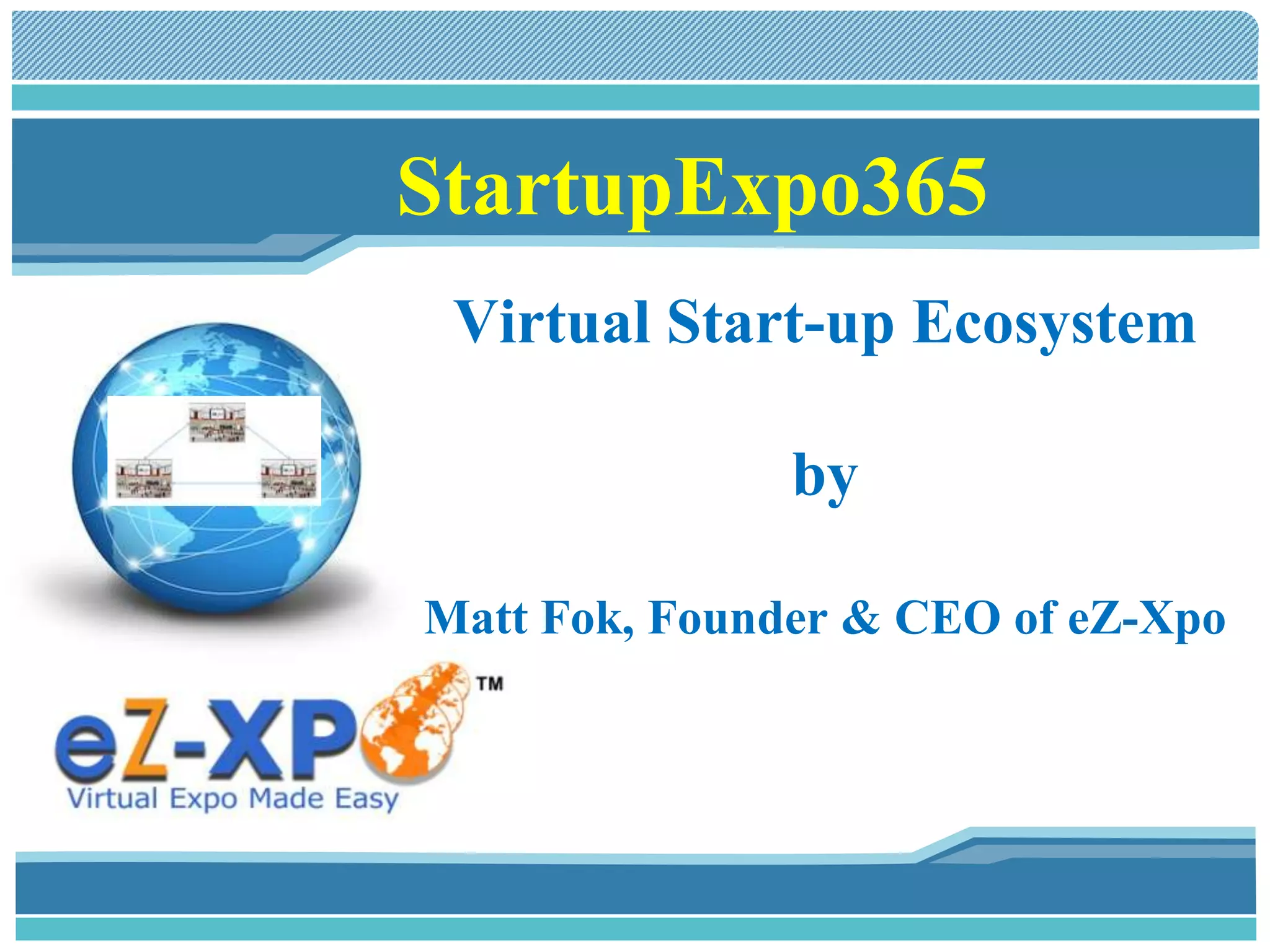
Startup360, branded in the deck as StartupExpo365, is a virtual startup marketplace ecosystem developed by Matt Fok, the CEO of eZ-Xpo. The deck positions the platform as a comprehensive solution for the three-way intersection of entrepreneurs, venture capital/angel investors, and the academic community. By utilizing virtual showcase rooms and a 'Virtual Startup Academy,' the company aims to shorten funding cycles and provide continuous engagement beyond traditional, physical events. While the deck highlights a diverse list of early adopters ranging from local business associations to global…
Key takeaways
- The platform targets a three-sided marketplace consisting of Start-ups/Entrepreneurs, VC/Angel Investors, and the Academic Community (Slide 2).
- The 'Virtual Showcase' feature includes judge ratings, peer reviews, and live chat to facilitate engagement (Slide 3).
- The company claims its solution can 'Shorten Funding Cycle & Boost Marketing ROI' through automatic follow-up tools (Slide 3).
- A 'Virtual Startup Academy' is proposed to provide live and on-demand mentoring to help founders avoid common pitfalls (Slide 4).
- StartupExpo365 distinguishes itself from competitors like AngelList and Gust by offering virtual expo and conference capabilities (Slide 5).
- The deck lists integrations with third-party tools including Salesforce, Eventbrite, Livestream, and Ustream (Slide 5).
- Early customer adopters are categorized into Local, Enterprise, and Global segments, including the Golden Gate Business Association and the Nigerian-American Chamber of Commerce (Slide 6).
- The deck completely omits a team slide, financial projections, and a specific investment ask within the provided slides.
StartupExpo365: The Virtual Ecosystem Pitch Analysis
Startup360, presented here under the brand StartupExpo365, is a platform designed to digitize the startup networking and funding process. The deck focuses on the transition from physical, one-off events to a persistent, virtual marketplace. The following teardown examines the six provided slides of the 12-slide deck, analyzing the product vision, competitive positioning, and market traction.
Slide 1: Title Slide
The opening slide introduces 'StartupExpo365' as a 'Virtual Start-up Ecosystem.' It explicitly attributes the project to Matt Fok, who is identified as the Founder & CEO of eZ-Xpo. The inclusion of the eZ-Xpo logo with the tagline 'Virtual Expo Made Easy' suggests that StartupExpo365 is a vertical-specific application of an existing underlying technology. The visual of a globe with interconnected virtual rooms establishes the theme of a global, digital-first network.
Slide 2: The Marketplace Participants
Slide 2 answers the question 'What is StartupExpo365?' by defining its three-sided marketplace. The slide claims the platform is 'The World’s First Virtual Entrepreneur Marketplace Ecosystem.' It uses a Venn diagram to show the overlap between three primary stakeholders: Start-ups/Entrepreneurs , VC/Angel Investors , and the Academic Community . This positioning suggests the platform intends to capture the entire lifecycle of a startup, from university research and incubation to professional investment.
Slide 3: Solution 1a – Virtual Showcase
This slide focuses on the 'Virtual Showcase' feature, which appears to be the core interface for startups to present their businesses. The slide lists three key functional benefits: Judge Rating & Peer Review , Live Chat Collaboration & Engagement , and Automatic Follow-up . A screenshot of the interface shows a 3D-rendered virtual booth environment. The stated goal at the bottom of the slide is to 'Shorten Funding Cycle & Boost Marketing ROI,' implying that the efficiency of digital interaction is the primary selling point for both founders and investors.
Slide 4: Solution 3 – Virtual Startup Academy
Expanding beyond just showcases, Slide 4 introduces the 'Virtual Startup Academy.' This feature is designed to provide 'Live & On-Demand Training & Mentoring' and 'Many to Many Collaboration.' The slide also mentions 'Self Assessment' tools. The call to action on this slide is to 'Avoid Common Pitfalls & Mistakes,' positioning the platform as an educational resource that prepares entrepreneurs for the funding process, thereby increasing the quality of deal flow for the investors on the platform.
Slide 5: Competitive Advantages
Slide 5 provides a direct comparison between StartupExpo365 and 'Others (AngelList, Gust).' The company claims a 'No' for competitors across five categories where StartupExpo365 claims a 'Yes' or a specific capability:
Virtual Pitch Engagement: Claimed as a unique feature. · Virtual Expo & Conference: Claimed as a unique feature. · Brand Flexibility: Claimed as a unique feature. · End-to-End Integration: The slide displays logos for Salesforce, Eventbrite, Livestream, Ustream, and Mailchimp to illustrate its technical ecosystem. · Viral Network Effect: Described as 'Local, Global, Regional.'
This slide is aggressive in its positioning, suggesting that established players like AngelList are limited by their lack of synchronous, event-based features.
Slide 6: Early Customer Adopters
The final provided slide showcases traction through a logo cloud of 'Early Customer Adopters,' categorized into three tiers:
Local: Includes the Golden Gate Business Association (GGBA), Black Chamber of Commerce, and SBXPO. · Enterprise: Includes IAEE (International Association of Exhibitions and Events), AIAA (The World’s Forum for Aerospace Leadership), and SVForum. · Global: Includes the Nigerian-American Chamber of Commerce, Hong Kong Economic & Trade Office San Francisco, and KIIC (Innovating the Future).
The presence of government-linked entities (Hong Kong Economic & Trade Office) and professional associations (IAEE) suggests the platform has found initial product-market fit as a white-label solution for organizations that traditionally host physical startup events.
What Works in This Deck
The deck successfully identifies a clear gap in the market: the transition of professional networking from physical to virtual spaces. By leveraging the existing eZ-Xpo technology, the founder demonstrates that the product is not just a concept but a functional tool with existing integrations (Salesforce, Eventbrite). The 'Early Customer Adopters' slide is particularly strong, as it shows a diverse range of organizations already using the platform, which provides significant social proof and validates the 'Academic' and 'Enterprise' segments mentioned earlier in the deck.
What is Missing
Despite the clear product features, the deck suffers from several major omissions common in early-stage pitches: 1. The Team: While Matt Fok is mentioned on the title slide, there is no dedicated team slide. Investors need to know who else is building this, their technical expertise, and their history in the startup or event space. 2. Business Model: The deck explains what the product does but not how it makes money. Is it a SaaS subscription for organizations? A transaction fee on investments? A per-event license? Without this, the 'Boost Marketing ROI' claim lacks financial context. 3. Market Size: There is no mention of the Total Addressable Market (TAM). The deck doesn't quantify how many startup events happen annually or the size of the virtual event market. 4. The Ask: The provided slides do not include a funding request. A pitch deck must eventually tell the investor how much money is needed and what milestones that capital will achieve.
Founder's Guide: What to Copy
Founders should look at Slide 5 as a good example of how to use a 'Feature Comparison' table to highlight specific technical advantages over well-known incumbents. Rather than just saying 'we are better,' StartupExpo365 lists specific integrations and capabilities (like virtual conferences) that their competitors lack. Additionally, the categorization of customers on Slide 6 (Local, Enterprise, Global) is an effective way to show the breadth of a platform's appeal without cluttering the slide with a random assortment of logos. It tells a story of scalability across different geographic and organizational sectors.
Frequently asked questions
- What is the primary value proposition of StartupExpo365?
- The primary value proposition is the creation of a 'Virtual Start-up Ecosystem' that operates 365 days a year. Unlike traditional physical expos, this platform provides continuous virtual showcases, judge ratings, and peer reviews. According to Slide 3, the goal is to shorten the funding cycle for entrepreneurs and increase marketing ROI for participants by automating follow-ups and engagement.
- How does StartupExpo365 compare to platforms like AngelList or Gust?
- According to the competitive advantage chart on Slide 5, StartupExpo365 claims to offer features that AngelList and Gust do not, specifically Virtual Pitch Engagement, Virtual Expo & Conference capabilities, and Brand Flexibility. The deck argues that while others are static directories, StartupExpo365 provides an 'Unlimited End-to-End Virtual Xpo Marketplace Network' with integrated live streaming and event management tools.
- Who are the target users for this virtual ecosystem?
- Slide 2 identifies three core user groups: Start-ups/Entrepreneurs who need visibility and funding, VC/Angel Investors looking for deal flow and engagement, and the Academic Community. The platform acts as a bridge between these groups, facilitating collaboration through a 'Virtual Startup Academy' and virtual showcase rooms.
- What integrations does the platform support?
- Slide 5 highlights several key 'End-to-End Integrations' that the platform supports to enhance its virtual events. These include Salesforce for CRM, Eventbrite for ticketing and registration, and Livestream, Ustream, and Mailchimp (indicated by the logo) for broadcasting and communication. These integrations are positioned as a competitive advantage over other startup platforms.
- What critical information is missing from this pitch deck?
- The deck is missing several fundamental components required for a professional investment round. There is no slide detailing the core team's background (other than the CEO's name), no financial data or revenue model, no market size (TAM/SAM/SOM) analysis, and no specific 'Ask' detailing how much capital is being raised or how it will be deployed.