Starburst’s 14-slide Series D deck is a study in narrative positioning. Rather than competing on features, the company frames the entire data warehousing industry as an obsolete, 30-year-old model that creates vendor lock-in and unpredictable costs. By leaning heavily on the pedigree of its founding team—creators of the Trino open-source project—and showcasing a high-tier customer list including Comcast and Verizon, Starburst builds a case for a 'data mesh' future. The deck successfully balances high-level vision with technical architecture, though it notably omits specific financial performa…
Key takeaways
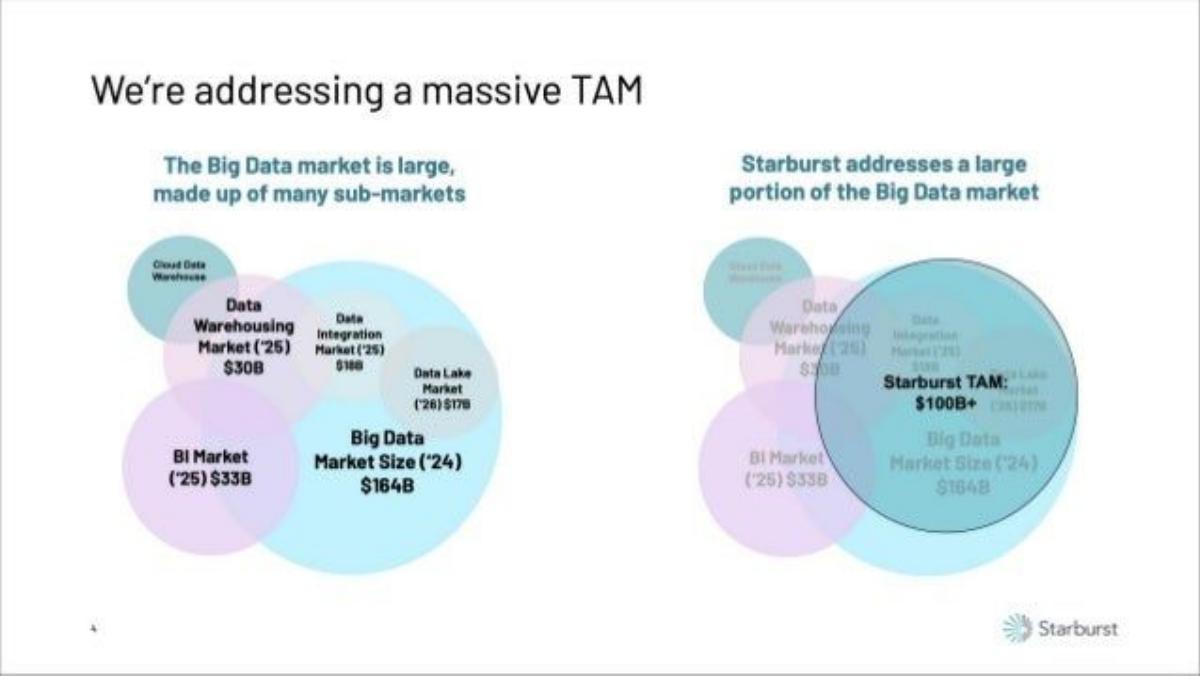
- The deck identifies a $100B+ Total Addressable Market (TAM) by aggregating sub-markets like Data Warehousing, Data Integration, and Data Lakes (Slide 4).
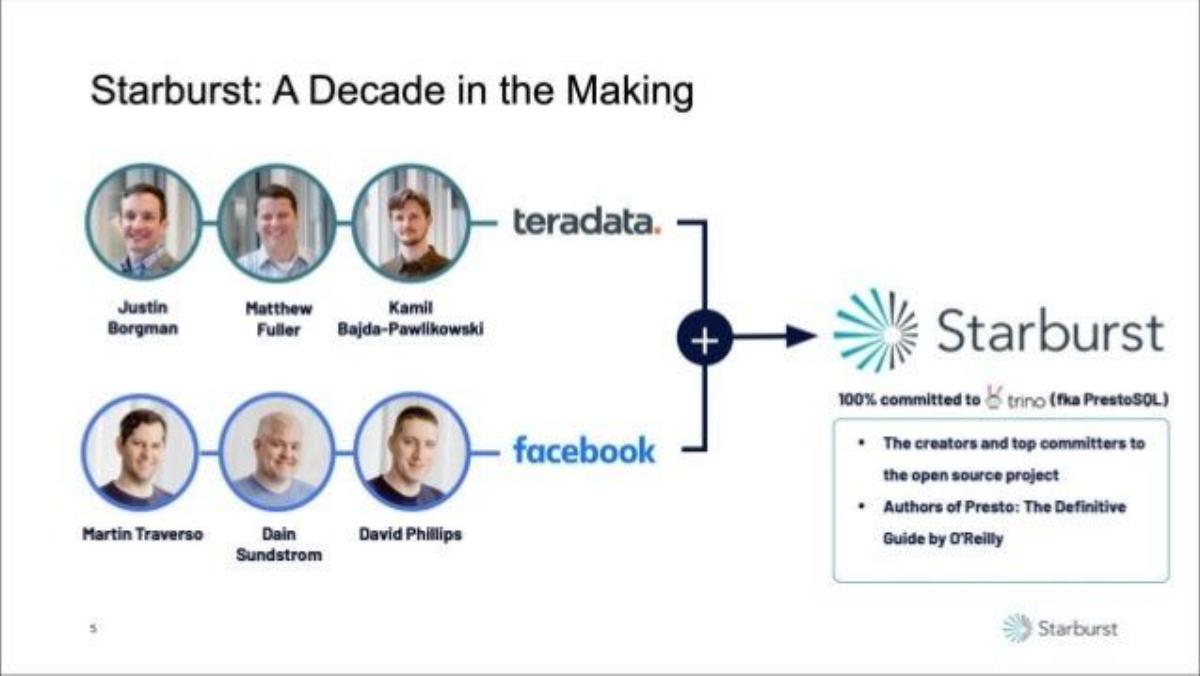
- Starburst leverages its founding team's history at Facebook and Teradata to establish deep technical authority in the Trino/Presto ecosystem (Slide 5).
- The narrative centers on a '30 years ago' vs. 'Today' comparison, arguing that cloud data warehouses haven't actually changed the fundamental problem of moving data (Slides 6-7).
- The platform is positioned as a solution to five specific pain points: speed, data duplication, vendor lock-in, cost, and limited visibility (Slide 8).
- A detailed architecture slide demonstrates connectivity across Data Lakes, Data Warehouses, and streaming data for various business personas (Slide 11).
- The company highlights an exceptionally high Net Promoter Score (NPS) of 85 to validate customer satisfaction (Slide 12).
- The deck lists blue-chip investors including Andreessen Horowitz (a16z), Index Ventures, and Coatue to signal institutional backing (Slide 12).
- The presentation lacks a specific 'Ask' slide or financial projections, which is common for late-stage decks where the round is often pre-empted or highly competitive.
The Narrative Strategy: Paradigm Shift over Product Features
Starburst’s Series D deck, used to raise $250M in 2022, is a masterclass in category creation. At this stage, a company is no longer proving that its software works; it is proving that it can dominate a massive market by replacing an existing, inferior way of doing things. Starburst does this by framing the last 30 years of data management as a series of failed promises. The deck is concise, visually consistent, and relies heavily on the 'Trino' open-source pedigree to establish a moat that competitors cannot easily replicate.
Slides 1-3: The Hook and the Macro Environment
Slide 1 is a standard title slide featuring Justin Borgman, Co-Founder & CEO. The tagline 'Analytics Anywhere' immediately sets the stage for the product's primary function.
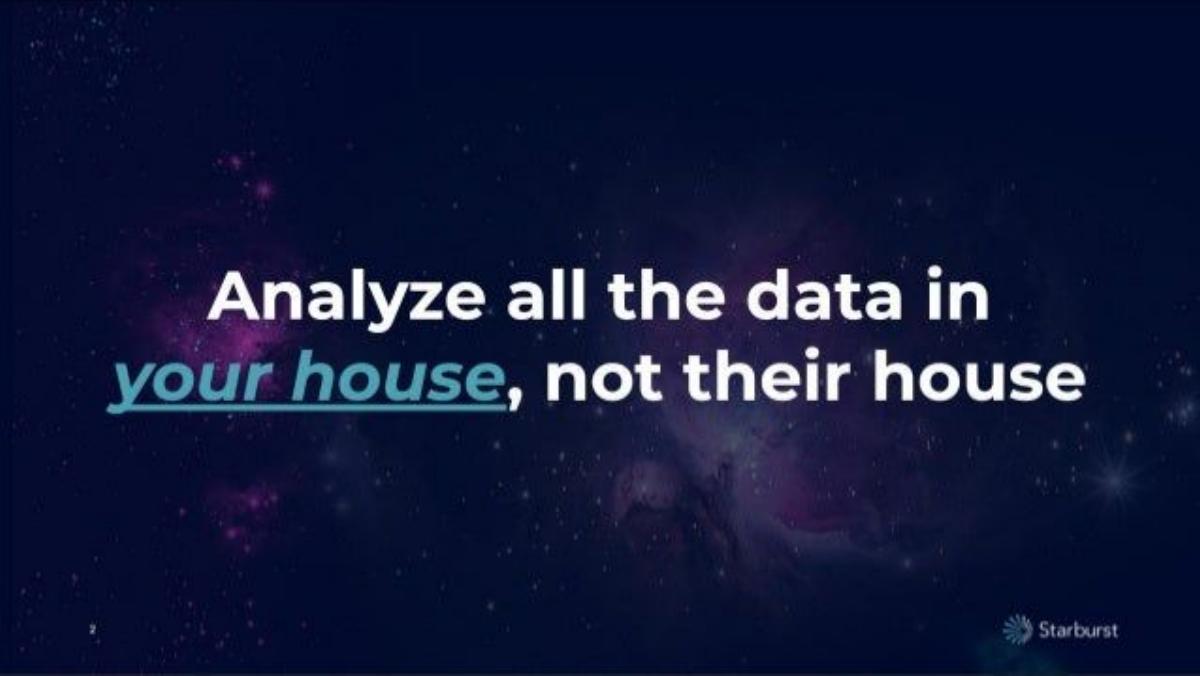
Slide 2 delivers the 'Why now' and the core philosophy in a single sentence: 'Analyze all the data in your house, not their house.' This is a direct shot at proprietary data warehouses that require customers to ingest data into their specific ecosystem to gain insights. By using the word 'house,' Starburst appeals to the desire for data sovereignty.
Slide 3 provides external validation for the urgency of the problem. Citing a May 2021 research report from Tableau and IDC, it states that '83% of CEOs want their organizations to be more data-driven.' This slide connects the technical solution to a high-level executive priority, ensuring the deck speaks to both the CTO and the CEO.
Slide 4: The $100B+ Market Opportunity
Slide 4 breaks down the Total Addressable Market (TAM). Instead of claiming the entire Big Data market ($164B by 2024), Starburst uses a Venn diagram to show how it captures value across multiple established categories. It lists the Data Warehousing Market at $30B, Data Integration at $18B, and Data Lakes at $17B. By positioning Starburst at the intersection of these, they claim a 'Starburst TAM' of $100B+. This is a sophisticated way to show market size because it acknowledges existing budgets that Starburst intends to disrupt.
Slide 5: The Pedigree Moat
Slide 5 , titled 'Starburst: A Decade in the Making,' is perhaps the most important slide for a technical Series D. It splits the founding team into two groups: the Teradata veterans (Borgman, Fuller, Bajda-Pawlikowski) and the Facebook engineers (Traverso, Sundstrom, Phillips). The slide explicitly notes they are the 'creators and top committers to the open source project' and authors of the O'Reilly 'Definitive Guide' to Presto. For an investor, this eliminates 'team risk.' It proves that the people building the company are the same people who invented the underlying technology used by the world's largest data companies.
Slides 6-8: Framing the Enemy
Slide 6 uses a historical photo of a man in a server room to represent Teradata '30 years ago.' The quote is 'Move all of your data into one place.' This establishes the 'old way' of doing things.
Slide 7 then mocks the modern 'Cloud Data Warehouse' by using the same photo inside a cloud icon. The text 'Not much has changed in 30 years' is a powerful indictment of modern giants like Snowflake or BigQuery, suggesting they are just the same old model with a new coat of paint. This is a bold positioning move.
Slide 8 lists the specific failures of the 'Data Warehouse Model.' It claims the model is slower than it looks, requires redundant copies of data, creates vendor lock-in, has unpredictable costs, and limits the user's view. By the end of this slide, the investor is primed to look for an alternative that solves these five specific pain points.
Slides 9-11: The Solution and Architecture
Slide 9 introduces the Starburst hub-and-spoke model. It shows Starburst in the center, connecting to OLTP Databases, Enterprise Applications, Third-Party data, and Web/Log data. On the right, it shows the output: Marketing, Finance, Externals, and Data Science. The message is clear: access data no matter where it lives.
Slide 10 is a transitional 'vision' slide with the phrase 'Light up your world, with Starburst' over a dark earth. It serves as a brief emotional reset before the technical deep dive.
Slide 11 is the 'money slide' for technical due diligence. It shows the 'Starburst Enterprise' layer sitting between the data sources (Data Lake, Data Warehouse, Non-Relational DBs) and the consumption tools (Python, Spark, Looker, Tableau). It highlights key enterprise features: 'Global Security,' 'Fine-grained access control,' and 'Column + Row-level permissions.' This slide proves that Starburst isn't just a query engine; it's a governed enterprise platform.
Slide 12: Traction and Social Proof
Slide 12 packs an enormous amount of data into one view. It lists '$164M Raised' (prior to this round) and shows logos for Index Ventures, Coatue, a16z, and Salesforce Ventures. It displays a 'Trusted by' section with heavyweights like Comcast, Verizon, Grubhub, and Upwork. Most impressively, it cites an '85 NPS' and the 'InfoWorld Technology of the Year 2021' award. For a Series D investor, this slide represents the 'de-risking' of the investment. High NPS plus blue-chip customers plus top-tier VCs equals a high-probability winner.
Slides 13-14: The Closing Vision
Slide 13 and Slide 14 close the deck with high-level mission statements: 'We exist to free our customers' and 'The wait is over. Break free and burst ahead.' These slides are designed to leave the investor with a sense of inevitability and purpose.
What Starburst Does Well
The deck’s greatest strength is its adversarial positioning . By attacking the fundamental premise of the data warehouse—that data must be moved to be useful—Starburst makes every other player in the space look antiquated. This is much more effective than a feature-by-feature comparison. Additionally, the founder-market fit is undeniable. Highlighting that they literally wrote the book on the technology they are selling is a level of authority few startups can match.
What Is Missing from the Deck
As a Series D deck, the most glaring omissions are financials and unit economics . There is no mention of Annual Recurring Revenue (ARR), Year-over-Year (YoY) growth rates, Net Revenue Retention (NRR), or Customer Acquisition Cost (CAC) ratios. While these were certainly in the data room, their absence from the pitch deck suggests this was a 'vision and momentum' presentation used to anchor high-level discussions rather than a cold-outreach deck. There is also no 'Ask' slide . We know from external records they raised $250M, but the deck itself does not state the amount sought or the intended use of funds.
Founder's Guide: What to Copy
The 'Old Way vs. New Way' Framework: Use Slides 6 and 7 as a template. If you can convince an investor that your competitors are just 'old tech in a new wrapper,' you win the narrative battle. · Pedigree Visualization: If your team has deep roots in a specific technology or previous successful exits, use Slide 5’s format to show the 'lineage' of your expertise. · The Ecosystem Slide: Slide 11 is a perfect example of how to show where your product fits in a complex enterprise stack. It shows both what you replace and what you integrate with. · NPS as a North Star: If you have a high NPS (above 70), feature it prominently. In B2B SaaS, customer love is the best indicator of long-term retention and expansion.
Frequently asked questions
- What is the core value proposition of Starburst according to the deck?
- The core value proposition is the ability to 'analyze all the data in your house, not their house' (Slide 2). This means querying data where it lives—whether in a data lake, warehouse, or on-premise—without the expensive and time-consuming process of moving it into a centralized proprietary system.
- How does Starburst handle the competition slide?
- Interestingly, Starburst does not use a traditional 'competitor grid.' Instead, it positions itself against the 'Data Warehouse Model' as a whole (Slide 8). It frames giants like Teradata and modern cloud warehouses as part of an outdated paradigm that requires data movement and creates vendor lock-in.
- What social proof does the deck provide?
- The deck provides three layers of social proof on Slide 12: financial security ($164M previously raised from top-tier VCs), customer trust (logos like Grubhub, VMware, and FINRA), and industry recognition (85 NPS and InfoWorld Technology of the Year 2021 award).
- How does the deck define its market size?
- On Slide 4, Starburst visualizes the Big Data market as a $164B opportunity in 2024. It specifically claims a TAM of $100B+ by showing how its platform overlaps with the Data Warehousing ($30B), Data Integration ($18B), and Data Lake ($17B) markets.
- Who are the key people behind Starburst mentioned in the deck?
- The deck highlights a 'Decade in the Making' team (Slide 5). It features Justin Borgman, Matthew Fuller, and Kamil Bajda-Pawlikowski from Teradata, alongside Martin Traverso, Dain Sundstrom, and David Phillips from Facebook, who are the original creators and top committers of the Trino (formerly PrestoSQL) project.