Quartus Capital Partners is raising a $100M AI-focused growth equity fund, building on their 2020 vintage performance. The deck positions the firm as a bridge between venture capital and private equity, focusing on growth-stage companies with proven business models and minimal technology risk. As of September 30, 2024, the fund reports a 27.50% Net IRR and a 1.71x TVPI, placing it in the top 5% of Cambridge Associates benchmarks for its vintage. The strategy emphasizes a 'multiplier effect' through operational transformation and global connectivity. With eight current portfolio companies, inc…
Key takeaways
- The fund targets a $100M total size with a minimum commitment of $1M for institutions and $100K for individuals (Slide 27).
- Performance as of Sept 30, 2024, shows a 27.50% Net IRR and 1.71x TVPI for the 2020 vintage (Slide 9).
- The current portfolio consists of 8 companies with a total enterprise value (TEV) of $476M (Slide 9).
- Investment focus is 80% AI-based software and 20% general technology, primarily in North America (Slide 19).
- The team claims a 'multiplier effect' through a commercial readiness framework and global market access (Slide 13).
- Target metrics for deals include 50%+ YoY revenue growth and a base case 10x exit potential (Slide 17).
- The fund structure includes a 2% management fee, 20% carried interest, and an 8% preferred return (Slide 27).
- The pipeline process involves screening over 2,000 deals to reach a final portfolio of 15-20 companies (Slide 21).
Executive Summary and Team
Slides 1-7: Introduction and Leadership
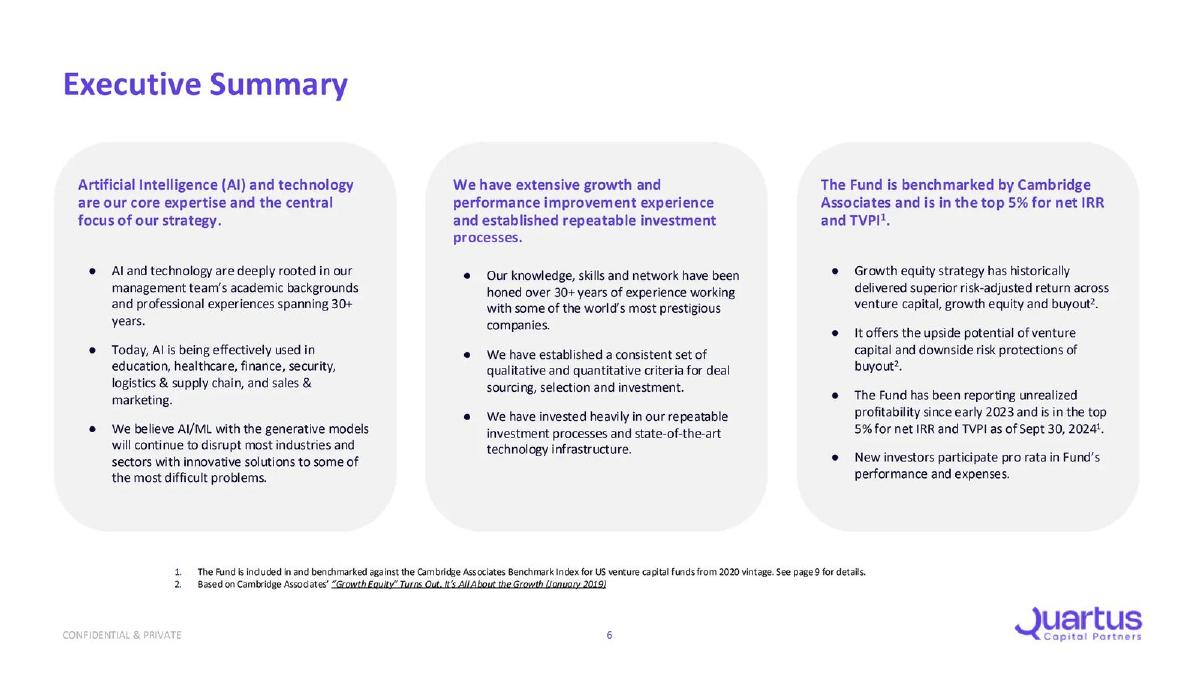
The Quartus AI Fund deck opens with a title slide identifying the firm as Quartus Capital Partners. It notes that the firm received the "US Emerging Manager Best Performance Award" from Private Equity Wire in 2024. Slide 3 is a standard executive summary divider, leading into the team overview on Slide 7.
The leadership team is presented as multi-disciplinary with global experience. Afzal M. Tarar (Founder and Managing Partner) is a former PwC partner with 30+ years of experience. Rizwan Muhammad (Partner) brings 30+ years in tech startups and operations, including time at Hitachi Vantara. Tim Tang, PhD (Partner) is a serial entrepreneur with 10+ successful exits. Sophia Gao, PhD, CFA (Partner) has experience as a CRO at a $1B+ AUM firm. Barry Day, Jr. (Principal) has 15+ years of investment experience, formerly with SK Group. The slide lists prior work at institutions including IBM, Deloitte, NASA, and JPMorgan Chase.
Performance and Benchmarking
Slide 9: Fund Performance vs. Benchmarks
This slide provides a detailed snapshot of the fund's 2020 vintage performance as of September 30, 2024. The Target Fund Size is $100M , with current AUM at $32.03M across 8 portfolio companies. Key metrics include a Total Enterprise Value (TEV) of $476M , a 2.19x MOIC , and a 1.71x TVPI . The Net IRR is reported at 27.50% . Notably, the DPI is 0.0x , indicating that no capital has been returned to investors yet.
The slide includes a comparison table using Cambridge Associates Benchmark Indices. Quartus claims its 27.50% Net IRR and 1.71x TVPI place it in the "Top 5%" category for 2020 vintage funds, which have benchmarks of 20.52% and 1.63% respectively. The fund's revenue growth is cited at 100.48% with a gross margin of 74.73%.
Mission and Strategy
Slides 11-15: The Growth Equity Approach
Slide 11 states the mission: to offer an AI and technology-focused venture growth equity strategy delivering superior risk-adjusted returns. Slide 13 introduces the "Quartus Multiplier Effect," which focuses on Growth Engineering, Global Connectivity, and Accelerated Exits. The firm uses a "Commercial Readiness Framework" to assess companies and an "Operational Transformation" plan to increase profitability.
Slide 15 justifies the Growth Equity strategy using Cambridge Associates data. It argues that Growth Equity has outperformed venture capital and buyouts over the last decade (17.1% vs 15.9% and 16% respectively over 5 years). It also highlights that Growth Equity companies maintained positive revenue growth during the 2009 downturn, whereas public companies and buyout-backed firms saw declines. The slide claims the impairment and capital loss ratios for Growth Equity (13.7%) are comparable to Buyouts (11.7%) and significantly lower than Venture Capital (32.7%).
Investment Framework
Slides 17-21: Metrics and Pipeline
Slide 17 visualizes the "Multiplier Effect" in action, showing how Quartus aims to accelerate revenue and EBITDA while flattening the risk curve during the growth phase. Key target metrics include 50%+ YoY Revenue Growth , high gross margins, low capital expenditure, and a 10x exit potential . They seek liquidity within 5 years and emphasize a "Margin of Safety" in valuation.
Slide 19 breaks down portfolio diversification. The target allocation is 80% AI-Based Software and 20% Technology. Geographically, 80% is North America and 20% is the Rest of the World. Investment types are 80% Direct and 20% Co-Investments & Secondaries. Slide 21 details the "Quartus Fit" selection process, showing a funnel that starts with 2,000+ deal intakes, narrows to 50+ for due diligence, and results in a final portfolio of 15-20 companies .
Portfolio Management and Current Assets
Slides 23-25: Active Monitoring and Portfolio Status
Slide 23 outlines the "Land and Expand" strategy: making small initial investments to gain information rights and board seats, then building out positions in top performers through follow-on rounds. They focus on growth-stage companies with "little technology risk" and seek to invest at a discount to the next round of financing.
Slide 25 lists the current portfolio of eight companies. Notable entries include:
Area9 Lyceum: AI-based adaptive learning, $180M valuation, $0.50M invested by fund, target 8x MOIC. · U-Method: AI engine for chronic disease, $22.5M valuation, $3.24M invested, target 21x MOIC. · Integrated Endoscopy: Med device, $45M valuation, $5.32M invested, target 15x MOIC. · NeuroSync: AI neuro health diagnostics, $25M valuation, $1.64M invested, target 22x MOIC. · Quanergy: 3D LiDAR software, $40M valuation, $0.85M invested, target 29x MOIC. · Wahyd Logistics: AI logistics, $48.50M valuation, $1.50M invested, target 12x MOIC.
The slide also mentions Cerebri and Greene Lyon , both with "TBD" for revenue and target MOICs of 5x and 7x respectively. Co-investors listed include Samsung, Microsoft's Venture Fund (M12), and LEGO Ventures.
Fund Terms
Slide 27: Structure and Service Providers
The final slide details the fund's mechanics. The Target Fund Size is $100M . The Minimum Commitment is $1M for institutions and $100K for individuals . The fund has a 7-year base term with two 1-year extensions. Financial targets are 30%+ IRR and 4x TVPI . The fee structure is a 2% management fee and 20% carried interest , with an 8% preferred return . The GP must commit at least 1% but may commit up to 5%. Service providers include JPMorgan Chase for banking, Davidoff Hutcher & Citron LLP for counsel, and Marcum LLP for audit.
What Works and What is Missing
What Works
Strong Benchmarking: The use of Cambridge Associates data to place the fund in the top 5% of its vintage provides immediate credibility (Slide 9). · Clear Strategy Definition: The deck does a good job of defining "Growth Equity" as a distinct asset class between VC and PE, highlighting its historical resilience (Slide 15). · Detailed Portfolio Transparency: Slide 25 provides specific valuations, investment amounts, and target MOICs for every company in the current portfolio. · Operational Value-Add: The "Multiplier Effect" (Slide 13) provides a framework for how the GP actually helps companies, rather than just providing capital.
What is Missing
DPI Strategy: With a 0.0x DPI on a 2020 vintage fund (Slide 9), the deck lacks a specific discussion on the timeline for the first distributions to LPs. · Case Studies: While the portfolio is listed, there are no deep-dive case studies showing exactly how the "Multiplier Effect" was applied to a specific company to drive the reported growth. · Use of Proceeds: While the fund size is stated, there is no breakdown of how the $100M will be allocated between new investments, follow-ons, and management reserves. · Exit Environment Analysis: Given the focus on "Accelerated Exits," the deck lacks a slide discussing the current M&A and IPO environment for AI companies.
Founder and GP Takeaways
For GPs raising an emerging fund, this deck serves as a model for performance-first storytelling . By leading with an award and top-decile benchmarks, Quartus shifts the conversation from "who are you?" to "how do you maintain this lead?" The inclusion of a detailed portfolio table (Slide 25) is a high-transparency move that builds trust, especially when including co-investor names like Samsung and Microsoft. Founders can learn from the "Multiplier Effect" slide (Slide 13); it demonstrates how to articulate a value proposition that goes beyond a check, focusing on specific frameworks like "Commercial Readiness" that appeal to growth-stage investors.
Frequently asked questions
- What is the specific investment stage for the Quartus AI Fund?
- The fund focuses on Venture Growth Equity, specifically growth-stage venture capital. According to Slide 23, they target companies with proven business models, significant growth potential, and little technology risk. This stage is positioned between early-stage venture and traditional private equity buyouts, aiming for a 'margin of safety' by investing at discounts to subsequent rounds or with downside protections.
- How does the fund's performance compare to industry benchmarks?
- As of September 30, 2024, the fund reports a Net IRR of 27.50% and a TVPI of 1.71x. Slide 9 compares these figures to Cambridge Associates benchmarks for 2020 vintage funds. The fund's Net IRR exceeds the Top 5% benchmark of 20.52%, and its TVPI exceeds the Top 5% benchmark of 1.63%, indicating top-tier performance relative to its peers.
- What are the key terms for limited partners in this fund?
- Slide 27 outlines the fund terms: a 7-year base term with two 1-year extensions, a 2% annual management fee, and 20% carried interest. There is an 8% preferred return (hurdle rate). The GP commitment is required to be at least 1%, though they may commit up to 5%. Co-investment opportunities are offered pro-rata to fund commitments without additional fees.
- What is the 'Quartus Multiplier Effect' mentioned in the deck?
- This is the firm's value-add strategy described on Slide 13. it consists of three pillars: Growth Engineering (commercial readiness and operational transformation), Global Connectivity (market access and strategic partnerships), and Accelerated Exits (leveraging global capital markets and diverse strategic investors). The goal is to shift the revenue and EBITDA curves upward while reducing risk during the growth phase (Slide 17).
- Which sectors and geographies does the fund prioritize?
- Slide 19 indicates a heavy concentration in AI-Based Software, which accounts for 80% of the sector allocation, with the remaining 20% in general technology. Geographically, 80% of the allocation is targeted toward North America, with 20% reserved for the 'Rest of the World.' The investment types are similarly split 80/20 between direct investments and co-investments/secondaries.