The Forethought Series B deck is a narrative-driven presentation that leverages founder Deon Nicholas’s exceptional technical background to sell a future where AI makes 'everyone a genius at their job.' Rather than leading with dense financial tables, the deck uses 22 slides to build a story of inevitability. It highlights the company’s TechCrunch Disrupt win and a high-tier customer list including Gusto and MasterClass to provide social proof. While it lacks traditional slides on unit economics, churn, or detailed revenue growth, it compensates with a clear product framework—Agatha—and a mas…
Key takeaways
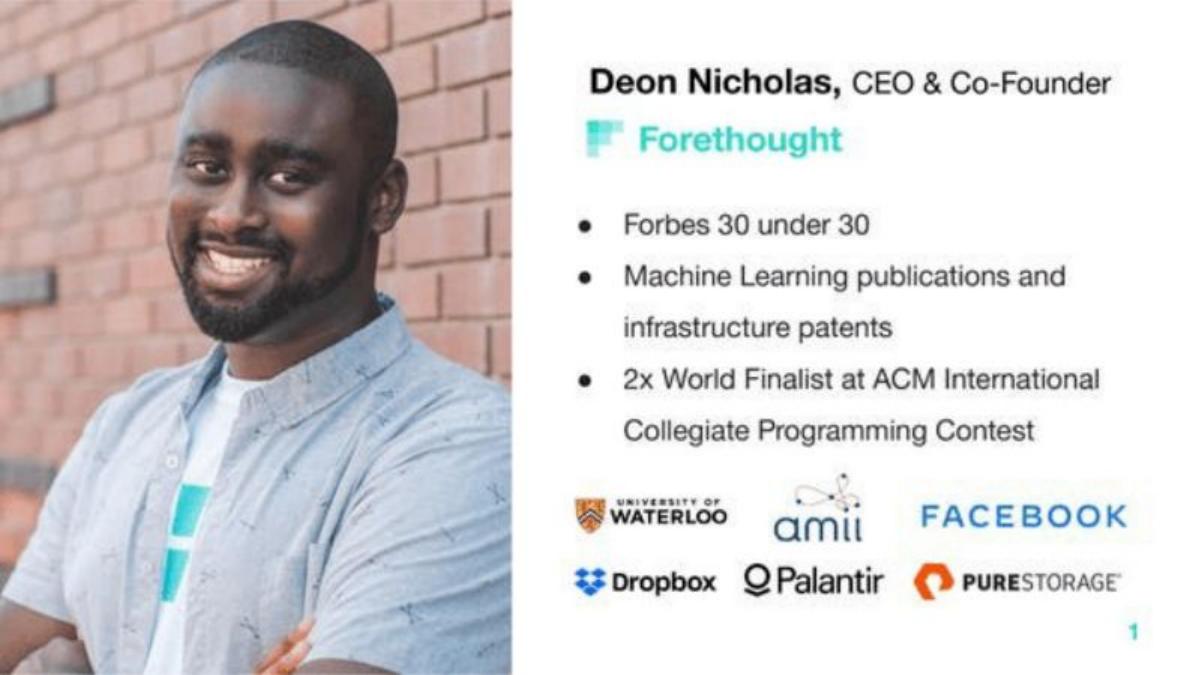
- The deck leads with founder Deon Nicholas’s pedigree, citing his Forbes 30 under 30 status and 2x World Finalist position at the ACM Programming Contest (Slide 1).
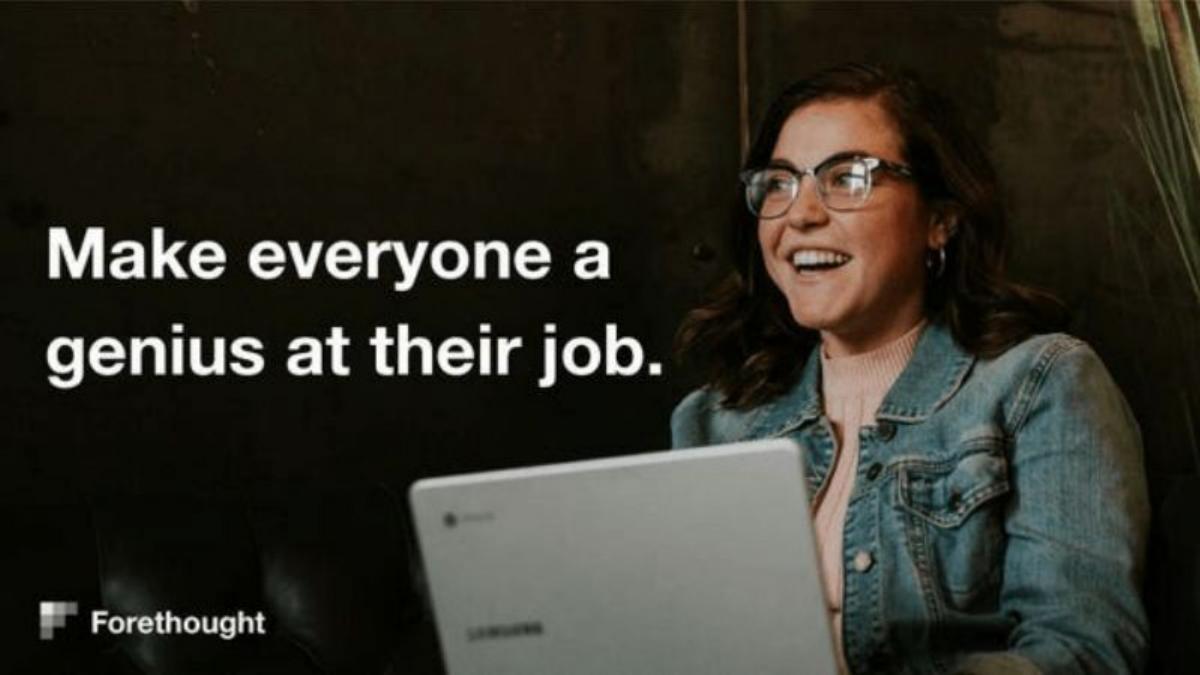
- The core mission is defined as 'Make everyone a genius at their job,' positioning the AI as an augmentative tool rather than a replacement (Slide 5).
- The product, Agatha, is categorized into four distinct functional pillars: Solve, Triage, Assist, and Discover (Slide 7).
- Social proof is heavily emphasized through a dedicated slide for the TechCrunch Disrupt win and the $100,000 prize (Slide 9).
- The company demonstrates enterprise readiness by listing high-growth customers such as Carta, Instacart, MasterClass, and Gusto (Slide 10).
- The deck identifies a '$100B Opportunity,' though it does not provide a bottom-up calculation for this figure (Slide 16).
- The 'Squad' slide highlights a talent density from top-tier institutions and tech giants like Google, Facebook, and MIT (Slide 11).
- The go-to-market strategy focuses on targeting COOs and VPs of Customer Support at mid-to-large companies like ESPN and TicketMaster (Slide 21).
The Narrative-First Approach to Series B
Forethought’s Series B deck is an anomaly in the world of mid-stage fundraising. Typically, by the time a company reaches a $17M Series B, the deck is a dense collection of spreadsheets, cohort analyses, and growth charts. Forethought, however, leans heavily into the founder narrative and the technological vision . This deck is less about where the company has been and more about the inevitability of where it is going. It uses the founder’s personal history as a proxy for technical defensibility, a strategy that clearly resonated with top-tier investors like NEA.
Slides 1-4: The Pedigree and the Platform
Slide 1 introduces Deon Nicholas, CEO and Co-Founder. This is a high-signal slide. It doesn't just list a title; it lists achievements that de-risk the technical execution of an AI startup: Forbes 30 under 30 , Machine Learning publications , and 2x World Finalist at ACM International Collegiate Programming Contest . The logos at the bottom—Facebook, Dropbox, Palantir—establish that the leadership comes from high-growth, high-engineering-bar environments.
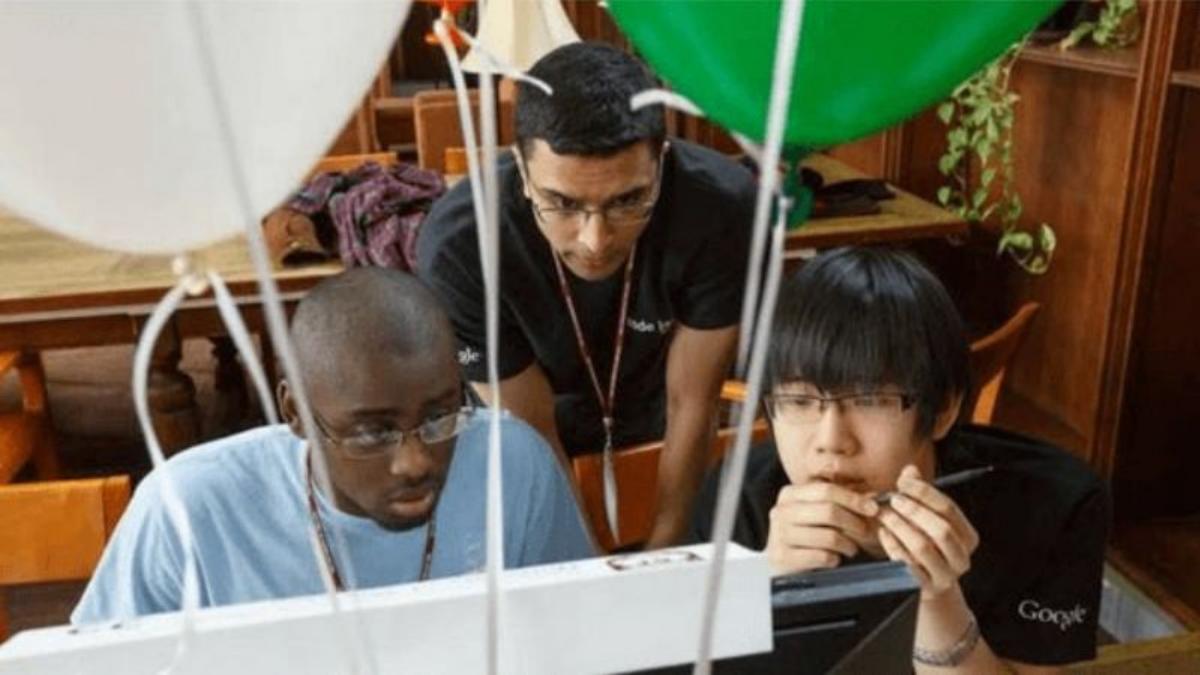
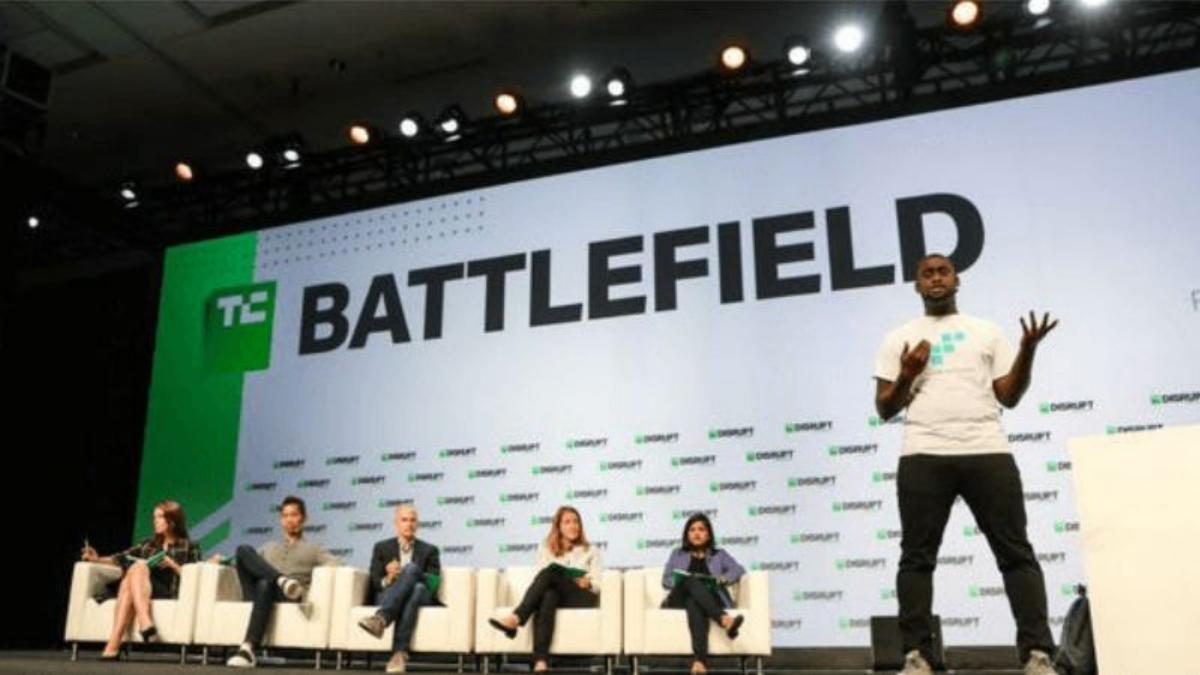
Slide 2 and 3 provide visual context. Slide 2 shows the team in a 'hacker' environment, while Slide 3 shows Nicholas on the TechCrunch Disrupt Battlefield stage. This sequence builds a story of a team that is both technically grounded and capable of winning on a global stage. Slide 4 is a simple branding transition, using a spotlight metaphor to signal that the company is ready for the main stage.
Slides 5-8: The Problem and the 'Agatha' Solution
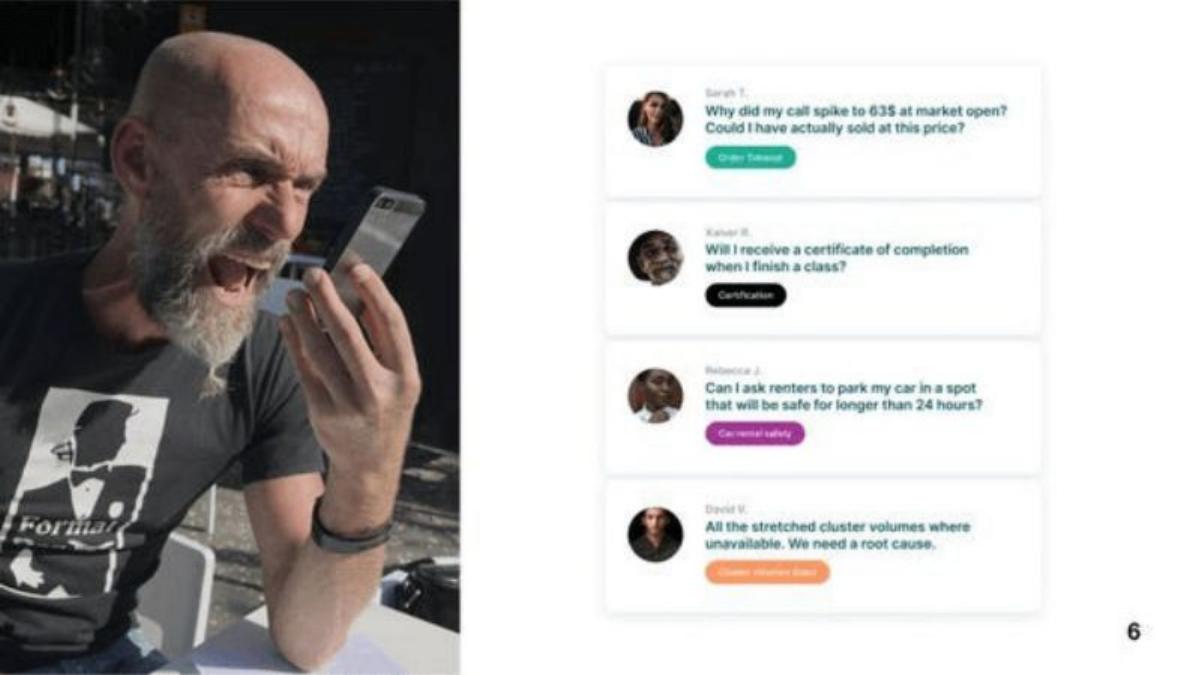
Slide 5 delivers the mission statement: 'Make everyone a genius at their job.' This is a critical positioning choice. In 2020, much of the AI narrative was about replacement; Forethought chose augmentation. Slide 6 illustrates the 'pain'—a frustrated user and a list of complex customer queries ranging from stock options to server cluster volumes. This slide proves the AI isn't just handling 'reset my password' tickets; it's handling high-complexity data.
Slide 7 introduces Agatha , the company's AI persona. The slide breaks the product down into four actionable verbs: Solve, Triage, Assist, and Discover . This framework is excellent for enterprise buyers who need to know exactly where a tool fits into their existing workflow. Slide 8 shows a product mockup, comparing the ease of an internal search to a Google search, emphasizing the 'genius' aspect of the tool.
Slides 9-11: Validation and The Squad
Slide 9 is a pure 'flex' slide. It shows the team winning the $100,000 check at TechCrunch Disrupt. For a Series B, this is a reminder of the company's early momentum and external validation. Slide 10 follows up with the 'Who's Who' of modern SaaS customers: Carta, Instacart, MasterClass, Thumbtack, Gusto, and Typeform . These are not just any customers; they are 'tech-forward' companies that other enterprises look to for trends.
Slide 11 , titled 'The Squad,' reinforces the talent density mentioned on Slide 1. It lists alma maters like MIT, Harvard, Berkeley, and Waterloo , alongside former employers like LinkedIn, Google, and Qualtrics . This slide tells investors that the $17M will be used to scale a team that is already among the best in the industry.
Slides 12-16: The Origin Story and Market Size
The deck then takes a surprising turn into a personal biography. Slides 12 through 15 detail Nicholas’s upbringing in Toronto ('The 6ix'), his early obsession with video games, and his first AI program—a 'personal tutor' that read history notes to generate quizzes. While unusual for a Series B, this serves to prove founder-market fit . It shows that the CEO has been thinking about 'making people smarter' through AI for over a decade, not just since the recent AI hype cycle began.
Slide 16 puts a price tag on the vision: a '$100B Opportunity.' While the deck lacks a slide showing the 'Bottom-Up' TAM (Total Addressable Market) calculation, the figure is large enough to justify the venture-scale returns required for a Series B investment.
Slides 17-21: The Vision and Go-To-Market
Slide 18 contextualizes Forethought within the 'Next Industrial Revolution.' It places AI as the 4th Revolution, following Steam, Electricity, and Computing. This is a classic 'Visionary' slide designed to make the investor feel they are part of a historical shift. Slide 19 adds a social mission component, 'Change the face of tech,' emphasizing diversity in leadership.
Slide 21 , 'What's Next,' is the closest the deck gets to a tactical roadmap. It outlines the go-to-market gameplan : targeting COOs and VPs of Customer Support at mid-to-large companies. It even names specific targets like ESPN and TicketMaster . This shows that the company has moved past the 'experimentation' phase and has a clear idea of who their buyer is and how to reach them.
What Works in the Forethought Deck
Founder Pedigree: The deck does an outstanding job of selling Deon Nicholas as a '1-in-1,000' founder. His technical awards and previous work history are front and center. · Clear Product Framework: The 'Solve, Triage, Assist, Discover' model (Slide 7) makes a complex AI product easy to understand for a non-technical investor. · Social Proof: Between the TechCrunch Disrupt win and the high-quality customer logos, the deck creates a sense of 'FOMO' (Fear Of Missing Out). · Human-Centric AI: By focusing on making people 'geniuses' rather than replacing them, Forethought avoids the ethical and adoption friction often associated with AI startups.
What is Missing from the Forethought Deck
Financial Metrics: There is a total absence of revenue, growth rates, or unit economics. For a Series B, this is highly unusual and suggests the round was likely pre-empted or driven entirely by technical milestones and team quality. · Competitive Landscape: The deck does not mention Zendesk, Salesforce, or other AI support competitors. It assumes the '4th Industrial Revolution' narrative is enough to differentiate. · The 'Ask': There is no slide stating how much they are raising or how the funds will be allocated (though the catalogue confirms it was $17M). · Retention Data: With customers like Instacart and Gusto, investors would typically want to see Net Revenue Retention (NRR) to prove the product is 'sticky.'
What Founders Should Copy
The 'Squad' Slide: If you have a high-pedigree team, don't just list names. Use logos of their former employers and universities to create an immediate visual impact of talent density. · The Four-Pillar Framework: If your product does many things, group them into 3-4 simple verbs. It helps the investor categorize your value proposition in their mind. · The Mission-Driven Narrative: Forethought doesn't just sell software; they sell the idea of 'making everyone a genius.' Founders should find the 'higher purpose' of their tool to make the pitch more memorable. · Personal Origin Story: If your background directly relates to the problem you are solving, don't be afraid to include a few slides on your journey. It builds trust in your long-term commitment to the space.
Frequently asked questions
- What is the primary business model of Forethought?
- Based on the catalogue facts and the customer list on slide 10, Forethought operates as a B2B SaaS company. They provide AI-driven customer service solutions to mid-to-large enterprises, charging a subscription fee for their platform, Agatha, which helps teams triage and solve support tickets more efficiently.
- How does the deck handle competition?
- Interestingly, the deck completely omits a traditional 'competitor matrix' or 'X/Y axis' slide. Instead of comparing features against incumbents, Forethought focuses on its unique technical approach and the founder's vision of the '4th Industrial Revolution,' positioning itself as a pioneer in the next wave of AI rather than a better version of existing tools.
- What metrics are included in the Series B deck?
- The deck is notably light on hard financial metrics. There are no slides detailing Monthly Recurring Revenue (MRR), Net Revenue Retention (NRR), or Customer Acquisition Cost (CAC). It relies almost entirely on qualitative traction, such as the TechCrunch Disrupt win and the logos of its customer base, to imply commercial success.
- Who were the key investors in this $17M round?
- According to the catalogue facts, the round was led or supported by a diverse group of VCs and high-profile angels. These include NEA, Sound Ventures (Ashton Kutcher and Guy Oseary), Operator Collective, and individuals like Sean 'Diddy' Combs, LL Cool J, and Qualtrics CEO Ryan Smith.
- What is 'Agatha' in the context of this deck?
- Agatha is the name of Forethought's AI platform. Slide 7 introduces it as the engine that powers four key functions: Solve (answering queries), Triage (routing tickets), Assist (helping agents), and Discover (finding insights). It is presented as the 'genius' assistant that empowers employees.