FOLX Health's Series B deck is a study in brand-led fundraising. Rather than leading with complex medical jargon or dense financial tables, the company focuses on the sociological and economic reality of the LGBTQ+ community. By highlighting that 1 in 5 Gen Z adults identify as LGBTQ+ (Slide 3) and that the community represents $1T in purchasing power (Slide 4), FOLX frames healthcare not just as a service, but as a civil right and a massive market opportunity. The deck successfully transitions from a B2C telehealth provider to an enterprise-ready platform, citing that diverse workforces can…
Key takeaways
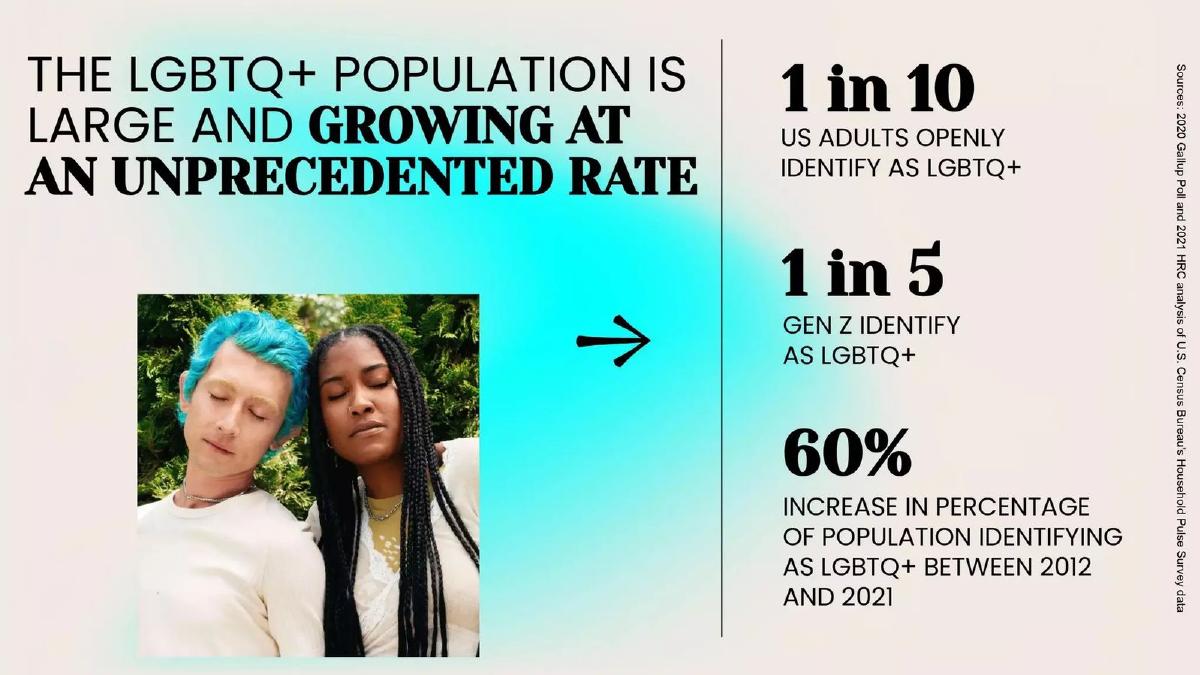
- The deck identifies a 60% increase in the population identifying as LGBTQ+ between 2012 and 2021 as a core growth driver (Slide 3).
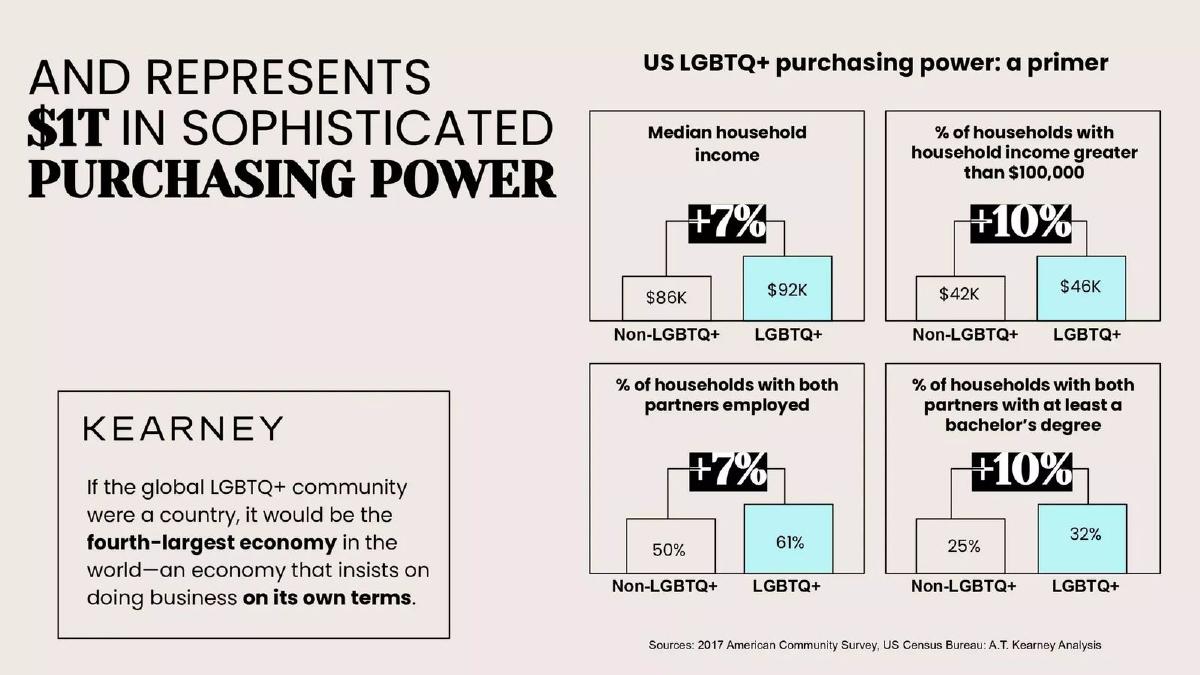
- It leverages a Kearney analysis stating the global LGBTQ+ community would be the fourth-largest economy in the world (Slide 4).
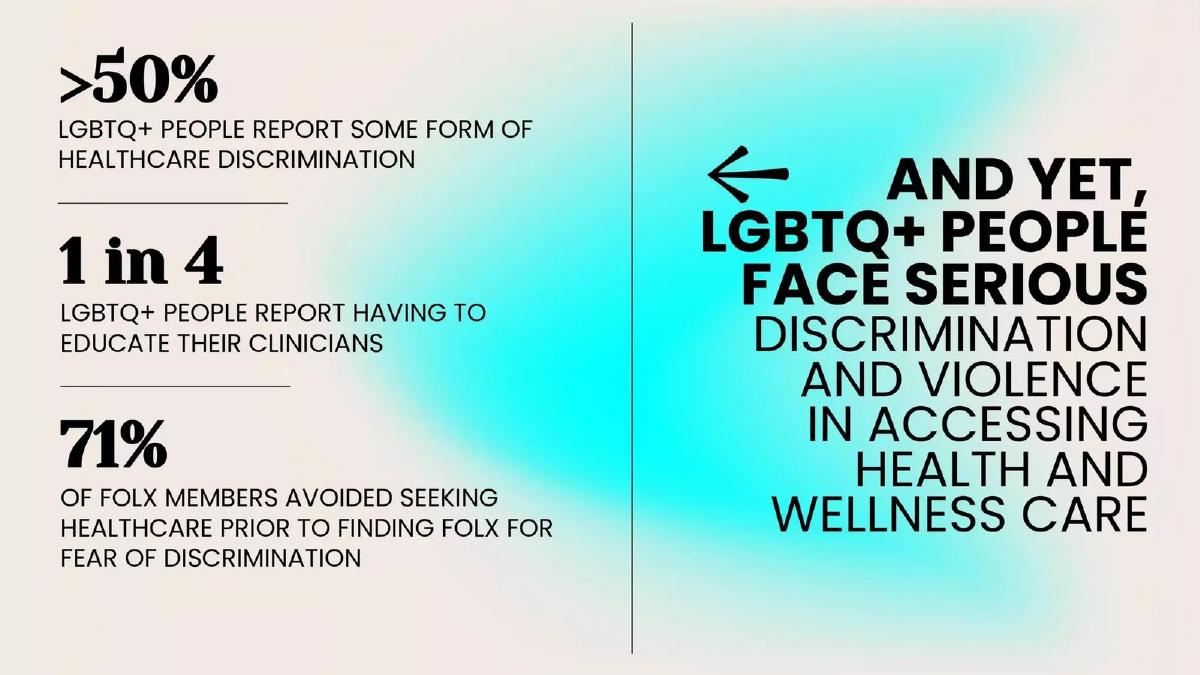
- FOLX highlights a critical service gap, noting that 1 in 4 LGBTQ+ people report having to educate their own clinicians (Slide 5).
- The company positions itself as a brand leader, citing 10.7 billion total media impressions in 2021 (Slide 12).
- Clinical quality is quantified by the fact that 100% of members feel supported by their FOLX clinician (Slide 14).
- The business model expansion targets enterprise clients, claiming that supporting a diverse workforce increases profitability by 36% (Slide 17).
- The deck omits a dedicated 'Team' slide, relying instead on the brand's collective reputation and press accolades.
- There is no explicit 'Ask' slide detailing the specific use of the $30M Series B funds within the presentation.
The Brand-First Series B: A Teardown of FOLX Health
FOLX Health’s 18-slide deck is a departure from the data-heavy, spreadsheet-driven presentations often seen in Series B rounds. Instead, it is a highly visual, narrative-driven document that prioritizes community identity and brand equity. In 2022, this approach helped the company secure $30M in funding to expand its LGBTQ-specialized telehealth services.
Slides 1-2: Setting the Visual Tone
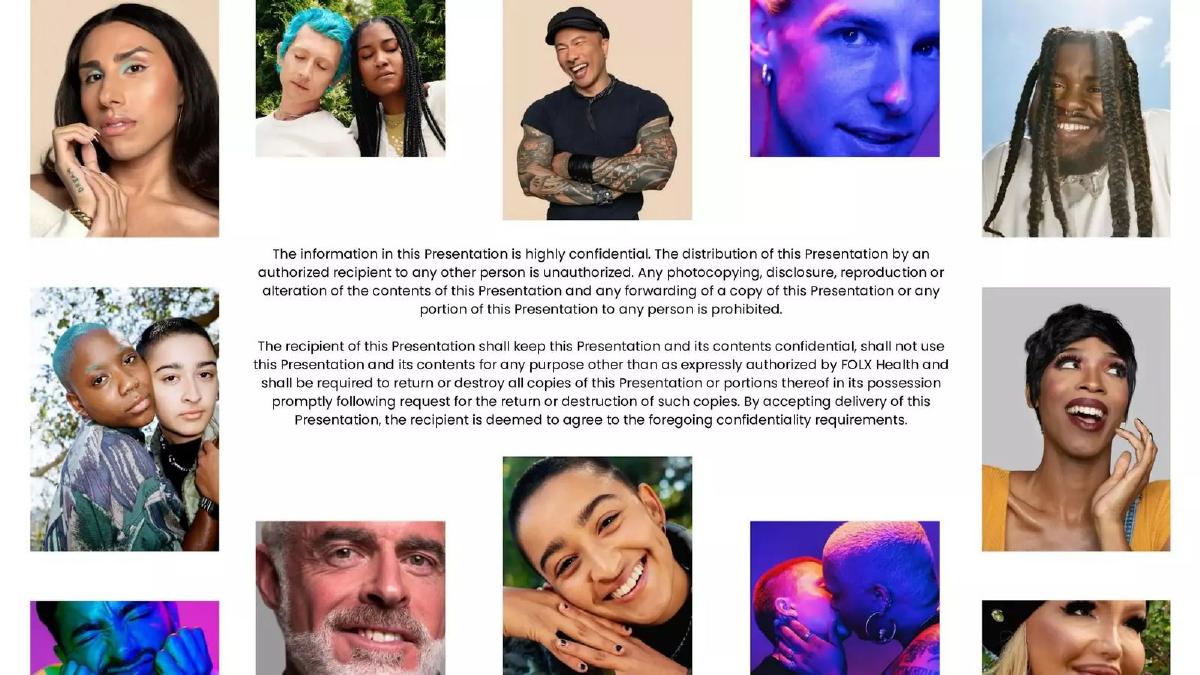
The deck opens with high-quality, full-bleed photography of the community it serves. Slide 1 features the FOLX logo overlaid on a close-up portrait, immediately establishing the brand's aesthetic. Slide 2 is a standard confidentiality notice surrounded by a collage of diverse faces. This reinforces the message that FOLX is not just a medical provider, but a platform built for a specific, multifaceted population.
Slides 3-4: The Macro Economic Opportunity
Slide 3, titled "THE LGBTQ+ POPULATION IS LARGE AND GROWING AT AN UNPRECEDENTED RATE," provides the foundational 'Why' for the investment. It cites that 1 in 10 US adults and 1 in 5 Gen Z identify as LGBTQ+. The most striking figure is the 60% increase in this population between 2012 and 2021. By leading with Gen Z, FOLX is signaling long-term market sustainability to investors.
Slide 4 moves from population size to economic power. It claims "$1T IN SOPHISTICATED PURCHASING POWER." The slide uses Kearney analysis to suggest that if the LGBTQ+ community were a country, it would be the fourth-largest economy in the world. The data points here are specific: LGBTQ+ households have a 7% higher median income ($92K vs $86K) and a higher percentage of bachelor's degrees (32% vs 25%) compared to non-LGBTQ+ households. This frames the demographic as a premium, high-value customer base.
Slides 5-6: The Failure of Traditional Healthcare
Slide 5 addresses the 'Problem.' It states that ">50% of LGBTQ+ people report some form of healthcare discrimination" and 71% of FOLX members avoided care prior to joining for fear of that discrimination. A critical pain point is highlighted: 1 in 4 report having to educate their own clinicians. This establishes the need for a specialized provider.
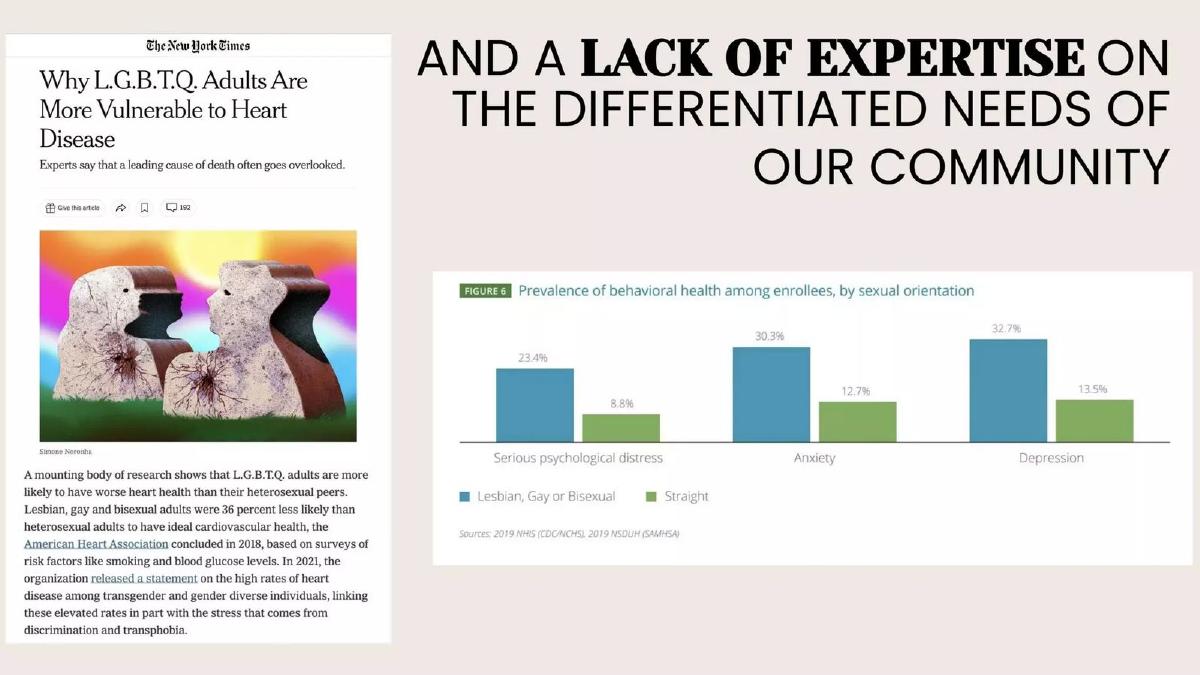
Slide 6 uses a New York Times clipping and behavioral health charts to show the physical and mental consequences of this systemic failure. It notes that the community is 36% less likely to have ideal cardiovascular health and shows significantly higher rates of serious psychological distress, anxiety, and depression compared to straight peers. This slide justifies the company's expansion into behavioral health.
Slides 7-9: The Solution and Product
Slide 7 is a transition slide titled "THE OPPORTUNITY." Slide 8 defines the mission: to be the "LEADING HEALTH AND WELLNESS PLATFORM FOR LGTBQIA CARE."
Slide 9 provides the product overview. It lists virtual care services including primary care, gender-affirming care, and sexual health. It specifically notes a "Q2’22 launch" for behavioral health. The slide also mentions "Proprietary protocols" and a "Referral Network," suggesting that FOLX is building a moat through specialized clinical standards that generalist telehealth providers lack.
Slides 10-12: The Brand Advantage
Slide 10 transitions into "THE FOLX ADVANTAGE." Slide 11 focuses on brand recognition, listing accolades like Time 100 Most Influential Companies 2022 and Fast Company’s Most Innovative Companies. The slide boasts "382 TOTAL PLACEMENTS" and "10.7B TOTAL IMPRESSIONS" for 2021. For a Series B company, these numbers are intended to prove that FOLX has achieved "category leader" status without needing a massive traditional advertising spend.
Slides 13-14: Clinical Excellence and Member Sentiment
Slide 13 highlights the network, claiming the "LARGEST VIRTUAL NETWORK OF LGBTQ-SPECIALIZED CLINICIANS." It contrasts FOLX’s internal training against the "5 hours of LGBT training" the average medical student receives. This is a key differentiator in healthcare: the quality of the provider network.
Slide 14 provides the deck's strongest traction metrics. It reports an "85+ NET PROMOTER SCORE," which is nearly unheard of in healthcare (where scores often hover in the 20s or 30s). It also claims 100% of members feel supported and 98% are making progress toward goals. These are "soft" metrics, but in a Series B deck, they serve as a proxy for high retention and low churn.
Slides 15-17: The Future and Enterprise Expansion
Slide 15 is a transition to the future vision. Slide 16 details the expansion into "BEHAVIORAL HEALTH, CONTENT AND COMMUNITY," emphasizing group-based care and learning programs. This suggests a move toward a lower-cost, higher-margin community model to complement 1-on-1 clinical visits.
Slide 17 presents the enterprise play: "LEVERAGING DEEP ALIGNMENT BETWEEN DTC & ENTERPRISE." It argues that supporting a diverse workforce increases profitability by 36%. This is the "scale" slide, showing investors that FOLX can move beyond individual subscriptions to large-scale B2B contracts with employers looking to improve their DEI (Diversity, Equity, and Inclusion) offerings.
Slide 18: Conclusion
The deck ends on Slide 18 with a simple "THANK YOU" and the company URL. There is no summary of the round terms, no use of proceeds, and no team bios.
What FOLX Health Does Well
The deck is a masterclass in demographic storytelling . By the time an investor reaches the product slides, they are already convinced that the LGBTQ+ market is massive, wealthy, and systematically mistreated. FOLX doesn't just sell a doctor's visit; they sell a solution to a civil rights issue that happens to have a $1T tailwind.
The use of social proof is also exceptional. By highlighting the Time 100 and Fast Company awards alongside a staggering 10.7 billion impressions, FOLX positions itself as an inevitable cultural force. This makes the $30M ask feel like a way for investors to buy into a movement rather than just a startup.
What is Missing from the FOLX Health Deck
From a traditional fundraising perspective, this deck is missing several "mandatory" slides:
Team Slide: There is no mention of the founders' backgrounds, medical directors, or executive leadership. This is highly unusual for a Series B. · Financials and Unit Economics: There are no mentions of CAC (Customer Acquisition Cost), LTV (Lifetime Value), or revenue growth rates. While the NPS is high, investors usually want to see how that translates into dollars. · The Ask: The deck does not state how much they are raising or how they plan to spend it. This information was likely handled in a separate document or during the live pitch. · Competition: There is no competitive landscape slide. FOLX assumes its specialized focus makes it incomparable to generalist telehealth firms like Teladoc or Hims & Hers.
Founder Takeaways: What to Copy
1. Lead with the 'Why' of the Market: If you are serving a niche or marginalized community, don't start with your app's features. Start with the sociological data that proves the market is underserved. FOLX’s use of the Kearney "fourth-largest economy" stat is a perfect example of framing a niche as a global opportunity.
2. Use NPS as a Weapon: In industries with notoriously bad customer service (like healthcare or insurance), a high NPS is a powerful indicator of product-market fit. If your score is above 70, it deserves its own slide.
Final Summary
The FOLX Health Series B deck succeeded because it sold a category , not just a company. By focusing on the massive economic and population shifts within the LGBTQ+ community, they made the case that a specialized health platform is a necessity, not a luxury. While the lack of financial data might be a red flag for a seed-stage company, for a Series B company with 10 billion media impressions, the brand itself became the primary asset being sold.
Frequently asked questions
- What is the primary market opportunity identified by FOLX Health?
- FOLX Health identifies the LGBTQ+ community as a massive, underserved market with $1T in purchasing power. Slide 3 notes that 1 in 5 Gen Z adults identify as LGBTQ+, representing a rapidly growing demographic. The deck argues that traditional healthcare fails this group, with over 50% reporting discrimination, creating a vacuum for a specialized, affirming provider to capture significant market share.
- How does FOLX Health demonstrate product-market fit?
- The deck uses high-level sentiment and engagement metrics rather than raw revenue data. On Slide 14, they report a Net Promoter Score (NPS) of 85+, which is exceptionally high for the healthcare industry. Additionally, they claim 98% of members feel they are making progress toward their health goals, signaling that their specialized clinical model is effectively solving the problem of healthcare avoidance.
- What are the core services offered by the platform?
- According to Slide 9, FOLX provides end-to-end virtual care. This includes primary care, gender-affirming care, and sexual/reproductive health care. The deck also highlights the launch of behavioral health in Q2 2022. Beyond clinical services, the platform offers proprietary protocols, a referral network, care advocacy, and community-based content to ensure a holistic health experience.
- How does the deck justify the transition from B2C to Enterprise?
- Slide 17 bridges the gap between their consumer brand and corporate health plans. It cites that a diverse workforce can increase profitability by 36%. FOLX positions itself as the partner for companies that want to attract and retain LGBTQ+ talent while decreasing overall healthcare costs through better, more targeted primary and mental health care.
- What key elements are missing from this pitch deck?
- This deck is notably missing a Team slide, a Financials/Projections slide, and a specific 'Ask' slide. While the catalogue facts confirm a $30M Series B, the deck itself focuses almost entirely on the 'Why' and the 'Brand' rather than the 'How' of the business operations or the specific allocation of capital. This is common in later-stage decks where the lead investor may already have these details.