Flye’s 2016 seed deck is a masterclass in brevity and metric-driven storytelling. In just 11 slides, the company identifies a massive gap in social media marketing: 90% of relevant content lacks identifiable hashtags or mentions. By positioning themselves as the solution that connects brands to these 'invisible' fans via location-based machine learning, Flye presents a compelling case for higher engagement. The deck highlights an 86% response rate, dwarfing traditional social ad click-through rates. While it lacks a formal 'Ask' slide or detailed financial projections, the traction—growing fr…
Key takeaways
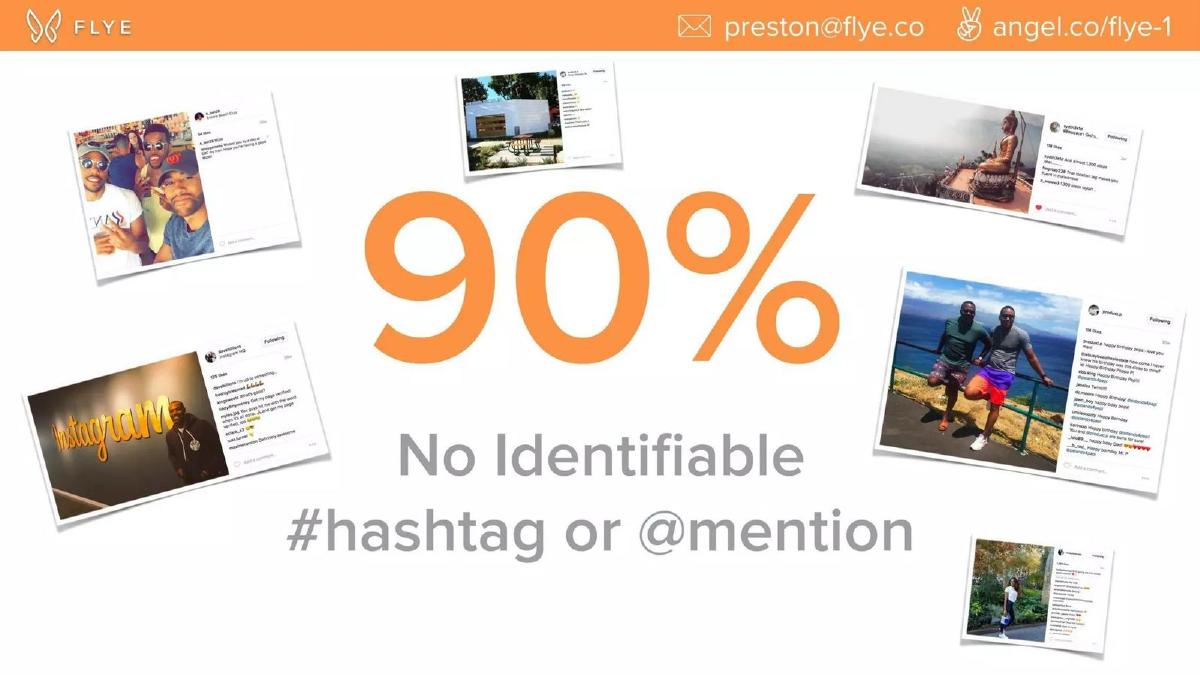
- 90% of social content relevant to brands contains no identifiable hashtag or @mention (Slide 3).
- Flye claims an 86% response rate, significantly higher than Facebook's 1.3% or Twitter's 0.17% click-through rates (Slide 7).
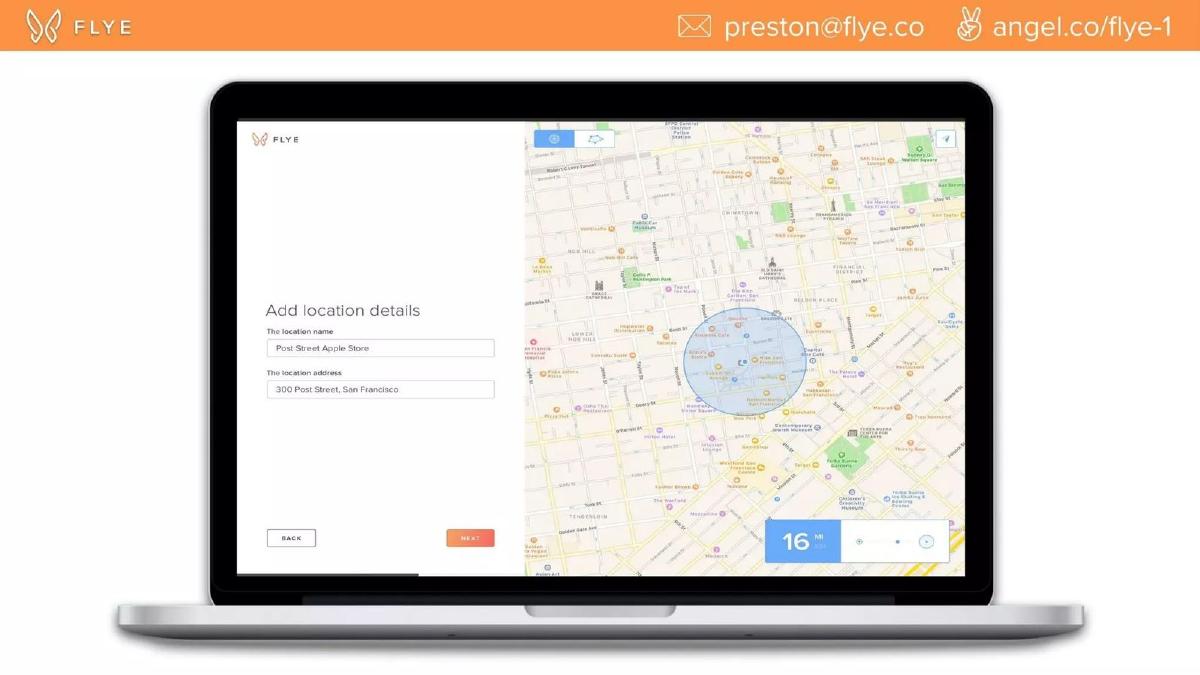
- The platform utilizes location-based targeting, demonstrated by a map interface for the Post Street Apple Store (Slide 5).
- Traction is shown through a steep MRR curve, reaching approximately $22,000 in March from a October start (Slide 8).
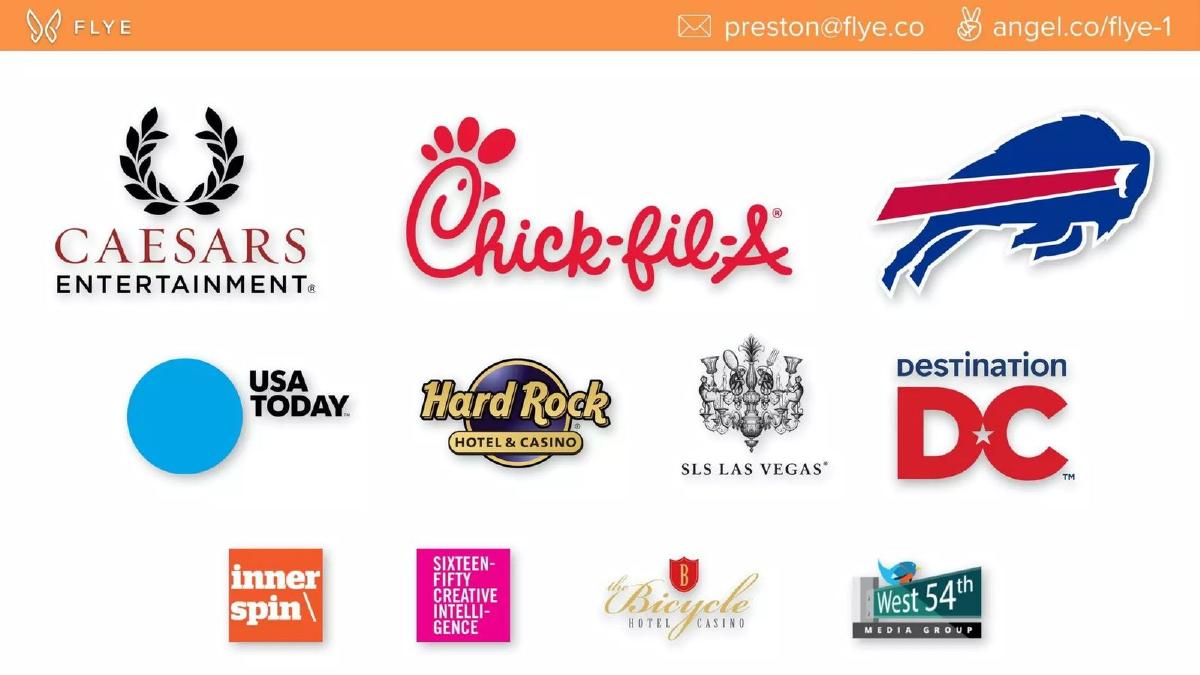
- The company secured 15+ major brands including Chick-fil-A, Caesars Entertainment, and the Buffalo Bills (Slide 6).
- The team includes experience from Booz Allen Hamilton, Uber, GitHub, and Workday (Slide 10).
- The deck identifies a $35 billion market opportunity, though it does not specify the source or segment (Slide 9).
- Month-over-month growth is stated at 28% (Slide 8).
The Hook: Real-Time Engagement
Slides 1-2: The Vision and the Proof
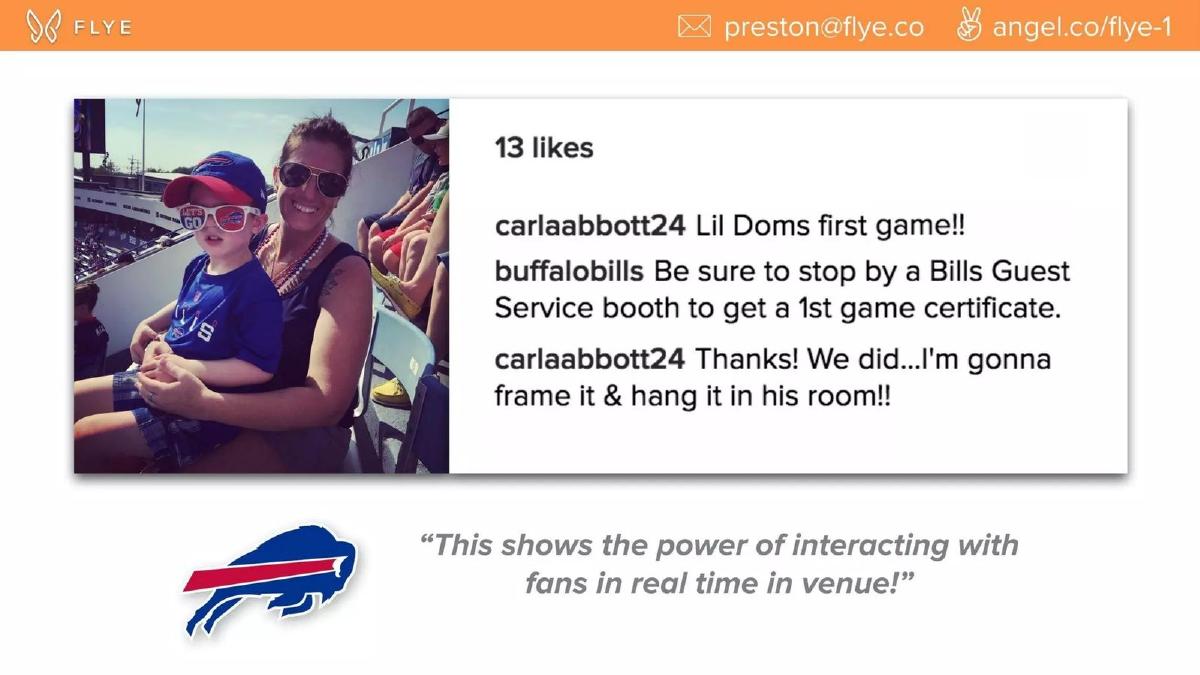
The deck opens with a simple title slide: "Connecting brands with their audience." It is minimalist, using a warm orange overlay on a lifestyle photo. Slide 2 immediately moves into a case study featuring the Buffalo Bills. It shows an Instagram post from a fan at a game and a real-time response from the team account. A quote from the Buffalo Bills states, "This shows the power of interacting with fans in real time in venue!" This is a classic 'show, don't tell' opening that establishes immediate credibility with a major sports brand.
The Problem: The Invisible 90%
Slides 3-4: Quantifying the Gap
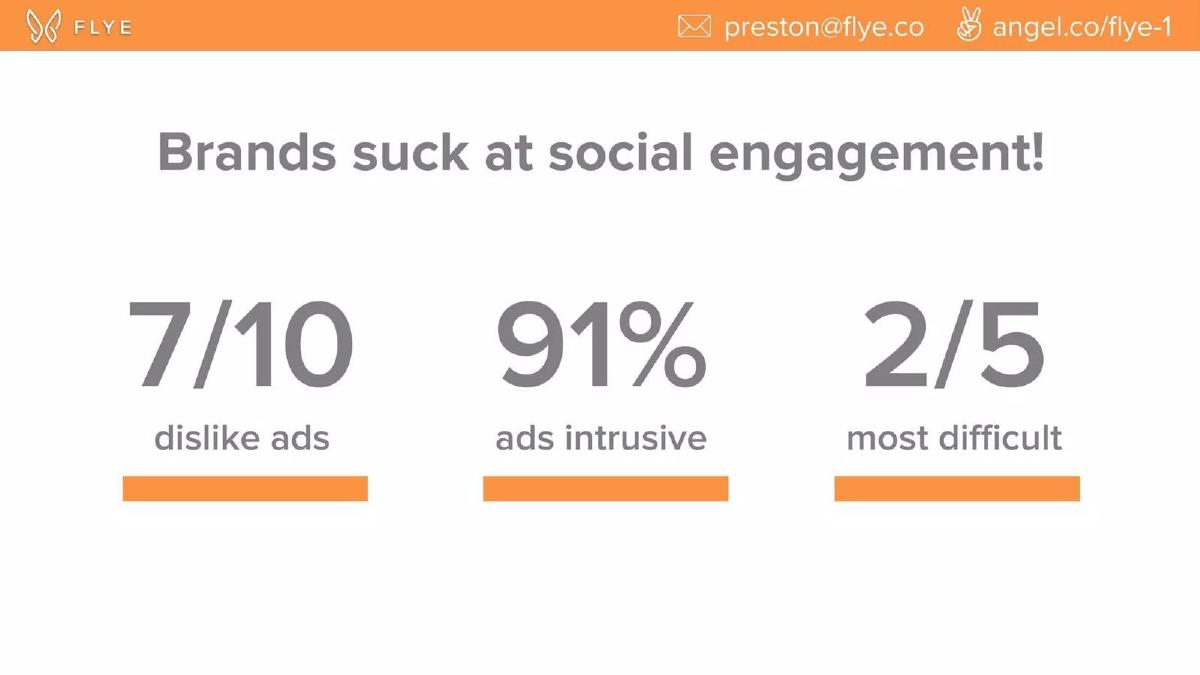
Slide 3 is the 'anchor' of the deck's logic. It features a massive "90%" and the text "No Identifiable #hashtag or @mention." This identifies the pain point: brands are only seeing 10% of the conversation. Slide 4 reinforces this by attacking traditional advertising, noting that 7/10 people dislike ads and 91% find them intrusive. By framing the problem this way, Flye positions itself not as an ad-tech company, but as an engagement-tech company that solves the 'difficulty' of social engagement (which 2/5 people find to be the most difficult task, per the slide).
The Solution: Location-Based Intelligence
Slide 5: Product Interface
Slide 5 provides a look at the platform. It shows a laptop displaying a map-based interface. The user is adding location details for the "Post Street Apple Store" in San Francisco. A blue radius on the map indicates a geofenced area. This slide explains the 'how'—Flye finds users based on where they are, not just what they type. This bypasses the hashtag problem identified earlier.
Traction and Social Proof
Slides 6-8: Brands, Response Rates, and Revenue
Slide 6 is a 'logo soup' slide featuring heavy hitters: Chick-fil-A, Caesars Entertainment, USA Today, and Hard Rock Hotel & Casino. This proves the product has enterprise-level appeal. Slide 7 provides the most impressive metric in the deck: an 86% response rate. It contrasts this against the low click-through rates of Facebook (1.3%), Instagram (0.4%), and Twitter (0.17%). Slide 8 visualizes the financial momentum. The MRR graph shows a sharp hockey-stick growth from October to March, ending at approximately $22,000 MRR with a 28% month-over-month growth rate.
Market and Team
Slides 9-11: The Opportunity and the People
Slide 9 is a simple, bold "$35B" over a background of money. While it lacks a breakdown of TAM/SAM/SOM, it signals the scale of the marketing sector they are targeting. Slide 10 introduces the five-person team. The logos at the bottom (Uber, GitHub, Workday, Booz Allen Hamilton) suggest a high level of technical and operational pedigree. The deck concludes on Slide 11 with a summary of their three strongest points: the 86% response rate, 28% M-o-M growth, and the $35 billion market, alongside contact information for CEO Preston McGee.
What Works in the Flye Deck
The 90% Hook: Identifying a specific, quantifiable failure in current marketing (the lack of hashtags) is a brilliant way to create a 'need' for the product. It makes the solution feel inevitable rather than optional.
Metric Contrast: Comparing their 86% response rate directly to the sub-2% click-through rates of major social platforms is a powerful persuasion tactic. It frames the product as an order of magnitude better than the status quo.
Clean Design: The deck uses a consistent color palette and avoids cluttered text. It is designed to be read quickly, which is ideal for a seed-stage pitch.
What is Missing
The Ask: There is no slide stating how much money Flye is looking to raise or what they plan to do with the capital. While we know from catalogue facts they raised $250,000, a prospective investor viewing this deck in isolation would be left guessing.
Business Model: The deck shows MRR, but it doesn't explain the pricing structure. Is it a per-location fee? A per-engagement fee? A flat SaaS subscription? This is a significant omission for a seed deck.
Competition: There is no mention of other social listening or geofencing tools. Investors want to know why Flye's 'Audience Fingerprint' is more defensible than existing enterprise tools like Sprout Social or Hootsuite.
What a Founder Should Copy
The 'Proof First' Approach: Starting with a real-world example (the Buffalo Bills) and then moving into the data that supports why that example is significant is a great way to build a narrative.
Focus on a Single 'Magic Number': Flye leans heavily on the 86% response rate. By the end of the deck, that number is burned into the reader's mind. Founders should find their one 'unfair' metric and make it the hero of the presentation.
Simplified Traction: The MRR graph on slide 8 is clear and honest. It shows the specific months and the specific dollar amounts, making the growth feel tangible rather than theoretical.
Frequently asked questions
- What problem does Flye solve for brands?
- Flye addresses the 'dark' social data problem. According to slide 3, 90% of social media posts do not use hashtags or mentions that brands typically track. This means brands miss the vast majority of organic engagement opportunities. Flye uses location data and machine learning to find these users so brands can interact with them in real-time.
- How does Flye's engagement compare to traditional ads?
- The deck makes a stark comparison on slide 7. While traditional social ads have click-through rates between 0.17% (Twitter) and 1.3% (Facebook), Flye reports an 86% response rate. This suggests that personalized, location-based outreach is far more effective than standard display advertising.
- What is Flye's current revenue and growth rate?
- As of the March data point on slide 8, Flye had reached approximately $22,000 in Monthly Recurring Revenue (MRR). The company reported a 28% month-over-month growth rate and had acquired more than 15 major brand customers within a five-month window.
- Who are the key people behind Flye?
- The founding team consists of Preston McGee (CEO), Alexander Ball (COO), David Thompson (CRO), and Ethan Berl (CTO), supported by Derek Briggs in Product Design. Their collective background includes prestigious institutions and companies like Princeton, UC Hastings, Uber, and GitHub (Slide 10).
- What is missing from the Flye pitch deck?
- The deck is missing several standard components: a clear 'Ask' slide (how much they are raising and on what terms), a detailed competition slide, a business model/pricing slide, and a slide explaining the specific use of funds. It relies heavily on traction and the '90% missing data' hook to carry the narrative.