Jack & Jill, a London-based HR tech startup, secured a $20M Seed round in 2025 by pitching a dual-agent system designed to replace traditional recruitment agencies. The deck focuses heavily on the 'human-like' quality of its AI agents, Jack (candidate-facing) and Jill (company-facing). By showcasing a rapid climb to over 30,000 users within five months and utilizing high-conviction testimonials, the founders successfully argued that they had solved the 'liquidity' problem in their beachhead market of London startups. While the deck lacks traditional financial projections or a detailed team sl…
Key takeaways
- The company positions itself as a 'first principles' rebuild of recruitment rather than an incremental tool (Slide 1).
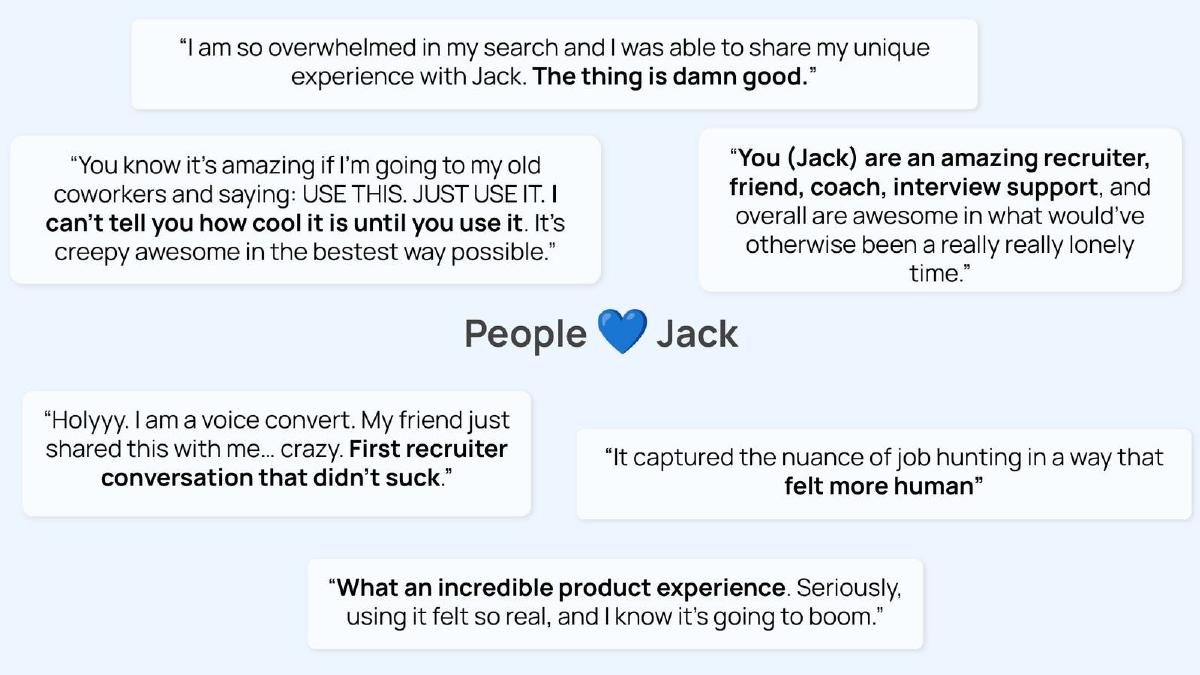
- User testimonials for the candidate-facing agent 'Jack' emphasize emotional support, calling it a 'coach' and 'friend' (Slide 2).
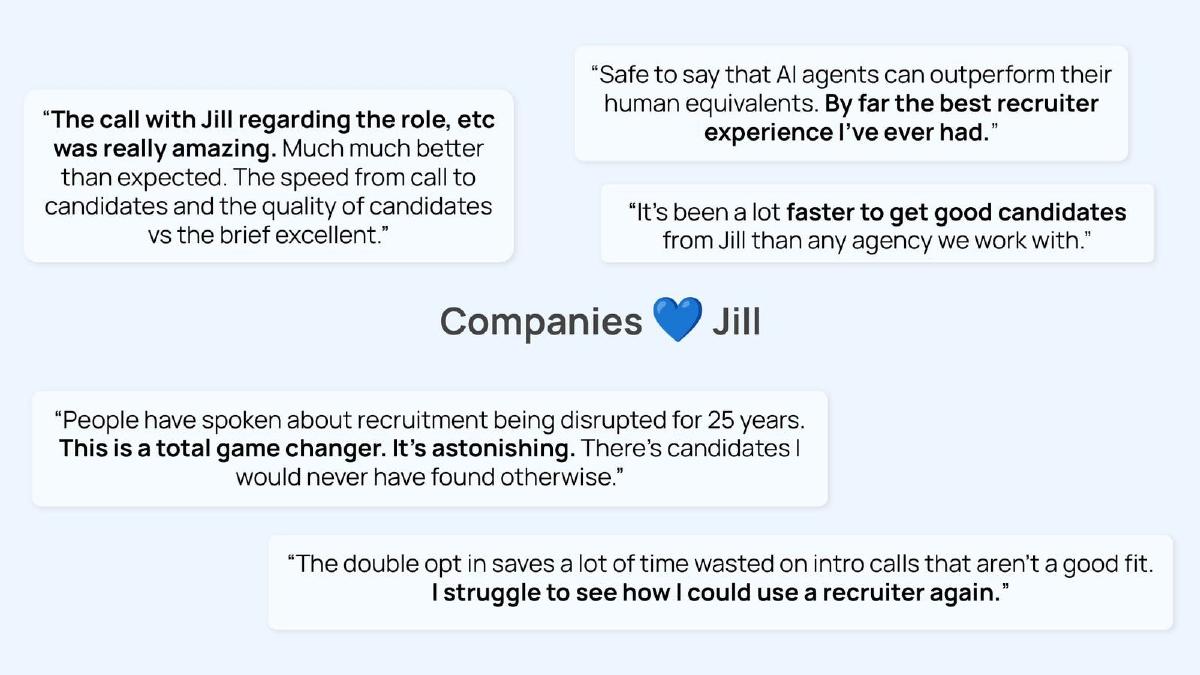
- B2B testimonials for 'Jill' claim the AI outperforms human recruiters in speed and candidate quality (Slide 3).
- The deck explicitly targets the disruption of both recruitment software and services, signaling a broad TAM (Slide 4).
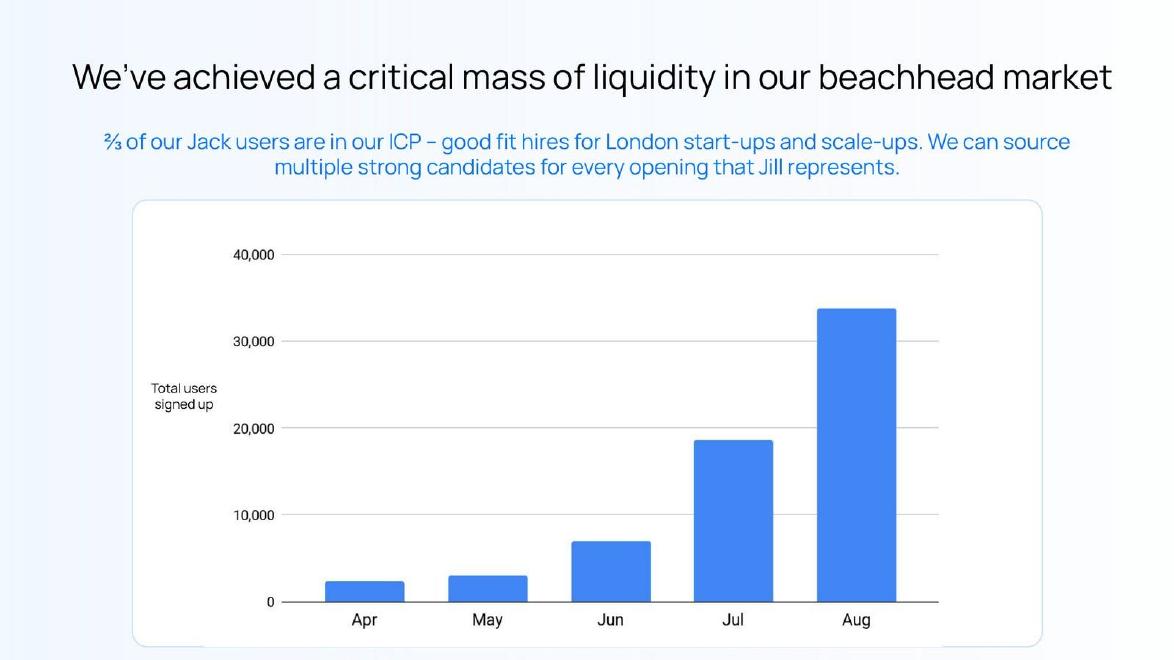
- Traction is demonstrated by a bar chart showing growth from near-zero in April to over 30,000 total users by August (Slide 5).
- The founders define their Ideal Customer Profile (ICP) as London start-ups and scale-ups, claiming 2/3 of users fit this criteria (Slide 5).
- The concept of 'double opt-in' is highlighted as a primary time-saver for hiring managers (Slide 3).
- The deck relies on a 'black box' visual style for several key slides, likely intended for live voice-over or video demos (Slides 4, 6).
The First Principles Approach to AI Recruitment
Jack & Jill’s pitch deck is a masterclass in narrative-driven fundraising. In an industry—recruitment—that has seen thousands of 'disruptors' fail to displace human agencies, this deck attempts to prove that autonomous agents are finally ready for prime time. The $20M Seed round reported by Business Insider in 2025 reflects a massive bet on the 'agentic' future of work. The deck doesn't lead with technical specifications; it leads with the emotional and operational impact of the agents themselves.
Slide 1: Title and Vision
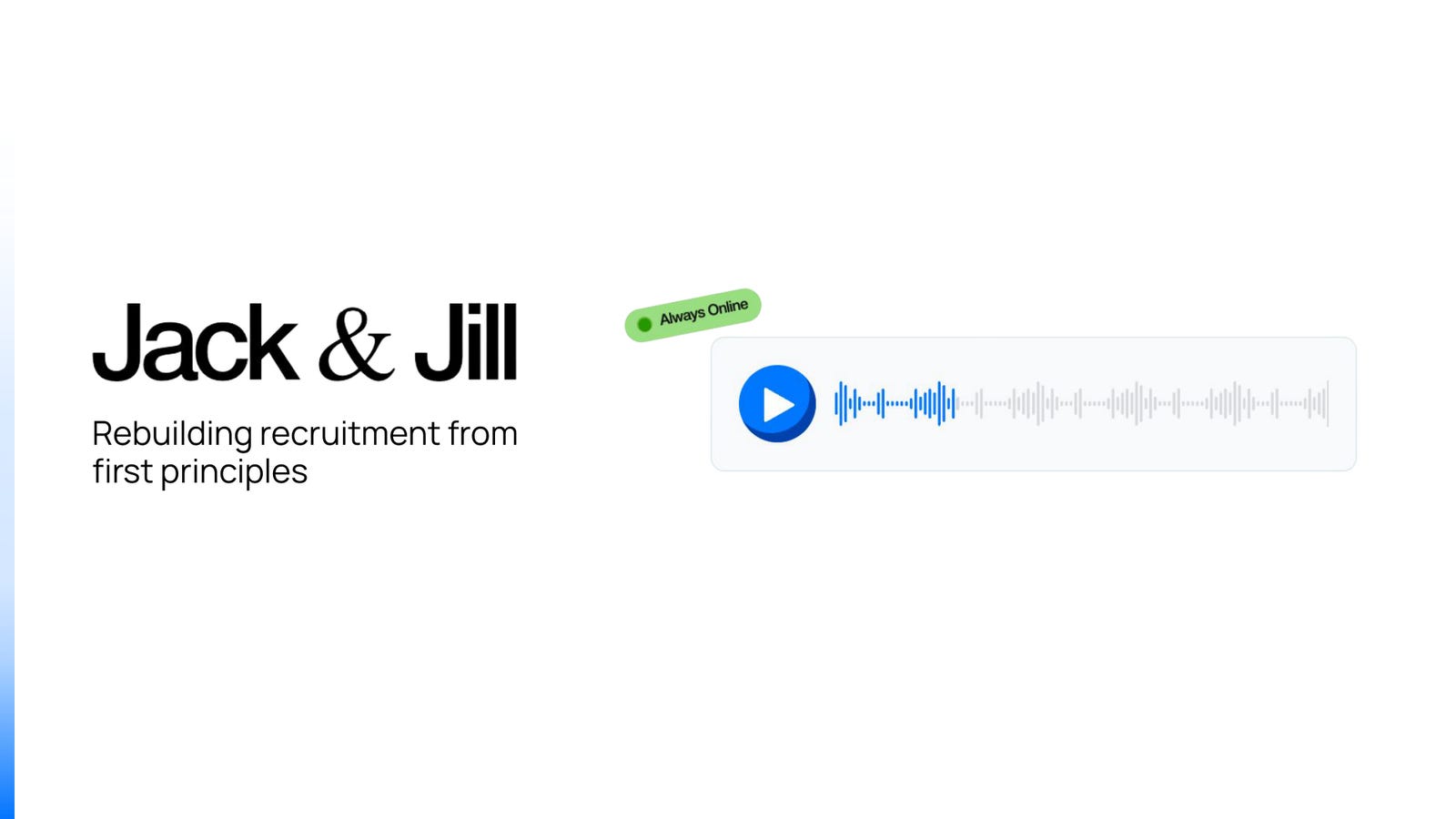
The deck opens with a minimalist title slide. The tagline, "Rebuilding recruitment from first principles," is a deliberate choice. It signals to investors that the founders aren't building a better Applicant Tracking System (ATS) or a job board; they are rethinking the fundamental interaction between a person looking for work and a company looking for talent. The visual of a voice waveform next to an "Always Online" status indicator immediately establishes the product's medium: conversational AI.
Slide 2: The Candidate Experience (Jack)
Slide 2 focuses entirely on the job seeker, personified by the agent 'Jack.' The slide is a collection of high-praise testimonials. One user calls it "creepy awesome in the bestest way possible," while another notes it "captured the nuance of job hunting in a way that felt more human." This is a critical strategic move. Most HR tech is loathed by candidates; by proving that candidates actually enjoy the interaction with the AI, Jack & Jill addresses the 'supply' side of the marketplace problem. The quote "First recruiter conversation that didn't suck" directly attacks the reputation of the incumbent human competition.
Slide 3: The Employer Experience (Jill)
If Slide 2 was about emotion, Slide 3 is about efficiency. Here, the company-facing agent 'Jill' is evaluated by hiring managers. The testimonials focus on two metrics: speed and quality. One quote states it is "faster to get good candidates from Jill than any agency we work with." Another highlights the "double opt-in" feature, which supposedly saves time wasted on unproductive intro calls. By positioning Jill as a replacement for the agency model rather than just a software tool, the company justifies a much higher potential price point and market share.
Slide 4: The Disruption Thesis
Slide 4 contains a bold statement: "Jack & Jill will disrupt software and services across the recruitment industry." The visual is a large black box, which in a modern pitch deck usually serves as a placeholder for a high-impact video demo or a live walkthrough. The text suggests a total-addressable-market (TAM) that encompasses both the $15B+ ATS software market and the multi-hundred-billion dollar global recruitment agency market. It frames the company as a category-killer.
Slide 5: The Liquidity Bar Chart
This is the 'money slide' for a Seed round. Slide 5 shows a bar chart of "Total users signed up" from April to August. The growth is exponential: starting at a few thousand and ending at over 30,000 users in just five months. The sub-headline is equally important: "2/3 of our Jack users are in our ICP – good fit hires for London start-ups and scale-ups." This tells investors that the growth isn't just 'noise' or low-quality signups; it is concentrated in a high-value, high-demand niche. The claim that they can "source multiple strong candidates for every opening" proves they have achieved the 'liquidity' necessary for a marketplace to function autonomously.
Slide 6: The Future Vision
Slide 6, like Slide 4, is a black-box visual. In the context of the deck's flow, this likely represents the 'How it Works' or 'Product Roadmap' section. After establishing that people love the product and that it is growing rapidly, the founders use this space to explain the underlying 'agentic' logic that makes this scale possible without a corresponding increase in human headcount.
What Works in This Deck
The 'Human' Factor: Most AI decks focus on LLM benchmarks or technical architecture. Jack & Jill focuses on how the AI makes people feel . By using words like 'friend,' 'coach,' and 'human,' they bypass the fear that AI is cold or impersonal, which is the biggest barrier to adoption in HR.
Market Concentration: Instead of claiming they can solve recruitment for everyone everywhere, they focus on a 'beachhead'—London startups. This specificity makes their growth numbers (30k users) feel much more significant because it represents a large percentage of a specific, reachable population.
The Dual-Agent Narrative: Splitting the product into 'Jack' and 'Jill' is a brilliant branding move. It makes a complex two-sided marketplace easy to understand. Investors can clearly see how the company services both sides of the transaction simultaneously.
What Is Missing from the Deck
The Team: In the provided 12 slides, there is no mention of the founders' backgrounds. For a $20M Seed round, the pedigree of the engineering and recruiting team is usually a primary driver of the valuation. Without this, we don't know if the founders are AI researchers, former agency owners, or serial entrepreneurs.
Business Model: The deck mentions disrupting 'services,' but it doesn't explicitly state how they charge. Is it a SaaS subscription, a per-hire fee (like an agency), or a success-based model? A $20M round usually requires a clear path to $100M in ARR, which is hard to visualize without pricing mechanics.
Competitive Landscape: The recruitment space is crowded with AI startups (e.g., Eightfold, Paradox, and dozens of others). The deck assumes the 'first principles' approach is unique enough to stand alone, but a slide showing how they differ from existing AI-sourcing tools would have strengthened the case for a $20M check.
Founder Takeaways
Sell the 'Liquidity,' Not Just the Tech: If you are building a marketplace, your most important slide isn't your feature list; it's your liquidity proof. Jack & Jill’s Slide 5 is the reason they raised $20M. It shows they have the 'supply' (candidates) to satisfy the 'demand' (employers).
Use Qualitative Proof Early: In the early stages (Seed/Series A), you might not have perfect retention cohorts. High-conviction, emotional testimonials from users can act as a proxy for Product-Market Fit. If a user calls your AI their 'friend,' you have captured something deeper than a utility.
Keep the Design Minimal: The deck uses a clean, Apple-esque aesthetic with plenty of white space. This makes the bold claims and the growth chart stand out. Founders should avoid cluttering slides with technical jargon when the goal is to sell a vision of industry-wide disruption.
Frequently asked questions
- What is the core technology behind Jack & Jill?
- Based on the publisher summary and Slide 1, the company uses AI agents to autonomously match job seekers with hiring companies. The deck visualizes this through a voice-interface UI, suggesting a conversational AI approach that handles the 'nuance' of recruitment calls, which users described as feeling 'more human' than traditional methods.
- How does the company define its market traction?
- Traction is defined by 'liquidity' in a specific beachhead market. Slide 5 shows a bar chart of 'Total users signed up,' which grew from approximately 2,000 in April to over 30,000 in August. They specifically note that 2/3 of these users are 'good fit hires' for London-based startups, indicating high-quality supply for their marketplace.
- Who are 'Jack' and 'Jill' in the context of the product?
- Jack is the AI agent for job seekers, described in Slide 2 testimonials as an 'interview support' and 'coach.' Jill is the AI agent for hiring companies, described in Slide 3 as a tool that saves time on intro calls and sources candidates faster than traditional agencies.
- What is missing from the Jack & Jill pitch deck?
- The provided 12-slide sequence omits several standard venture components, including a formal team slide with bios, a detailed breakdown of unit economics (CAC/LTV), a competitive landscape matrix, and a specific use-of-funds slide for the $20M raised. It leans heavily on qualitative feedback and top-level user growth.
- What is the primary value proposition for employers?
- According to Slide 3, the primary value is speed and efficiency. Employers claim the AI is 'faster to get good candidates' than agencies and that the 'double opt-in' mechanism eliminates wasted time on intro calls that are not a good fit.