The italist seed deck from 2014 is a 13-slide exercise in high-signal brevity. Eschewing the traditional problem-solution narrative, the deck relies on large-format photography and massive typography to deliver a few critical metrics. At the time of the pitch, the company was already generating over $2M in ARR with a 30% profit margin and 50% month-over-month growth over the preceding half-year. The business model—an inventory-free marketplace connecting Italian luxury boutiques to global consumers—is implied rather than explained in detail. With a founding team boasting a previous $80M exit,…
Key takeaways
- The deck leads with a massive traction signal, claiming to be the largest marketplace for luxury boutiques on slide 2.
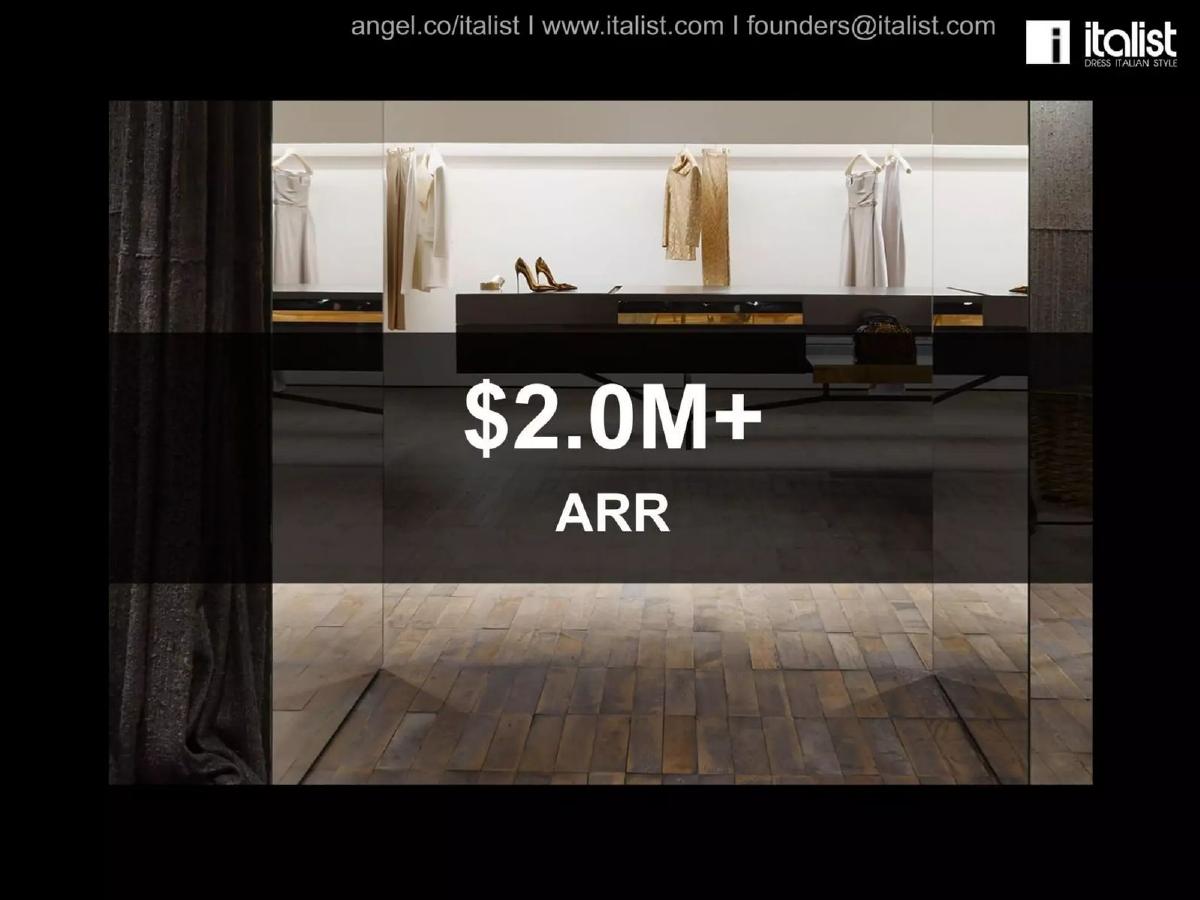
- Revenue is the centerpiece of the pitch, with slide 4 stating $2.0M+ ARR at the time of the seed round.
- Growth velocity is highlighted on slide 5, showing 50% month-over-month growth for the last 6 months.
- The unit economics are exceptionally strong for a seed-stage startup, with an average sale of $700+ (slide 6) and a 30% profit margin (slide 7).
- The market opportunity is defined by inefficiency, specifically a huge fragmented market that is not online (slides 8 and 9).
- The business model is asset-light, emphasizing a 'no inventory' approach despite offering a large selection from 70 shops (slides 10 and 11).
- Founder credibility is established through a single, high-impact metric: a previous $80M exit (slide 12).
- The deck completely omits a traditional 'Ask' slide, competitive matrix, or detailed product roadmap.
The Power of High-Signal Minimalism
The italist seed deck is a masterclass in 'letting the numbers do the talking.' In an era where pitch decks are often bloated with 20+ slides of market research and hypothetical user personas, italist took the opposite approach. This 13-slide deck, dated February 3rd, 2015, uses a visual language of luxury and a data language of pure traction. By the time an investor reaches the final slide, they have been hit with a series of high-impact figures that make a 'no' very difficult to justify.
The deck was used to raise $1.1 million in seed funding. At this stage, most companies are selling a dream. Italist, however, was already selling a reality: a functioning marketplace with millions in revenue and a proven team. The teardown below examines how they structured this brief but potent narrative.
Slides 1-3: The Luxury Hook and Global Reach
Slide 1: Title The cover slide sets the tone immediately. It features a high-end, architecturally significant boutique interior. The branding is clean, and the sub-tagline 'DRESS ITALIAN STYLE' clearly defines the niche. Notably, the slide includes the Angel.co link and founder email at the top, making the deck actionable from the first second.
Slide 2: The Bold Claim Instead of a mission statement, slide 2 makes a scale claim: 'LARGEST MARKETPLACE FOR LUXURY BOUTIQUES.' By starting with a superlative, they establish market leadership as the baseline of the conversation. The background image continues the luxury boutique aesthetic, reinforcing the industry they operate in.
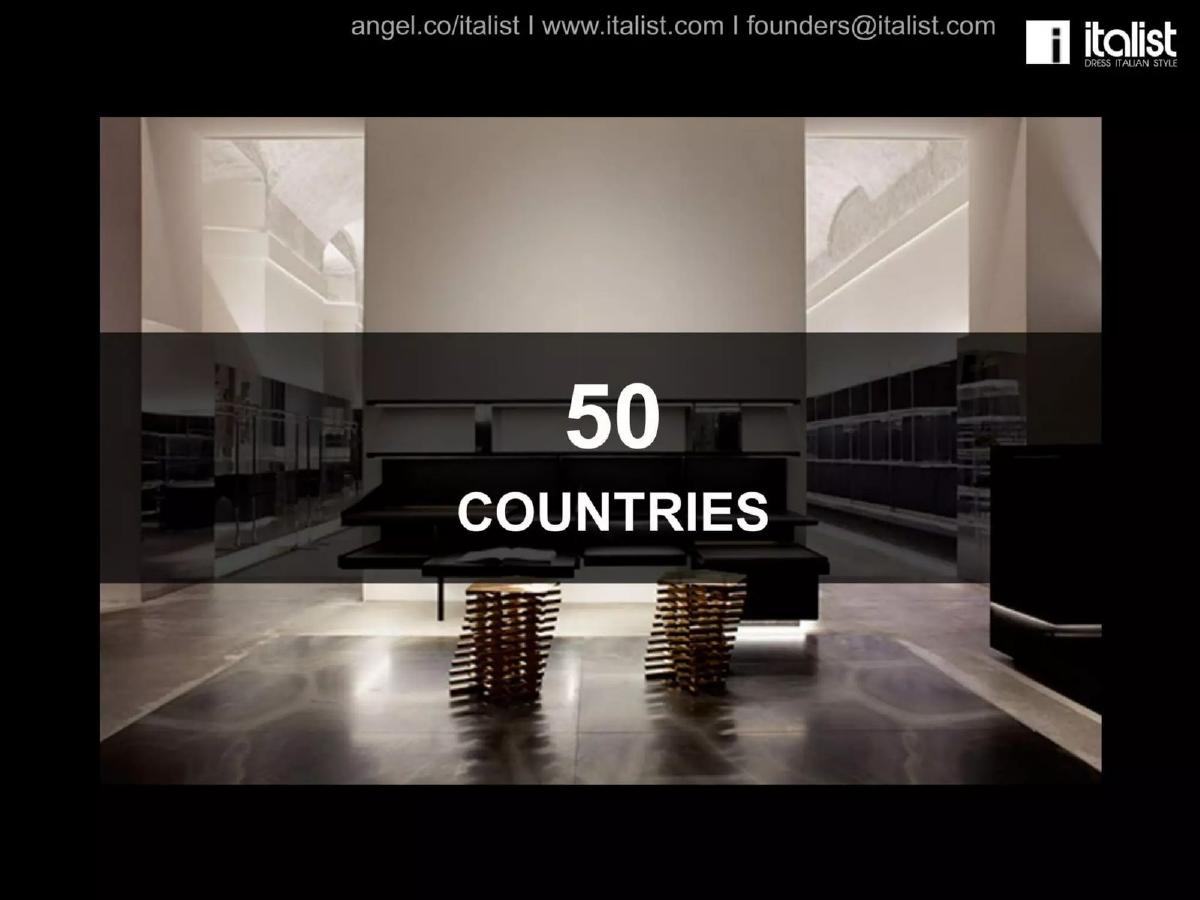
Slide 3: Geographic Footprint '50 COUNTRIES' is the only text on this slide. This serves two purposes: it proves the model is globally scalable and shows that they have already solved the complex logistics of international luxury shipping. For a seed-stage company in 2014, being active in 50 countries was a significant operational milestone.
Slides 4-7: The 'Unicorn' Metrics
This section of the deck is where the actual fundraising happens. These four slides contain the 'hard' data that justifies a venture investment.
Slide 4: Revenue '$2.0M+ ARR.' This is a staggering number for a seed round. Many companies raise Series A rounds with less revenue. By placing this early in the deck, italist effectively ends the debate over product-market fit. The market has already spoken.
Slide 5: Velocity '50% M-O-M LAST 6 MONTHS.' Revenue is great, but growth is what VCs buy. A 50% month-over-month growth rate sustained for half a year is 'triple-triple-double-double' territory. It suggests that the $2M ARR is just the beginning of a vertical climb.
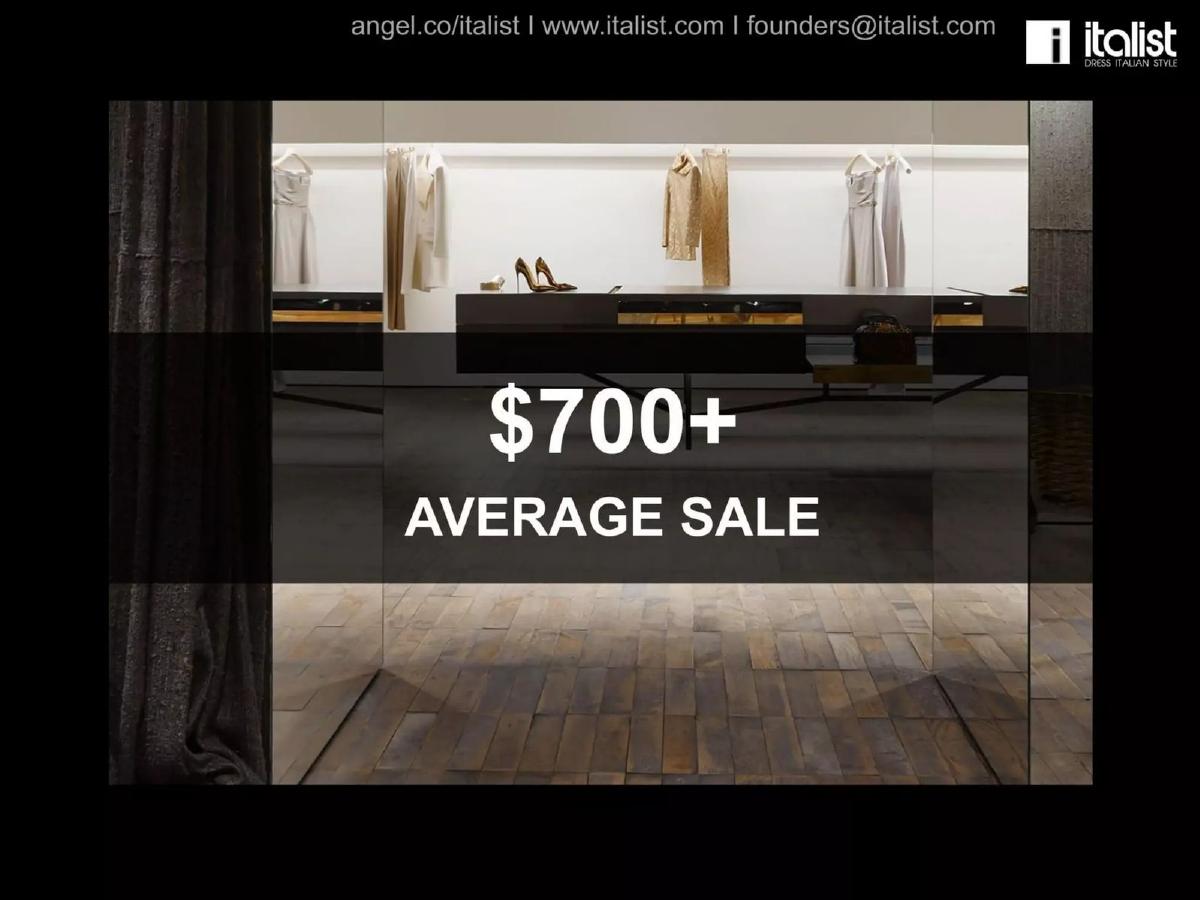
Slide 6: Average Order Value (AOV) '$700+ AVERAGE SALE.' In e-commerce, AOV is a primary health metric. A $700+ AOV allows for high customer acquisition costs and premium shipping services while remaining profitable. It differentiates italist from mass-market retailers where margins are squeezed by low price points.
Slide 7: Profitability '+30% PROFIT MARGIN.' This slide is the knockout punch. Not only is the company growing at 50% monthly with millions in revenue, but they are doing so profitably. This indicates a highly efficient business model that doesn't require constant infusions of capital just to keep the lights on.
Slides 8-11: The Business Model and Market Gap
After establishing that the business works, the deck briefly explains why it works and how it is structured.
Slide 8 & 9: The Problem/Opportunity These slides identify the market inefficiency: 'HUGE FRAGMENTED MARKET' and 'NOT ON-LINE.' This is the classic marketplace play—taking a disparate group of physical sellers (Italian boutiques) and providing them with a unified digital storefront. It explains why a $700 AOV is possible; these boutiques have exclusive goods that were previously inaccessible to the global market.
Slide 10 & 11: Supply and Scalability Slide 10 notes they have '70 SHOPS' on the platform. Slide 11 highlights the 'LARGEST OFFER' and, crucially, 'NO INVENTORY.' This is the 'Asset-Light' slide. It tells investors that italist doesn't take the risk of buying clothes that might not sell. They are a pure platform, which is the most scalable version of e-commerce.
Slides 12-13: The Team and The Summary
Slide 12: The Founders The team slide features Raffaele Giovine, Andrea Milani, and Giuseppe Sacco. There are no long bios or lists of previous employers. Instead, there is one line: 'PREVIOUS $80M EXIT.' This is the ultimate credential in startup fundraising. It tells investors that the founders have done this before, they know how to scale, and they know how to provide a return to shareholders.
Slide 13: The Closing The final slide summarizes the core value proposition: '$2M+ ARR,' '50% M-O-M GROWTH,' and 'HIGH TICKET, HIGH MARGIN.' It repeats the contact information and the Angel.co link. It is a concise reminder of why the investor should reach out immediately.
What Works in the italist Deck
Extreme Clarity: There is no jargon. There are no complex diagrams. The deck uses large fonts and simple phrases to convey massive concepts. · Traction-First Narrative: By leading with revenue and growth, the founders bypass the need to 'convince' investors that people want their product. The data is the proof. · Visual Consistency: The use of high-quality boutique photography as backgrounds maintains a 'luxury' feel throughout the deck, which is essential for a fashion-tech company. · Credibility via Exit: Mentioning the $80M exit on the team slide is a high-signal move that immediately elevates the founders above the typical seed-stage entrepreneur.
What is Missing from the italist Deck
The Ask: The deck never specifies how much money they are raising or what the terms are. While this is often handled in person or in a follow-up email, a 'Use of Funds' slide is a standard omission here. · Competitive Landscape: There is no mention of competitors like Farfetch or Yoox, which were already established in 2014. Investors would naturally want to know how italist differentiates itself from these giants. · Product/Tech Deep Dive: The deck doesn't show the website interface or explain the technology behind the 'no inventory' sync with 70 different boutiques. It treats the tech as a black box. · Unit Economics (CAC/LTV): While they mention AOV and profit margin, they don't explicitly state the Customer Acquisition Cost (CAC) or Lifetime Value (LTV), which are the two most important metrics for scaling a marketplace.
What Founders Should Copy
The 'One Big Number' Rule: If you have a metric that is truly impressive (like $2M ARR at Seed), give it its own slide. Don't bury it in a bulleted list. · Minimalist Copy: If a slide has more than 10 words, ask yourself if you can cut it down to 5. Italist proves that less is more when the 'less' is high-impact. · Direct Contact Info: Putting the founder's email and the platform link (Angel.co) on every slide (or at least the first and last) reduces friction for investors who want to move fast. · Focus on Efficiency: Highlighting a 'No Inventory' model is a great way to signal capital efficiency to VCs who are wary of the heavy overhead associated with traditional retail.
In conclusion, the italist deck is a reminder that when you have a business that is clearly working, you don't need a long pitch. You just need to show the numbers, prove you have the right team to scale them, and get out of the way.
Frequently asked questions
- How can a deck succeed with so little text?
- Minimalism works when the metrics are undeniable. Italist wasn't pitching a hypothetical idea; they were pitching a business already doing $2M in ARR with 50% monthly growth. When traction is that high, excessive explanation can actually dilute the message. The founders used large, bold text to ensure the most important numbers were impossible to miss.
- Why did italist emphasize 'No Inventory' so heavily?
- In e-commerce, inventory is a massive capital drain and a risk factor. By highlighting that they have 'No Inventory' (slide 11) while still offering the 'Largest Offer,' they signaled to investors that the business is highly scalable and capital-efficient. This marketplace model allows them to grow without the overhead of warehousing or unsold stock.
- What is the significance of the $700+ average sale?
- A high Average Order Value (AOV) is critical for luxury marketplaces. It means the cost of customer acquisition (CAC) can be higher while still maintaining profitability. Combined with the 30% profit margin mentioned on slide 7, it proves that the business generates significant cash flow per transaction, which is rare for early-stage e-commerce.
- Is the lack of a 'Problem' slide a mistake?
- While traditional advice insists on a 'Problem' slide, italist substitutes it with 'Huge Fragmented Market' and 'Not On-line' (slides 8-9). For experienced investors, these two phrases identify the problem (inefficiency and lack of digital access) and the opportunity (consolidation) simultaneously without needing a multi-slide narrative.
- How important was the 'Previous $80M Exit' to this raise?
- It was likely the deciding factor for many investors. A seed-stage company with $2M ARR is impressive, but a team that has already delivered an $80M exit suggests they know how to scale that revenue into a major liquidity event. It de-risks the execution side of the investment significantly.