iSprout’s 15-slide deck presents a clear, asset-heavy growth strategy for the Indian commercial real estate market. Founded in 2016 in Hyderabad, the company differentiates itself from traditional co-working by focusing on 'managed office spaces' with private suites and dedicated server rooms. The deck highlights significant traction, growing from 200 members in 2017 to a projected 8,400 in 2022. With a core philosophy centered on anchor tenants (70% of the mix) and long-term enterprise relationships, the company seeks $10 million in equity and $10 million in debt for its Series A. While the…
Key takeaways
- The company was founded in Hyderabad in 2016 and had 8 locations in operation by early 2022 (Slide 2).
- Traction is measured by 'Members,' showing growth from 200 in 2017 to a projected 8,400 by the end of 2022 (Slide 5).
- The business model relies on a 70/30 split between long-term anchor tenants and short-term contracts (Slide 7).
- Market size projections cite JLL data, estimating a 123 million square foot market by 2030 with a 15% CAGR (Slide 8).
- The Series A investment ask is $20 million, split evenly between $10 million in equity and $10 million in debt (Slide 13).
- Capex is the primary driver of capital allocation, accounting for 70% of the intended investment spend (Slide 14).
- The leadership team includes two Chartered Accountants and a serial entrepreneur with experience at Goldman Sachs and Citibank (Slide 12).
- The deck explicitly distances itself from 'Co-Working,' positioning the product as 'Only Managed Office Space' (Slide 4).
Slide-by-Slide Teardown
Slide 1: Title Slide
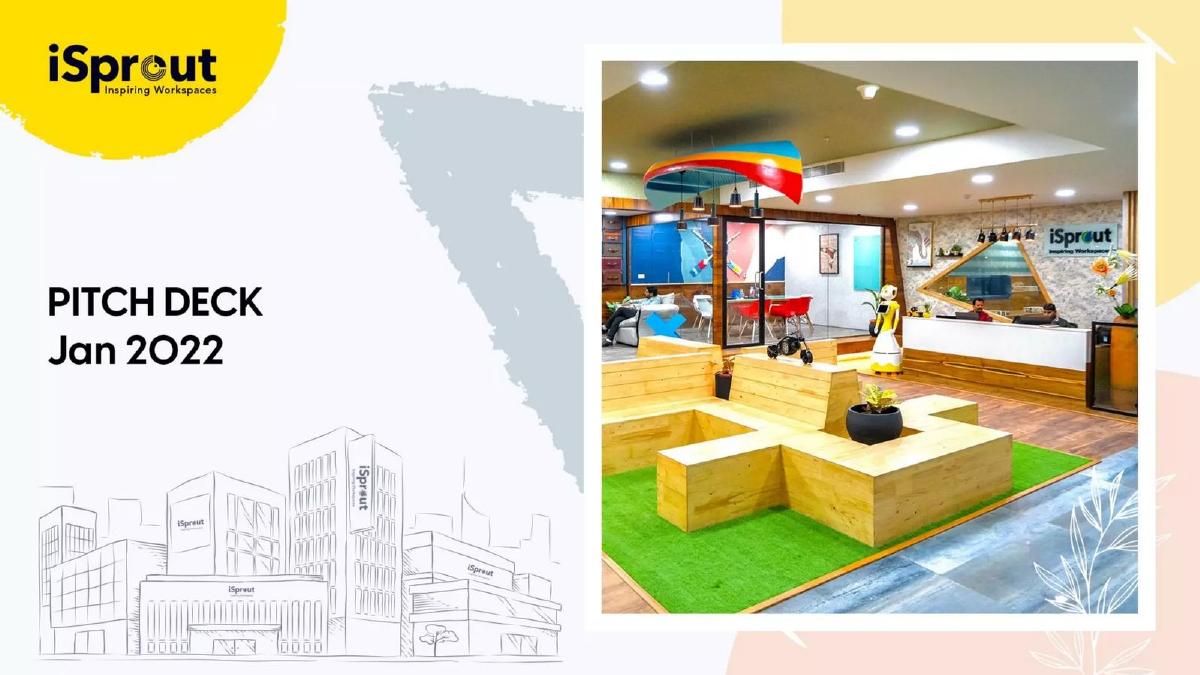
The cover slide features the iSprout logo with the tagline "Inspiring Workspaces." It includes a date of Jan 2022 and a high-quality photograph of a modern office interior, featuring a reception desk, a robot, and stylized wooden seating. The visual identity is established with a yellow and white color palette.
Slide 2: Company Overview
This slide provides a snapshot of the company's footprint. It states iSprout was Founded in Hyderabad in 2016 . Key metrics include 8 Locations In Operation , 5400 Workstations In Operation , 2 Locations In Pipeline , and a Total of 8400 Workstations . This slide effectively establishes the company as a proven operator rather than a pre-revenue concept.
Slide 3: Problem Statement
The deck identifies four primary problems for corporate occupiers: Large Capex & Longer Lease Commitment , Significant Resource Cost On Non-Core Activities , Privacy & Info Security Concerns , and Noisy And Disturbing Environment . The use of icons and a city-skyline background helps categorize these as enterprise-level issues.
Slide 4: Solution
The solution slide mirrors the problem slide, offering: Low Capex And Less Commitment , End-To-End Administration , Private Suites With Access Control , Dedicated Server Rooms , No Co-Working, Only Managed Office Space , and No Network Overlap . The explicit rejection of the "Co-Working" label is a strategic positioning move to appeal to security-conscious enterprise clients.
Slide 5: Growing Rapidly (Traction)
A bar chart illustrates member growth from 2017 to 2022. The figures are: 200 members in 2017 , 2200 in 2018 , 5000 in 2019 , 5000 in 2020 (showing flat growth during the height of the pandemic), 5400 in 2021 , and a projected 8400 in 2022 . The stagnation in 2020-2021 is presented honestly, reflecting the reality of the commercial real estate market during lockdowns.
Slide 6: Our Differentiation
This slide uses lifestyle and facility photography to highlight five pillars: Privacy Prioritized , Innovative & Efficient Designs , Safety & Security , End-to-end services , and Seamless Scalability . It reinforces the "managed" aspect of the business, showing reception services and security checkpoints.
Slide 7: Our Core Philosophy
This is a critical business model slide. It breaks down the strategy into four parts: Target Consumers (Large & Medium Enterprises), Growth Drivers (Margin led initially, volume led later), Nature of Tenants (70% anchor tenants, 30% short term), and Infrastructure (Customizing for consumers). The 70% anchor tenant strategy is a key risk-mitigation detail for investors.
Slide 8: Market Size
Citing JLL as a source, the slide shows the flex-space market growing from 19 MN SFT in 2018 to 35 MN SFT in 2021 , with a projection of 123 MN SFT by 2030 . It notes an Expected CAGR of 15% Per Annum and states that iSprout plans to capture "no less than 10% of the total growth."
Slide 9: India: The Occupiers' View
Using CBRE Research, this slide argues for market demand. It claims 70% of occupiers chose flexible spaces for agility in 2018, 73% planned to increase their footprint in 2019, and 81% said they would increase or retain flexible spaces post-COVID-19. This builds a macro-economic case for the business model.
Slide 10: Road Map of Current & Future Operations
A six-step timeline shows the company's journey: 01 Started Operations, 02 Growth Phase, 03 COVID-19 disruption, 04 Super-Growth Opportunity, 05 Phase 1 Investment (Expansion in Hyderabad, Bengaluru, and Pune), and 06 Phase 2 Investment (New and existing markets).
Slide 11: Business Plan – Focus Areas
The company identifies four strategic pillars: Capitalise Flex-Market Expansion , Powered by Technology (proprietary software), Strategic Partnerships (landlord tie-ups), and Capture Limited Grade A Supply . This slide explains how they will achieve the growth mentioned in the roadmap.
Slide 12: Founders
The team consists of four individuals: CA Sundari (Co-Founder and CEO, 15+ years experience), Sreenivas Tirdhala (Co-Founder and CMO, ex-Goldman Sachs/Citibank), CA Sesshaa Prasad (Founding Partner, 26+ years experience), and Vijay Oddiraju (CEO and Co-founder of Volante Technologies). The presence of two Chartered Accountants (CAs) suggests a strong focus on financial management.
Slide 13: Investment Ask
The ask is clearly defined: $10mn by way of equity and $10mn by way of debt for the Series A. It also mentions they have raised $4m from well-known investors till date and estimates a Series B requirement of $30mn - $50mn in 12 months. This is a bold, transparent funding roadmap.
Slide 14: Investment Spend
A pie chart breaks down the use of funds: 70% Capex , 15% Marketing & Sales , 10% Working Capital & Contingency , and 5% Technology . This confirms that iSprout is an asset-heavy business where capital is primarily used to build out physical office inventory.
Slide 15: Thank You
A standard closing slide with the logo and a "Thank you!" message. No contact information is visible on this specific slide.
What iSprout Does Well
The iSprout deck is exceptionally clear about its market positioning . By explicitly stating "No Co-Working" on Slide 4, they distance themselves from the volatility and brand baggage associated with that sector, instead aligning with the more stable "Managed Office" category. This is reinforced by their 70% anchor tenant strategy on Slide 7, which appeals to investors looking for predictable cash flows.
The traction slide (Slide 5) is also a highlight. It doesn't just show a hockey stick; it shows the reality of the 2020-2021 pandemic period where growth slowed, which adds credibility to the subsequent 2022 projections. Furthermore, the Investment Ask (Slide 13) is one of the most direct in the industry, specifying the split between debt and equity, which is crucial for a real-estate-adjacent business.
What is Missing from the iSprout Deck
The most glaring omission is Unit Economics . For a business spending 70% of its capital on Capex, investors need to see the payback period per workstation, the average revenue per occupied workstation (ARPOW), and the margins at the individual location level. While they mention being "Margin Led" on Slide 7, they provide no data to back this up.
Additionally, there is no Competitive Landscape analysis. The Indian flex-space market is crowded with players like Awfis, Smartworks, and TableSpace. iSprout fails to mention how they specifically win against these incumbents beyond general statements about "privacy" and "design." Finally, while they mention Proprietary Technology on Slide 11, there are no screenshots or specific details on what this software actually does to drive efficiency.
Founder Takeaways: What to Copy
Be Specific About the Ask: Don't just ask for a lump sum. iSprout’s breakdown of $10M equity and $10M debt (Slide 13) shows they understand their capital structure and how to leverage debt for asset-heavy growth. · Position Against the Industry: If your sector has a "bad word" (like 'Co-working' was in 2022), explicitly state why you are different. iSprout’s "No Co-Working" claim is a masterclass in defensive positioning. · Use Third-Party Validation: Citing JLL and CBRE (Slides 8 and 9) provides an objective baseline for your market size claims, making your internal projections feel more grounded in reality. · Define Your Tenant Mix: If you are a B2B service, showing the split between long-term and short-term contracts (Slide 7) demonstrates a sophisticated understanding of your revenue stability and risk profile.
Frequently asked questions
- What is the specific problem iSprout is solving?
- According to Slide 3, iSprout addresses four main pain points for enterprises: large capital expenditure (Capex) and long lease commitments, significant resource costs spent on non-core administrative activities, privacy and information security concerns, and the noisy, disturbing environments often found in traditional shared offices. By offering managed spaces, they allow companies to outsource office management while maintaining private, secure environments.
- How does iSprout differentiate itself from WeWork or other co-working spaces?
- Slide 4 and Slide 6 emphasize that iSprout provides 'Managed Office Space' rather than traditional co-working. Key differentiators include private suites with access control, dedicated server rooms for data security, and 'no network overlap.' Their core philosophy (Slide 7) focuses on large and medium enterprises as target consumers, prioritizing long-term relationships over the high-churn, freelancer-heavy model typical of standard co-working hubs.
- What are the financial requirements for their next stage of growth?
- As stated on Slide 13, iSprout is seeking a Series A round of up to $10 million in equity and $10 million in debt. They also provide a forward-looking estimate for a Series B round, projected to be between $30 million and $50 million, required approximately 12 months after the Series A. This indicates a capital-intensive strategy focused on rapid physical expansion.
- How does the company plan to spend the raised capital?
- The investment spend is heavily weighted toward physical infrastructure. Slide 14 shows that 70% of the funds are allocated to Capex (fit-outs and new locations). The remaining 30% is split between Marketing & Sales (15%), Working Capital & Contingency (10%), and Technology (5%), which includes the development of proprietary management software.
- What is the current scale of the business according to the deck?
- Slide 2 reports that as of January 2022, iSprout had 8 locations in operation with 5,400 workstations active. They had an additional 2 locations in the pipeline, bringing their total capacity to 8,400 workstations. Their roadmap (Slide 10) indicates they have already moved through initial growth phases and are entering a 'Super-Growth Opportunity' phase post-COVID-19.