Angle Health’s 12-slide Series A deck focuses on the transition from legacy 'paper and fax' insurance to a 'full-stack' digital carrier. By positioning themselves as a licensed carrier (NAIC 16933) rather than just a software layer, they address the core pain points of the $2.61 trillion U.S. health insurance market. The deck emphasizes vendor consolidation—moving employers from 5+ disparate vendors to a single solution—and showcases a clear path from their Utah launch to major hubs like NYC and Texas. Despite redacting specific revenue and membership figures in this public version, the visua…
Key takeaways
- The company establishes immediate regulatory credibility on Slide 1 by citing their NAIC Company Code 16933 and status as a full-stack licensed carrier.
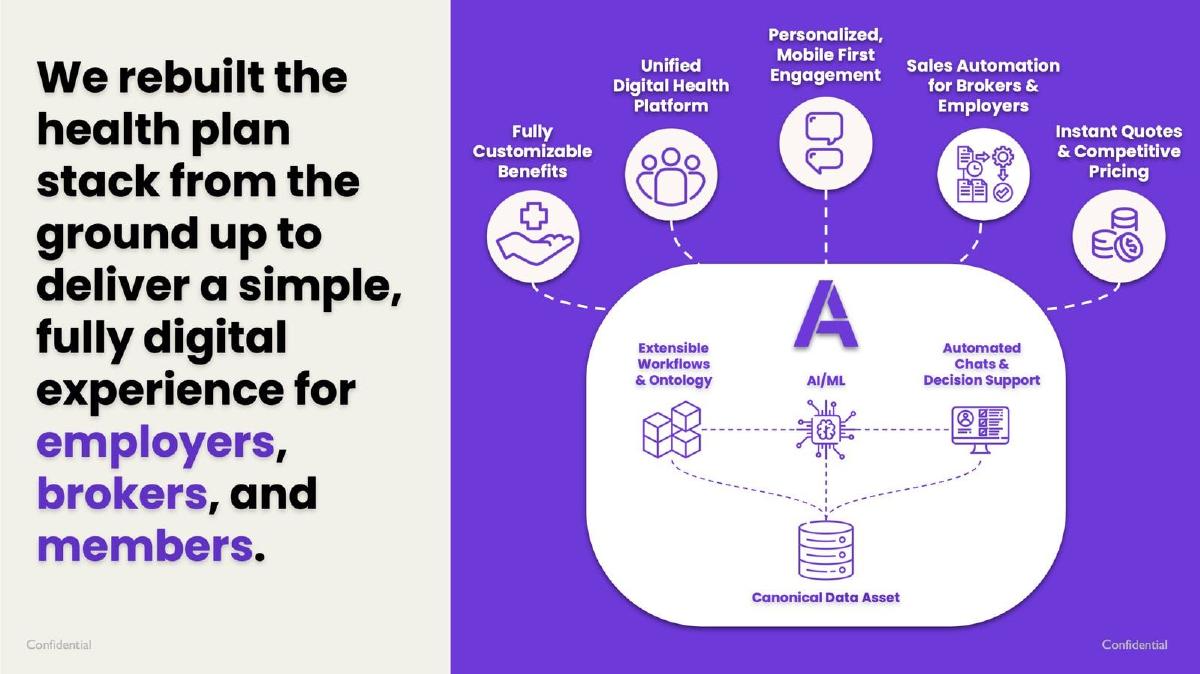
- Slide 3 defines the value proposition as a 'simple, fully digital experience' for three distinct stakeholders: employers, brokers, and members.
- Angle Health positions its technology as a 'Canonical Data Asset' on Slide 3, using AI/ML to power automated chats and decision support.
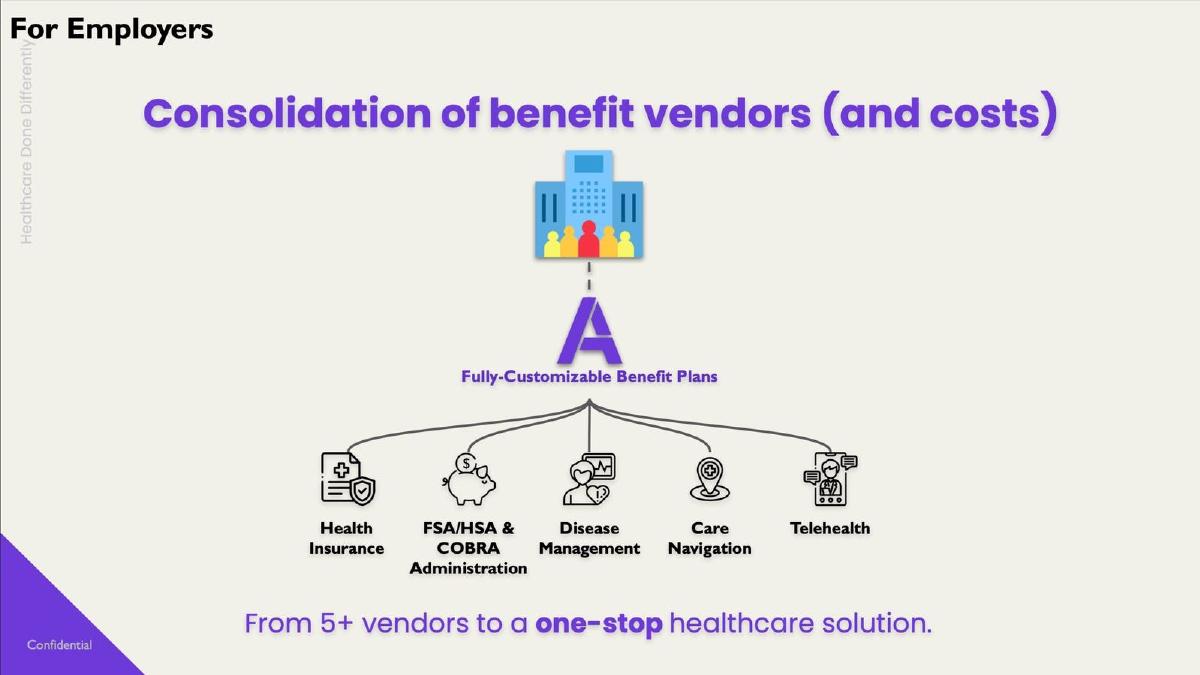
- The 'Consolidation' slide (Slide 5) highlights a key selling point: replacing 5+ vendors across insurance, COBRA, and telehealth with one platform.
- Slide 7 shows a significant inflection point in the 'Annual Revenue Run Rate' chart starting in January 2022, six months after their July 2021 launch.
- The market expansion strategy on Slide 9 uses specific dollar values for regional opportunities, such as $56 billion for the Texas triangle (ATX, HOU, DFW).
- Slide 11 leverages external validation via a quote from a16z partners, framing the company within a larger thesis that the world's largest company will be in consumer health tech.
- The deck omits a specific 'Ask' slide and detailed unit economics, likely due to the sensitive nature of insurance loss ratios in a Series A round.
Introduction: The Full-Stack Insurance Play
Angle Health’s pitch deck represents a classic 'full-stack' disruption strategy. In an era where many health-tech startups attempt to build a better user interface on top of legacy systems, Angle Health chose the harder, more capital-intensive path of becoming a licensed carrier. As reported by Business Insider, this deck helped secure a $58M Series A in 2023. The narrative is built on the premise that healthcare is broken not just because of the user experience, but because the underlying infrastructure is built on 'paper forms and faxes.'
Slide 1: The Regulatory Hook
The title slide does more than introduce the name. It immediately addresses the biggest hurdle for any insurance startup: regulation. By including the text 'Angle Health operates as a full-stack, licensed health insurance carrier (NAIC Company Code 16933)' , the founders signal to investors that they have already cleared the massive barrier to entry that stops most competitors. They define themselves as a 'one-stop healthcare solution,' setting the stage for a consolidation play.
Slide 2: The Team
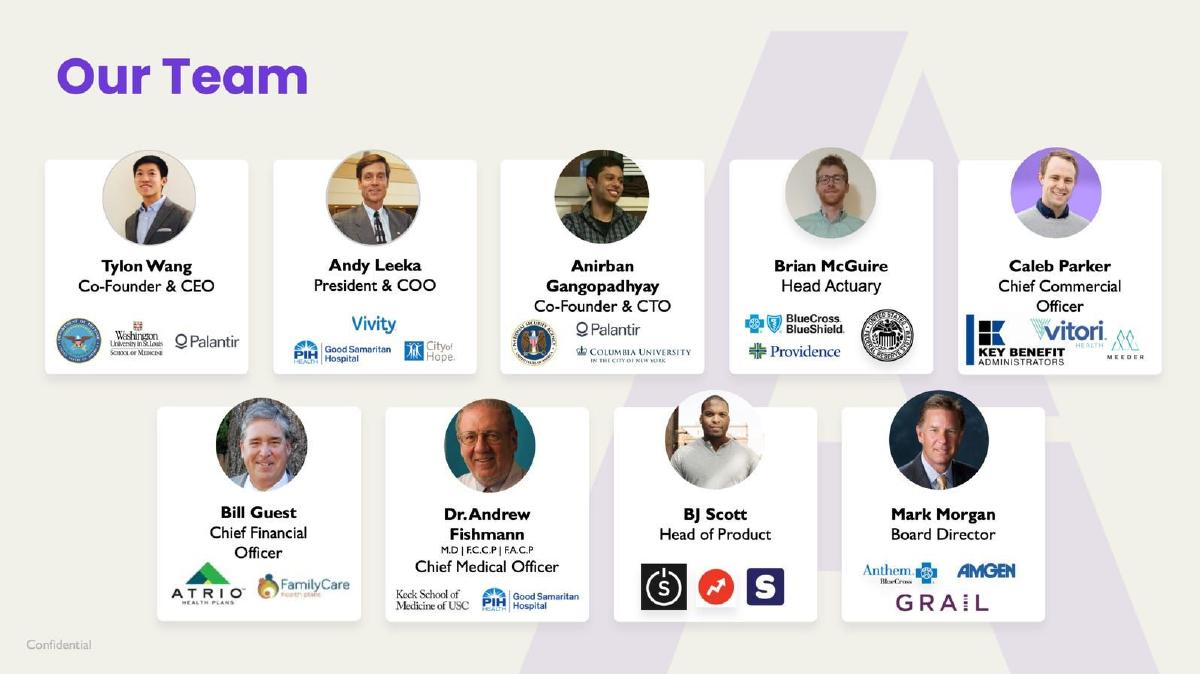
While the specific names and backgrounds are part of the internal deck, the placement of the team slide at the front (Slide 2) suggests that the founders' pedigree was a primary selling point. In highly regulated industries like insurance, investors bet heavily on the team's ability to navigate legal complexities and technical infrastructure simultaneously.
Slide 3: The Digital Architecture
This slide serves as the 'How it Works' section. It visualizes the transition from a fragmented system to a unified platform. The center of the diagram is the 'Canonical Data Asset' fed by AI/ML. This is a crucial technical claim; it suggests that by owning the data and the underwriting, they can provide 'Instant Quotes & Competitive Pricing.' The slide identifies three key users: Employers, Brokers, and Members, acknowledging that in insurance, the person using the product (member) is rarely the one buying it (employer) or the one recommending it (broker).
Slide 4 & 5: The Value Proposition of Consolidation
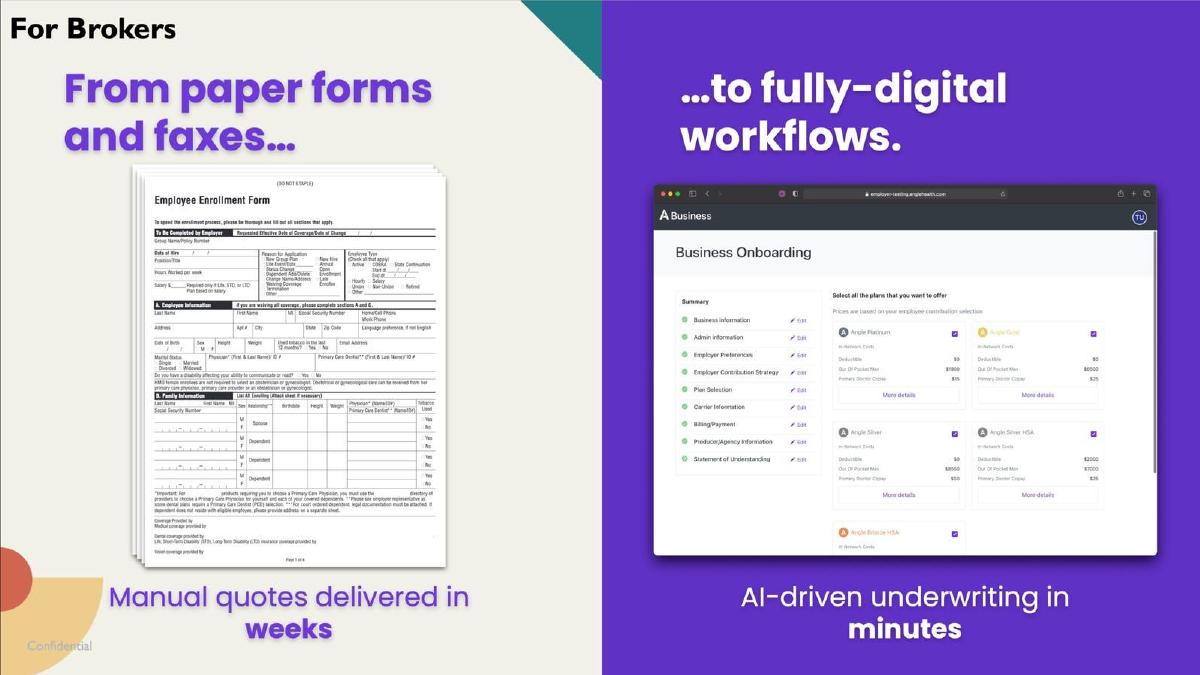
Slide 4 contrasts the 'old way' (paper and faxes) with 'fully-digital workflows.' Slide 5 hammers home the economic benefit for the employer. It claims to move the company 'From 5+ vendors to a one-stop healthcare solution.' By listing Health Insurance, FSA/HSA administration, Disease Management, Care Navigation, and Telehealth as a single package, Angle Health positions itself as a way to reduce administrative overhead and total cost, not just a way to buy insurance.
Slide 6: The Member Experience
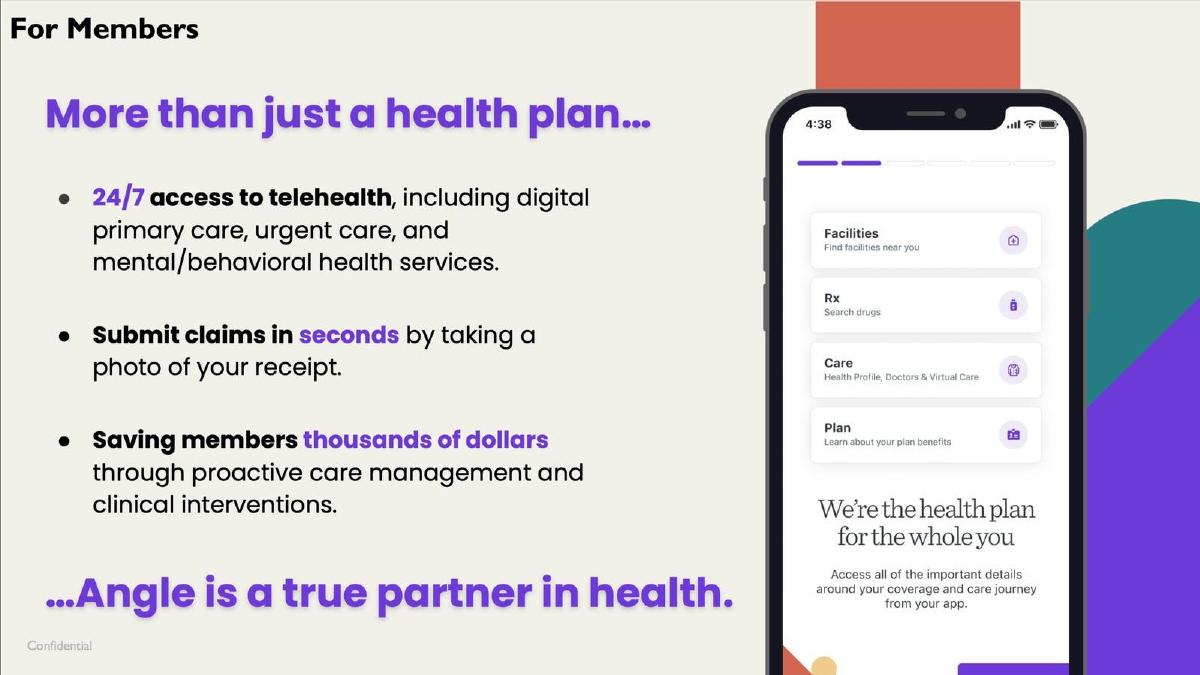
This slide focuses on the end-user. It promises '24/7 access to telehealth' and the ability to 'submit claims in seconds.' For a Series A investor, this slide proves that the product isn't just a back-end efficiency tool—it’s a consumer-grade application designed to drive member retention and satisfaction, which ultimately lowers costs for the employer.
Slide 7: Traction and Inflection Points
Slide 7 is the 'Progress' slide. Although the specific numbers are redacted in this version, the bar chart for 'Annual Revenue Run Rate' shows a clear and aggressive growth trajectory. The chart indicates a launch on July 1, 2021, with relatively flat growth for the first six months, followed by a massive step-up in January 2022. This likely corresponds to the 'Open Enrollment' cycle typical in the insurance industry. The inclusion of 'Reported Loss Ratios' is the most important metric on this slide; it tells investors how well the company is pricing risk.
Slide 8 & 9: Distribution and Scale
Slide 8 (redacted) likely covers the unit economics of their broker channel. Slide 9, 'Market Expansion,' provides the roadmap. It breaks down the U.S. market into digestible chunks, starting with the '$12 Billion Utah' market where they launched. It then identifies the '$56 Billion' opportunity in Texas (ATX, HOU, DFW) and the '$88 Billion' opportunity in California. By providing these specific figures, they demonstrate a sophisticated understanding of the geographic nature of insurance licensing and provider networks.
Slide 10, 11 & 12: The Vision and The Close
Slide 10 provides revenue projections, while Slide 11 uses a powerful third-party endorsement. The quote from a16z (Daisy Wolf and Vijay Pande) —'we think the biggest company in the world will be a consumer health tech company'—places Angle Health within a massive, venture-backed thesis. It suggests that Angle is the 'consumer-obsessed, healthcare-native tech company' the industry has been waiting for. The deck concludes on Slide 12 with a simple summary: 'Angle Health is revolutionizing healthcare benefits.'
What Angle Health Does Well
Regulatory Transparency: Leading with their NAIC code is a power move. It removes the 'can they actually do this?' doubt immediately. · Stakeholder Mapping: The deck clearly addresses the 'Triad' of insurance: the broker who sells it, the employer who pays for it, and the member who uses it. Most health-tech decks ignore the broker, which is a fatal mistake in the B2B space. · Visualizing Complexity: The diagram on Slide 3 takes a complex backend (AI, data assets, ontologies) and makes it look like a clean, streamlined engine. · Market Sizing: Instead of just saying 'Healthcare is a $4T market,' Slide 9 breaks it down by specific cities and states where they actually intend to compete.
What is Missing from the Deck
Unit Economics: While loss ratios are mentioned, there is no explicit mention of Customer Acquisition Cost (CAC) vs. Lifetime Value (LTV). In a broker-led model, these figures are vital for understanding long-term profitability. · Competitive Landscape: The deck does not explicitly name competitors like Oscar Health, Clover, or the 'Big Five' incumbents. It relies on the 'paper and fax' trope to represent the competition rather than addressing specific market rivals. · Provider Network Details: For an insurance company, the strength of the provider network (which doctors can I see?) is everything. The deck mentions being a 'licensed carrier' but doesn't explain how they build or lease their networks in new states like Texas or New York.
Founder Takeaways: How to Pitch a Regulated Industry
If you are building in a highly regulated space (FinTech, HealthTech, InsurTech), the Angle Health deck provides a blueprint for building investor confidence. First, prove you are legal. Don't hide your licenses in the appendix; put them on slide one. Second, show the 'Old World' vs. 'New World.' The contrast between faxes and AI-enabled workflows is a visceral way to explain why your tech matters. Third, respect the existing distribution channels. Angle Health didn't try to 'disrupt' brokers out of existence; they built 'Sales Automation for Brokers.' If you want to scale fast, build tools for the people who already control the customers. Finally, anchor your vision in a larger thesis. By quoting a16z, Angle Health isn't just a startup; they are the manifestation of a 'biggest company in the world' prediction.
Frequently asked questions
- What does 'full-stack' mean in the context of Angle Health?
- As stated on Slide 1, Angle Health is not just a software interface; they are a licensed health insurance carrier (NAIC 16933). This means they underwrite the risk, administer benefits, and navigate care directly, rather than acting as a middleman for a legacy insurer like Aetna or UnitedHealthcare.
- How does Angle Health use AI according to the deck?
- Slide 3 illustrates an AI/ML layer sitting atop a 'Canonical Data Asset.' This technology powers extensible workflows, automated chats, and decision support, aiming to replace the 'paper forms and faxes' mentioned on Slide 4 with fully digital, automated processes.
- What is the primary distribution strategy for Angle Health?
- While Slide 8 is redacted, Slide 3 explicitly mentions 'Sales Automation for Brokers & Employers.' In the health insurance industry, brokers are the primary gatekeepers for small-to-midsized businesses, and Angle Health builds tools specifically to win their favor.
- Which markets did Angle Health prioritize for expansion?
- Slide 9 shows a launch in Utah ($12B market), followed by planned expansions into Texas ($56B), California ($88B), New York ($32B), Florida ($18B), and Colorado ($12B). They target high-density urban hubs with significant employer-based coverage.
- What financial metrics are emphasized in the progress section?
- Slide 7 tracks 'Annualized Premiums,' 'MoM Revenue Growth,' 'Groups (Customer Businesses),' and 'Members.' Crucially for an insurer, they also track 'Reported Loss Ratios' for 2021 and 2022, which measures the percentage of premiums paid out as claims.