Yumi Nutrition’s 2017 pitch deck is a textbook example of an early-stage consumer goods (CPG) deck that prioritizes financial clarity over complex narrative. Seeking £100k in SEIS-approved seed funding, the Salford-based startup identifies a clear gap in the £278B global supplement market: the 'pill fatigue' caused by bad-tasting, difficult-to-swallow vitamins. The deck shines in its transparency, detailing a £7.60 acquisition profit per bottle on a £13.99 RRP. While the team slides are light on deep industry pedigree, the traction slide—showing £15k in monthly sales and existing profitabilit…
Key takeaways
- The company seeks a £100k SEIS-approved seed round to scale marketing and inventory (Slide 17).
- Yumi reports a high acquisition profit of £7.60 per bottle against a retail price of £13.99 (Slide 13).
- The business was already profitable at the time of the pitch, generating £15k+ in monthly sales (Slide 14).
- Market data cites a $278B worldwide dietary supplement market with 9.6% annual growth (Slide 8).
- The product strategy focuses on 'pill fatigue,' offering chewable alternatives to traditional supplements (Slide 3).
- Financial projections target a scale from £22k turnover in Year 1 to £6.89M by Year 5 (Slide 15).
- The team includes founders with backgrounds in business development, finance, and graphic design (Slide 12).
- Future product expansion includes CBD, Apple Cider Vinegar, and functional powders or drinks (Slide 6).
Introduction: The SEIS Seed Play
Yumi Nutrition’s 2017 pitch deck is a lean, 18-slide document designed for a specific purpose: securing a £100k SEIS-approved seed round. Based in Salford, England, the company entered a crowded dietary supplement market with a focused value proposition: making vitamins palatable. This teardown examines how they used transparency and unit economics to stand out to early-stage investors.
Slides 1-4: The Hook and the Problem
Slide 1 is a minimalist title slide. It immediately declares the round size— £100k SEIS SEED —which is a tactical move for UK investors looking for tax-efficient opportunities. The imagery of gummies establishes the product category instantly.
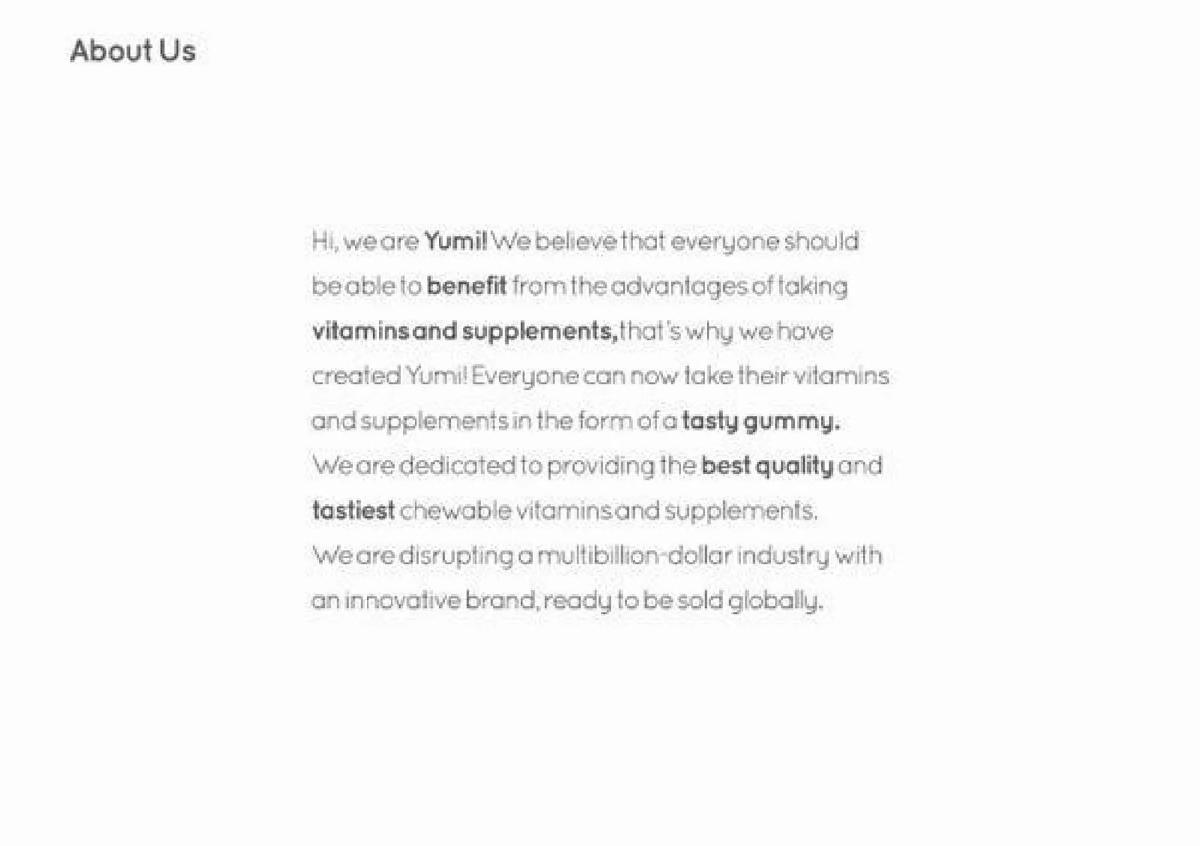
Slide 2 , titled 'About Us,' serves as the executive summary. It uses bold text to highlight 'benefit,' 'vitamins and supplements,' 'tasty gummy,' and 'best quality.' The claim of 'disrupting a multibillion-dollar industry' is standard pitch fare, but it sets the scale of ambition.
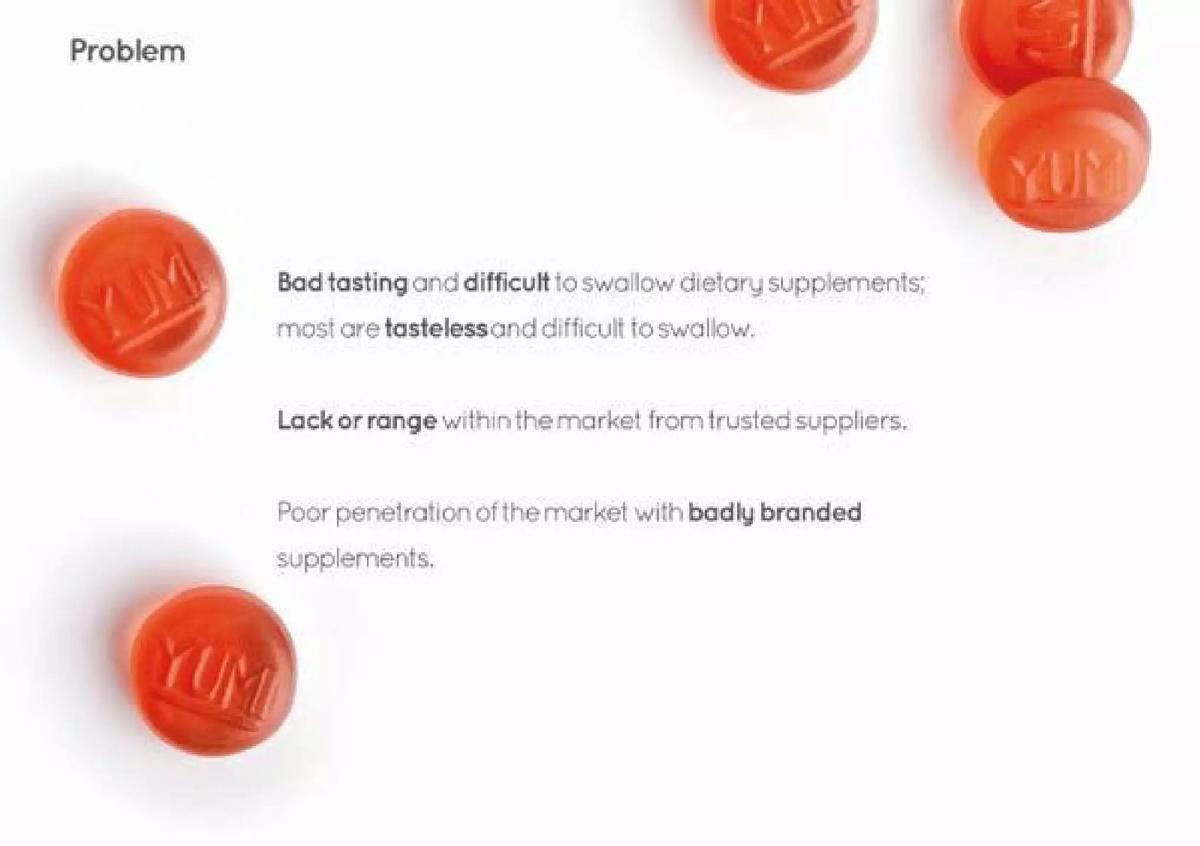
Slide 3 defines the 'Problem.' It identifies three pain points: supplements that are 'bad tasting and difficult to swallow,' a 'lack of range' from trusted suppliers, and 'poor penetration' by 'badly branded' products. By framing the problem around taste and branding rather than scientific efficacy, Yumi positions itself as a lifestyle brand rather than a medical one.
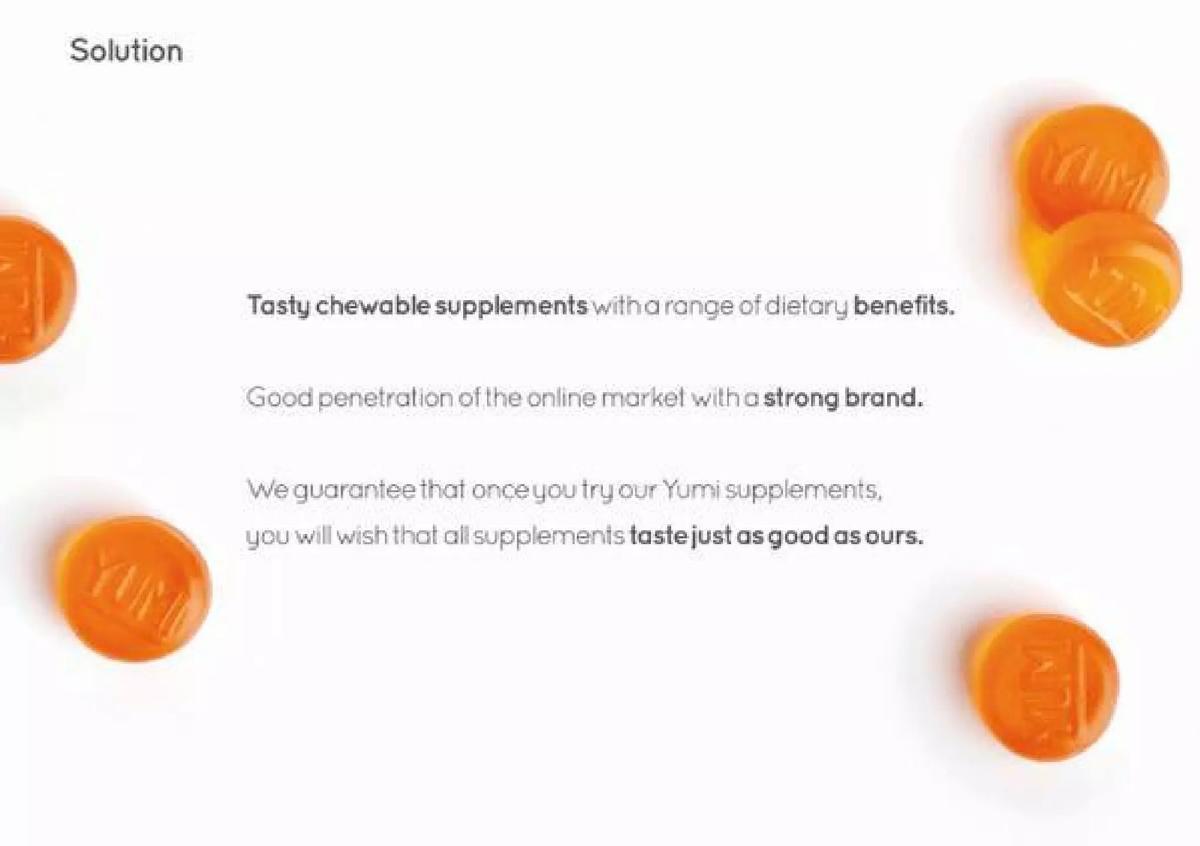
Slide 4 presents the 'Solution.' It mirrors the problem slide, promising 'tasty chewable supplements' and a 'strong brand.' The slide includes a bold guarantee: 'once you try our Yumi supplements, you will wish that all supplements taste just as good as ours.'
Slides 5-7: Product and Social Proof
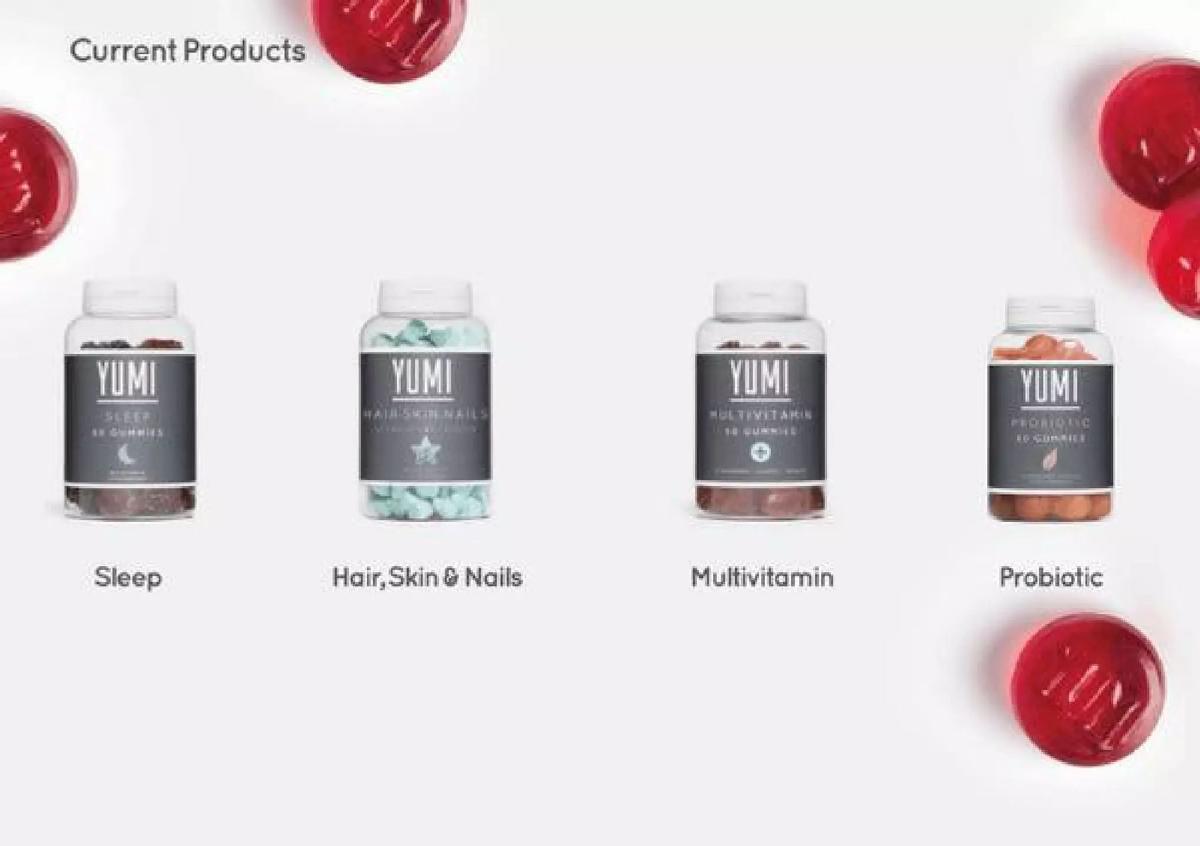
Slide 5 showcases the 'Current Products.' The lineup includes four SKUs: Sleep, Hair, Skin & Nails, Multivitamin, and Probiotic. The packaging is uniform, utilizing a dark, minimalist label that supports their 'strong brand' claim from the previous slide.
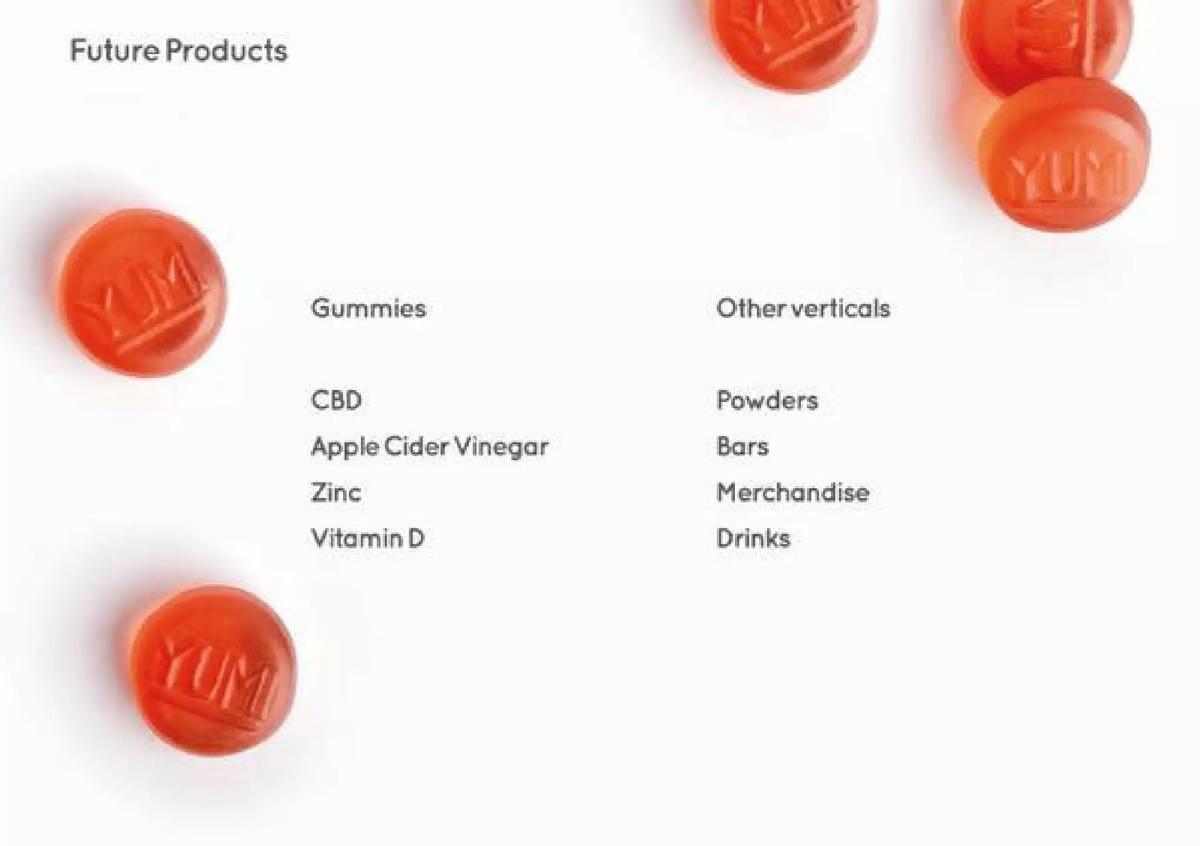
Slide 6 looks at 'Future Products.' This is a critical slide for showing growth potential. They list upcoming gummies like CBD , Apple Cider Vinegar , Zinc , and Vitamin D . More importantly, they signal an intent to move into 'Other verticals' including powders, bars, merchandise, and drinks, suggesting they view Yumi as a platform brand, not just a gummy company.
Slide 7 provides 'Customer Reviews.' While only two quotes are featured (Lauren Harris and Elise B), they specifically validate the problem/solution claims regarding taste and efficacy (e.g., 'hair feels stronger,' 'sleeping much better').
Slides 8-10: Market Dynamics and Competition
Slide 8 and Slide 9 tackle 'The Market' and 'Market Size.' They cite a $278B worldwide dietary supplement market (Grandview Research, 2017) and a £1.4B current addressable market in the UK. A key data point on Slide 8 is that 7.5% of the $77B US market is now in gummy format, providing a benchmark for their potential penetration.
Slide 10 is the 'Competitive Landscape.' Yumi uses a standard 2x2 matrix with 'Price' and 'Variety of Product' as the axes. They position themselves in the 'High variety / Mid-price' quadrant. Competitors listed include Boots , Vitafusion , Olly , Sugarbearhair , and Hairburst . This slide effectively shows that while they aren't the cheapest, they aim to offer more breadth than the niche 'beauty gummy' brands.
Slides 11-13: Execution and Economics
Slide 11 outlines 'Routes to Market.' The strategy is split between B2C (E-commerce, social media, SEO) and B2B (Health stores, wholesale, and international expansion into the US). This dual-track approach suggests a diversified revenue stream.
Slide 12 introduces 'The Team.' Sebastien Vanderlinden is credited with 7 years of business dev experience and bringing in £600k of business in a previous role. Adam Barker brings a finance background from Oxford and a record of £250k in monthly business dev. Joshua Margetts handles the graphic design. The team is young and sales-heavy, which aligns with the brand-first strategy of the company.
Slide 13 is arguably the most important slide in the deck: 'Unit Economics.' It provides a transparent breakdown of a single bottle:
RRP per bottle: £13.99 · Cost per bottle: £1.77 · Co-Packing & Packaging: £0.30 · Shipping: £2.32 · Cost per new customer: £2.00 · Acquisition profit per bottle: £7.60
This level of detail is rare in seed decks and proves that the business has a healthy contribution margin even after accounting for marketing costs.
Slides 14-18: Traction, Financials, and The Ask
Slide 14 covers 'Traction.' The headline is that the business is 'already profitable.' They report £15k+ monthly sales and set a target to reach £100k monthly sales within 18 months. They also note that the founders have fully funded the business to this point.
Slide 15 presents 'Financial Projections.' The table shows a 5-year plan:
Year 1: £22k Turnover / £12k Net Profit · Year 2: £419k Turnover / £56k Net Profit · Year 3: £1.80M Turnover / £430k Net Profit · Year 4: £4.46M Turnover / £0.92M Net Profit · Year 5: £6.89M Turnover / £1.33M Net Profit
The slide also notes that 30% of profit is intended to be distributed to shareholders yearly, which is an unusual inclusion for a high-growth startup pitch but may appeal to certain angel investors.
Slide 16 , 'The Future,' reiterates the plan to scale to the US, Australia, and New Zealand.
Slide 17 details the 'Funding Requirements.' The £100k ask is broken down via a pie chart: 50% for Marketing & Growth, 30% for Inventory & Operations, and 20% for Administrative & Staff. This aligns with the goal of scaling an already-profitable model.
Slide 18 is the contact slide, providing a direct email and phone number for the founders.
What Works in This Deck
The standout feature of the Yumi Nutrition deck is its financial transparency . By including a specific unit economics slide (Slide 13), the founders remove the guesswork for investors. They demonstrate that they understand their margins, their shipping costs, and their customer acquisition costs (CAC). For a D2C brand, these are the only metrics that truly matter at the seed stage.
The traction slide (Slide 14) is also highly effective. Stating that the business is already profitable on £15k a month suggests that the founders are disciplined with capital. This makes the £100k ask feel like 'fuel for the fire' rather than a lifeline to keep the lights on.
What is Missing
The most notable omission is a deep dive into the supply chain . While they mention 'Co-Packing' costs, there is no information on who their manufacturers are or if they have exclusive formulations. In the supplement industry, regulatory compliance and quality control are major risks; the deck does not address how they manage these factors.
Additionally, the Team slide (Slide 12) lacks industry-specific experience. While the founders have strong sales and design backgrounds, there is no mention of a nutritionist, pharmacist, or CPG veteran on the advisory board. This might lead investors to question the long-term defensibility of the product formulations.
What a Founder Should Copy
Founders should emulate the clarity of the 'Ask' found on Slide 1 and Slide 17. By specifying that the round is SEIS-approved, Yumi immediately qualifies itself for a specific pool of UK investors.
The Unit Economics slide is also a gold standard for CPG decks. Instead of using vague terms like 'high margins,' Yumi shows the exact pound-and-pence breakdown. This builds immediate trust and shows a level of operational maturity that is often missing in early-stage pitches. Finally, the use of bold text for key metrics throughout the deck ensures that even a casual skimmer will walk away with the most important facts: £15k monthly sales, £7.60 profit per bottle, and a £100k ask.
Frequently asked questions
- What is the specific investment ask in this deck?
- Yumi Nutrition is seeking £100k in seed funding. The deck explicitly mentions on Slide 1 and Slide 17 that the round is SEIS (Seed Enterprise Investment Scheme) approved, which is a significant tax incentive for UK-based investors. The funds are earmarked for marketing (50%), inventory and operations (30%), and administrative staff (20%).
- How does Yumi define its competitive advantage?
- The deck positions Yumi as a high-variety, mid-to-high price point brand. On Slide 10, they use a 2x2 matrix to place themselves against competitors like Sugarbearhair (low variety) and Vitafusion (low price). Their core value proposition is solving the 'bad tasting and difficult to swallow' nature of traditional supplements through a 'strong brand' and 'tasty gummy' format.
- What are the unit economics for a single bottle of Yumi vitamins?
- Slide 13 provides a detailed breakdown: the Recommended Retail Price (RRP) is £13.99. Costs include £1.77 for the product, £0.30 for packing, £2.32 for shipping, and £2.00 for customer acquisition. This results in a healthy acquisition profit of £7.60 per bottle, demonstrating a sustainable margin for a D2C brand.
- What is the company's growth strategy for the next five years?
- According to Slide 15, Yumi expects to grow turnover from £22k in Year 1 to £419k in Year 2, eventually reaching £6.89M by Year 5. This growth is predicated on scaling into the US, Australia, and New Zealand markets (Slide 16) and expanding the product line into new verticals like powders, bars, and drinks (Slide 6).
- Who are the founders and what is their experience?
- The team consists of Sebastien Vanderlinden (Business Dev & Marketing), Adam Barker (Finance & Fintech), and Joshua Margetts (Graphic Design). While they lack deep pharmaceutical or nutritional science backgrounds, the deck emphasizes their ability to generate revenue, citing Vanderlinden's £600k in business generated in a previous role and Barker's record of £250k in a single month (Slide 12).