Spire Global’s 2012 seed deck is a masterclass in 'market timing' and 'technology tailwinds.' Rather than focusing on a specific customer problem, the deck argues that the satellite industry has reached a tipping point due to the CubeSat standard. By comparing traditional, bulky sensors to modern 5g components, Spire illustrates a 1,000x price/performance improvement (Slide 4). The deck effectively uses the P-POD container analogy to explain how they bypass the 'launch bottleneck' by piggybacking on existing missions (Slide 3). While it lacks a team slide, financial projections, or a specific…
Key takeaways
- The deck frames CubeSats as an exponential technology where forecasts are consistently revised upward, citing a jump from 90-105 launches in 2011 to a forecast of 120-190 by 2013 (Slide 2).
- Spire leverages the 'shipping container' analogy for the P-POD system to explain how they eliminate the need for dedicated, expensive launches (Slide 3).
- A specific hardware comparison shows a TNO Sun Sensor shrinking from 475g and 900.9 cm³ in 2006 to just 5g and 2.2 cm³ by 2012 (Slide 4).
- The company claims a 1,000x price/performance improvement in sensors over a six-year period (Slide 4).
- Power capabilities on CubeSats are shown growing on an exponential curve, moving from a relative value of 1 in 2000-2005 to 100 in 2010-2015 (Slide 5).
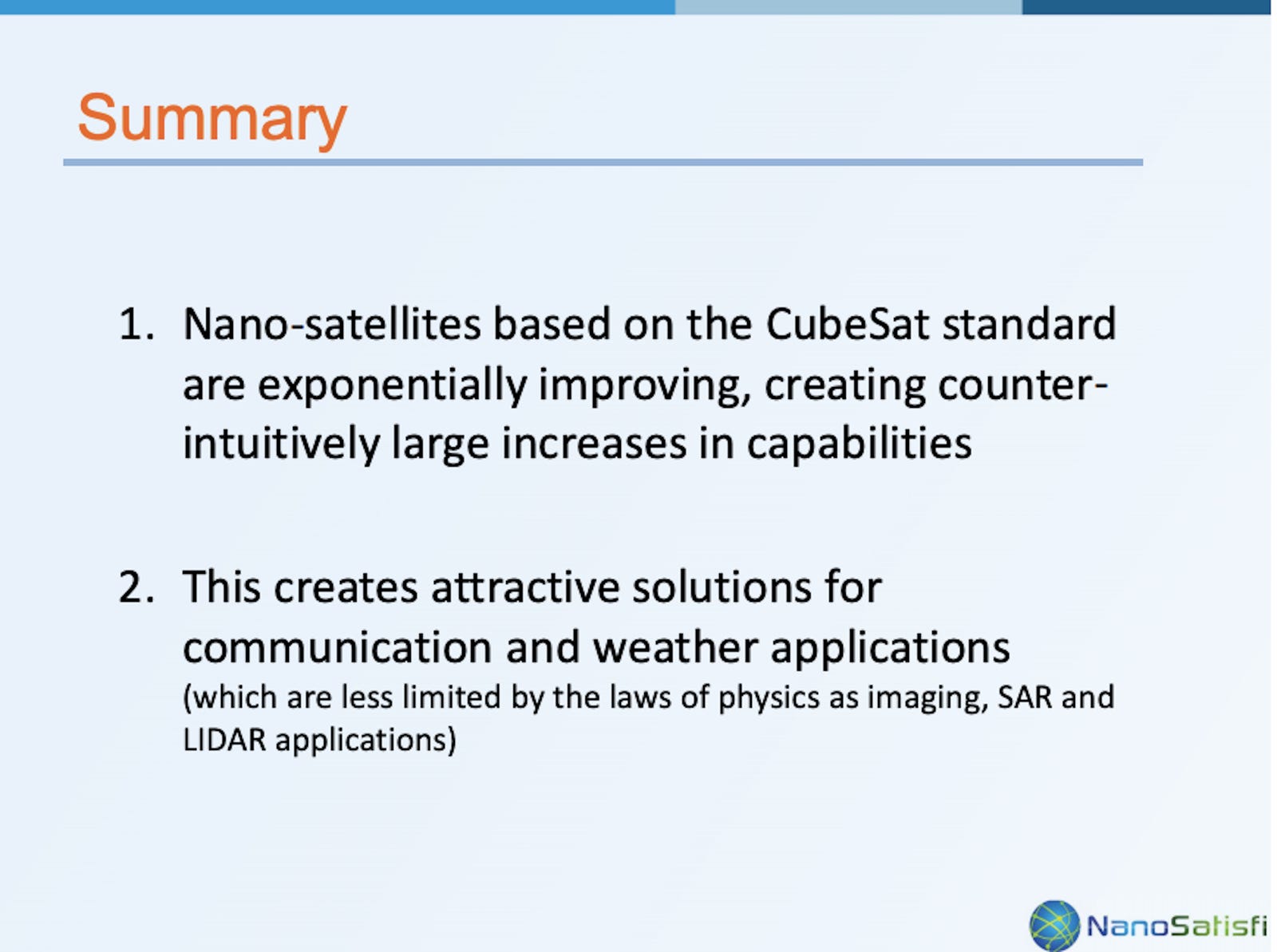
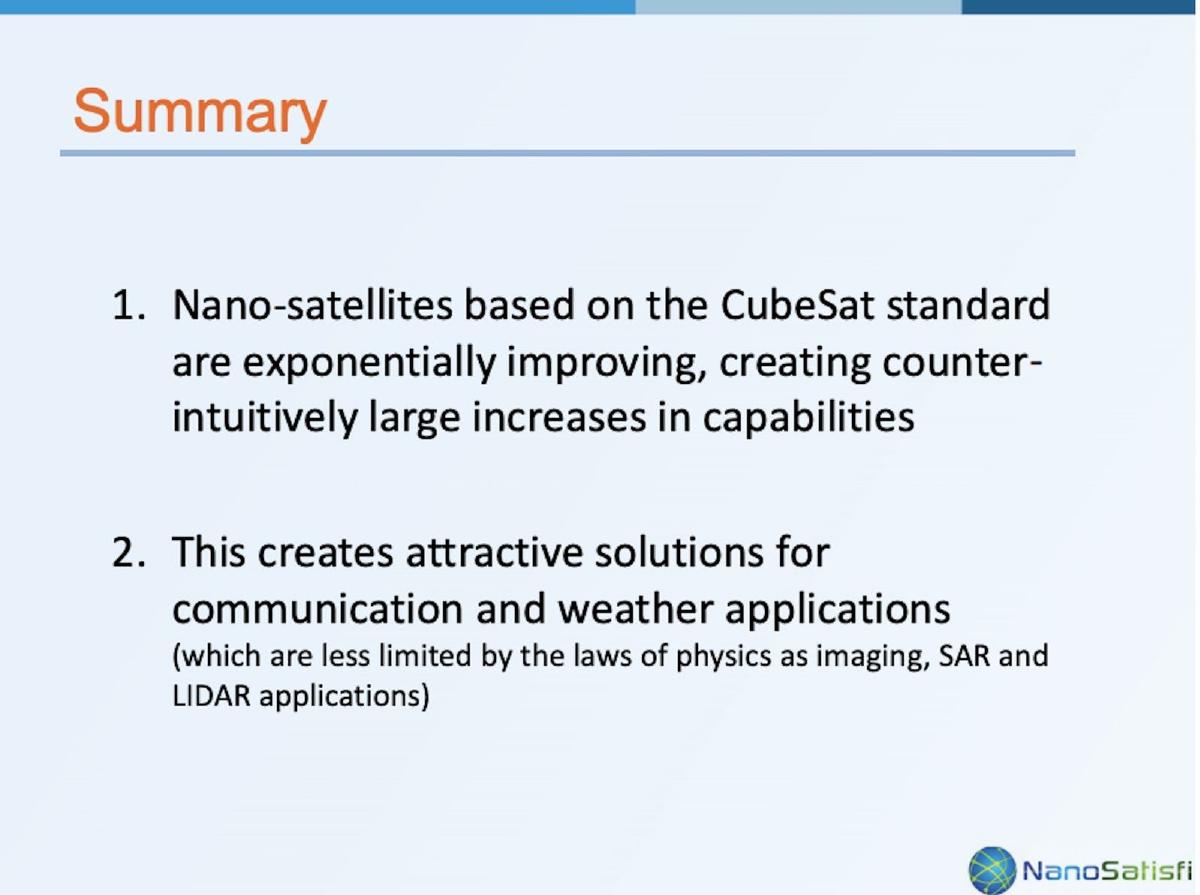
- The deck identifies communication and weather as the primary applications because they are 'less limited by the laws of physics' compared to imaging or LIDAR (Slide 1).
- The branding on the slides reflects the company's original name, NanoSatisfi, prior to its rebranding as Spire Global.
- The deck is heavily focused on technical feasibility and industry trends, omitting traditional business slides like competition, team, and go-to-market strategy.
The Macro Argument for Small Space
Spire Global’s 2012 seed deck (under its original name, NanoSatisfi) is a focused argument for a paradigm shift. In the early 2010s, the space industry was dominated by 'bus-sized' satellites costing hundreds of millions of dollars. This deck seeks to dismantle that reality by presenting the CubeSat as the 'PC' to the mainframe satellite. It is a technical manifesto that relies on the inevitability of hardware miniaturization to justify a $4M seed round.
Slide 1: The Thesis
The deck opens with a Summary slide that sets two foundational pillars. First, it asserts that CubeSats are improving exponentially, leading to 'counter-intuitively large increases in capabilities.' Second, it narrows the business focus to communication and weather applications . Interestingly, the slide includes a parenthetical note that these applications are 'less limited by the laws of physics' than imaging or SAR (Synthetic Aperture Radar). This is a strategic admission; it tells investors that the company is picking the 'low-hanging fruit' of space data where small sensors can already compete with giants.
Slide 2: The Upward Revision of History
Slide 2, titled Nanosatellites – A Disruptive Exponential Technology , uses three charts to prove market momentum. The top-left chart shows 2011 forecasts (90-105 launches), while the top-right chart shows the 2013 revision (120-190 launches). The takeaway is explicitly stated: 'forecasts have to be continually revised upward.' By showing that even industry experts were underestimating the growth of CubeSats, Spire creates a sense of urgency. The bottom chart tracks academic interest, showing a spike in published articles containing the word 'CubeSat' from 2001 to 2012, signaling that the talent and research pipeline is maturing.
Slide 3: Solving the Launch Bottleneck
One of the biggest risks in space startups is 'launch risk.' Slide 3 addresses this by highlighting the CubeSat Standard and the P-POD Container . The deck describes a CubeSat as being the 'size of a bottle of good wine' and the P-POD as being 'similar to a shipping container.' This is a brilliant use of analogy. By comparing space logistics to the shipping industry, Spire demystifies the complexity of orbital insertion. The key takeaway on this slide is the bolded conclusion: 'No dedicated launch needed!' This significantly lowers the projected CapEx for the business, as they can 'piggy-back' on existing missions.
Slide 4: The 1,000x Price/Performance Improvement
Slide 4 is the 'Moore’s Law' slide. It tracks the evolution of a Sun Sensor from 2006 to 2012. The data is stark:
2006: 475g weight, 900.9 cm³ size. · 2008: 365g weight, 560.9 cm³ size, €15,000 price. · 2012: 5g weight, 2.2 cm³ size, €2,500 price.
The slide claims an 'At least 1,000x price/performance improvement.' For a seed investor, this is the most important slide in the deck. It proves that the hardware is no longer the barrier to entry; the barrier is now how one uses that hardware to collect and sell data.
Slide 5: The Power Curve
Space hardware is useless without power. Slide 5, Available Power on CubeSats , shows a bar chart with an exponential curve overlaid. It indicates a jump from a relative power value of 1 (2000-2005) to 10 (2005-2010) and finally to 100 (2010-2015). This addresses a common technical objection: that small satellites can't generate enough power to run sophisticated radios or sensors. By showing a 100x increase in power availability, Spire reinforces the 'Why Now' of the investment opportunity.
Slide 6: Antenna Capabilities
Slide 6, Exponential Antenna Capabilities , is purely visual. It shows four different stages of antenna development, moving from simple wire antennas to complex deployable structures and eventually a large inflatable parabolic dish. While the slide lacks text, the visual progression implies that the 'physics limitations' mentioned on Slide 1 are being solved through clever engineering. It suggests that CubeSats are no longer limited to low-bandwidth 'beeps' but can now handle high-throughput data transmission.
What is Missing from the Deck?
The provided 11-slide sequence is notably missing several 'standard' pitch deck elements. There is no Team slide , which is unusual for a seed round where the founders' pedigree is often the primary selling point. There is no Competition slide , ignoring other early movers in the NewSpace sector like Planet Labs (then Cosmogia). Most importantly, there is no Business Model or Financials slide . The deck explains why the technology is possible and why it is cheap, but it doesn't explain how Spire will turn weather data into a billion-dollar revenue stream. Finally, there is no 'Ask' slide detailing how the $4M will be spent or what milestones it will achieve.
What Founders Should Copy
Founders in deep tech or hardware should emulate Spire’s use of comparative metrics . Slide 4’s breakdown of weight, size, and price over time is the most effective way to communicate a technological tipping point. If your industry is undergoing a 'miniaturization' or 'commoditization' phase, you must show the delta between the 'old way' and the 'new way' using hard units (grams, cm³, dollars). Additionally, the use of the 'Shipping Container' analogy for the P-POD system is a masterclass in simplifying complex infrastructure. If your business relies on a complex third-party ecosystem, find a way to explain it using a 20th-century industrial equivalent that every investor understands.
Conclusion
Spire Global’s seed deck is a 'Technology First' presentation. It was built for an era when the biggest question wasn't 'Who will buy this?' but 'Can you actually do this for less than $100 million?' By leaning into the CubeSat standard and exponential hardware trends, Spire successfully framed space as a software-like opportunity with hardware-like defensibility. The $4M raised in 2012 served as the foundation for what would eventually become a publicly traded leader in the space data industry.
Frequently asked questions
- Why does the deck focus so much on the CubeSat standard?
- In 2012, space was still viewed as a high-capital, high-risk industry. By focusing on the CubeSat standard (Slide 3), Spire argued that space hardware had become standardized and commoditized. This lowered the perceived risk for investors by showing that the company wasn't building bespoke, unproven rockets, but rather leveraging a 'shipping container' model for orbital delivery.
- What specific industries did Spire target in this early deck?
- Slide 1 explicitly identifies communication and weather applications as the most attractive solutions. The founders argued these sectors were less constrained by physics than imaging (SAR/LIDAR), allowing small satellites to provide high value without the massive lenses or power requirements of traditional reconnaissance satellites.
- How did Spire demonstrate the 'exponential' nature of their tech?
- They used three primary metrics: launch volume, sensor size, and power. Slide 4 is the most impactful, showing a sun sensor's weight dropping from 475g to 5g. Slide 5 shows a 100x increase in available power over 15 years. These charts were designed to convince VCs that satellites were finally following the same growth curve as semiconductors.
- Is there a business model or revenue projection in the deck?
- No. The 11-slide sequence provided is almost entirely technical and macro-trend focused. It establishes the 'Why Now' and the 'How,' but it omits the 'How much money will we make.' This is common in very early-stage deep tech decks where the primary hurdle is proving the technology is viable and affordable.
- What is the significance of the P-POD container mentioned on Slide 3?
- The P-POD (Poly-Picosatellite Orbital Deployer) is the 'enabler.' By being certified on 12+ launch vehicles, it allows Spire to 'piggy-back' on other missions. This slide is crucial because it solves the 'Launch Bottleneck,' proving that the company can get its hardware into space frequently and cheaply without building its own rockets.