Instaparty’s 9-slide deck from 2016 presents a mobile-first solution for the nightlife industry, aiming to replace 'antiquated forms' and phone calls with instant digital bookings. The company proposes a marketplace where venue owners can push real-time deals to fill capacity, while patrons receive booking confirmations within minutes. The business model is built on a 9.25% convenience fee, which the deck claims is slightly below the industry threshold. While the deck features a robust board of advisors from firms like Goldman Sachs and SourceMedia, it lacks critical data points such as curre…
Key takeaways
- The company identifies 'fundamental defects' in the party booking process for bars and clubs, specifically citing latency and outdated systems on Slide 2.
- The solution relies on push notifications to create 'immediacy and urgency' between patrons and venue managers on Slide 3.
- Instaparty utilizes a profit-sharing business model with a 9.25% convenience fee charged to participating venues on Slide 4.
- A core feature called 'DEALS' allows venue owners to instantly create offers to maximize capacity in real-time on Slide 5.
- The deck lists five specific competitors, including TableList, YPlan, and Gaggy, but claims a 'more focused value' on Slide 6.
- The management team consists of one core founder, Liam Hayden, supported by a seven-person board of advisors on Slide 7.
- Slide 8 indicates the product is still in development, stating capital is needed to 'complete the successful development and launch'.
- The deck omits a specific dollar amount for the funding ask and provides no financial projections or historical traction metrics.
The Instaparty Pitch Deck Teardown
Instaparty emerged in the mid-2010s during a wave of 'Uber-for-X' startups, specifically targeting the nightlife and hospitality sector. This 9-slide deck, dated 2016 via its source listing, focuses on the friction inherent in booking group events at bars and clubs. The deck is minimalist, relying on high-level value propositions rather than deep technical specifications or financial modeling.
Slide 1: Title Slide
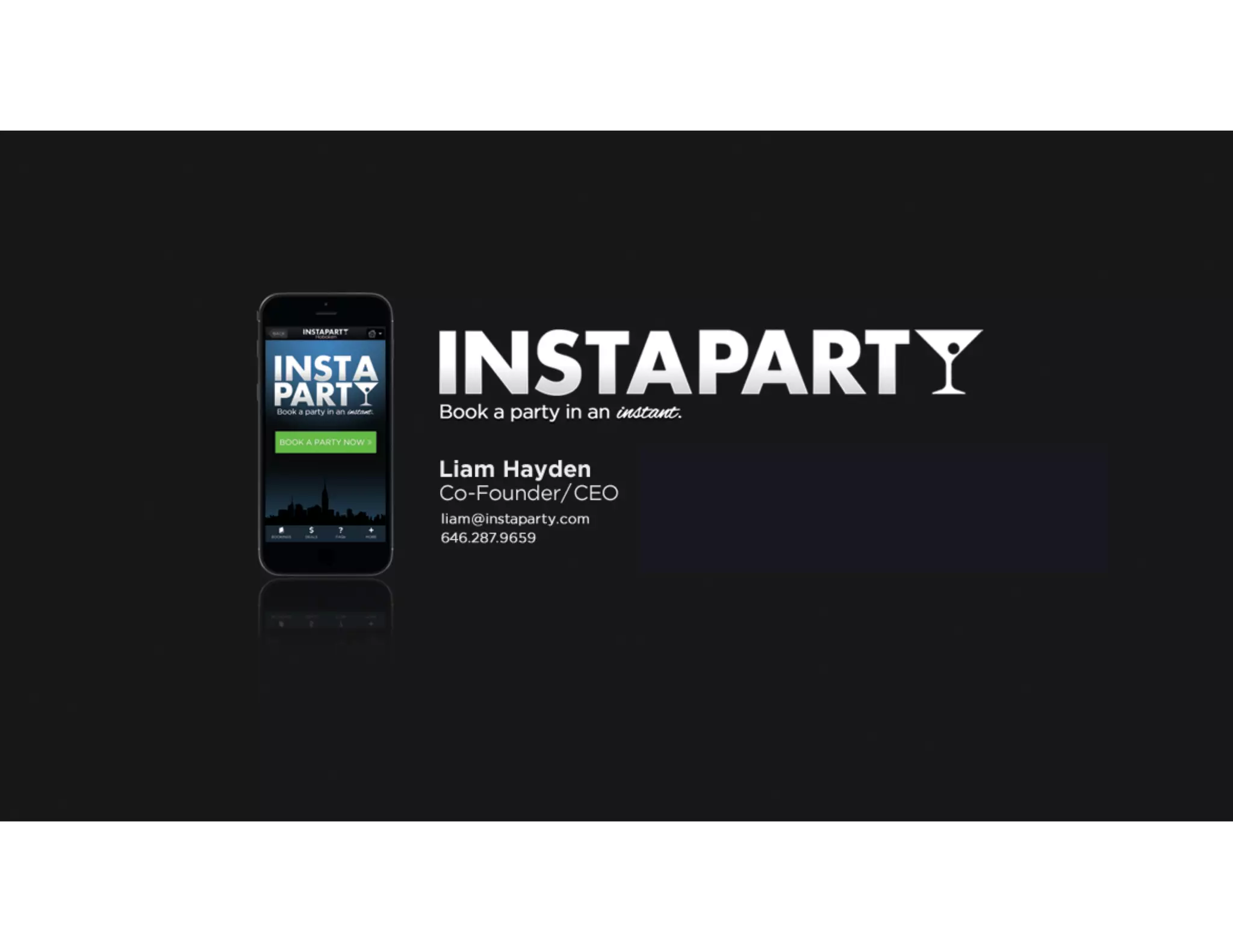
The opening slide establishes the brand identity with a dark, nightlife-themed aesthetic. It features the company logo, a mobile handset mockup showing the app interface, and the tagline: "Book a party in an instant." Liam Hayden is identified as the Co-Founder and CEO, providing direct contact information including an email address and phone number. The visual design is consistent with the 'premium' nightlife vibe the company aims to facilitate.
Slide 2: The Problem
Instaparty defines the problem as "fundamental defects" in the booking process for bars, pubs, and clubs. The slide highlights two pain points: venue owners lose business due to "outdated systems" and "lack of timely responses," while customers suffer from "latency." The deck explicitly calls out the frustration of making phone calls and filling out "antiquated forms on websites." This slide effectively identifies a manual process ripe for digitization, though it lacks data on exactly how much revenue is lost to these inefficiencies.
Slide 3: Our Solution
The solution slide claims to have "changed the way patrons and venue owners connect." The mechanics involve users customizing a party to their needs and being directly connected to a venue manager. The key differentiator mentioned is that managers confirm bookings "within minutes." The slide also notes the use of push notifications to create "immediacy and urgency," positioning the app as a real-time communication tool rather than a passive booking log.
Slide 4: Business Model
Instaparty proposes a 9.25% convenience fee charged to venues. The slide describes this as a "true profit sharing approach." By stating that this rate is "slightly under the industry threshold," the company attempts to position itself as a venue-friendly partner. However, the slide does not define what the "industry threshold" actually is, nor does it provide projections for Average Order Value (AOV) or expected volume per venue.
Slide 5: Underlying Magic
This slide introduces the "DEALS" feature, which functions as a card up their sleeve. It describes a portal where venue owners can "INSTANTLY create a specific deal" to maximize capacity or fill their calendar in real-time. This suggests a dynamic pricing or yield management component, allowing venues to push offers to users who are actively searching for a place to go. This is the most strategically sound slide in the deck, as it addresses the perishable inventory problem in the hospitality industry.
Slide 6: Competition
The deck acknowledges that the space is "heating up" and lists five competitors: TableList , YPlan , Gaggy , barHappy , and Guest of a Guest . Instaparty differentiates itself by claiming to be more "focused" and allowing users to create their own specific party rather than choosing "bland, pre-packaged deals." While it names competitors, it lacks a traditional competitive matrix to show exactly where Instaparty wins on features or price.
Slide 7: Management Team
The team slide is heavily weighted toward advisors rather than full-time staff. Liam Hayden is the only "core team" member listed. The board of advisors, however, is impressive for an early-stage startup, featuring executives from:
Goldman Sachs (Gary Godshaw, Managing Director) · SourceMedia (John DelMauro, Senior VP) · Centro (Joe Didato, Regional Sales Director) · Burbio (Dennis Roche, Founder)
The presence of these advisors suggests the founder had a strong professional network, which is often used to compensate for a small core team in early-stage pitches.
Slide 8: The Time is Now... JOIN US.
This functions as the closing argument and call to action. It claims the company has identified the market, established a following of bar owners, and aligned with an "award winning development firm." Crucially, it states that capital is needed to "complete the successful development and launch into the marketplace." This confirms the company is in a pre-revenue, pre-launch state. The slide does not state the amount of equity offered or the total capital sought.
Slide 9: Thank You
The final slide repeats the contact information for Liam Hayden against a backdrop of the New York City skyline, reinforcing the geographic focus or origin of the startup.
What Works in This Deck
Clear Problem Identification: The deck does a good job of articulating the specific friction points of the status quo—phone calls and slow web forms. Any investor who has tried to book a table for a group can immediately empathize with the problem statement.
Focus on Real-Time Utility: By emphasizing push notifications and "instant" deals, Instaparty moves away from being a simple directory and toward being an active marketplace. The ability for a bar manager to push a deal at 9:00 PM to fill a slow Tuesday night is a clear value add for the supply side of the marketplace.
Strong Advisory Board: For a solo founder (or a founder with an unlisted team), having names from Goldman Sachs and major media companies provides a level of institutional credibility that can help open doors for partnerships.
What is Missing from This Deck
The Ask: This is the most significant omission. A pitch deck is a tool for fundraising, yet there is no mention of how much money is being raised, the valuation cap, or the specific milestones the funding will achieve. Saying "infusion of the right investment capital" is too vague for a professional pitch.
Market Size (TAM/SAM/SOM): The deck mentions the market is "heating up" but provides no data on the size of the nightlife booking industry. Investors need to know if this is a $100 million opportunity or a $10 billion opportunity to justify the risk of a pre-launch startup.
Unit Economics: While the 9.25% fee is clear, the deck doesn't explain the cost of customer acquisition (CAC) versus the lifetime value (LTV) of a user. In a crowded marketplace with competitors like YPlan, acquisition costs are typically the primary reason these businesses fail.
Traction Metrics: Even if the app isn't launched, the deck claims a "strong following of barowners." Quantifying this (e.g., "20 bars in Manhattan signed letters of intent") would have significantly strengthened the pitch.
What a Founder Should Copy
The 'Underlying Magic' Slide: Founders should emulate the way Instaparty explains their secret sauce. Instead of listing features, they explain the benefit to both sides of the marketplace (venues get capacity, users get bespoke deals). It is a concise way to explain a two-sided value proposition.
Direct Competitor Acknowledgment: Many founders try to claim they have no competition. Instaparty correctly identifies five active players. This shows the founder is aware of the market landscape and understands that competition validates the existence of the problem.
Visual Consistency: The deck uses a consistent dark theme that matches the industry it serves. It feels like a product for the nightlife industry, which helps in storytelling.
Final Verdict
The Instaparty deck is a classic example of a "concept deck." It successfully identifies a real-world annoyance and proposes a logical digital solution. However, as an investment vehicle, it is incomplete. The lack of a specific financial ask, the absence of market sizing data, and the reliance on a single core team member make it a high-risk proposition that relies almost entirely on the strength of the advisory board and the founder's ability to execute the final stages of development.
Frequently asked questions
- What is the primary problem Instaparty aims to solve?
- According to Slide 2, Instaparty targets the 'fundamental defects' in how bars, pubs, and clubs handle party bookings. The founders argue that venue owners lose business due to slow response times, while customers are frustrated by the need to make phone calls, write emails, or fill out 'antiquated forms' on websites.
- How does Instaparty generate revenue?
- Slide 4 outlines a commission-based business model. The platform charges participating venues a 9.25% convenience fee for bookings made through the app. The deck describes this as a 'true profit sharing approach' and notes that this rate is slightly below the standard industry threshold.
- What is the 'Underlying Magic' of the platform?
- As detailed on Slide 5, the unique selling point is a portal that allows venue owners to create real-time deals. This is designed to help venues fill empty capacity on short notice, while allowing users to search for and 'jump on' offers that suit their specific group size and needs.
- Who is behind the company?
- Slide 7 identifies Liam Hayden as the Co-Founder and CEO. While he is the only core team member listed, the company is supported by a board of advisors with experience at Goldman Sachs, SourceMedia, Centro, and various tech startups like Burbio and EmailPredict.
- Is the product currently live?
- Based on Slide 8, the product appears to be in the pre-launch phase. The slide states that with investment, the company will be able to 'complete the successful development and launch into the marketplace,' implying the app was not fully operational at the time of the pitch.