Instafreight’s NOAH18 deck is a masterclass in presenting unit economics for a marketplace business. By breaking down Full Truck Load (FTL) and Part Truck Load (LTL) metrics, the company demonstrates a clear path to profitability with a 'month to break even' of less than three months. The deck leans heavily on the narrative of a fragmented market, using Star Wars-themed visuals to illustrate that even the largest incumbents like DHL and DB Schenker hold less than 3% market share combined. While the deck lacks a formal team slide or a specific funding ask in this 8-slide selection, it succeeds…
Key takeaways
- The European freight market is extremely fragmented, with DB Schenker, Kuehne + Nagel, and DHL holding only 3%, 0.2%, and 0.5% market share respectively (Slide 4).
- The current value chain is inefficient, involving six distinct layers from customer to driver, including brokers, forwarders, and subcontractors (Slide 6).
- Instafreight positions itself as a 'one-stop shop' featuring a real-time pricing engine and automated load matching (Slide 7).
- The platform integrates directly with shippers via Web, API, and SAP ERP systems (Slide 7).
- Full Truck Load (FTL) orders yield an average order value (AOV) of 600€ with a margin of 8-12% (Slide 14).
- Part Truck Load (LTL) orders have a lower AOV of 200€ but higher margins of 10-14% (Slide 14).
- The company claims a rapid payback period, with a 'month to break even' of 2-3 months for FTL and less than 2 months for LTL (Slide 14).
- Retention is driven by fixed contracts with larger clients and a subscription business model (Slide 14).
Instafreight: Digitizing the Fragmented Road Freight Market
The Instafreight deck from the NOAH18 Berlin conference is a focused, data-driven presentation that prioritizes market dynamics and unit economics over flashy storytelling. As a 'Digital Forwarding Company,' Instafreight aims to solve the inherent messiness of European road logistics. The deck is notable for its transparency regarding margins and customer acquisition costs, which is rare in public-facing conference decks.
Slide 1: Title Slide
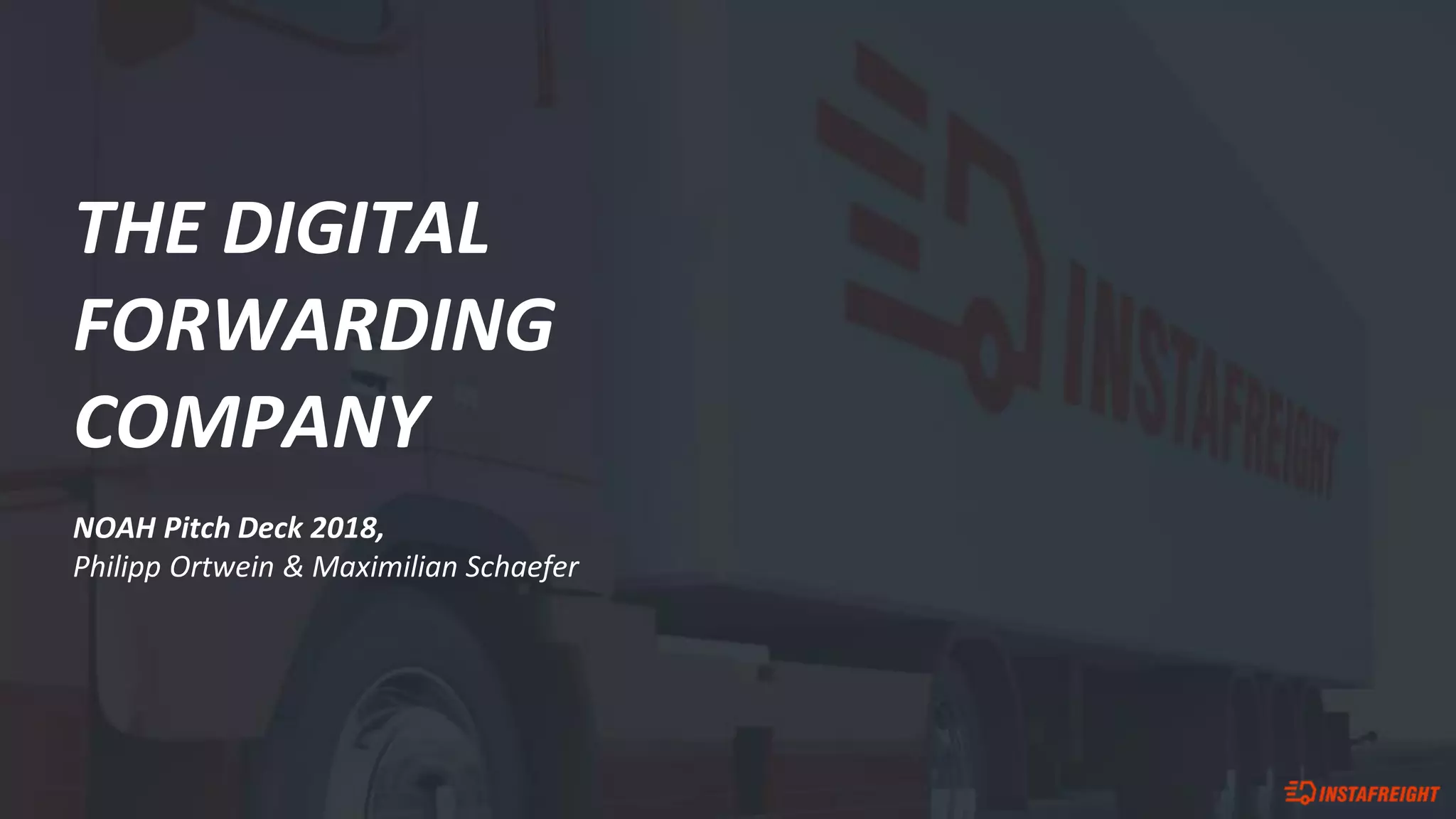
The deck opens with a clear declaration of identity: 'THE DIGITAL FORWARDING COMPANY.' It identifies the presenters as Philipp Ortwein and Maximilian Schaefer and notes the context as the NOAH Pitch Deck 2018. The background image of a truck with Instafreight branding establishes the industry immediately. The branding is consistent, using a high-contrast orange and white color scheme that persists throughout the deck.
Slide 2 and 3: The Visual Hook
Slide 2 features a high-resolution image of a customized Western Star truck (reminiscent of Optimus Prime), likely used as a visual metaphor for the 'transformation' of the trucking industry. Slide 3 shifts to a Star Wars theme, depicting Imperial Starfighters in space. This is a creative way to visualize market share. It labels the ships with major incumbents: DB Schenker (3%), DHL (0.5%), and Kuehne + Nagel (0.2%). The vastness of space represents the remaining 96.3% of the market, effectively illustrating that no single player dominates the European freight landscape.
Slide 6: The Problem Statement
This slide breaks down the 'great challenges' facing the freight forwarding market. It lists six specific pain points: fragmentation, lack of density (empty back loads), excessive intermediaries, non-digital communication, opaque pricing, and low quality. The right side of the slide shows the 'inefficient value chain,' a downward staircase of six entities: Customer -> Broker -> Forwarder -> Carrier -> Subcontr. -> Driver. This visualizes how margin is eroded and communication is diluted before the service is actually performed.
Slide 7: The Solution - The Digital Layer
Instafreight introduces itself as the 'next generation digitized forwarding company.' The slide uses a three-column layout to show how the platform sits in the middle of the ecosystem. On the left, Shippers connect via Web, API, or SAP ERP. In the center, Instafreight provides the 'One-stop shop,' 'Real-time pricing engine,' and 'Automated load matching.' On the right, Carriers and Networks connect via Web, Mobile app, or system integration. This slide successfully explains the product architecture without needing deep technical jargon.
Slide 8: Product Transparency
This slide provides a glimpse into the user interface. It shows a 'Track and Status' map view for order management and mobile app screenshots for drivers. The mobile screens show 'Available jobs' with specific pricing (e.g., 'Take job now for 141.00€') and a step-by-step checklist for the driver (e.g., 'On the way to pick up cargo'). This proves the 'fully digitized processes' mentioned in the previous slide are functional and user-friendly.
Slide 14: The Economics of the Platform
This is arguably the most important slide in the deck. It provides a detailed breakdown of 'Order- and Acquisition Economics' for Q1. For Full Truck Load (FTL), the Average Order Value (AOV) is 600€ with an 8-12% margin, resulting in a 60€ contribution per order. With 2-3 orders per month, the monthly contribution is 180€. Given a 300€ acquisition cost, the break-even is 2-3 months. For Part Truck Load (LTL), the AOV is 200€, but the margin is higher (10-14%), leading to a break-even in less than 2 months. The slide also notes that customers are 'very sticky' and that fixed contracts secure volume with larger clients.
Slide 16: Contact Information
The final slide provides direct email addresses for Maximilian Schaefer and Philipp Ortwein, the company website (instafreight.de), and the physical address in Berlin, Germany. It maintains the dark, truck-themed background from the title slide, closing the loop on the presentation's visual identity.
What Works in This Deck
1. Extreme Clarity on Unit Economics: Most decks hide their margins and CAC (Customer Acquisition Cost). Instafreight puts them in a clear table on Slide 14. This builds immediate trust with sophisticated investors who understand that marketplace businesses live or die by these ratios.
2. Market Fragmentation Visualization: The use of the Star Wars 'Star Destroyers' to show that even DHL only owns 0.5% of the market is a brilliant way to show the 'Size of the Prize.' It turns a boring statistic into a memorable visual narrative.
3. Identifying the 'Hidden' Value Chain: By listing the six layers of the traditional freight process (Slide 6), the founders clearly identify where the 'waste' is that they intend to capture as profit.
What is Missing
1. The Team Slide: In this 8-slide selection, there is no information about the founders' backgrounds or why they are the right people to solve this problem. While their names are on the first and last slides, their pedigree is omitted.
2. A Funding Ask: The deck describes the business but does not state how much capital is being raised or what that capital will be used for (e.g., geographic expansion, R&D, or marketing).
3. Competitive Landscape (Digital): While the deck mentions traditional incumbents like DHL, it does not address other digital-first competitors who were emerging in the European market around 2018. Investors would want to know how Instafreight differs from other 'Uber for Trucking' clones.
What a Founder Should Copy
1. The 'Month to Break Even' Metric: If you are running a marketplace or a high-transaction business, calculate your CAC and your monthly contribution margin per customer. If you can show a payback period of less than 3 months, as Instafreight does on Slide 14, you have a very compelling case for scalability.
2. Integration Proof: Slide 7 mentions an 'SAP ERP' integration. For B2B startups, showing that you plug into the existing 'systems of record' (like SAP, Salesforce, or Oracle) is a powerful way to signal that your product is enterprise-ready and has low friction for adoption.
3. Specificity in Product Shots: Instead of showing a generic landing page, Slide 8 shows the actual workflow: a map for the manager and a 'Take job' button for the driver. This makes the abstract concept of 'digitized forwarding' feel concrete and real.
Frequently asked questions
- What is Instafreight's core value proposition?
- Instafreight acts as a digital freight forwarding company that simplifies the logistics process. According to Slide 7, they provide a 'one-stop shop for road freight' by offering real-time pricing, fully digitized processes, and automated load matching. They bridge the gap between shippers (using Web, API, or SAP ERP) and carriers (using Web or Mobile apps) to eliminate the traditional, opaque layers of brokerage.
- How does Instafreight make money?
- Based on the unit economics provided on Slide 14, the company earns a margin on every shipment. For Full Truck Loads (FTL), they earn a margin of 8-12% on a 600€ AOV. For Part Truck Loads (LTL), the margin is slightly higher at 10-14% on a 200€ AOV. They also mention recurring revenue through a subscription business model and fixed contracts with larger clients.
- What market problem is the company solving?
- Slide 6 identifies six major market challenges: high fragmentation, lack of density (back loads), too many intermediaries, non-digital communication, opaque pricing, and low quality. The deck argues that these factors lead to an inefficient value chain where information and margin are lost as a shipment passes from a customer through brokers, forwarders, and carriers before reaching the driver.
- Who are Instafreight's main competitors according to the deck?
- Slide 4 identifies the 'incumbents' as DB Schenker, Kuehne + Nagel, and DHL. However, the slide uses these names to highlight market fragmentation rather than direct competition; it notes that even these giants only control 3.7% of the market combined, suggesting a massive 'long tail' of smaller operators that Instafreight aims to aggregate.
- What are the acquisition costs and payback periods?
- Slide 14 reveals that the acquisition cost for an FTL customer is 300€, while an LTL customer costs 150€. Because the contribution per order is 60€ (FTL) and 25€ (LTL), and customers place multiple orders per month, the company achieves break-even on acquisition costs in 2-3 months for FTL and under 2 months for LTL.