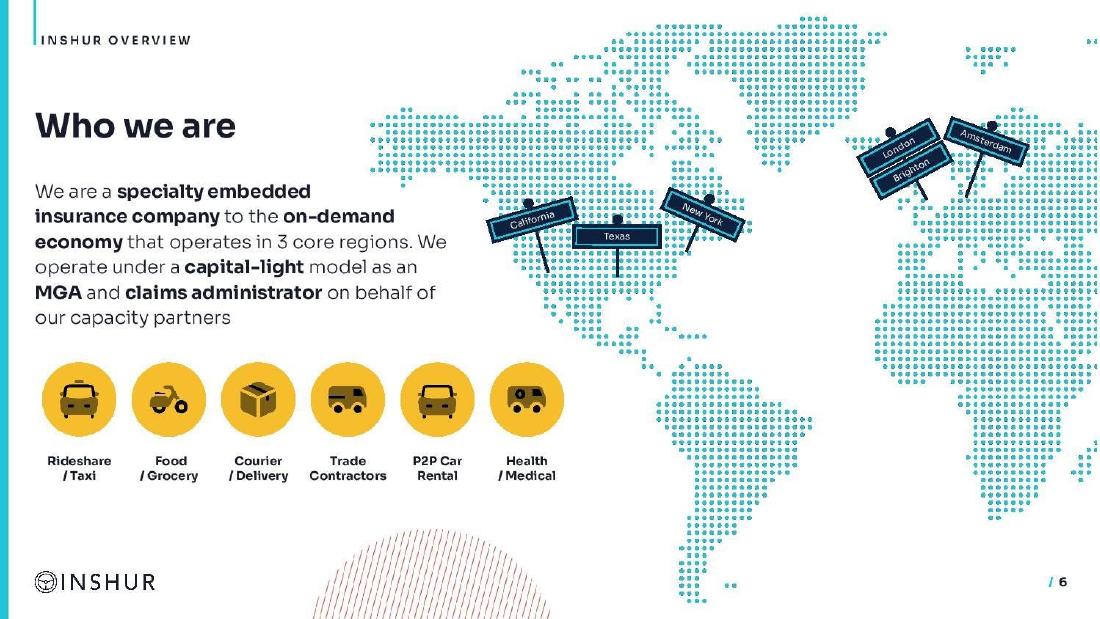
Inshur’s 16-slide deck for their $19M Series B round is a highly professional exercise in market positioning. Rather than just pitching a product, Inshur pitches a new category: 'InsurTech 2.0.' The deck highlights a massive $35 billion premium opportunity by 2025, driven by a 19.9% CAGR in delivery and mobility platforms. The narrative focuses on moving away from the high-burn, direct-to-consumer models of the past toward a capital-light, embedded partnership model. While the deck lacks a traditional team slide or a detailed breakdown of the $19M use of funds, its strength lies in its clear…
Key takeaways
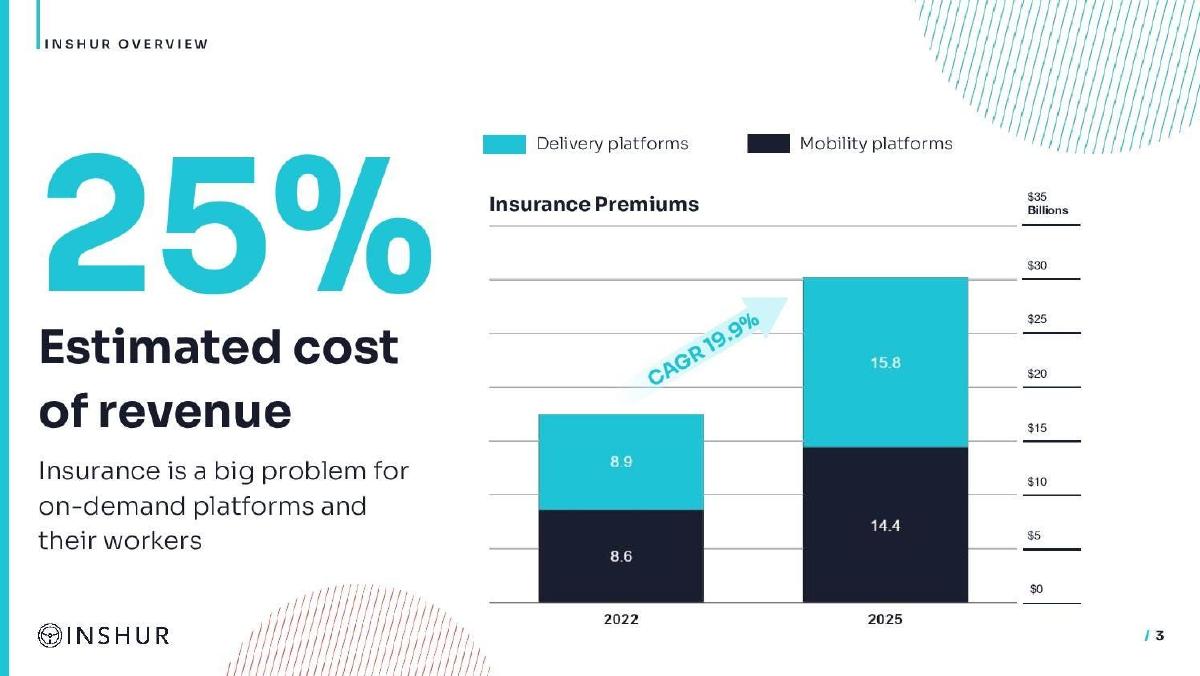
- Inshur positions insurance as a critical cost center for gig platforms, representing 25% of the estimated cost of revenue on slide 3.
- The deck forecasts a total insurance premium market of $35 billion by 2025, split between delivery ($15.8B) and mobility ($14.4B) on slide 3.
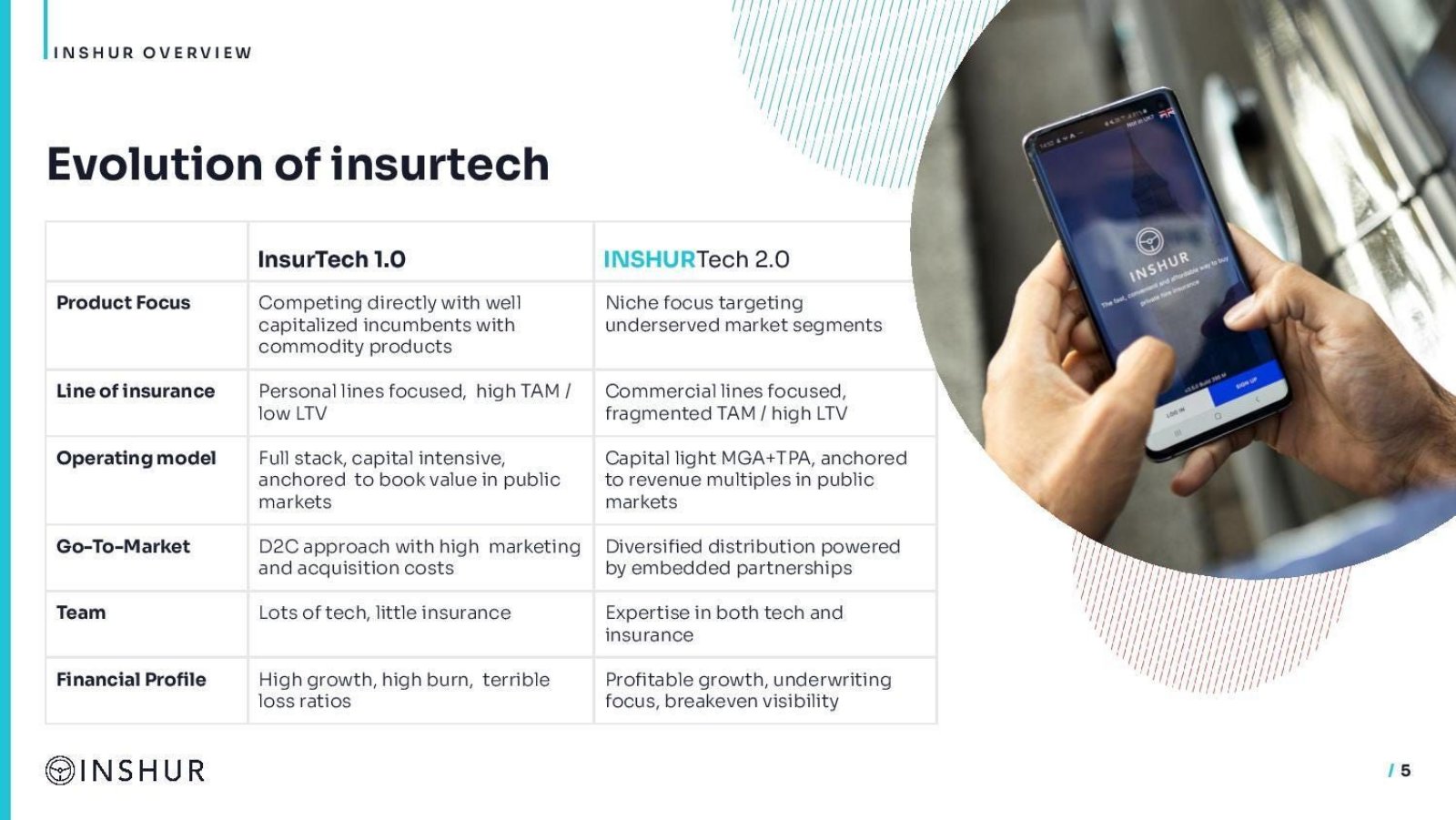
- Slide 5 introduces the 'InsurTech 2.0' framework, contrasting Inshur’s capital-light MGA+TPA model against the 'terrible loss ratios' of InsurTech 1.0.
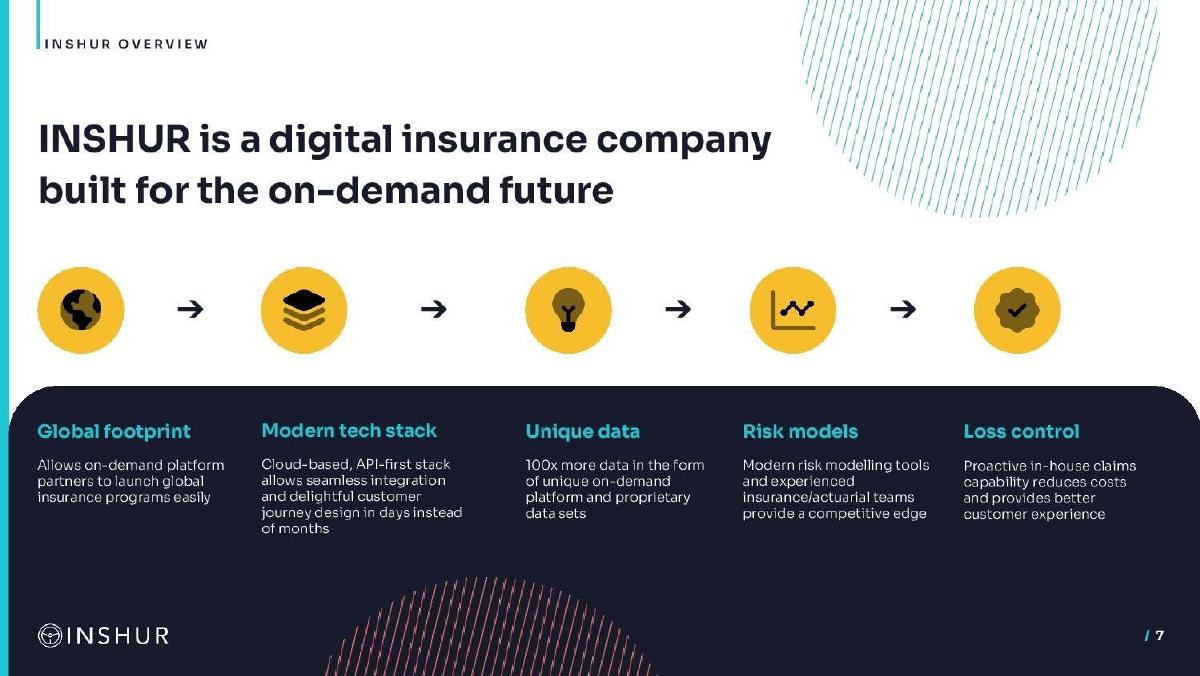
- The company claims a data advantage on slide 7, stating they have 100x more data through unique on-demand platform and proprietary data sets.
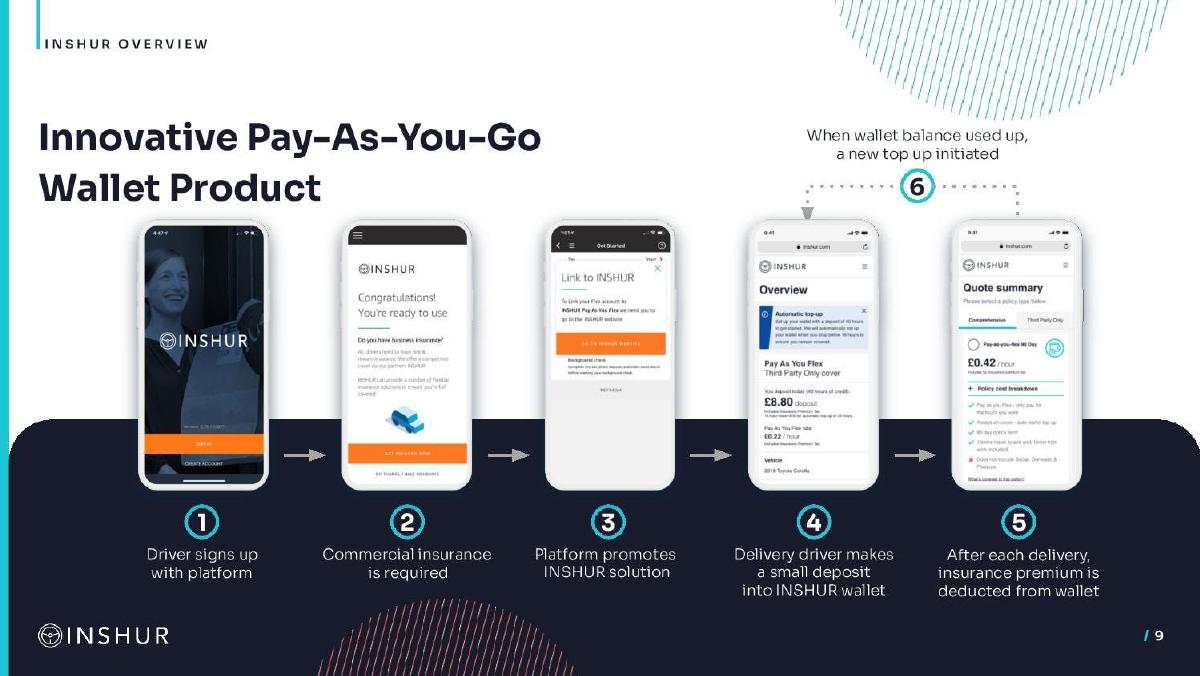
- The product walkthrough on slide 9 demonstrates a 6-step embedded journey, from driver sign-up to automatic premium deduction via a digital wallet.
- Market trends on slide 13 highlight that 77% of on-demand drivers have multiple income streams, justifying a flexible, cross-platform insurance product.
- According to slide 15, 26% of drivers believe platforms should offer better insurance pricing, providing a clear mandate for Inshur’s B2B2C distribution model.
- The deck omits a dedicated team slide, financial historicals, and a specific 'Ask' slide detailing the $19M round terms.
The Strategic Positioning of InsurTech 2.0
Inshur’s 2024 Series B deck is a masterclass in narrative-driven fundraising. At a time when many first-generation insurtech companies have struggled with high loss ratios and unsustainable customer acquisition costs, Inshur uses its deck to distance itself from those failures. By categorizing the industry into '1.0' and '2.0,' they frame their business model not just as a startup, but as the logical evolution of a flawed industry. The deck, reported by Business Insider to have raised $19M, focuses heavily on the massive scale of the gig economy and the specific pain points of its workers.
Slide 1-2: Brand Identity
The deck opens with a clean, dark-themed title slide featuring the company logo and the tagline: Insurance for the on-demand future . The year 2024 is clearly marked. The visual language is consistent throughout, using a professional palette of navy, teal, and coral. The imagery immediately centers on the end-user: a delivery driver with a smartphone and packages, grounding the high-level fintech concept in a real-world use case.
Slide 3: The $35 Billion Problem
Slide 3, titled INSHUR OVERVIEW , presents the core market opportunity. It leads with a large 25% figure, identified as the Estimated cost of revenue that insurance represents for on-demand platforms. This is a powerful hook; it frames insurance not as a peripheral service, but as a primary blocker to platform profitability. The slide includes a bar chart showing insurance premiums growing from $17.5 billion in 2022 to a projected $35 Billion in 2025, representing a CAGR of 19.9% . The market is split almost evenly between Delivery platforms ($15.8B) and Mobility platforms ($14.4B) , showing that Inshur has a massive, diversified TAM.
Slide 5: The 'InsurTech 2.0' Manifesto
This is arguably the most important slide in the deck. Inshur uses a comparison table to contrast InsurTech 1.0 with INSHURTech 2.0 . They characterize the previous generation as having 'terrible loss ratios,' 'high burn,' and 'lots of tech, little insurance.' In contrast, Inshur claims a Niche focus , a Capital light MGA+TPA operating model, and Profitable growth . By highlighting their 'Expertise in both tech and insurance,' they address a common investor criticism of fintech: that founders often understand the software but fail to respect the underlying actuarial risk.
Slide 7: The Value Proposition
Slide 7 outlines the five pillars of the Inshur platform: Global footprint , Modern tech stack , Unique data , Risk models , and Loss control . The most significant claim here is under 'Unique data,' where the company asserts it has 100x more data in the form of unique on-demand platform and proprietary data sets. This suggests a defensive moat; by integrating directly with platforms like Uber or DoorDash, Inshur can price risk more accurately than a legacy insurer who only sees a driver's personal history.
Slide 9: Product Walkthrough - The Digital Wallet
Slide 9 provides a visual 6-step flow of the Innovative Pay-As-You-Go Wallet Product . The journey starts with a driver signing up for a platform and being prompted that commercial insurance is required. The platform then promotes the INSHUR solution. The driver makes a small deposit into a digital wallet, and after each delivery, insurance premium is deducted from the wallet . The slide also shows an automatic top-up feature once the balance is depleted. This is a clear demonstration of 'embedded finance'—the insurance is invisible, frictionless, and tied directly to the driver's revenue-generating activity.
Slide 11-15: Market Trends and Driver Insights
The final section of the deck focuses on the 'why now' through the lens of driver behavior. Slide 13 notes that 77% of on-demand economy drivers have other income streams , emphasizing the need for flexible insurance that doesn't charge a flat monthly fee for a part-time job. It also includes a demographic insight: drivers from minority backgrounds (81%) are more likely to be employed in addition to driving. Slide 15 brings it back to the B2B2C opportunity, stating that 26% of drivers want platforms to offer better insurance pricing and 25% want advice/assistance. This data justifies Inshur’s partnership-led go-to-market strategy; the platforms have the audience, and the audience is asking for this specific product.
What Inshur Does Well
The deck excels at category creation . By explicitly defining 'InsurTech 2.0,' Inshur preemptively answers questions about why they will succeed where others (like Root or Metromile) have faced public market struggles. They move the conversation away from 'disrupting insurance' to 'enabling the gig economy.'
The visual clarity of the product slide (Slide 9) is also a major strength. Many fintech decks stay at a high level of abstraction, but Inshur shows exactly how the money flows from the driver to the wallet to the premium. This builds confidence in the technical execution of the 'embedded' promise.
Finally, the use of third-party data (BLS) combined with their own proprietary findings creates a balanced argument. They aren't just saying the market is big; they are showing that they understand the specific financial pressures on their end-users, which is critical for a product aimed at the 'underbanked' or gig worker segment.
What is Missing from the Deck
The most glaring omission is a Team Slide . In a Series B round, the pedigree of the leadership team—specifically their experience in handling insurance capacity and regulatory hurdles—is usually a top-three concern for investors. While the text mentions 'Expertise in both tech and insurance,' there are no faces or names to back this up in the 16-slide sequence provided.
There is also a lack of Financial Traction . While the market growth is shown, the deck does not explicitly state Inshur’s own Revenue, Gross Written Premium (GWP), or Loss Ratio history. For a company claiming to be 'InsurTech 2.0' (which they define as having 'breakeven visibility'), showing the actual path to that breakeven would have been a powerful addition.
Lastly, there is no Competitive Landscape slide. The gig insurance space has other players (such as Zego in the UK or Buckle in the US). A slide showing how Inshur’s tech stack or data integrations specifically outperform these direct competitors would have rounded out the 'Unique data' claim.
Founder Takeaways
Define your era: If your industry has seen recent high-profile failures, don't ignore them. Create a '2.0' framework that explains why your model is different and how you've learned from the '1.0' mistakes. · Focus on the 'Cost of Revenue': If you are selling a B2B or B2B2C product, show how much of your partner's revenue is currently being eaten by the problem you solve. The 25% figure on slide 3 is a perfect example of a 'burning platform' metric. · Show the flow: Don't just say you have a 'wallet' or 'API.' Show the user journey from sign-up to payment. It makes the technology feel real and ready to scale. · Use demographic data to prove need: Inshur’s use of driver sentiment data (Slide 15) proves that there is 'pull' from the end-user, not just 'push' from the startup. This is vital for proving product-market fit.
Frequently asked questions
- What is the core problem Inshur is solving?
- Inshur addresses the high cost and friction of insurance for the gig economy. As shown on slide 3, insurance accounts for 25% of the cost of revenue for on-demand platforms. Traditional insurance is often too rigid for drivers who work across multiple apps or part-time. Inshur provides an embedded, pay-as-you-go solution that adjusts to the driver's actual activity.
- How does Inshur differentiate itself from first-generation insurtechs?
- On slide 5, Inshur defines itself as 'InsurTech 2.0.' Unlike 1.0 companies that focused on personal lines and high-burn D2C marketing, Inshur focuses on commercial lines, uses a capital-light MGA (Managing General Agent) model, and leverages embedded partnerships for distribution to keep acquisition costs low and loss ratios stable.
- What does the 'Pay-As-You-Go Wallet' actually do?
- Slide 9 illustrates a digital wallet where drivers make a small deposit. As they complete deliveries or rides, the insurance premium is automatically deducted from the wallet. When the balance is used up, a new top-up is initiated. This ensures drivers are only paying for insurance while they are actually working and earning.
- What are the key market drivers mentioned in the deck?
- The deck cites a 19.9% CAGR in insurance premiums for the on-demand sector (slide 3) and specific driver demographics. Slide 13 notes that 77% of drivers have other income streams, and slide 15 highlights that a quarter of drivers actively want their platforms to provide better insurance assistance and pricing.
- What information is missing from the Inshur pitch deck?
- The deck is notably missing a team slide, which is unusual for a Series B. It also lacks a detailed slide on unit economics (CAC/LTV), a competitive landscape map, and a specific breakdown of how the $19M will be spent. These details were likely handled in a supplemental data room rather than the primary pitch narrative.