Instamojo’s 2013 pre-seed deck is a textbook example of how to pitch a product-led growth story before 'PLG' was a buzzword. The 14-slide deck focuses heavily on the friction of existing e-commerce solutions, contrasting them against a three-step 'Upload, Share, Sell' workflow. The most compelling data point is a stated 9% conversion rate, which the deck claims is 6x higher than the average e-commerce website. By combining this high-intent metric with a team that boasted experience at Amazon, PayPal, and Microsoft, Instamojo successfully raised $500,000. The deck is light on financial project…
Key takeaways
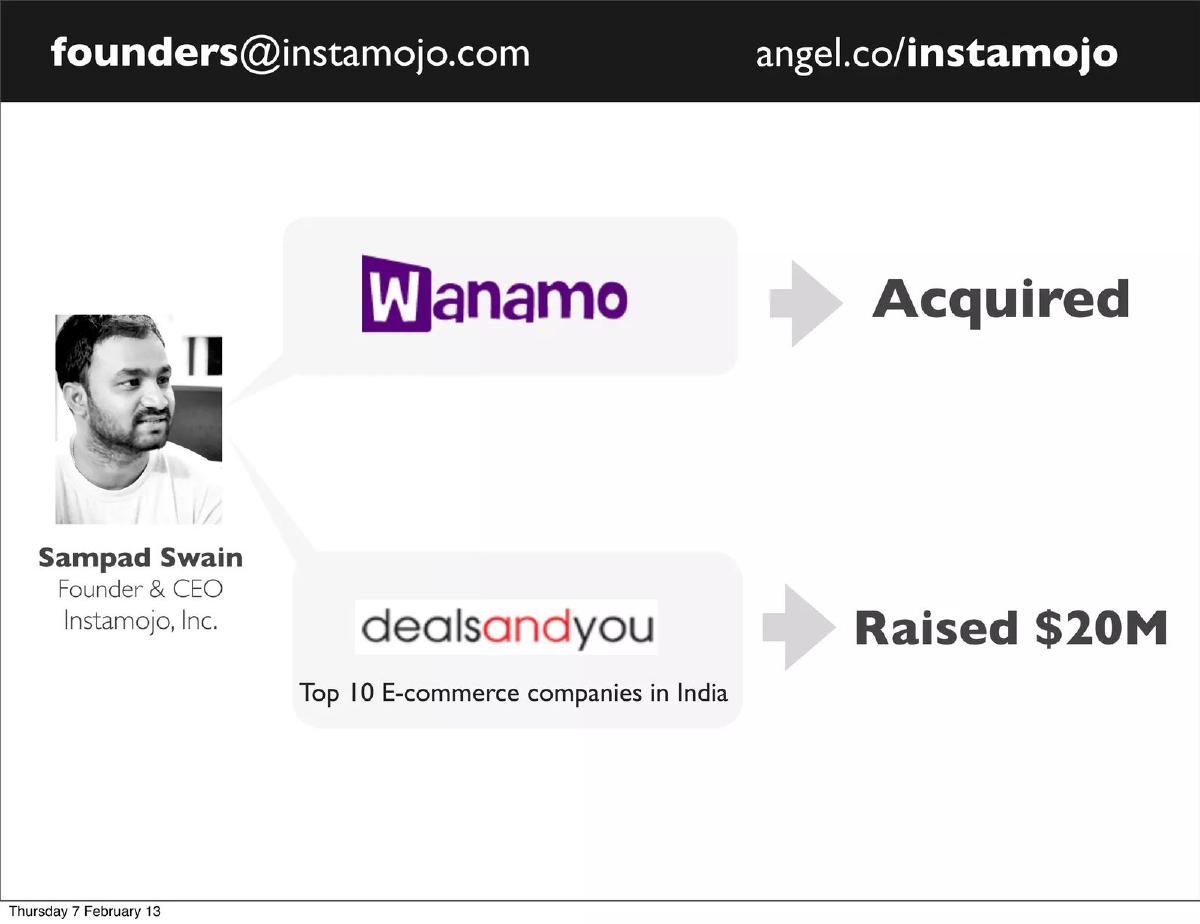
- The deck leads with founder credibility, highlighting a previous acquisition (Wanamo) and a $20M raise (dealsandyou) on slide 2.
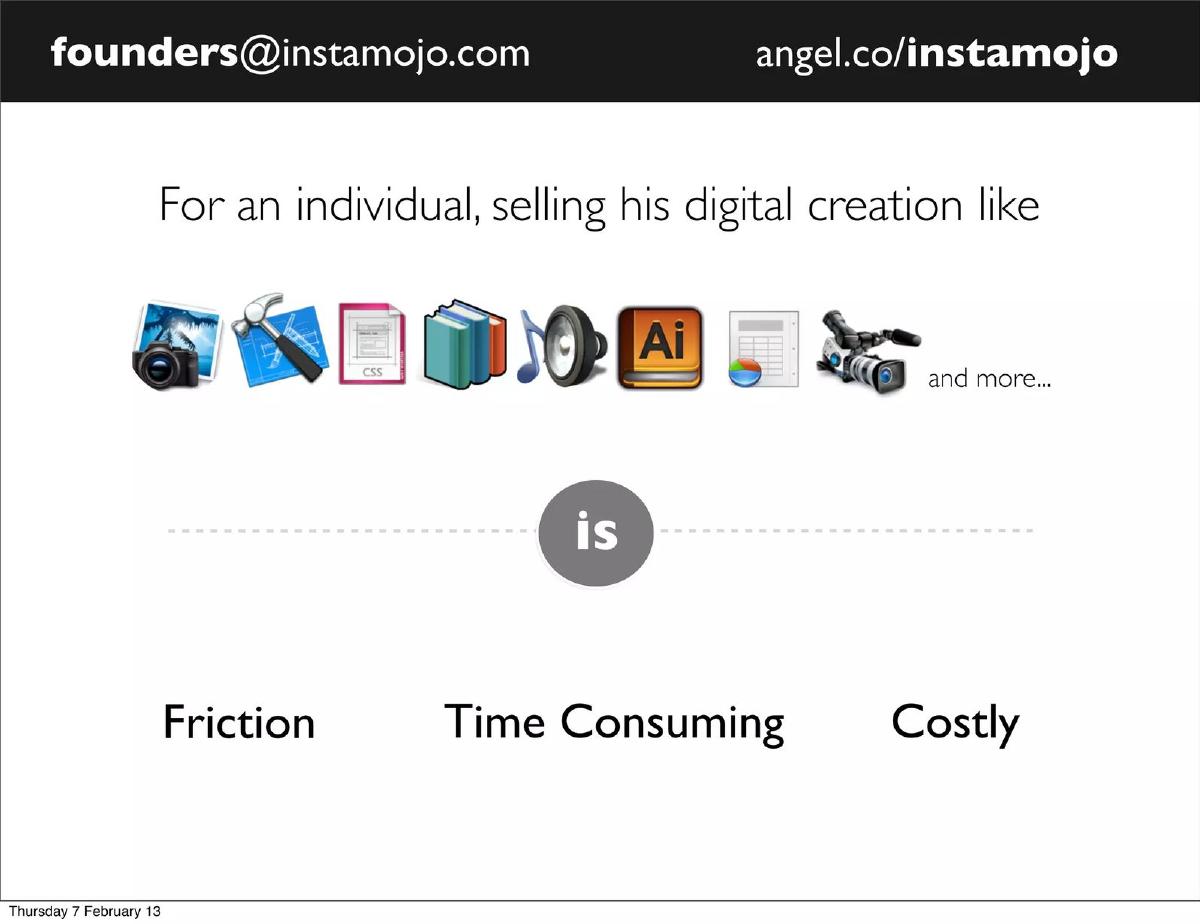
- It identifies friction, time, and cost as the primary barriers for individuals selling digital creations on slide 3.
- A 9% conversion rate is the central 'hero metric,' positioned as 6x the industry average on slide 7.
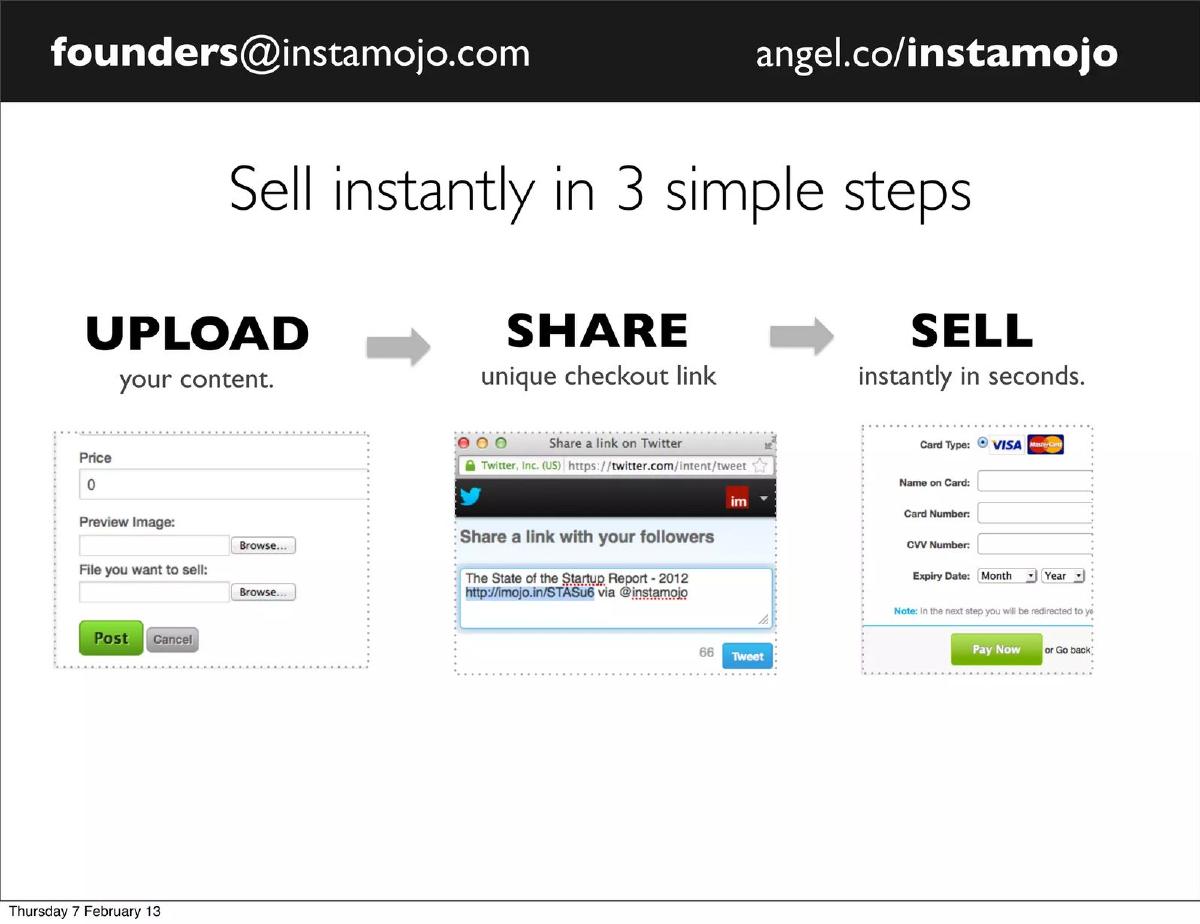
- The product is simplified into a three-step process: Upload, Share, and Sell via a unique link on slide 6.
- Traction is demonstrated through a 100% revenue growth chart covering September 2012 to January 2013 on slide 10.
- Merchant acquisition costs (MAC) are shown to be trending downward over a four-month period on slide 9.
- The market size for digital goods is projected to reach $36 billion by 2014, citing JP Morgan and WSJ on slide 11.
- The team slide emphasizes 20+ years of collective experience at major tech firms like Google, Amazon, and PayPal on slide 12.
Introduction: The Power of the Frictionless Link
In 2013, the e-commerce landscape in India was dominated by complex marketplaces and cumbersome payment gateways that required significant technical integration. Instamojo entered the market with a radically different premise: selling online should be as easy as sharing a link. This teardown examines the 14-slide deck that secured $500,000 in pre-seed funding, a round that eventually paved the way for the company to raise over $8.4 million and become a staple of the Indian FinTech ecosystem.
Slide 1: The Hook
The cover slide is minimalist, featuring the Instamojo logo and the tagline: "We make Selling Online as Easy as Sharing." By emphasizing the word "Sharing," the founders immediately signal that their product is social, lightweight, and modern. The inclusion of the AngelList URL and a direct founder email address at the top of every slide is a tactical choice that makes the deck feel accessible and ready for investor due diligence.
Slide 2: Founder Pedigree
Instamojo chooses to lead with the team, specifically CEO Sampad Swain. This is a common strategy for pre-seed decks where the product might still be evolving, but the founder's ability to execute is proven. The slide highlights two major milestones: the acquisition of Wanamo and a $20M raise for dealsandyou, which is noted as a "Top 10 E-commerce company in India." This establishes Swain not just as a founder, but as a founder who understands the specific market (e-commerce) they are disrupting.
Slides 3-4: The Problem of Friction
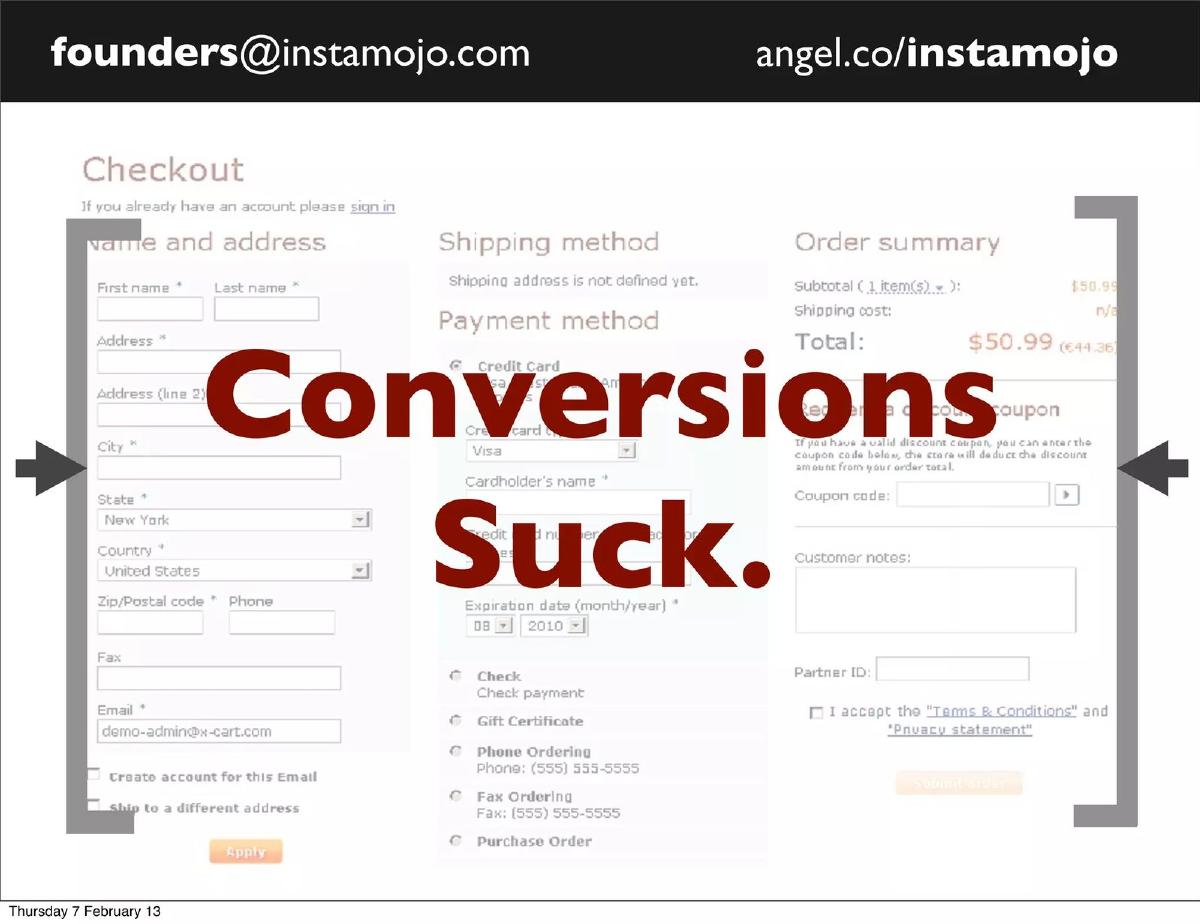
Slide 3 uses icons for photos, code, books, and music to define "digital creations." It identifies three pain points: Friction, Time Consuming, and Costly. Slide 4 is the emotional peak of the problem section. It shows a cluttered, multi-field checkout form with the bold text "Conversions Suck." overlaid. This is a highly effective slide because it visualizes the exact pain point—the drop-off caused by complexity—that Instamojo intends to solve.
Slides 5-6: The Three-Step Solution
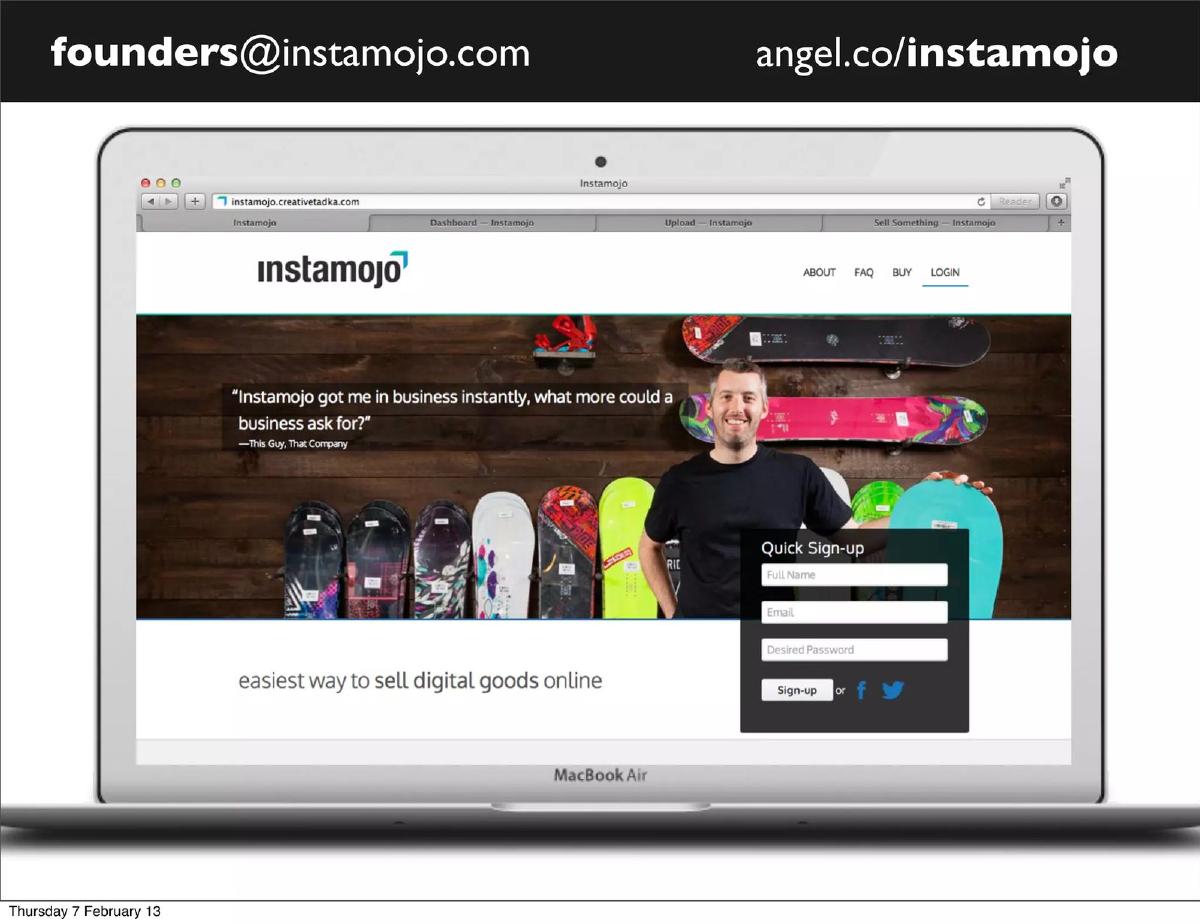
Slide 5 provides a clean product shot on a MacBook Air, framing Instamojo as the "easiest way to sell digital goods online." Slide 6 breaks down the mechanics into three steps: UPLOAD, SHARE, and SELL. The screenshots show a simple file uploader, a Twitter share box, and a minimal payment form. By showing the UI, the founders prove that they have already built a functional alternative to the "sucking" conversions shown on the previous slide.
Slide 7: The Hero Metric
This is arguably the most important slide in the deck. It presents a simple equation: Instamojo 9% conversion = 6x More than average E-commerce websites. In the world of FinTech and e-commerce, a 9% conversion rate is exceptionally high. By anchoring the pitch to this specific number, Instamojo moves the conversation from "this is a nice idea" to "this is a high-performance engine."
Slides 8-10: Traction and Unit Economics
Slide 8 shows the analytics dashboard, emphasizing that the platform provides "Powerful analytics behind every link." This suggests that Instamojo is not just a payment processor, but a business management tool. Slide 9 displays a declining bar chart for Merchant Acquisition Costs (MAC) from October 2012 to January 2013. A declining MAC is a primary indicator of organic growth and viral loops. Slide 10 follows this up with a +100% Revenue Growth chart. While the Y-axis lacks specific dollar amounts, the upward trajectory across five months provides the necessary momentum for a pre-seed raise.
Slide 11: Market Size
The deck narrows its focus to the "Worldwide Digital Goods Market." Citing JP Morgan and the Wall Street Journal, it shows a market growing from $16 billion in 2010 to $36 billion in 2014. By focusing on digital goods rather than the entire e-commerce market, the founders make their 9% conversion rate claim more believable—digital goods are easier to convert than physical ones, and this slide justifies their niche entry point.
Slide 12: The Full Team
The team slide reinforces the technical and operational depth of the company. It lists roles (CTO, Bizdev, Engineer, UI/UX) and logos for Amazon, PayPal, Microsoft, and Georgia Tech. The mention of "20+ years of experience" combined with the PayPal logo is particularly relevant for a FinTech startup, as it suggests the team understands the regulatory and technical hurdles of payments.
Slide 13: The Ask
The final substantive slide is clear and direct. They are Raising $500,000 , with $250,000 Committed. The inclusion of logos for Google, 500 Startups, and Blume Ventures provides the ultimate social proof. For an investor looking at the remaining $250,000, the risk feels significantly lower knowing that 500 Startups has already vetted the deal.
What Works in This Deck
Metric Focus: The 9% conversion rate is a brilliant anchor. It is a specific, measurable outcome that directly solves the problem stated earlier in the deck. · Visual Contrast: The deck does a great job of contrasting the "old way" (messy forms) with the "new way" (clean links). · Social Proof: Leading with a successful founder and ending with committed high-profile investors creates a "winning" narrative that is hard for investors to ignore. · Simplicity: The three-step process (Upload, Share, Sell) makes a complex financial transaction feel as simple as a social media post.
What Is Missing
Business Model Details: The deck mentions revenue growth but never explicitly states the take rate or fee structure. While it is implied to be a transaction fee, a slide on unit economics would have added clarity. · Competitive Landscape: There is no mention of competitors like Gumroad (which launched around the same time) or traditional gateways. The deck assumes the investor agrees that the current way "sucks" without acknowledging other innovators in the space. · Regulatory/Compliance Strategy: In the Indian FinTech market, regulatory hurdles are significant. The deck ignores the legal complexities of payment processing, which is a common omission in early-stage decks but a frequent point of friction in due diligence.
What a Founder Should Copy
The "Problem Overlay": Using a screenshot of a competitor's bad UX and overlaying a bold, provocative statement like "Conversions Suck" is a powerful way to build empathy for the user. · The "Committed" Ask: Never go into a pitch without mentioning what is already committed. It creates a sense of urgency and validation. · The Hero Equation: If you have one metric that is significantly better than the industry average, turn it into a large, simple equation like Slide 7. Don't bury your best data in a table. · Pedigree Logos: If your team has worked at name-brand companies, use the logos. They act as a shorthand for quality and reduce the perceived risk of the investment.
Frequently asked questions
- What was the primary value proposition of Instamojo in this deck?
- The primary value proposition was removing the friction of selling digital goods online. The deck contrasts the 'sucking' conversion rates of traditional, complex checkout forms with Instamojo’s three-step process: upload content, share a link, and sell instantly. By reducing the checkout process to a simple link, they claimed to achieve a 9% conversion rate, significantly higher than traditional e-commerce platforms.
- How did the founders establish their authority in the FinTech space?
- The founders used two slides to establish credibility. Slide 2 focuses on CEO Sampad Swain’s track record, noting a prior acquisition and a $20M raise. Slide 12 highlights the broader team's pedigree, listing 20+ years of experience at top-tier institutions like IIT Bombay, Amazon, PayPal, and Microsoft. This combination of entrepreneurial success and technical experience at scale was crucial for a pre-seed raise.
- What specific metrics did Instamojo use to prove traction?
- Instamojo focused on three key growth metrics: revenue growth, conversion rates, and acquisition costs. Slide 10 shows a 100% revenue growth trend from late 2012 to early 2013. Slide 9 displays a bar chart showing a steady month-over-month decline in Merchant Acquisition Costs (MAC). Finally, slide 7 highlights a 9% conversion rate, which served as the proof of product-market fit.
- How did the deck define the market opportunity?
- The deck focused specifically on the 'Worldwide Digital Goods Market.' Using data from JP Morgan, GigaOM, and the Wall Street Journal, slide 11 illustrates a market growing from $16 billion in 2010 to a projected $36 billion in 2014. This narrow focus helped justify why a specialized tool for digital creators was necessary rather than a general-purpose e-commerce platform.
- What was the status of the fundraising round at the time of the deck?
- According to slide 13, the company was seeking a total of $500,000. At the time the deck was finalized, they had already secured $250,000 in commitments. The slide also lists high-profile logos including 500 Startups, Blume Ventures, and the Indian Angel Network, which served as powerful social proof to close the remaining half of the round.