The InOpen corporate presentation from August 2012 serves as a case study in leveraging institutional credibility to penetrate the fragmented Indian K-12 market. The deck centers on 'Computer Masti,' a computer science curriculum developed in collaboration with IIT Bombay. With a reported 300,000 students and 125+ schools across 5 states, the company demonstrated significant early traction. Financially, the deck claims a revenue of Rs 2.25 crore and break-even status in 2012, representing 3x growth from the previous year. While the deck excels at establishing pedagogical authority and social…
Key takeaways
- The company leverages a high-authority joint venture with IIT Bombay and HBCSE to establish immediate credibility in the education sector (Slide 10).
- InOpen achieved significant early scale, reaching 300,000 students and 125+ schools within 30 months of operation (Slide 2, Slide 10).
- The curriculum is localized for the Indian market, available in 8 Indian languages and 2 foreign languages (Slide 2).
- Financial performance was strong for the period, with Rs 2.25 crore in revenue and achieving profitability/break-even in 2012 (Slide 10).
- The team structure balances academic depth (PhD from IIT Bombay) with operational experience from Google and Teach for India (Slide 7).
- The deck identifies a specific pedagogical gap: the shift from teaching software syntax to teaching logical thinking and 21st-century skills (Slide 5).
- Global reach is hinted at through e-book downloads in more than 120 countries, though direct school sales remain focused on India (Slide 2).
- The presentation lacks a clear 'Ask' slide, missing details on funding requirements or valuation expectations.
Executive Summary: The Power of Institutional Backing
The InOpen corporate presentation from August 2012 is a masterclass in using institutional credibility to solve the 'trust gap' in the education sector. By positioning their flagship product, Computer Masti, as a collaborative effort with IIT Bombay, InOpen bypassed the typical skepticism faced by new curriculum providers. The deck focuses heavily on pedagogy and social proof, backed by impressive early-stage revenue and school penetration figures.
Slide 1: Title and Branding
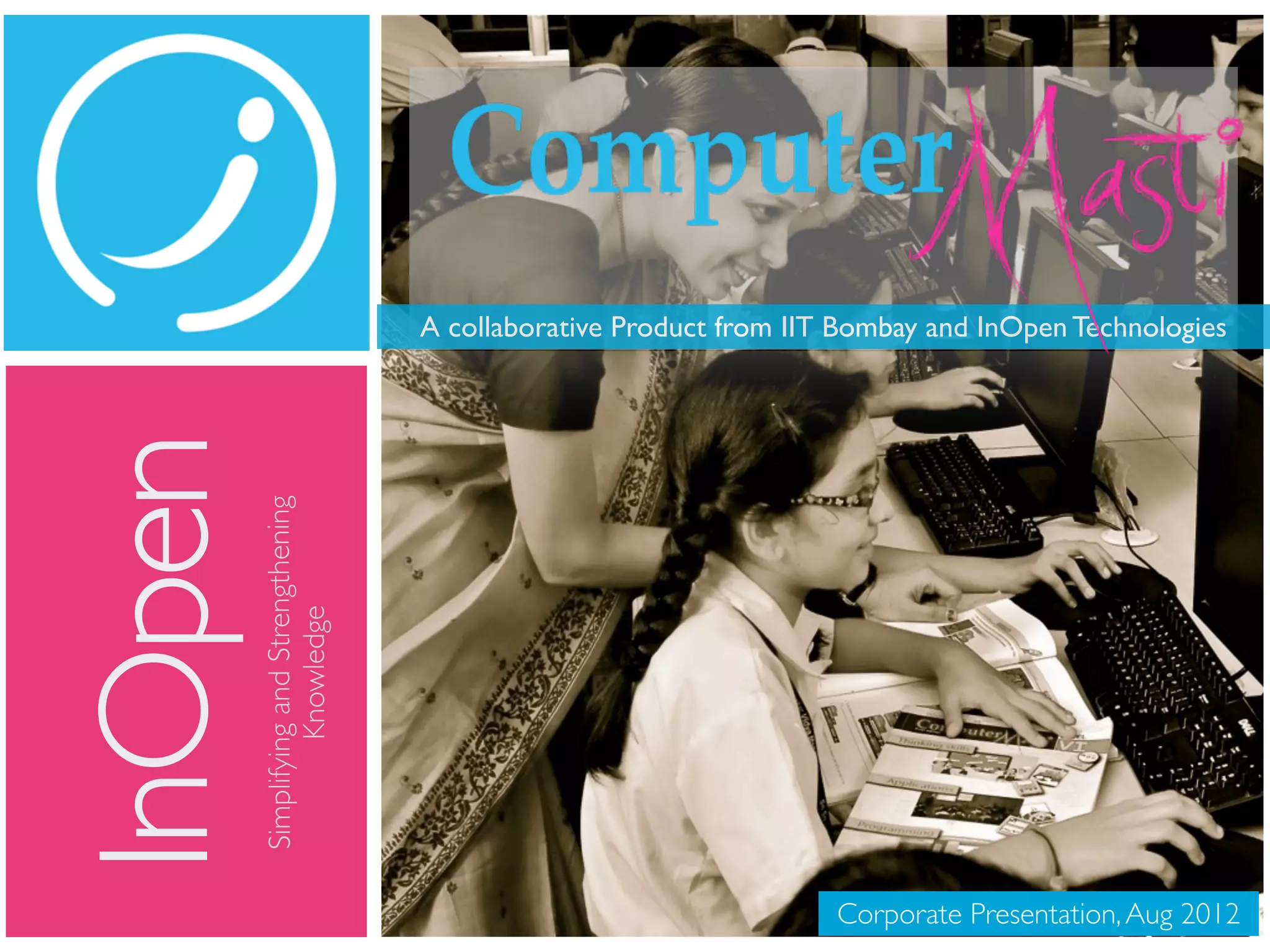
The cover slide immediately establishes the partnership between InOpen Technologies and IIT Bombay. The branding for 'Computer Masti' is prominent, featuring a playful font that contrasts with the formal 'Corporate Presentation' subtitle. The imagery of a teacher assisting a student in a computer lab sets the context for a B2B2C school-based model. The date, August 2012, anchors the metrics that follow.
Slide 2: Traction Highlights
This slide uses iconography to display four key metrics. First, it notes the curriculum is available in 8 Indian languages and 2 foreign languages, signaling market adaptability. Second, it claims 125+ schools as customers. Third, it states the product is directly used by 300,000 students and 2,000+ trained teachers. Finally, it mentions e-book downloads in over 120 countries, suggesting a global digital footprint despite a localized physical sales strategy.
Slide 3: The 'Why' - Problem Statement
InOpen identifies the problem as an 'overdose of information' that leaves students and teachers overwhelmed. They argue that while content exists, it lacks the 'right combination of cognitive, behavioral, and attitude' skills. The slide emphasizes a shift from memorization to thinking skills, setting the stage for their specific pedagogical approach.
Slide 4: Understanding the Current Scenario
Using an illustration of a classroom, this slide highlights common frustrations in computer education. Speech bubbles like 'Focus on Syntax,' 'Is my presentation jazzy?', and 'Programming Sucks' represent the superficial nature of existing computer classes. It effectively visualizes the pain points of an outdated curriculum that focuses on tools rather than logic.
Slide 5: Questioning the Current Scenario
This slide uses analogies to deepen the problem statement. It asks if knowing how to operate an email service is the same as knowing how to compose a letter, or if knowing MS-PPT syntax makes one an effective presenter. This logical framing prepares the reader for a solution that prioritizes 'thinking' over 'operating.'
Slide 6: The Solution - Computer Masti
Here, the company introduces the 'Computer Masti' (CM) curriculum. It defines the solution through three pillars: a standard curriculum with trained teachers, fun and engaging content to boost interest in science, and a 'constructivist pedagogical approach.' The mention of 'Scaffolded learning' signals that the product is built on established educational theories.
Slide 7: The Team
The team slide is strong on academic and operational credentials. It lists Rupesh Kumar Shah (CEO, IIM-C) and Prof. Sridhar Iyer (IIT Bombay Faculty). The inclusion of a PhD in Psychology for Learning and Research and two VPs with 'Teach for India' and 'Google' experience suggests a balance between pedagogical depth and modern corporate scaling tactics.
Slide 8 & 9: Social Proof and Field Activity
These slides are purely visual, showing students holding certificates from 'Computer Masti' summer camps and a 'Principal Conference.' These images serve to prove that the company isn't just a content producer but an active participant in the school ecosystem. It demonstrates real-world engagement with their two primary stakeholders: students and school administrators.
Slide 10: The 'Why Us' - Competitive Advantage and Financials
This is the most data-dense slide in the set. It reiterates the 'unfair advantage' of the IIT Bombay joint venture. Crucially, it provides financial data: Rs 2.25 crore in revenue, 3x growth from the previous year, and the achievement of break-even/profitability in 2012. It also notes the presence in 5 states across all school boards, proving the product's versatility.
What InOpen Does Well
Institutional Credibility: The deck never lets the reader forget the IIT Bombay connection. In the Indian education market, this is a massive differentiator that opens doors to school principals and boards that would otherwise be closed to a startup. Pedagogical Depth: Unlike many EdTech decks that focus solely on the 'app' or the 'tech,' InOpen spends significant time explaining how children learn. Terms like 'constructivist pedagogy' and 'scaffolded learning' appeal to the academic sensibilities of their B2B buyers. Early Profitability: Claiming break-even at a revenue of Rs 2.25 crore is a strong signal to investors that the company has a sustainable unit economic model and isn't just burning cash for growth.
What Is Missing from the Deck
The Ask: There is no slide indicating how much capital the company is looking to raise or what the funds will be used for. This suggests the deck may have been used for general corporate partnerships or that the 'Ask' was delivered in a separate document. Competitive Landscape: While they claim an 'advantage over competition,' they do not name specific competitors or provide a feature-comparison matrix. Unit Economics: We see total revenue, but we don't see the cost of acquisition (CAC) for a new school or the lifetime value (LTV) of a student contract. Future Roadmap: The deck shows where they are (125 schools), but not the specific plan to get to 1,000 schools or how the product will evolve technologically.
Founder's Playbook: Lessons to Steal
Leverage 'Unfair' Partnerships: If your startup is born out of a university or a research lab, make that the centerpiece of your pitch. InOpen uses the IIT Bombay logo and faculty names to provide a 'halo effect' of quality. Use Analogies to Explain Value: Slide 5's comparison between 'operating an email service' and 'composing a letter' is a brilliant way to explain a complex pedagogical shift in simple terms. Founders should use similar 'A is not B' logic to clarify their unique value proposition. Show, Don't Just Tell: The photos of the Principal Conference and the students with certificates (Slides 8 and 9) provide 'ground truth' that the business is operational and respected by its community. In B2B sectors, social proof is often more persuasive than a bar chart.
Frequently asked questions
- What is the core product offered by InOpen?
- The core product is 'Computer Masti,' a computer science curriculum developed as a collaborative product between IIT Bombay and InOpen Technologies. It focuses on scaffolded learning and a constructivist pedagogical approach, aiming to teach students logical thinking and programming concepts rather than just software operation.
- How does InOpen differentiate itself from other EdTech providers?
- InOpen differentiates itself through its 'unfair advantage'—a joint venture with IIT Bombay and the Homi Bhabha Centre for Science Education (HBCSE). This provides a level of academic validation that most private EdTech startups lack. Additionally, their content is available in 8 Indian languages, catering to a diverse national market.
- What were the company's financial milestones at the time of this deck?
- According to Slide 10, the company had clocked revenues of Rs 2.25 crore. They reported reaching break-even and becoming profitable in 2012, while achieving 3x growth compared to the 2010-11 period. This suggests a sustainable business model early in their lifecycle.
- What is the target market and current reach mentioned in the slides?
- The primary target is the K-12 school system in India. At the time of the deck (August 2012), they were in 125+ schools across 5 states, covering all educational boards. Their curriculum was used by 300,000 students, and they had trained over 2,000 teachers.
- Who are the key members of the leadership team?
- The team is led by Co-founder & CEO Rupesh Kumar Shah (MBA from IIM-C) and Co-founder Prof. Sridhar Iyer (CSE Faculty at IIT Bombay). The leadership includes VPs with backgrounds in Psychology (PhD from IIT Bombay), Teach for India, Google, and Kirloskar.