Hedra’s 9-slide Series A deck is a masterclass in 'pedigree-first' fundraising. In an era where AI foundation models often require hundreds of millions in capital, Hedra makes a bold claim on Slide 3: they developed their 'Character-3' model for under $2 million. The deck avoids traditional financial metrics and market sizing, focusing instead on the technical superiority of their omnimodal model and the high-signal backgrounds of their team members, who boast over 23,000 combined academic citations. By positioning themselves as the team to 'shatter the uncanny valley' (Slide 6), Hedra succes…
Key takeaways
- The deck explicitly highlights capital efficiency, stating on Slide 3 and Slide 8 that the entire model was developed for under $2 million.
- Hedra positions its 'Character-3' model as the world's first omnimodal foundation model in production (Slide 3).
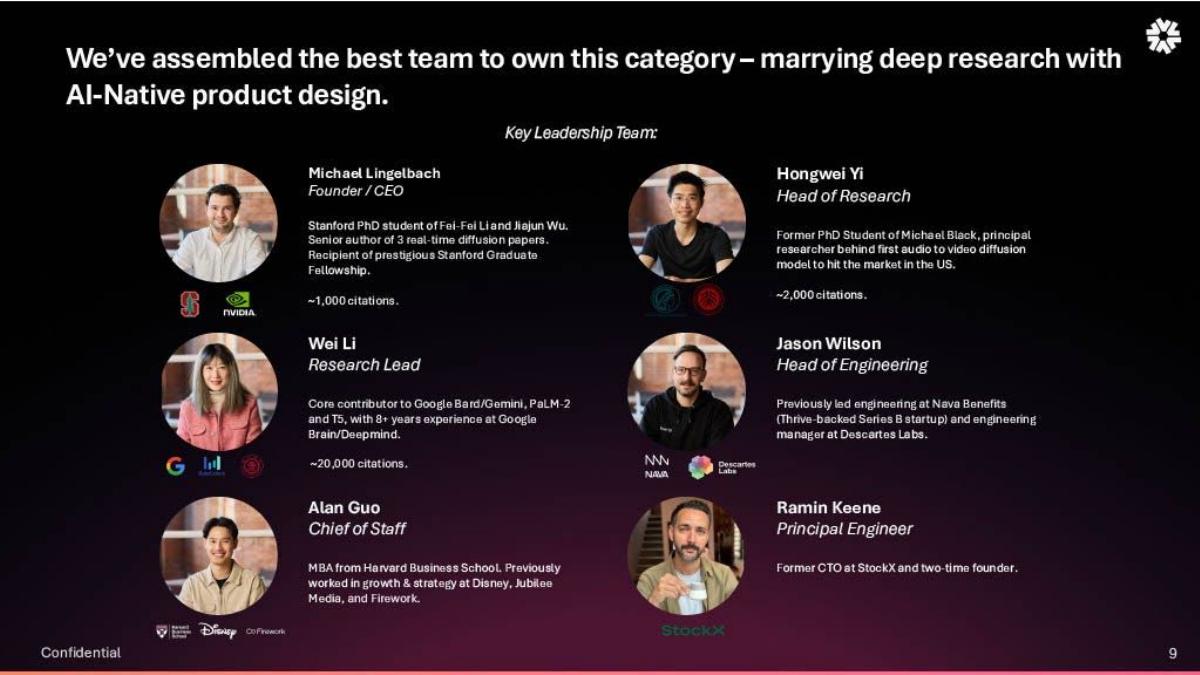
- The team slide (Slide 7) uses academic citations as a primary metric of credibility, listing figures like ~20,000 citations for their Research Lead.
- The company identifies three distinct customer segments: Consumers, Prosumers, and Marketing Teams (Slide 4).
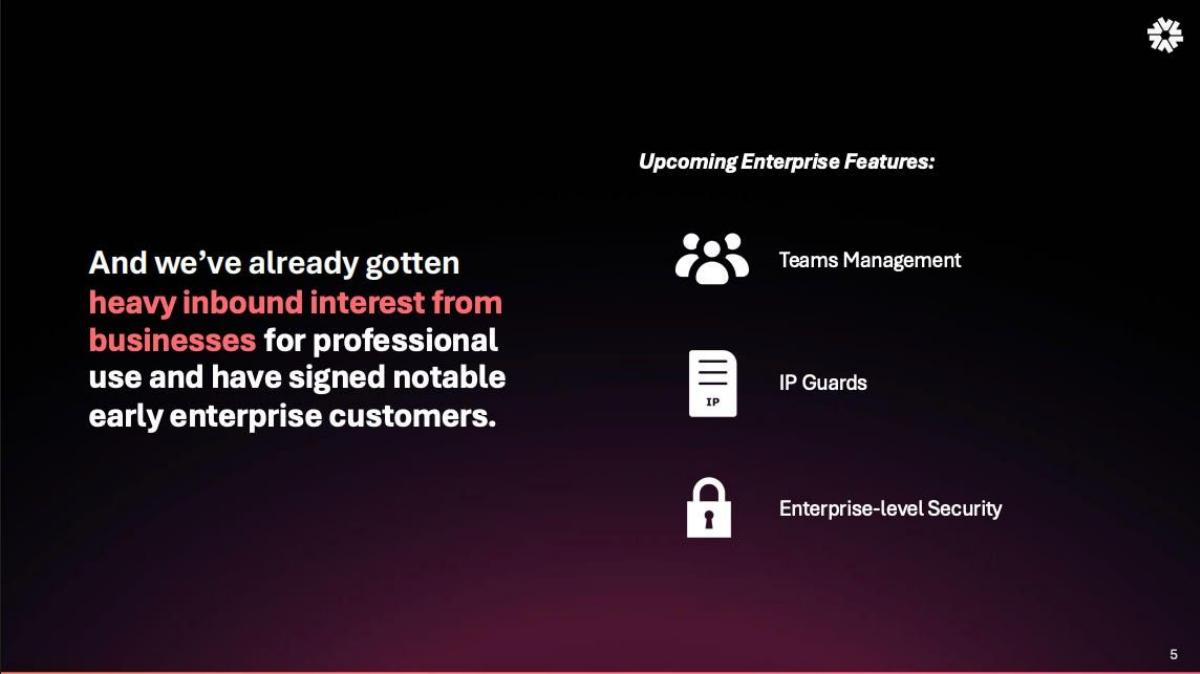
- Enterprise readiness is signaled through a roadmap of 'Upcoming Enterprise Features' including IP Guards and Teams Management (Slide 5).
- The deck lacks traditional slides for competition, market size (TAM), and current revenue or user growth metrics.
- Hedra defines its mission as building an 'end-to-end storytelling platform,' moving beyond just a single model (Slide 8).
- The visual identity of the deck relies heavily on high-quality AI-generated character examples to demonstrate the product's capabilities (Slides 3, 4, and 8).
The Efficiency Play in a High-Burn Industry
Hedra’s pitch deck for their $32M Series A is a concise, 9-slide document that prioritizes technical authority and capital efficiency over traditional business metrics. In the current AI landscape, where foundation models are often synonymous with massive compute costs, Hedra’s recurring mention of their sub-$2M development budget serves as a powerful differentiator. The deck is designed to convince investors that this specific team can achieve what others spend ten times more to attempt: shattering the 'uncanny valley' of AI-generated characters.
Slide 1: Title Slide
The deck opens with a minimalist black and purple gradient background featuring the Hedra logo. The text is simple: "Series A Investor Overview." There are no taglines or mission statements here, just a clean professional entry point that sets a serious tone for the technical presentation to follow.
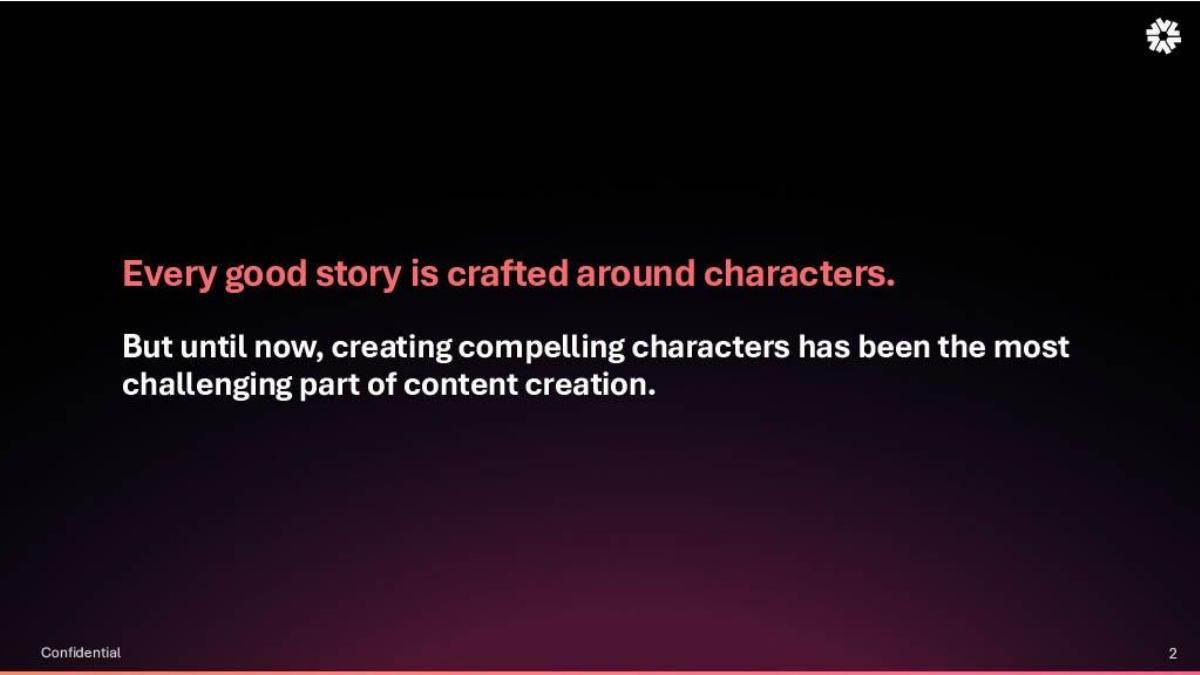
Slide 2: The Problem Statement
Slide 2 addresses the 'Why now?' and the core friction in the market. It states: "Every good story is crafted around characters. But until now, creating compelling characters has been the most challenging part of content creation." By framing the problem around 'storytelling' rather than just 'video generation,' Hedra positions itself as a creative tool rather than just a technical utility. This slide establishes the character as the atomic unit of their value proposition.
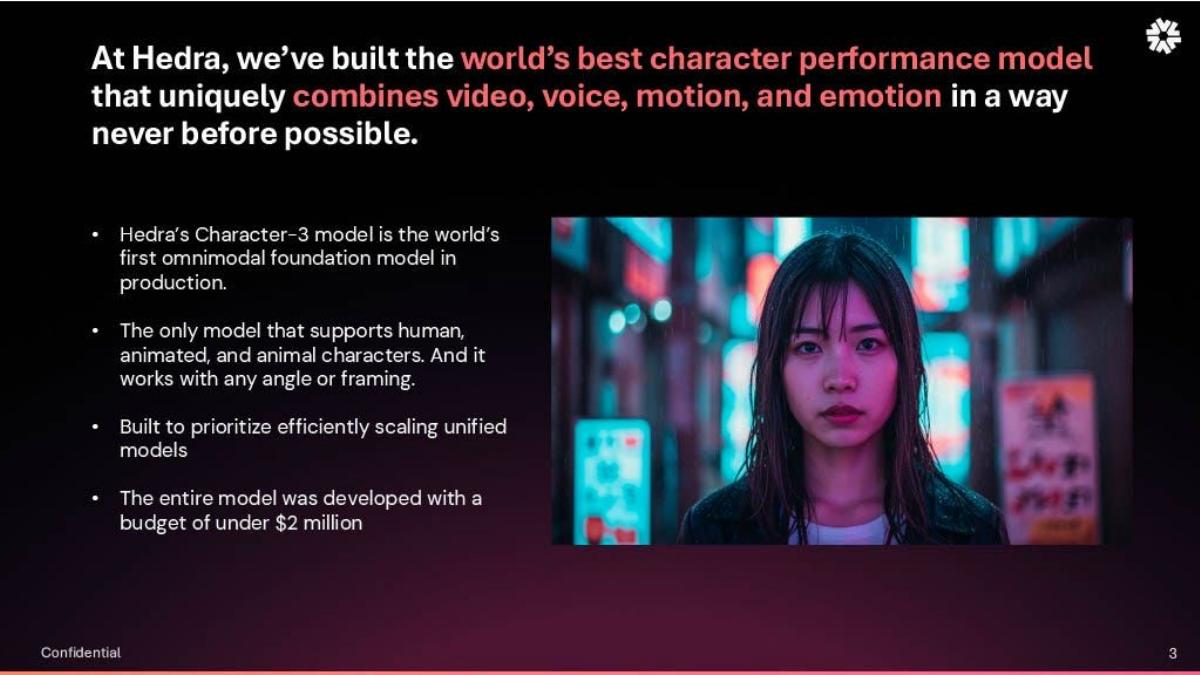
Slide 3: The Technical Solution
This is arguably the most important slide in the deck. It introduces the "Character-3" model, described as the "world’s first omnimodal foundation model in production." The slide lists four key claims:
It uniquely combines video, voice, motion, and emotion. · It supports human, animated, and animal characters at any angle. · It is built to scale unified models efficiently. · The entire model was developed with a budget of under $2 million.
The inclusion of the $2 million figure is a strategic move to appeal to venture capitalists concerned about the high capital intensity of AI startups. It suggests a high ROI on engineering talent.
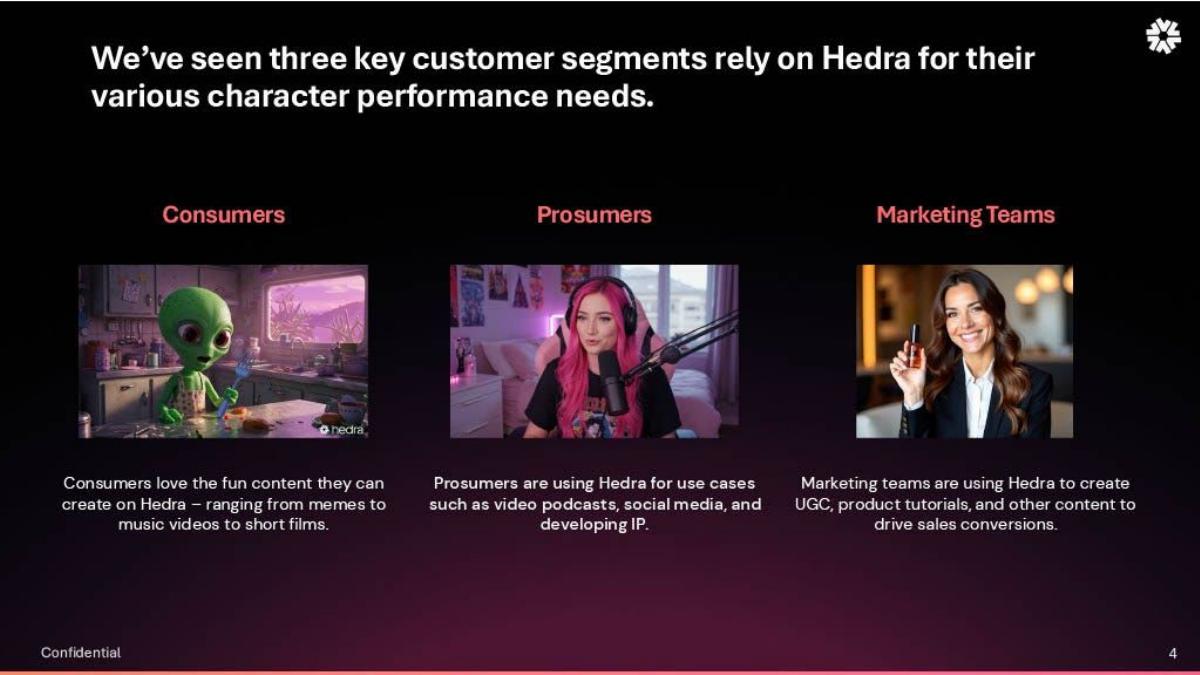
Slide 4: Customer Segmentation
Slide 4 breaks down the market into three buckets: Consumers, Prosumers, and Marketing Teams. Each segment is accompanied by a visual example of the output: an alien character for consumers, a streamer-style setup for prosumers, and a professional-looking spokesperson for marketing teams. This slide demonstrates that the technology has horizontal applications, from "memes and music videos" to "driving sales conversions."
Slide 5: Enterprise Traction and Roadmap
To move beyond the 'toy' phase of AI, Slide 5 highlights "heavy inbound interest from businesses" and the signing of "notable early enterprise customers." It lists three upcoming features essential for B2B adoption: Teams Management, IP Guards (crucial for brand safety), and Enterprise-level Security. This slide addresses the 'How do you make money?' question by pointing toward a SaaS-style enterprise model.
Slide 6: The Competitive Moat
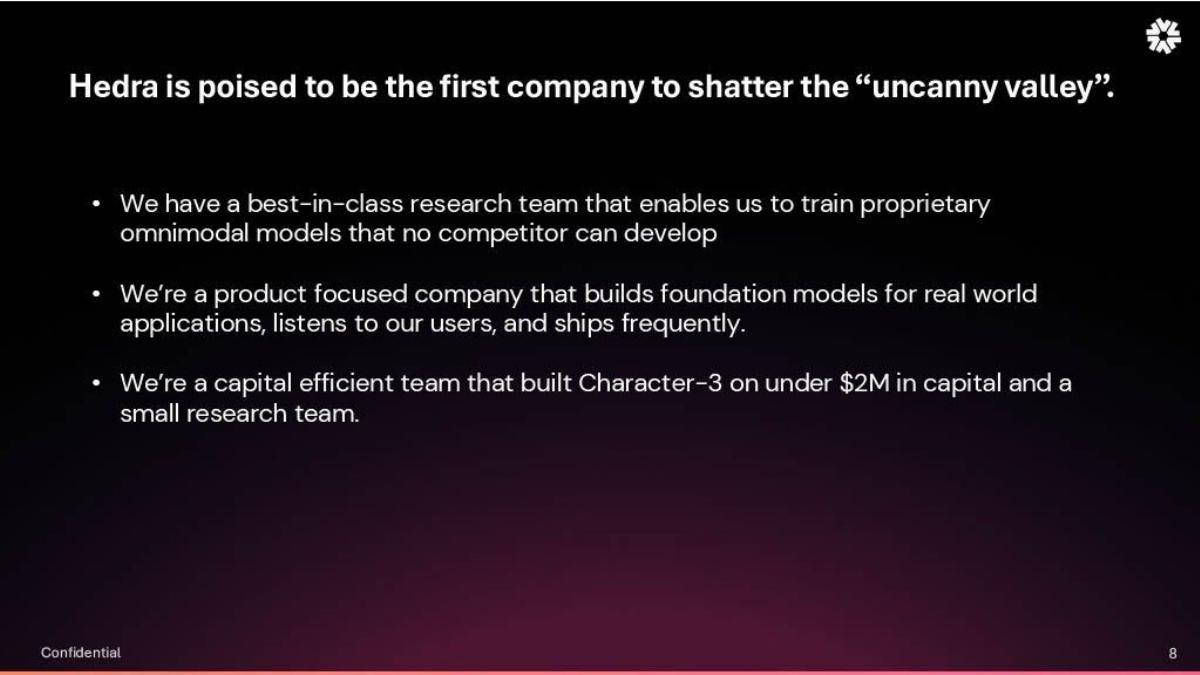
Slide 6 doubles down on the company's positioning. It claims Hedra is "poised to be the first company to shatter the 'uncanny valley'." It defines their moat through three pillars: a best-in-class research team, a product-focused approach that "ships frequently," and the aforementioned capital efficiency. By stating they train models that "no competitor can develop," they are making a claim on proprietary architecture rather than just brute-force compute.
Slide 7: The Team Slide
In a Series A for a deep-tech company, the team slide is the 'closer.' Hedra’s team slide is exceptionally strong, featuring:
Michael Lingelbach (CEO): Stanford PhD student under Fei-Fei Li, with experience at NVIDIA. · Wei Li (Research Lead): A core contributor to Google Bard/Gemini with ~20,000 citations. · Hongwei Yi (Head of Research): ~2,000 citations and a background in audio-to-video diffusion. · Jason Wilson (Head of Engineering): Former engineering lead at Series B startups. · Alan Guo (Chief of Staff): Harvard MBA with Disney and growth strategy experience. · Ramin Keene (Principal Engineer): Former CTO at StockX.
The use of citation counts is a specific 'flex' for AI investors, signaling that these are not just engineers, but the people who wrote the foundational papers the industry relies on.
Slide 8: The Vision
Slide 8 expands the scope from a model to a platform. "We’re on a mission to build the world’s best end-to-end storytelling platform." It reiterates the $2M budget and the love from various segments, while teasing "larger feature releases that will reinvent creation workflows." This slide serves to show that the Series A capital will be used to build the ecosystem around the core model.
Slide 9: Contact Slide
The deck concludes with a simple "Thank You" and the CEO’s contact information. It maintains the minimalist aesthetic of the rest of the deck, ensuring the focus remains on the content rather than the design.
What Hedra Does Exceptionally Well
The standout feature of this deck is its clarity of signal . In just 9 slides, Hedra communicates a massive technical achievement (an omnimodal model) and a massive business achievement (doing it for $2M). They don't waste time on generic market growth charts because the quality of the team and the efficiency of the build act as a proxy for success. The use of academic citations on the team slide is a brilliant way to quantify 'talent' in a way that is verifiable and prestigious.
What is Missing from the Deck
While the deck was clearly successful in raising $32M, it omits several standard components that other founders might need:
No Competitor Matrix: There is no mention of Sora, Runway, or Pika, despite these being direct competitors in the AI video space. · No Financials: There is no mention of current revenue, pricing models, or burn rate. · No TAM/SAM/SOM: The deck assumes the investor already knows the market for AI video is massive. · No Specific 'Ask': The deck does not state how much money they are raising or how they will specifically allocate the funds (e.g., % to compute vs. % to headcount).
These omissions suggest that the round may have been highly competitive or 'pre-emptive,' where the founders had enough leverage to focus only on the vision and the team.
Founder's Guide: What to Copy
Highlight your efficiency. If you have built something significant with less capital than your peers, make that a headline. It proves you are better at resource allocation and technical architecture than the competition. Use high-signal metrics for your team. If you are in a technical field, don't just list logos; list citations, patents, or specific products your team members were 'core contributors' to. Keep it short. Hedra proved that you don't need 20 slides to raise $30M+ if your core thesis is strong enough. Every slide in this deck serves a specific purpose: Problem, Solution, Market, Roadmap, Moat, Team, Vision. There is no filler.
Frequently asked questions
- How much did Hedra raise with this deck?
- According to publisher-reported facts from Business Insider, Hedra raised $32 million in a Series A round in 2024. The deck itself is titled 'Series A Investor Overview' on Slide 1, though it does not specify the exact dollar amount being sought within the slides.
- What is Hedra's core technology?
- Hedra's core technology is the 'Character-3' model. As described on Slide 3, it is an omnimodal foundation model that combines video, voice, motion, and emotion. It is designed to support human, animated, and animal characters from any angle or framing.
- Who are the target customers for Hedra?
- Slide 4 identifies three key segments: Consumers (creating memes and music videos), Prosumers (video podcasts and social media), and Marketing Teams (UGC, product tutorials, and sales conversions). Slide 5 also notes 'heavy inbound interest from businesses' and early enterprise customers.
- What makes Hedra's team stand out in the deck?
- The team slide (Slide 7) emphasizes deep research pedigree. It highlights experience from Stanford, Google Deepmind, NVIDIA, and ByteDance. Notably, it lists academic citation counts for research leads, such as ~20,000 citations for Wei Li and ~2,000 for Hongwei Yi, to prove technical authority.
- Does the deck include financial projections or revenue?
- No. The 9-slide deck omits all traditional financial metrics, including current revenue, burn rate, and future projections. It focuses entirely on technical milestones, team quality, and product vision, which is common for early-stage AI research companies.