Industrial Upcycling, led by Michael Rada, positions itself as a pioneer in 'Industry 5.0,' focusing on waste prevention rather than just waste management. The deck introduces a proprietary 6R methodology and L.E.D. principles (Transparency, Profit Sharing, Efficiency) to help corporations identify 'On-The-Ground-Mines' within their own waste streams. The business model is multifaceted, generating revenue through education, analytics, implementation, and a 'Reverse Sourcing' buy-and-sell model. While the deck highlights significant theoretical gains for unnamed clients—including a $2.5 billio…
Key takeaways
- The company defines its mission as building a 'wasteless world' by targeting waste prevention at the industrial source (Slide 2).
- It utilizes a proprietary 6R Waste Prevention Processing methodology instead of the standard 3R waste hierarchy (Slide 5).
- The business model relies on a tiered fee structure including hourly, weekly, monthly, and annual fees, plus a 'Reverse Sourcing' trade model (Slide 11).
- The founder claims a 99% success rate during a two-year test launch phase (Slide 12).
- Case studies cite significant financial impacts, such as a $250,000 annual gain for a vinyl record producer and $2 million for an electronics producer (Slide 8).
- The investment ask ranges from $100,000 to $1,000,000 with an expected return of 15-25% over five years (Slide 12).
- The deck omits a traditional team slide, listing only Michael Rada as 'President and Project Father' (Slide 1).
- The competitive landscape is framed as a 'Blue Ocean,' where traditional waste management companies are viewed as 'deniers of waste prevention' (Slide 10).
Executive Summary and Vision
Slide 1: Title Slide
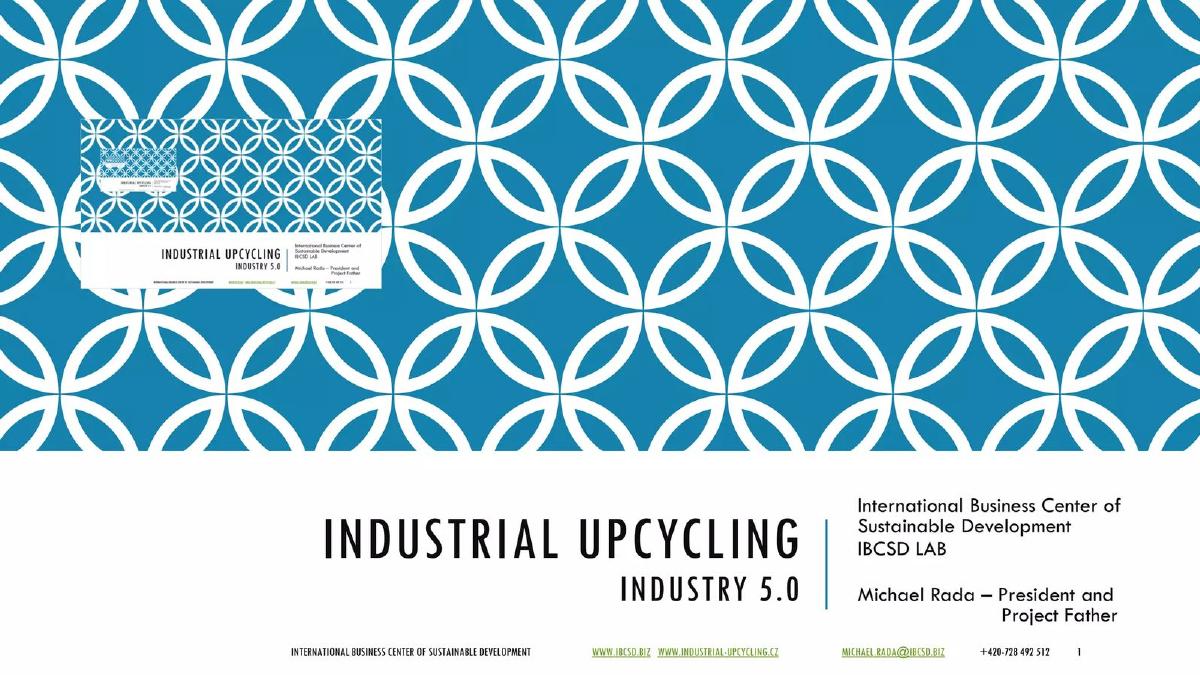
The deck opens with the title 'INDUSTRIAL UPCYCLING INDUSTRY 5.0.' It identifies the organization as the 'International Business Center of Sustainable Development (IBCSD LAB).' Michael Rada is listed as the 'President and Project Father.' The slide includes contact information, including a Czech Republic phone number and two URLs: ibcsd.biz and industrial-upcycling.cz.
Slide 2: Personal Mission
Michael Rada introduces himself and his intention 'TO BUILD WASTELESS WORLD.' He argues that the Earth is becoming a 'global landfill' and identifies industries as the main polluters. He claims that because no one targets waste prevention, he started 'INDUSTRIAL UPCYCLING.' The slide defines this as identifying 'On-The-Ground-Mines'—products and materials for systematic utilization rather than waste. Visuals include a cartoon of an excavator digging into the Earth and 'before/after' photos of processed industrial scrap.
Slide 3: Founder Background
Titled 'WHO I AM, WHO WE ARE,' this slide states that Rada has more than 25 years of business experience in industrial environments. He introduces the 'L.E.D. methodology,' which consists of Transparency, Profit Sharing, and Efficiency. He mentions a team of experts capable of working with wood, steel, and nature, though no specific names are provided. Small maps and charts at the bottom suggest global reach, citing visitors from 26 countries looking for 'Industry 5.0' advantages.
The Problem and the Methodology
Slide 4: The Waste Crisis
Under the heading 'EARTH CHANGE TO LANFILL,' the slide notes that waste management activities and waste volume have both increased over the last four decades. It makes the claim that 'WASTE become new currency and source of growing profit,' which is why the planet's image has changed. Four photos show piles of industrial waste, including wooden pallets and metal scrap, to illustrate the current state of exploitation.
Slide 5: The 6R Approach
This slide defines Industrial Upcycling as the 'only existing tool world wide' that uses systematic waste prevention tools to cut waste volume. It explicitly states that the company does not follow the standard '3R WASTE HIERARCHY' (Reduce, Reuse, Recycle) but instead uses '6R WASTE PREVENTION Processing.' The slide emphasizes efficiency over optimization and action over long-term planning. Screenshots of the company's web presence and audience overview are included as social proof.
Slide 6: Profitability and Awareness
Titled 'GENERATE PROFIT, NOT WASTE,' the slide outlines the goal of changing the mindset of business owners and decision-makers. It claims that the results of the methodology do not depend on the volume or size of the investment. A pie chart at the bottom shows a breakdown of funding sources, with 55% coming from central government and 35% from devolved administrations, totaling £26.8m for a 'NGO waste mng. Company' compared to Industrial Upcycling.
Operational Strategy and Traction
Slide 7: Segmentation
The slide breaks down the process into six steps: 1. General Education (workshops), 2. Mindset Change, 3. On-Site IU Analytics, 4. Implementation, 5. Development (supply chain expansion), and 6. Control & Correction (maintenance). Visuals show magazine features and Google search results for 'recognize upcycling' to demonstrate market presence.
Slide 8: Case Studies
Titled 'WHO BENEFITS ALREADY,' this slide lists specific financial gains for unnamed clients under NDA:
Largest world producer of vinyl records: gain $250K USD/YEAR · Largest global hotel chain: Food waste reduction · Automotive producer: gain $2.5B USD (Note: Slide states this project followed similar principles but is not strictly Industrial Upcycling) · Electronics producers: gain $2M USD/YEAR
Photos of industrial kitchens and lighting fixtures are provided as 'visual evidence.'
Slide 9: Application and Scalability
The slide asserts that Industrial Upcycling is not limited to any industry or location and is a 'scalable process.' It claims the value of this approach is significantly higher than global waste management evaluations. Images include wooden pallets, space debris, and industrial smoke stacks, suggesting a broad range of applicable environments.
Market Position and Business Model
Slide 10: Competitive Landscape
The company describes itself as a 'BLUE OCEAN' project with no competitors. It labels existing waste management companies as 'deniers of WASTE PREVENTION' who profit from wasteful behavior. The slide argues that traditional waste companies will never tell a client to 'PRODUCE LESS WASTE' because it hurts their business model.
Slide 11: Revenue Streams
Titled 'HOW WE MAKE MONEY TO RUN IU PROJECTS,' the slide details a six-layer business model:
Education: Hourly fee for workshops. · IU Setup: Weekly fee for analytics. · Implementation: Monthly fee for integration. · IU Development: Annual fee for expansion. · IU Network: Membership fee. · Reverse Sourcing: A 'Buy & Sell' trade relationship.
This indicates a transition from a service-based consultancy to a transactional trade model.
The Investment Ask
Slide 12: Investment Possibilities
The founder claims a 99% success rate during a two-year test launch. The investment ask is:
Investment Size: $100,000 – $1,000,000 USD · Investment Time: 5 Years · Investment Return: 15 – 25%
The slide includes a condition that the investor must be aligned with the goal of waste prevention; otherwise, they are recommended 'not to invest IU.'
Slide 13: Contact Information
The final slide provides the 'online gate' URL, an email address, a phone number, and social media handles. It also invites potential partners to visit their office in Plzen, Czech Republic. Michael Rada is again titled 'IU founder and project father.'
What Works and What is Missing
What Works
The deck is strong in its ideological positioning. By framing traditional waste management as a 'denier' of progress, it successfully carves out a niche for its 'Industry 5.0' concept. The distinction between the 3R and 6R methodologies provides a clear, proprietary framework that feels more advanced than standard environmental consulting. Furthermore, the inclusion of specific dollar amounts for client gains (Slide 8) provides tangible evidence of the methodology's economic value, even if the clients remain anonymous.
What is Missing
The most significant omission is a comprehensive team slide. While Michael Rada is presented as the visionary leader, a $1 million investment usually requires proof of a robust operational team, including engineers, logistics experts, and sales professionals. The deck also lacks a detailed use-of-funds breakdown; it is unclear whether the $100k-$1M will be used for software development, physical infrastructure, or marketing. Finally, there are no forward-looking financial projections or a clear 'Exit Strategy' for investors beyond the stated 15-25% return.
Founder's Guide: What to Copy
The 'Blue Ocean' Framing: Founders in crowded markets should copy the way this deck redefines the competition. By calling waste management companies 'deniers,' the founder shifts the conversation from 'who does it better' to 'who is actually solving the problem.' This is a powerful way to position a startup against entrenched incumbents.
Tiered Revenue Model: The breakdown of revenue into hourly, weekly, monthly, and annual fees (Slide 11) is an excellent way to show how a company can capture value at every stage of the customer journey. It demonstrates a clear path from low-friction entry (workshops) to high-value, long-term partnerships (annual development and sourcing).
Methodology Branding: Creating a proprietary name for a process (like the 'L.E.D. methodology' or '6R Waste Prevention') makes a service-based business feel like a scalable product. It gives investors something concrete to 'own' rather than just investing in a consultant's time.
Frequently asked questions
- What is the core methodology of Industrial Upcycling?
- The company operates on two primary frameworks: the 6R Waste Prevention Processing methodology and the L.E.D. methodology, which stands for Transparency, Profit Sharing, and Efficiency. Unlike traditional waste management that focuses on recycling (3Rs), Industrial Upcycling aims to prevent waste entirely by treating discarded materials as 'On-The-Ground-Mines' for systematic utilization.
- How does the company generate revenue?
- Revenue is generated through six distinct layers: education (hourly fees), IU setup and analytics (weekly fees), implementation (monthly fees), development/expansion (annual fees), network membership fees, and 'Reverse Sourcing,' which involves a buy-and-sell business trade relation for materials.
- What kind of results has the company achieved for clients?
- According to Slide 8, the company has helped a vinyl record producer gain $250,000 per year and an electronics producer gain $2 million per year. It also claims to have influenced an automotive producer to achieve a $2.5 billion gain, though it notes this specific project followed similar principles rather than the full Industrial Upcycling methodology.
- What are the terms of the investment ask?
- The founder is seeking between $100,000 and $1,000,000. The investment timeline is set at five years, with a projected return of 15-25%. The deck specifies that the investment must be aligned with the intention of supporting a global waste prevention movement.
- Who is the leadership behind the project?
- The deck identifies Michael Rada as the 'President and Project Father.' He claims over 25 years of business experience in industrial environments. While Slide 3 mentions 'people around me are experts,' there are no specific names, bios, or photos of a broader executive team.