Infraspeak’s 13-slide deck is a highly effective example of how to balance emotional storytelling with hard data. The presentation begins by personifying the industry's inefficiencies through a character named Peter, who manages 460 daily tasks and a $1.1M budget. This narrative hook leads into a clear product breakdown featuring NFC-enabled mobile apps for technicians and specialized web interfaces for managers and executives. The deck’s strength lies in its traction slide, which shows a growth curve reaching 38 customers by October 2016, supported by blue-chip logos like Siemens and InterCo…
Key takeaways
- The deck uses a persona named Peter to illustrate the overwhelming volume of 460 daily tasks in facility management on slide 3.
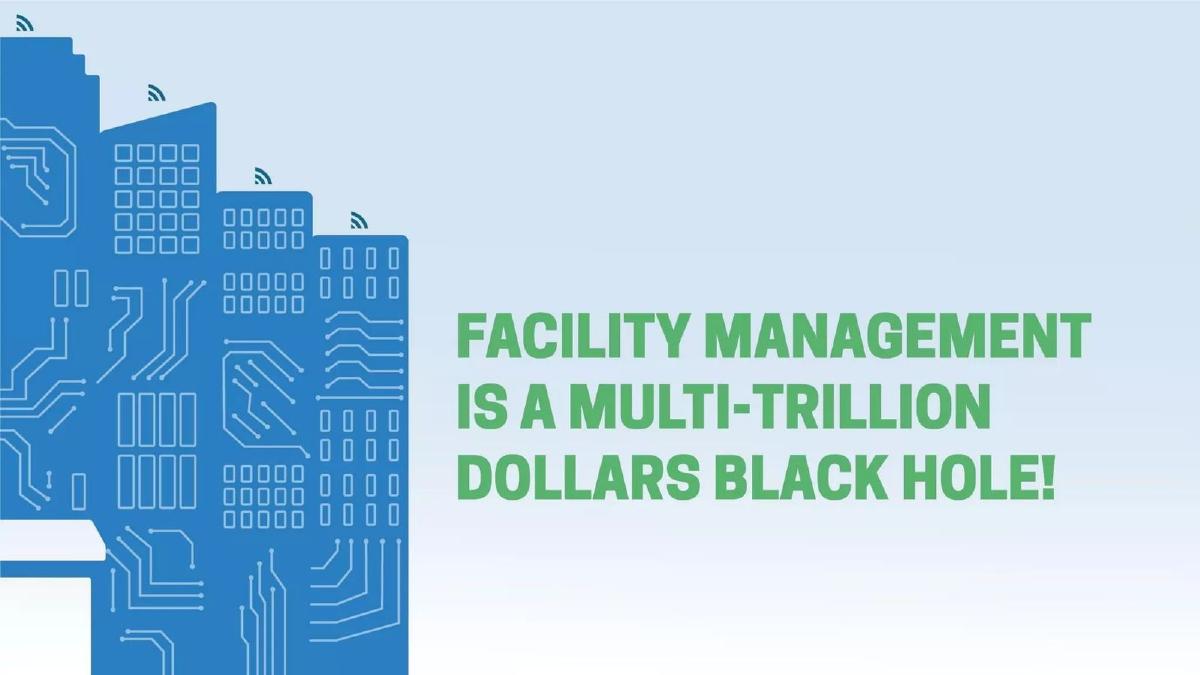
- Facility management is framed as a multi-trillion dollar 'black hole' to establish massive market scale on slide 2.
- Product functionality is divided by user role, showing mobile apps for technicians and web interfaces for CEOs and CFOs on slides 8 and 9.
- The company utilizes NFC technology to connect physical assets to their digital platform, as shown on slide 8.
- Traction is visualized through a customer acquisition graph that grew from near zero in early 2015 to 38 customers by late 2016 on slide 10.
- The deck lists high-profile enterprise clients including Siemens, Leroy Merlin, and InterContinental Hotels & Resorts on slide 10.
- Financial health is highlighted by a $10K MRR and a 0% churn rate on slide 11.
- The founding team combines technical software expertise with civil engineering and startup incubation experience on slide 6.
The Narrative Power of the 'Small' Problem
Infraspeak’s deck is a masterclass in making a massive, abstract industry feel tangible. While many founders start with a slide full of global statistics, Infraspeak starts with Peter. By narrowing the scope of a multi-trillion dollar industry down to the daily life of one overwhelmed manager, they create an immediate emotional connection with the investor. This teardown examines how they transition from this personal narrative into a high-growth SaaS story backed by enterprise logos and perfect retention metrics.
Slides 1-5: The Problem and the Persona
Slide 1 is a standard title slide, but it immediately establishes the brand identity: 'Smart Facility Management.' It also includes a call to action by linking to their Angel.co profile, a common practice in 2015-2016 fundraising.
Slide 2 sets the macro stage, calling Facility Management a 'multi-trillion dollars black hole.' This is a bold claim, but it serves to establish the Total Addressable Market (TAM) without using a boring concentric circle chart. The use of the term 'black hole' suggests that money goes in, but data and efficiency do not come out.
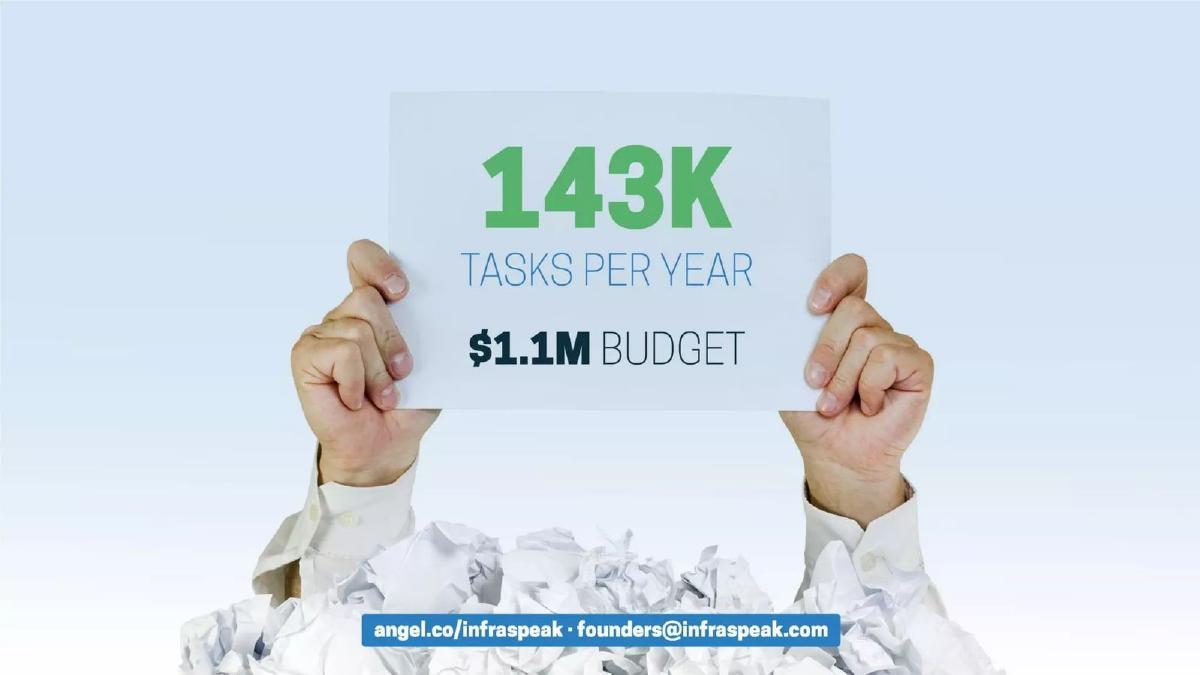
Slides 3, 4, and 5 introduce 'Peter.' This is a classic storytelling device. Slide 3 shows Peter buried under a pile of paper, holding a sign that says 'Daily 460 Tasks.' Slide 4 raises the stakes: '143K Tasks Per Year' and a '$1.1M Budget.' By slide 5, Peter is holding a sign that simply says 'HELP!' surrounded by icons representing leaking faucets, broken lights, and failing HVAC systems. This sequence effectively communicates that the current way of working is unsustainable and that the 'black hole' is made of unmanaged paperwork and reactive chaos.
Slide 6: The Founding Team
After establishing the problem, the deck introduces the people capable of solving it. Slide 6 features Luís Martins and Felipe Ávila da Costa. The credentials listed are highly relevant to the problem space. Martins is described as a 'Civil Engineer,' 'Software Developer,' and 'Maintenance Expert'—a rare trifecta that suggests he understands both the physical assets and the code required to manage them. Da Costa brings the business and scale expertise, with an MBA and experience managing over 250 startups in an incubator. This balance of domain expertise and operational experience is a strong signal for Series A investors.
Slides 7-9: The Solution and Product Architecture
Slide 7 is a transition slide with the brand values: 'Simple, Smart, Flexible.' It leads into the technical breakdown of the platform.
Slide 8 focuses on the 'Mobile App.' It specifically highlights the use of NFC (Near Field Communication). This is a critical technical differentiator. By showing a technician tapping a robotic arm or piece of equipment with a mobile device, Infraspeak demonstrates how they bridge the gap between the physical world and digital data. It implies that data entry is automated and location-verified, solving the 'paperwork' problem introduced by Peter.
Slide 9 shows the 'Web Interfaces.' The deck wisely segments the product by user persona. Operational Managers see technical data, CEOs and CFOs see financial data (represented by a dollar sign icon), and general employees see a simplified reporting interface. This slide proves that Infraspeak isn't just a tool for technicians; it is a management system that provides visibility to the entire organization.
Slides 10-11: Traction and Financial Validation
Slide 10 is the 'money slide.' It features a customer acquisition graph showing steady, accelerating growth from January 2015 to October 2016, ending at 38 customers. More impressive than the number is the quality of the logos on the right side of the slide. Securing Siemens, InterContinental, Crowne Plaza, and Leroy Merlin as early customers validates that the product can handle the complexity of global enterprise operations.
Slide 11 provides the 'Key Metrics.' The company reports $160K in total revenue and $10K in MRR. While these numbers might seem small for a Series A today, the most important figure on this slide is the '0% Churn Rate.' For a SaaS company, zero churn is the ultimate proof of product-market fit. It tells investors that once a facility manager starts using Infraspeak, they don't leave. The slide also notes a revenue model consisting of 'Setup Fees + SaaS,' which is typical for enterprise software that requires initial hardware (NFC tags) or data migration.
Slides 12-13: The Future and Contact
Slide 12, titled 'This is just the beginning,' outlines the roadmap. It points toward 'IoT Integration' and 'Predictive Maintenance.' This is a crucial pivot from the 'Help!' narrative of the earlier slides. It suggests that Infraspeak will move from helping managers survive the day to helping them predict and prevent failures before they happen. This increases the long-term value of the platform.
Slide 13 is a simple contact slide, repeating the founders' email and the Angel.co link over a background image of elevator maintenance, reinforcing the industrial focus of the company.
What Works in This Deck
The Persona Strategy: By using 'Peter,' the founders avoid the trap of being too technical too early. They make the investor feel the pain of the customer before they show the solution.
Logo Density: For a young company, the caliber of their client list is exceptional. Listing Siemens and InterContinental side-by-side proves the product is horizontal and scalable across industries.
The Churn Metric: Highlighting 0% churn is the strongest possible way to end a traction section. It mitigates the risk of the relatively low MRR by showing that the revenue is extremely high-quality and stable.
What Is Missing
The Ask: There is no slide stating how much money they are raising or what the specific milestones for the next 18 months are. While this might have been handled in a verbal pitch or a separate document, its absence in the deck leaves a gap in the narrative.
Competitive Landscape: The deck assumes that the only competition is 'paper' (as seen in Peter's pile). It does not address other CMMS (Computerized Maintenance Management System) players or legacy software incumbents.
Unit Economics: While we see MRR and churn, we don't see the cost to acquire these 38 customers. In a Series A deck, investors usually look for a clear understanding of the sales motion and its efficiency.
What a Founder Should Copy
Visual Simplicity: This deck uses very little text. It relies on icons, clear headers, and high-impact imagery. This ensures the audience listens to the founder rather than reading the slides.
Role-Based Product Views: If your software has different users (e.g., field workers vs. executives), copy Slide 9. Showing that you have tailored interfaces for different stakeholders demonstrates a deep understanding of enterprise buying cycles.
NFC/Hardware Integration: If you are a software company dealing with physical assets, show the point of contact. The icon of the phone touching the machine on Slide 8 is a perfect way to explain a complex integration in one second.
Frequently asked questions
- What is the primary problem Infraspeak is solving?
- Infraspeak addresses the extreme inefficiency in facility management, which it describes as a 'multi-trillion dollar black hole.' The deck illustrates this through a facility manager persona who must handle 143,000 tasks per year and a $1.1M budget, often leading to a state of being overwhelmed by paperwork and reactive maintenance issues.
- How does the Infraspeak product actually work?
- The platform consists of two main components: a mobile app for technicians that uses NFC tags to identify equipment and log work, and web interfaces for operational managers and executives. This setup allows for real-time data collection from the field, which is then aggregated into dashboards for financial and operational oversight.
- What kind of traction did Infraspeak have when this deck was used?
- At the time of the deck (late 2016), Infraspeak had acquired 38 customers. Their financial metrics included $160,000 in total revenue and $10,000 in Monthly Recurring Revenue (MRR). Most notably, the company reported a 0% churn rate, indicating extremely high product stickiness among their early user base.
- Who are the target customers for this platform?
- The deck highlights a diverse range of enterprise clients, suggesting a broad horizontal application. Listed logos include industrial giants like Siemens, hospitality chains like InterContinental and Crowne Plaza, and retail companies like Leroy Merlin and AKI. This demonstrates the platform's utility across different types of physical infrastructure.
- What is missing from the Infraspeak pitch deck?
- The deck lacks a formal 'Ask' slide detailing how much capital is being raised and how it will be allocated. It also omits a competitive landscape analysis and detailed unit economics, such as Customer Acquisition Cost (CAC) or Lifetime Value (LTV), though the 0% churn rate hints at a strong LTV.