In My Tum is a London-based startup aiming to digitize local artisan grocers by providing a managed online marketplace and delivery infrastructure. The deck, dated July 2020, outlines a model where grocers drive their own existing foot traffic to the platform, theoretically lowering customer acquisition costs. With a pre-seed traction of 7 grocers and £25k GMV, the company forecasts a rapid scale-up to 1,200 grocers and £100m GMV within three years. The presentation concludes with an ambitious 'Journey to Exit' slide, projecting a £700m valuation by September 2025. While the model addresses a…
Key takeaways
- The company identifies a specific niche in 'artisan grocers' who lack the technical expertise for delivery and UX (Slide 6).
- The business model relies on grocers driving their own existing in-store customers to the platform to minimize marketing spend (Slide 3).
- Revenue is generated through a 20% commission on sales, with an estimated £16k annual commission per grocer (Slide 4).
- Initial traction as of June 2020 was 7 grocers in London generating £25k in GMV (Slide 5).
- The deck forecasts reaching 60 grocers and £1m in annual revenue by the end of 2021 (Slide 4).
- Expansion plans move from London to targeted UK areas, then to Europe by September 2023 (Slide 5).
- The founders explicitly target a £700m exit valuation by September 2025 (Slide 5).
- The platform claims to offer delivery services that cost less than in-house solutions for small grocers (Slide 2).
Executive Summary: The Local Grocer Digitization Play
In My Tum entered the market in mid-2020, a period defined by the rapid acceleration of e-commerce due to global lockdowns. Their pitch deck focuses on a specific segment of the retail market: the artisan, independent grocer. These are businesses with high-quality products and loyal local followings but limited technical infrastructure. The deck proposes a managed marketplace model where the startup handles the 'tech' and 'logistics' while the grocer provides the 'inventory' and 'initial customer base.'
Slide 1: Title and Positioning
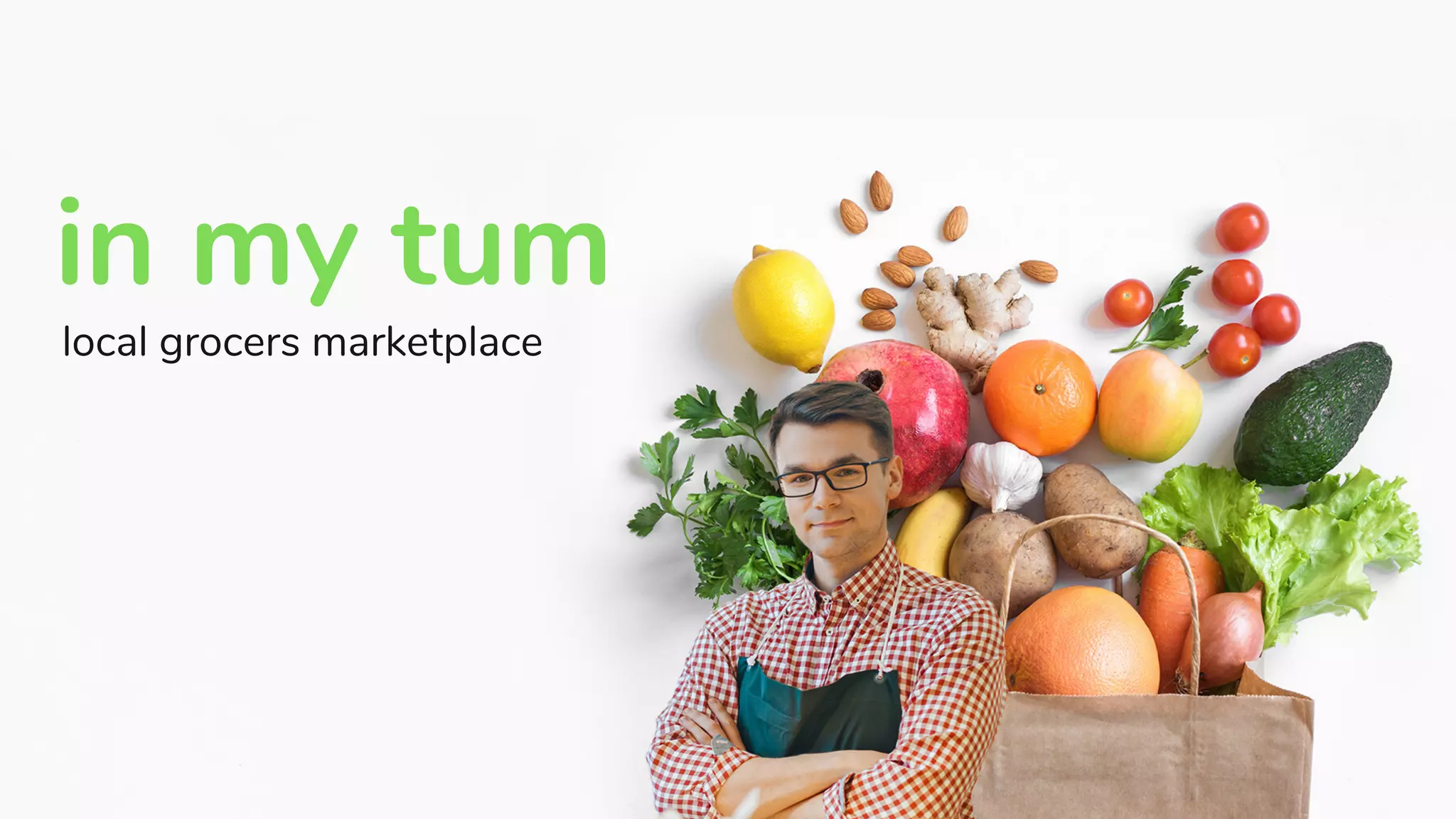
The cover slide introduces the brand 'in my tum' with the subtitle 'local grocers marketplace.' The visual identity is clean, using a bright green color palette associated with freshness and health. The imagery features a grocer in a checkered shirt and apron standing next to a brown paper bag overflowing with fresh produce (peppers, lettuce, potatoes, citrus). This immediately establishes the sector and the target partner profile.
Slide 2: The Value Proposition
Slide 2 defines the platform as a tool for 'artisan grocers to sell online.' It lists three core pillars of the service: driving existing customers to the platform, finding new customers, and providing delivery that 'costs less than in-house.' A screenshot of a sample store, 'SUNFLOUR BAKERY,' shows a clean UI with categories for Breads, Dairy, Fruit, Meats, and Veggies. This slide attempts to solve the 'why now' by highlighting the cost-efficiency of their delivery model compared to a grocer hiring their own driver.
Slide 3: Our Model
This slide breaks down the operational workflow into three stages: Partner , Operate , and Empower .
Partner: Independent grocers drive their own foot traffic to the site. · Operate: In My Tum manages the online presence and marketing spend. · Empower: The startup provides the 'toolkit' for delivery to the customer's door.
The imagery shows a traditional farmer's market stall contrasted with a modern consumer using a laptop while eating, and a car being loaded with groceries, illustrating the bridge between old-world retail and new-world convenience.
Slide 4: Forecasted Growth YE2021
The financial model is presented through four green circles and one large GMV circle. The math is explicit: 60 grocers each doing £80k in online sales results in £5m total annualised GMV. With a 20% commission rate (£16k per grocer), the company projects £1m in annualised revenue. This slide is crucial because it defines the unit economics—a 20% take rate is standard for marketplaces but high for low-margin grocery, suggesting they are targeting premium 'artisan' price points where such margins are sustainable.
Slide 5: Journey to Exit
This is the most aggressive slide in the deck. It maps a five-year trajectory:
JUN '20: London only, 7 grocers, £25k GMV (Current state at time of deck). · SEP '21: UK expansion, 60 grocers, £5m GMV. · SEP '22: Targeted UK areas, 300 grocers, £25m GMV. · SEP '23: Europe expansion, 1200 grocers, £100m GMV. · SEP '25: Exit to 1 buyer at a £700m valuation.
Projecting a specific exit valuation and date is rare in early-stage decks and can be polarizing for investors, as it assumes a very specific market condition and acquisition appetite five years into the future.
Slide 6: The Opportunity and Traction
The final slide in this set summarizes the 'pain point': businesses with existing customers struggle to become tech businesses. It reiterates that existing customers are the 'lowest cost to acquire' and claims that In My Tum can manage marketing budgets more efficiently than a small shop owner. It makes a bold claim that their platform will be the 'first grocer marketplace in the world' and highlights the 'multi billion GMV' potential. The mention of having acquired the first 7 grocer partners 'pre-seed' serves as the primary proof of concept.
What Works in This Deck
Clear Niche: By focusing on 'artisan' grocers rather than all grocery stores, the company avoids a direct head-to-head battle with supermarket giants. This niche usually has higher average order values (AOV), which makes a 20% commission more palatable.
Marketing Efficiency: The strategy of having grocers drive their own customers to the platform is a clever way to solve the 'cold start' problem common in marketplaces. It reduces the initial CAC (Customer Acquisition Cost) for the startup.
Simple Monetization: The revenue model is straightforward. There are no complex subscription tiers or hidden fees mentioned; it is a pure performance-based commission model, which is easy to sell to small business owners.
What Is Missing
The Team: In the provided slides, there is no mention of who is building this. In a pre-seed or seed round, the founders' backgrounds in logistics, retail, or software engineering are often more important than the projections.
Competitive Landscape: The claim to be the 'first grocer marketplace in the world' is highly debatable. In 2020, companies like Farmdrop (UK) or Mercato (US) were already operating in similar spaces. A slide addressing how they differ from these incumbents or from generalist delivery apps like UberEats/Deliveroo is missing.
Logistics Detail: 'Delivery that costs less than in-house' is a significant claim. The deck does not explain how this is achieved. Are they using a gig-economy fleet? Their own electric vans? A third-party API? The margins of the business live or die on this detail.
Founder Takeaways
Be Cautious with Exit Projections: While investors want to see a 'big' vision, putting a specific price tag and date on an exit (e.g., £700m in Sep '25) can sometimes look naive or overly rigid. It is often better to show the market size (TAM) and how you capture it, rather than naming an exit price.
Leverage Partner Assets: In My Tum's best idea is using the grocer's existing physical footprint as a marketing channel. If you are building a B2B2C marketplace, always look for ways to make your B2B partners your primary customer acquisition engine.
Visual Consistency: The deck uses a consistent visual language. The use of real screenshots (Slide 2) alongside aspirational lifestyle photography helps ground the 'tech' in reality. Founders should ensure their 'product' slides look like a finished product, even if it is just a high-fidelity mockup.
Frequently asked questions
- What is the core value proposition for grocers?
- In My Tum provides a complete digital toolkit that includes an online storefront, marketing management, and a delivery infrastructure. The primary benefit is allowing small, independent grocers to offer a professional online shopping experience and delivery service without the overhead of building their own tech stack or managing a fleet of drivers, which the deck claims is cheaper than in-house options.
- How does the company plan to acquire customers?
- The strategy is unique in that it shifts the burden of customer acquisition partly onto the grocers. Slide 3 states that grocers 'drive their existing in-store customers online to our platform.' This allows the company to leverage established local brand loyalty while focusing their own marketing spend on finding new customers to add to the ecosystem.
- What are the financial projections for the first full year?
- By the end of 2021, the company forecasts having 60 grocers live on the platform. They estimate each grocer will generate £80k in online sales, leading to a total annualised GMV of £5m. Based on their 20% commission rate, they project £1m in estimated annualised revenue for the startup itself.
- What is the long-term exit strategy presented in the deck?
- The deck includes a specific 'Journey to Exit' timeline. It projects scaling from a UK-only presence to a European presence with 1,200 grocers and £100m GMV by September 2023. The ultimate goal stated is an exit in September 2025 to a single buyer at a projected valuation of £700m.
- What critical information is missing from these slides?
- The provided slides lack a dedicated team page, which is essential for assessing execution risk. There is also no detailed breakdown of the 'delivery toolkit'—specifically whether they use third-party logistics or their own fleet—and no mention of competitors like Shopify, Deliveroo, or specialized local food apps that might occupy the same space.