Infozone presents a mobile-first local search and discount platform aimed at disrupting traditional marketing and daily deal models in Eastern Europe. The deck, dated November 2012, focuses on the growth of smartphone adoption in Bulgaria (600,000+) and Romania (3 million+). It positions itself as a solution for businesses to reach nearby customers and for users to find relevant deals within five seconds. While the deck provides a clear breakdown of fund allocation—prioritizing marketing at 55%—it lacks critical financial projections, a team slide, and a specific capital ask amount. The valid…
Key takeaways
- The platform aims to disrupt traditional marketing, daily deals, and plastic loyalty cards (Slide 2).
- The core value proposition for users is finding relevant local information and benefits within 5 seconds (Slide 4).
- The market size is defined by 600,000+ smartphones in Bulgaria and over 3 million in Romania (Slide 6).
- Direct competitors listed include Foursquare, Yelp, BGMaps, Yellow Pages, and GetLokal (Slide 6).
- The company claims the platform is easily deployable and adaptable for various regions and industries (Slide 7).
- Early validation is shown via the 'Viva.Infozone' app with 879 downloads (Slide 9).
- Marketing activities are the primary focus for future funding, accounting for 55% of the budget (Slide 10).
- The deck omits a specific dollar amount for the funding ask and provides no information on the founding team.
Slide-by-Slide Teardown
Slide 1: Title Slide
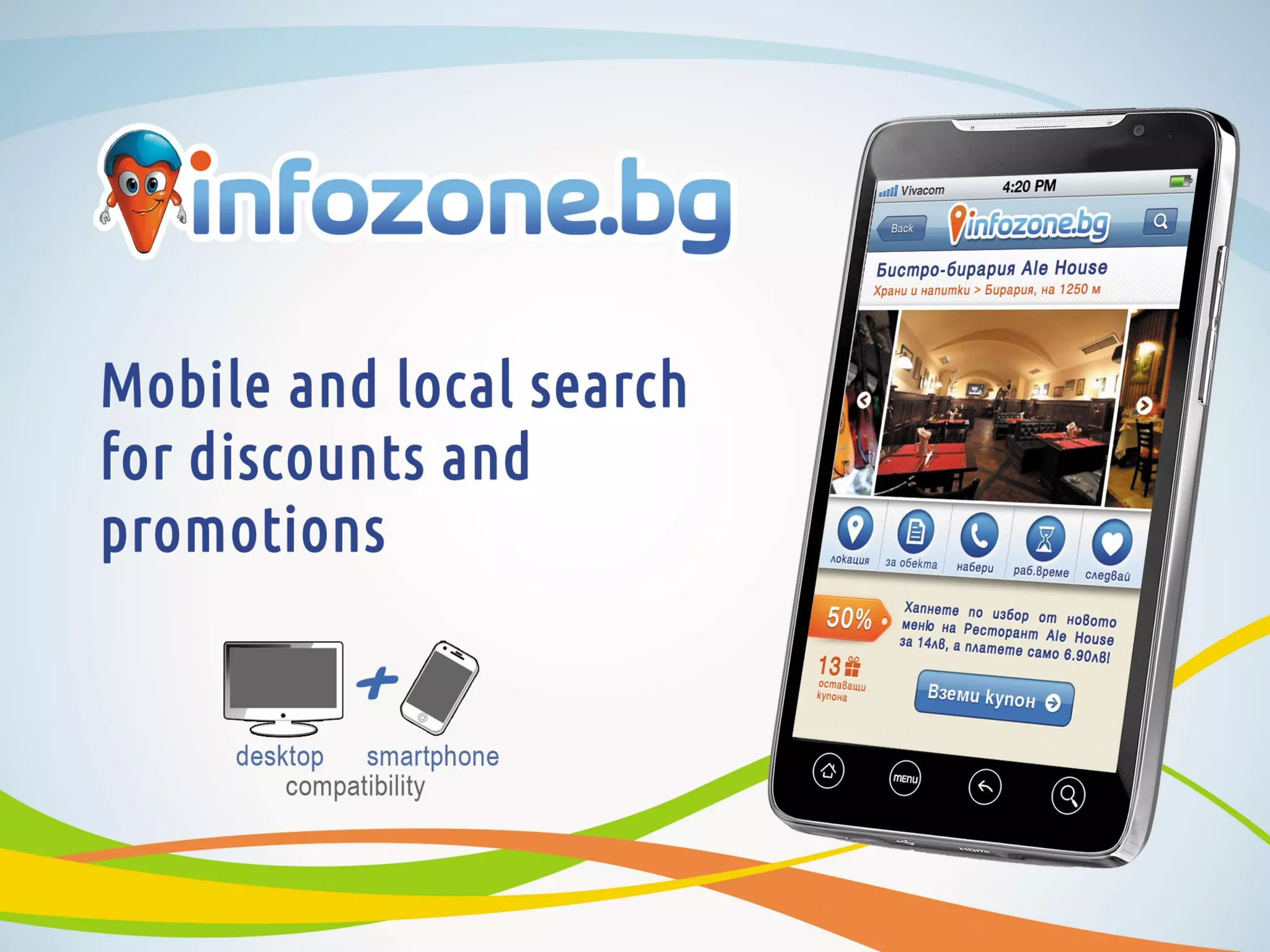
The cover slide introduces Infozone.bg with the tagline 'Mobile and local search for discounts and promotions.' It features a mascot—a stylized orange character with a blue hat—and a smartphone mockup displaying the app interface. The interface shown is for 'Bistro-birariya Ale House' and includes buttons for location, object info, dialing, working hours, and following. A 50% discount coupon is prominently displayed. The slide also notes 'desktop + smartphone compatibility,' establishing the cross-platform nature of the service.
Slide 2: What do we disrupt?
This slide positions the company as a disruptor. It explicitly states the intent to 'Capitalize on mobile as a disrupter.' The three targets for disruption are traditional marketing, the daily deals model (likely referring to the Groupon-style era), and plastic loyalty cards. This is a standard strategic positioning slide for the 2012 era, focusing on the transition from physical to digital assets.
Slide 3: Problem (businesses)
The deck uses a cartoon character to illustrate the business owner's dilemma. The text asks: 'How to reach, interact and attract more clients nearby using the mobile channel?' This frames the problem as a lack of connectivity between local brick-and-mortar stores and the mobile-carrying public.
Slide 4: Solution
The solution is presented in two bullet points. For businesses, Infozone helps 'implement their mobile strategy and attract clients nearby.' For end users, the value proposition is speed and relevance: 'Help end users find what is relevant, useful and beneficial around them – in 5 seconds.' The inclusion of a specific time metric (5 seconds) is a strong way to define the user experience goal.
Slide 5: Features (end users)
This slide focuses on user engagement. It lists 'Users are engaged with real rewards' and 'Relevant location aware notifications.' The smartphone graphic shows various discount percentages (20%, 50%, 70%) and dollar signs, reinforcing the 'discounts and promotions' theme from the title slide.
Slide 6: Market & Competition
Market size is quantified by smartphone penetration in the target region. It cites '600,000 + smartphones in Bulgaria' and 'More than 3 mln. in Romania.' The competition section is a simple list including daily deals websites and specific apps/services: Four Square, Yelp, BGMaps, Yellow Pages, and GetLokal. There is no competitive matrix or 'X vs Y' chart to show how Infozone differs from these established players.
Slide 7: Scalability
To address investor concerns about growth, this slide claims the platform is 'easily deployable,' 'adaptable for various regions/industries,' and that the 'Back office do all support / customization.' This suggests a centralized management model where the technology can be white-labeled or rolled out to new cities with minimal local infrastructure.
Slide 8: The Secret
The 'Secret' slide is a conceptual illustration. The text states: 'Businesses engage users as individuals.' The graphic shows a building (the business) communicating directly with five different smartphone users. This implies a shift from mass marketing to personalized, 1-to-1 mobile engagement, though it does not explain the underlying technology that enables this 'secret.'
Slide 9: Project Validated!
Validation is shown through a screenshot of the 'Viva.Infozone' app on what appears to be a carrier-specific app store (VIVA Apps). The slide shows 879 downloads. While this proves the app exists and has been downloaded, the number is relatively small, and the screenshot shows 0 ratings/votes, indicating very early-stage traction.
Slide 10: Use of Funds
The final slide in this set, titled 'How we will use the money?', provides a percentage breakdown of the budget. Marketing is the clear priority at 55%. Content creation and feature development each get 15%. Technical support and G&A costs are allocated 7.5% each. Notably, the slide does not mention the total amount of money being raised, only how the 'budget' will be split.
What Infozone Does Well
Clear Value Proposition: The deck is very clear about what the product is: a mobile app for local discounts. By Slide 4, the investor knows exactly what the business does for both the merchant and the consumer.
Regional Focus: Instead of claiming a global market, the deck focuses on specific, reachable numbers in Bulgaria and Romania. This makes the market entry strategy feel more grounded and realistic for an early-stage startup.
Speed as a Feature: Claiming that a user can find what they need in '5 seconds' is a bold and effective way to communicate the efficiency of the UI/UX without needing a complex demo.
What is Missing from the Deck
The Team Slide: There is no information regarding who is building this. In early-stage fundraising, the 'who' is often more important than the 'what.' Without a team slide, investors cannot assess the founders' ability to execute.
Financial Projections: The deck mentions a budget but provides no revenue model or projections. How does Infozone make money? Is it a subscription for businesses, a commission on coupons, or an advertising model? This is a significant omission.
The Ask: While Slide 10 shows how they will spend the money, it never says how much money they need. A pitch deck should clearly state the funding goal (e.g., 'Seeking $250k for 12 months of runway').
Unit Economics: There is no mention of Customer Acquisition Cost (CAC) or Lifetime Value (LTV). For a marketing-heavy business (55% of budget), understanding the cost to acquire a user is vital.
Founder Takeaways
Quantify Your 'Secret': If you have a slide titled 'The Secret,' it should ideally explain a proprietary advantage—like a unique algorithm or a strategic partnership—rather than just a general marketing concept like 'engaging individuals.'
Use Concrete Traction: Infozone was right to include a screenshot of their app store presence, but 879 downloads is a 'vanity metric' unless paired with retention data or active user numbers. If your numbers are small, focus on growth rates or engagement depth instead.
Structure the Budget: The percentage breakdown on Slide 10 is a good start, but it must be tied to a specific dollar amount. Investors need to know if you are asking for $50,000 or $5,000,000 to understand if the opportunity fits their portfolio.
Frequently asked questions
- What is the primary problem Infozone is trying to solve?
- According to Slide 3, the problem is specifically for businesses: 'How to reach, interact and attract more clients nearby using the mobile channel?' It addresses the gap between local merchants and the growing population of smartphone users who are looking for immediate, location-aware rewards and information.
- How does Infozone define its competitive landscape?
- Slide 6 identifies two categories of competition. First, 'Daily deals websites,' which were popular in 2012. Second, established local search and social platforms including global players like Foursquare and Yelp, alongside regional services such as BGMaps, Yellow Pages, and GetLokal.
- What is the 'Secret' mentioned in the deck?
- Slide 8 defines their 'Secret' as: 'Businesses engage users as individuals.' The accompanying graphic shows a central business building sending targeted arrows to individual smartphone users, suggesting a personalized or direct-to-consumer notification strategy rather than broad-based advertising.
- What evidence of traction does the deck provide?
- Traction is presented on Slide 9 under the heading 'Project Validated!' It shows a screenshot of the 'Viva.Infozone' app on the VIVA Apps store. The metric provided is 879 downloads ('Изтегляния: 879') and a 0-star rating based on 0 votes at the time the screenshot was taken.
- How does the company plan to spend the investment?
- Slide 10 outlines a percentage-based budget: 55% for marketing activities, 15% for creating content, 15% for new features development, 7.5% for technical support, and 7.5% for general and administrative costs. However, it does not state the total amount of capital they are seeking.