infinitspace's 2020 seed deck is a masterclass in founder-market fit. By leveraging the deep industry experience of founders from WeWork and Mindspace, the company positioned itself as the professional solution for landlords facing a post-COVID office crisis. The deck argues that landlords must offer flexibility to survive but lack the operational expertise to do it themselves. Their 'Flexspace-as-a-Service' model offers a 20% commission-based revenue structure, promising landlords 2.2x rental price potential. While the deck relies heavily on future projections and lacks current revenue data,…
Key takeaways
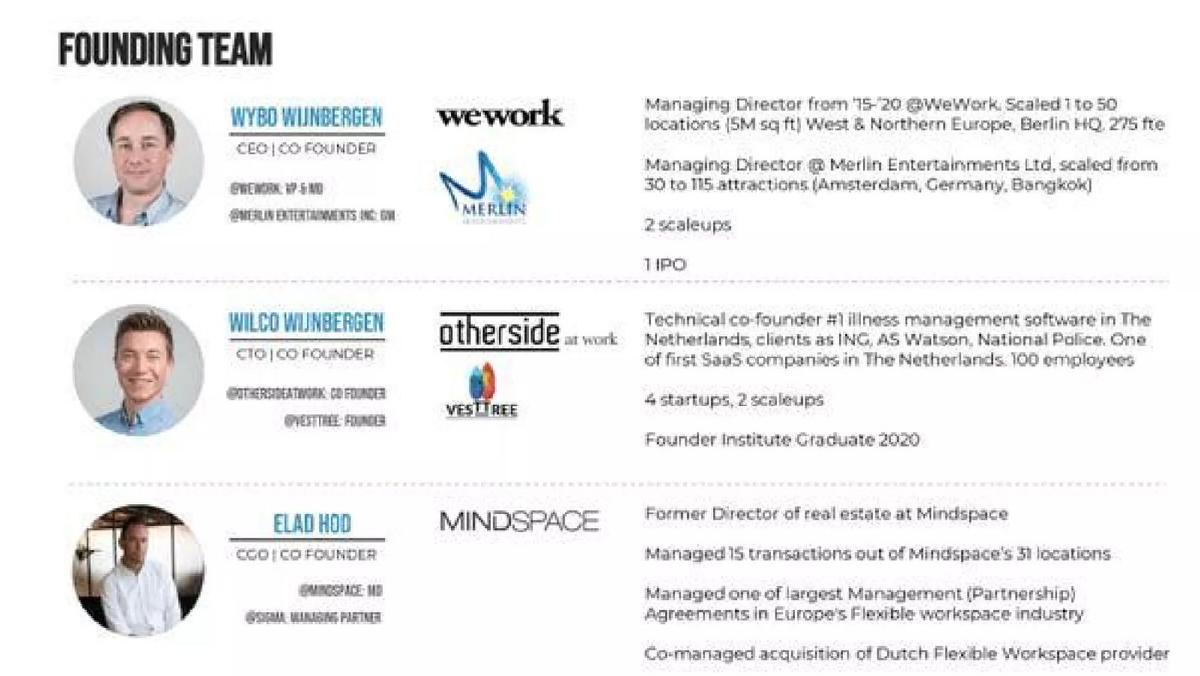
- The founding team includes a former WeWork Managing Director who scaled 50 locations and a former Director of Real Estate at Mindspace (Slide 2).
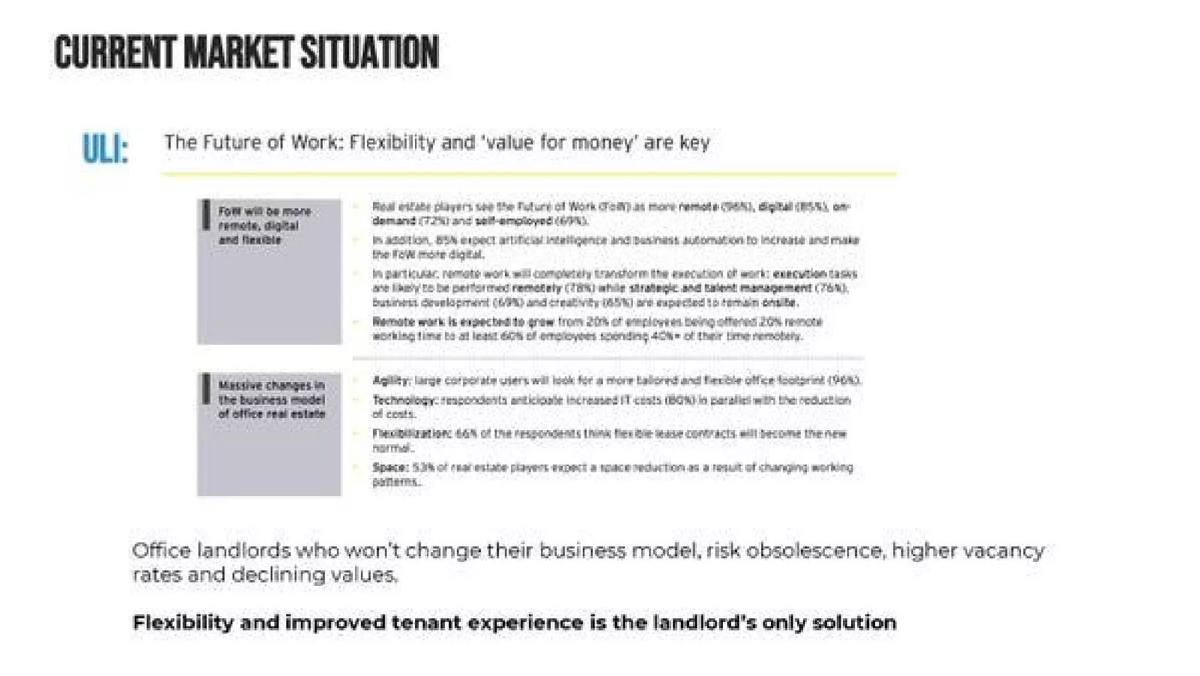
- The company identifies a massive market shift where 66% of real estate players expect flexible lease contracts to become the new normal (Slide 3).
- infinitspace operates on a white-label basis, allowing landlords to keep their own brand while outsourcing operations (Slide 7).
- The business model is based on a 20% commission on revenue plus a setup fee of up to EUR 61,000 per building (Slide 14).
- Financial projections target an Annual Recurring Revenue (ARR) of 86.3 million EUR by 2025 (Slide 14).
- The deck claims a total pipeline of over 100,000 square meters as of January 2021 (Slide 16).
- The mission is centered on the '15-minute commute' concept, aligning with UN Sustainable Development Goals (Slide 18).
- The deck lacks a specific 'Ask' slide detailing how the $1.2 million would be allocated or what the specific valuation was at the time.
Executive Summary: The Post-WeWork Pivot
The infinitspace pitch deck arrived at a pivotal moment in commercial real estate. Founded in late 2020, the company sought to capitalize on the disruption caused by COVID-19 and the internal struggles of major coworking players. By offering a white-label service, they positioned themselves not as a competitor to landlords, but as a technical and operational partner. The deck successfully raised $1.2 million by focusing on a high-pedigree team and a clear, commission-based revenue model.
The Team and Market Context (Slides 1-4)
Slide 1: Title The deck opens with a clear value proposition: "White Label Flexible Workspace Brands for office-building-owners & corporates." The imagery is a standard blurred office shot, but the subtitle immediately identifies the target customer.
Slide 2: Founding Team This is arguably the strongest slide in the deck. It lists Wybo Wijnbergen (CEO) as a former Managing Director at WeWork who scaled 50 locations (5M sq ft). Wilco Wijnbergen (CTO) is noted as a technical co-founder of illness management software with 100 employees. Elad Hod (CGO) is a former Director of Real Estate at Mindspace. The presence of "ex-WeWork" and "ex-Mindspace" leadership provides immediate credibility in a complex operational sector.
Slide 3: Current Market Situation Citing the Urban Land Institute (ULI), this slide highlights that 66% of respondents think flexible lease contracts will become the new normal. It sets the stakes: landlords who don't change risk "obsolescence, higher vacancy rates and declining values."
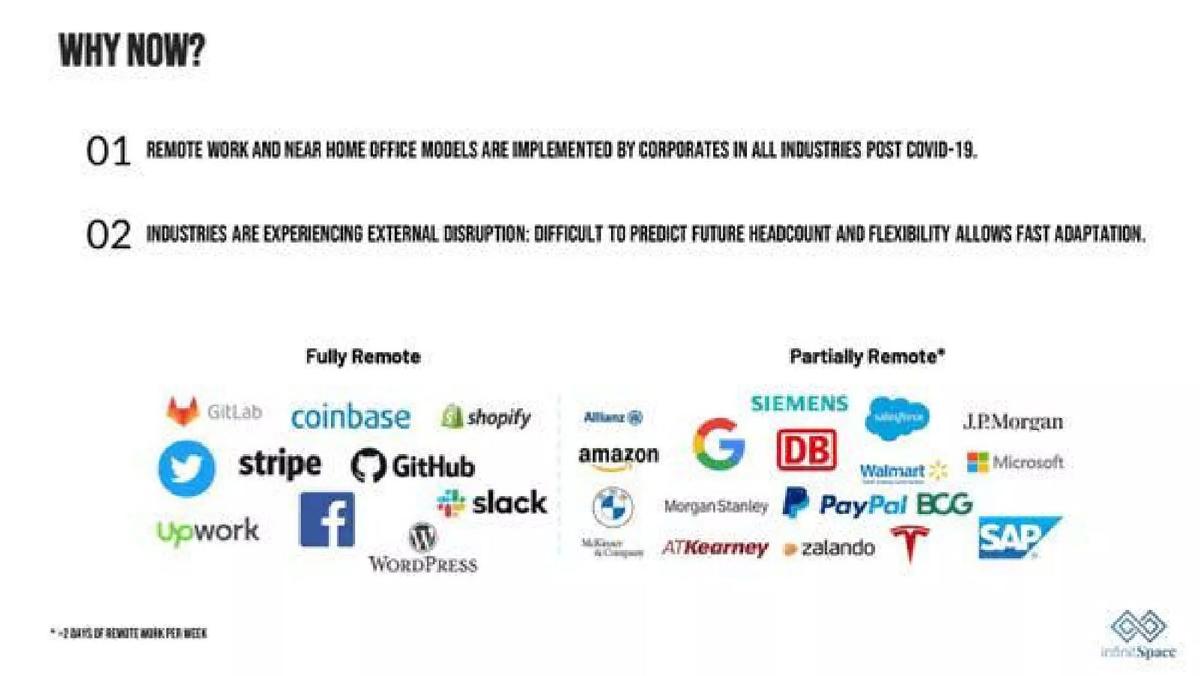
Slide 4: Why Now? This slide leans into the COVID-19 catalyst. It lists major tech companies (GitLab, Twitter, Shopify) as "Fully Remote" and others (Google, Amazon, Microsoft) as "Partially Remote." The argument is that industries are experiencing external disruption, making future headcount difficult to predict and flexibility essential.
Defining the Problem and Solution (Slides 5-9)
Slide 5: The Problem – For Landlords The deck breaks down the "Complexity of flexibility" into a list: software, marketing, community hosts, service partners, events, and automated invoicing. It uses quotes from JLL, CNBC, and Forbes to validate the claim that 30% of office stock will be flexible by 2030.
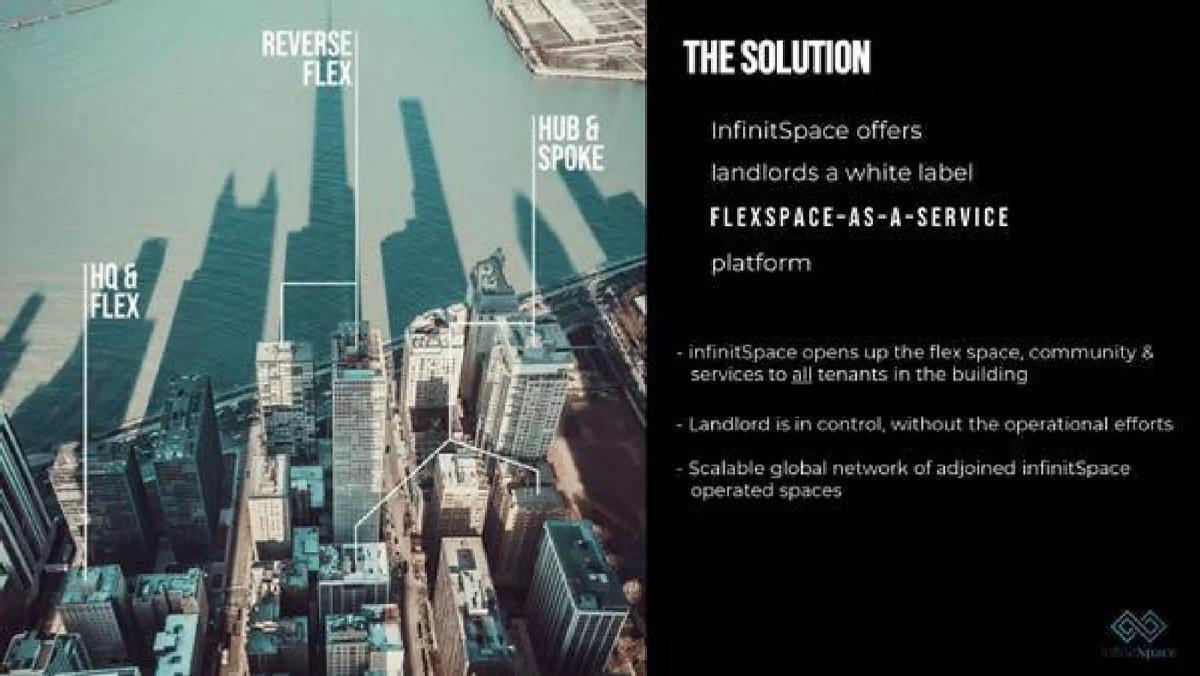
Slide 6: The Solution The solution is defined as "Flexspace-as-a-Service." The slide uses a city aerial view to visualize different models: HQ & Flex, Reverse Flex, and Hub & Spoke. The key takeaway is that the landlord stays in control without the operational effort.
Slide 7: 3 Solutions to Offer Flex Space This is a classic comparison table. It pits "Operators" (like WeWork) and "Landlord Operated" against "infinitspace." The pros for infinitspace include keeping the landlord's brand, global network access, and expert management. The cons are transparently listed: a 20% commission and no rental income guarantee.
Slide 8: The Solution (Visual) A Venn diagram shows the intersection of Coworking, Property Management, and Tenant Experience, joined by "People," "Services," and "Tech." It’s a conceptual slide meant to show the holistic nature of their offering.
Slide 9: USP’s The Unique Selling Propositions are categorized into three points: a holistic approach to the asset, the optional white-label branding, and a "member first" software platform. It emphasizes "landlord stickiness" and "tenant stickiness."
Execution and Product (Slides 10-12)
Slide 10: Execution This slide reiterates the team's strength but adds "Professional partners" for ICT, cleaning, and F&B. It suggests that their scale allows for discounts that individual landlords couldn't achieve on their own.
Slide 11: What We Offer This slide breaks the product into four pillars: Tech (on-site data), Software (white-label platform), Services (curated events), and Community (on-site managers). A bar chart at the bottom indicates that while tech and software serve all tenants, services and community are more focused on the flex tenants.
Slide 12: How Does It Work A four-step process flow: 1. Landlord has vacant space. 2. infinitspace conceptualizes a brand. 3. infinitspace sells and facilitates operations. 4. Landlord profits from a 2.2x rental price (at 70% occupancy) while infinitspace takes a 20% commission.
Financials and Traction (Slides 13-16)
Slide 13: Value Proposition This slide summarizes the benefits for two groups. For landlords: maximized revenue and control of CAPEX. For companies (members): geographic flexibility and no operational stress.
Slide 14: Revenue Model The financial heart of the deck. It lists a setup fee of up to EUR 61,000 and a 20% commission. The chart projects aggressive growth: from 1.5M EUR ARR in 2021 (36k sqm) to 86.3M EUR ARR in 2025 (576k sqm). Note that these are projections, not historical performance.
Slide 15: Market Size Europe The deck estimates the total European office market at 372 million square meters. It predicts the flexible market will grow from 4% in 2020 to 30% in 2030. infinitspace aims to capture 14% of that flexible market by 2030.
Slide 16: Traction – Up To Now A timeline from October 2020 to February 2021. It shows the company grew its pipeline from 70k sqm to over 100k sqm. Crucially, it mentions "1 LOI (3k sqm)" and "3 NDA's (60k sqm)." This indicates that while they hadn't launched yet, they had significant legal interest from landlords.
Future and Mission (Slides 17-18)
Slide 17: Traction – Future The roadmap includes opening the first location in June 2021, a Series A round of 1.5M EUR in August 2021, and reaching 30 locations by July 2022. It sets clear milestones for future investors.
Slide 18: Mission The deck ends on a social note: "Our mission is to provide workspace to everyone within a 15 minute commute." It includes the UN Sustainable Development Goals logo, specifically Goal 11 (Sustainable Cities and Communities).
What Works in This Deck
Founder-Market Fit: The team slide (Slide 2) is the strongest asset. In a sector where operational failure is common, having leaders from the two biggest names in the industry is a massive de-risking factor. · Clear Revenue Alignment: The 20% commission model (Slide 14) is easy to understand and aligns the startup's success directly with the landlord's success. · Timeliness: The "Why Now" slide (Slide 4) perfectly captures the post-COVID anxiety of commercial landlords, making the solution feel like a necessity rather than a luxury.
What Is Missing
The Ask: The deck does not explicitly state how much they are raising in this specific round or how they will spend the funds. While the catalogue facts state they raised $1.2M, the deck itself omits the specific terms. · Unit Economics: While Slide 14 shows ARR projections, it doesn't detail the cost of acquisition for a landlord or the operational costs per square meter for infinitspace. · Case Studies: Because the company was new, there are no examples of a completed building or a landlord testimonial. The traction is based entirely on a pipeline of LOIs and NDAs.
What a Founder Should Copy
The Comparison Table (Slide 7): Instead of just saying "we are better," they clearly list the "Cons" of their own model (20% commission). This builds trust with investors by showing a realistic understanding of the trade-offs. · Pipeline Transparency (Slide 16): Distinguishing between "Pipeline," "NDAs," and "LOIs" is much more effective than just giving a single large number. It shows the investor exactly where the company stands in the sales cycle. · Problem Definition (Slide 5): Breaking down a vague problem like "flexibility is hard" into specific operational tasks (invoicing, social, health & safety) makes the startup's value proposition much more tangible.
Frequently asked questions
- What is the primary problem infinitspace solves for landlords?
- According to Slide 5, landlords face extreme complexity when trying to offer flexible workspaces, including needs for specialized software, marketing, community hosts, automated invoicing, and health and safety compliance. infinitspace argues that by 2030, over 30% of office stock will be flexible space, and landlords who don't adapt risk obsolescence and declining asset values.
- How does the revenue model work for infinitspace?
- Slide 14 outlines two primary revenue streams: a one-time flexspace setup fee of up to EUR 61,000 per building and a recurring 20% commission on the revenue generated by the flexible space. This aligns their incentives with the landlord, as they only profit when the space is generating income.
- What makes the founding team particularly qualified?
- Slide 2 highlights deep domain expertise. CEO Wybo Wijnbergen was a Managing Director at WeWork, scaling the company to 50 locations in Europe. CGO Elad Hod was the Director of Real Estate at Mindspace, managing 15 transactions. This 'insider' knowledge of the coworking industry is a core pillar of their pitch.
- What is the 'White Label' advantage mentioned in the deck?
- Slide 7 and Slide 9 explain that unlike traditional operators (like WeWork) who use their own brand, infinitspace allows the landlord to keep their brand. This gives the landlord more control over asset valuation, design, and CAPEX, while infinitspace handles the 'operational efforts' behind the scenes.
- What was the company's traction at the time of the seed round?
- Slide 16 shows that between October 2020 and February 2021, the company moved from founding to having a pipeline of over 100,000 square meters. This included one Letter of Intent (LOI) for 3,000 square meters and three NDAs covering 60,000 square meters, indicating strong early interest from landlords.