The inDinero 2010 pitch deck, originating from the Y Combinator Summer 2010 cohort, presents a clear value proposition: accounting software designed for business owners rather than accountants. The deck is notable for its aggressive market sizing, claiming a $26B U.S. Revenue TAM based on 49 million potential domestic customers. It provides specific unit economics, including a 4% conversion rate to paid plans and a $530 Customer Lifetime Value. Perhaps most striking is the heavy reliance on social proof; two full slides are dedicated to 'Incredible Investors,' featuring founders and executive…
Key takeaways
- The company positions itself as a business-centric alternative to traditional accounting software (Slide 1).
- Market sizing is calculated by combining 27 million registered businesses with 22 million 'micro' businesses to reach 49 million potential customers (Slide 2).
- The deck claims a $26B U.S. Revenue TAM based on a $530 annual customer value (Slide 2).
- Product strategy involves avoiding 'accounting features' in favor of automated data downloads from banks, credit cards, and PayPal (Slide 3).
- Technical differentiation is built on integration with 5000+ banks and a transaction categorization AI (Slide 4).
- Monetization relies on a freemium model with paid tiers at $29/month and $99/month (Slide 6).
- Unit economics show a target acquisition cost of less than $20 per user against a $530 CLV (Slide 6).
- Two consecutive slides are used to showcase 12 high-profile angel investors, including Jawed Karim, Kevin Hartz, and Steve Blank (Slides 7-8).
Introduction
The 2010 inDinero pitch deck is a quintessential example of a Y Combinator 'Demo Day' style presentation. It is lean, focused on high-level metrics, and leans heavily on the credibility of its early backers. At a time when cloud accounting was still finding its footing against desktop incumbents, inDinero sought to carve out a niche by focusing on the business owner's experience rather than the accountant's workflow.
Slide 1: Title and Positioning
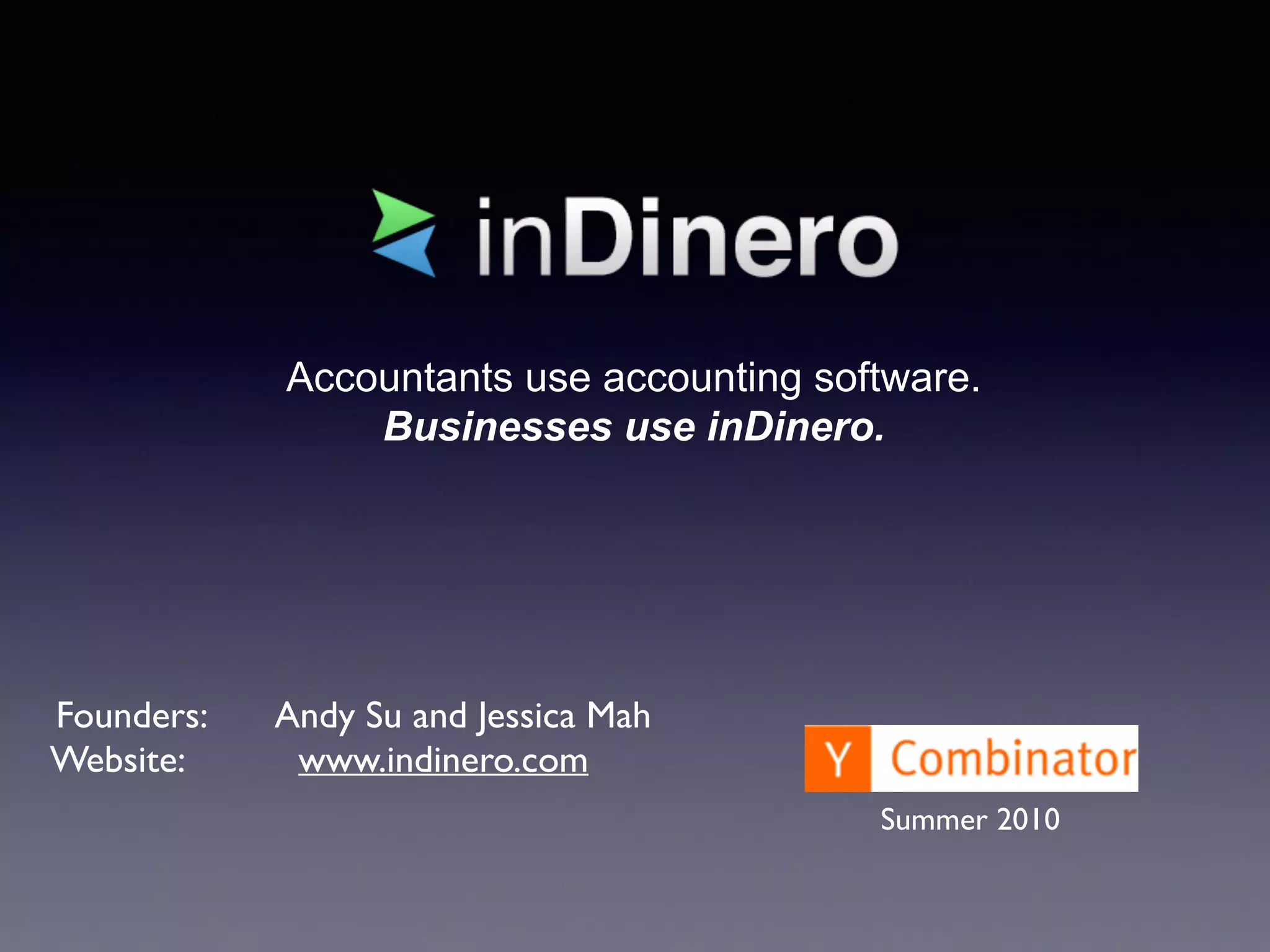
The cover slide establishes a clear dichotomy: 'Accountants use accounting software. Businesses use inDinero.' This immediately identifies the target audience and the problem (complexity). The slide lists founders Andy Su and Jessica Mah and prominently features the Y Combinator Summer 2010 logo, signaling the company's pedigree right from the start.
Slide 2: Market Size
Slide 2, titled 'Market is Enormous,' attempts to quantify the opportunity. It uses SBA data to claim 27 million registered businesses and 22 million micro-businesses. The resulting '49M Potential Domestic U.S. Customers' is an aggressive figure, as it likely includes many inactive or hobbyist entities. However, the math leads to a '$26B U.S. Revenue TAM,' calculated by multiplying the customer base by a $530 annual value. This slide is designed to show that even a small percentage of market capture results in a massive business.
Slide 3: Product and Customer Feedback
This slide combines a product screenshot with qualitative feedback. The core functionality is described as automatically downloading data from banks, credit cards, and PayPal. The 'Our customers said' section is crucial; it notes that users specifically asked the founders not to build traditional accounting features. This validates their 'anti-accounting' positioning. It also mentions a partnership with FreshBooks, suggesting early ecosystem integration.
Slide 4: Key Technology
Slide 4 focuses on three pillars: Consolidation, AI, and Forecasting. The 'Consolidation' pillar claims integration with over 5,000 banks. The 'Transaction Categorization AI' mentions processing over 100,000 transactions, which serves as a proxy for traction and data density. Finally, 'Automatic Forecasting' promises a forward-looking view of business finances, moving the product beyond a mere record-keeping tool into a strategic one.
Slide 5: User Acquisition
The acquisition strategy is four-fold. First, a viral loop through accountants and bookkeepers (each having 20-200 potential clients). Second, partnerships with financial institutions, specifically mentioning a 'potential partnership with American Express OPEN.' Third, targeting online seller communities (PayPal, eBay, Etsy). Fourth, standard SEO/SEM. This slide demonstrates a diversified approach to growth, balancing organic viral loops with paid and partner channels.
Slide 6: Monetization and Funnel Economics
This is the most data-dense slide in the deck. It outlines a freemium model with paid tiers at $29 and $99 per month. Key metrics include a 4% conversion rate and a $530 CLV. The 'Funnel Economics' section provides a concrete example: 1,000 users lead to 40 upgrades, resulting in $21,200 in revenue. Crucially, they state it is cost-effective to acquire users at less than $20 per user, implying a very healthy LTV/CAC ratio if these figures hold at scale.
Slides 7 & 8: The Investor Roster
The final two slides in the provided set are dedicated to 'Incredible Investors.' This is a pure social proof play. By listing 12 high-profile individuals from the most successful tech companies of the era (YouTube, Yelp, Twitter, Google, PayPal), inDinero is telling the VCs that the 'smart money' has already done the due diligence. Names like Steve Blank and Keith Rabois add significant intellectual and operational credibility to the young founding team.
What Works in the inDinero Deck
Clear Differentiation: The deck does an excellent job of explaining who the product is not for. By explicitly stating that accountants use other software, they simplify the value proposition for the non-expert business owner.
Unit Economics: Slide 6 provides the exact numbers investors look for in a SaaS business: conversion rates, CLV, and target CAC. This shows the founders are thinking about the business as a machine, not just a product.
Social Proof: The two investor slides are a powerful 'trust signal.' For a seed-stage company, having the founders of YouTube and Yelp on the cap table is a massive advantage that this deck leverages fully.
What is Missing from the inDinero Deck
Competitive Landscape: The deck mentions QuickBooks only in the context of customer feedback. It does not provide a feature-by-feature comparison or a 'magic quadrant' to show how they will defend their position against Intuit or other emerging cloud players like Xero.
The Team: While the founders' names are on the cover, there is no slide detailing their specific backgrounds, technical expertise, or why they are the right people to build a fintech company. In early-stage investing, the 'Why You' is often as important as the 'Why Now.'
The Ask: The provided slides do not include a closing slide with a funding goal. Investors need to know how much is being raised, the valuation expectations (or terms), and the specific milestones that the new capital will enable the company to reach.
Founder Takeaways
Lead with your strongest asset: If you have a world-class cap table, don't hide it. inDinero used two full slides to showcase their investors because, at the seed stage, that was their strongest evidence of potential success. · Simplify the TAM: While their 49M customer figure is debatable, the math is easy to follow. Founders should ensure their market sizing isn't just a big number, but a logical calculation based on a realistic price point. · Use 'Anti-Positioning': Sometimes defining what you are not is more effective than defining what you are. By positioning against 'accounting software,' inDinero made their product feel accessible to the average entrepreneur. · Quantify the Funnel: Even if the data is early, showing that you understand the relationship between 1,000 users and a specific dollar amount of revenue demonstrates a level of operational maturity that investors appreciate.
Frequently asked questions
- What is inDinero's core value proposition?
- inDinero positions itself as the financial tool for business owners who find traditional accounting software too complex. As stated on Slide 1, 'Accountants use accounting software. Businesses use inDinero.' The product focuses on automation—specifically downloading data from banks and PayPal—and providing automatic forecasting rather than requiring manual entry of accounting journals or ledgers.
- How does inDinero calculate its Total Addressable Market (TAM)?
- On Slide 2, the company cites sba.gov data to identify 27 million registered U.S. businesses and adds 22 million 'micro' businesses (1-2 employees) to reach a total of 49 million potential customers. By multiplying this by a $530 annual customer value ($48/month average), they arrive at a $26 billion U.S. Revenue TAM. This figure explicitly excludes international customers.
- What are the specific unit economics mentioned in the deck?
- Slide 6 outlines a freemium model where approximately 4% of users convert to paid plans. The company estimates a Customer Lifetime Value (CLV) of ~$530, based on a 12-month retention period. They also note that 20% of upgrades choose the $99/month unlimited plan. Their funnel economics suggest that 1,000 users result in 40 upgrades, generating $21,200, making it cost-effective to acquire users at under $20 each.
- Who were the notable investors in inDinero at the time of this deck?
- The deck highlights an extensive list of angel investors across Slides 7 and 8. Notable names include Jawed Karim (YouTube founder), Kevin Hartz (Eventbrite CEO), Jeremy Stoppelman (Yelp CEO), Keith Rabois (PayPal/Slide), Elad Gil (Twitter), Ben Ling (Google), Geoff Ralston (Lala CEO), and Steve Blank (Professor at Berkeley and Stanford).
- What is missing from the inDinero pitch deck?
- The provided 8 slides lack a dedicated 'Team' slide detailing the founders' backgrounds (though names are on the cover), a 'Competition' slide showing how they stack up against incumbents like QuickBooks, and a clear 'Ask' slide detailing how much capital is being raised and how it will be spent. It also lacks a detailed roadmap for future product development beyond the current AI categorization.