Indemand raised $125,000 in 2015 with a remarkably lean 7-slide deck. The presentation positions the company as a white-label infrastructure provider for the on-demand economy, specifically targeting local retailers who are losing ground to venture-backed delivery giants. While the deck excels at visual clarity and identifying a massive 15-million-business market opportunity in the US, it is notably devoid of traditional startup metrics. There are no slides covering revenue, unit economics, traction, or a specific financial 'ask.' This teardown explores how a compelling narrative and a clear…
Key takeaways
- The deck uses a minimalist 7-slide structure that prioritizes visual impact over text-heavy data.
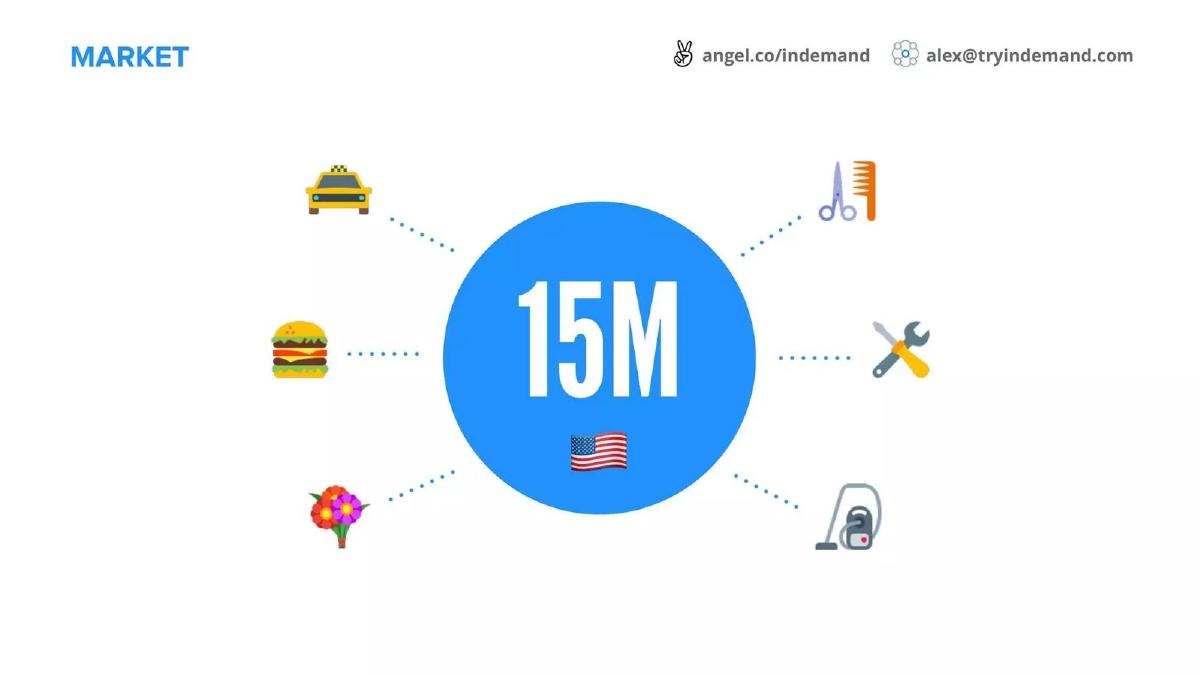
- Indemand identifies a total addressable market of 15M businesses in the US across various sectors like food, floral, and services (Slide 4).
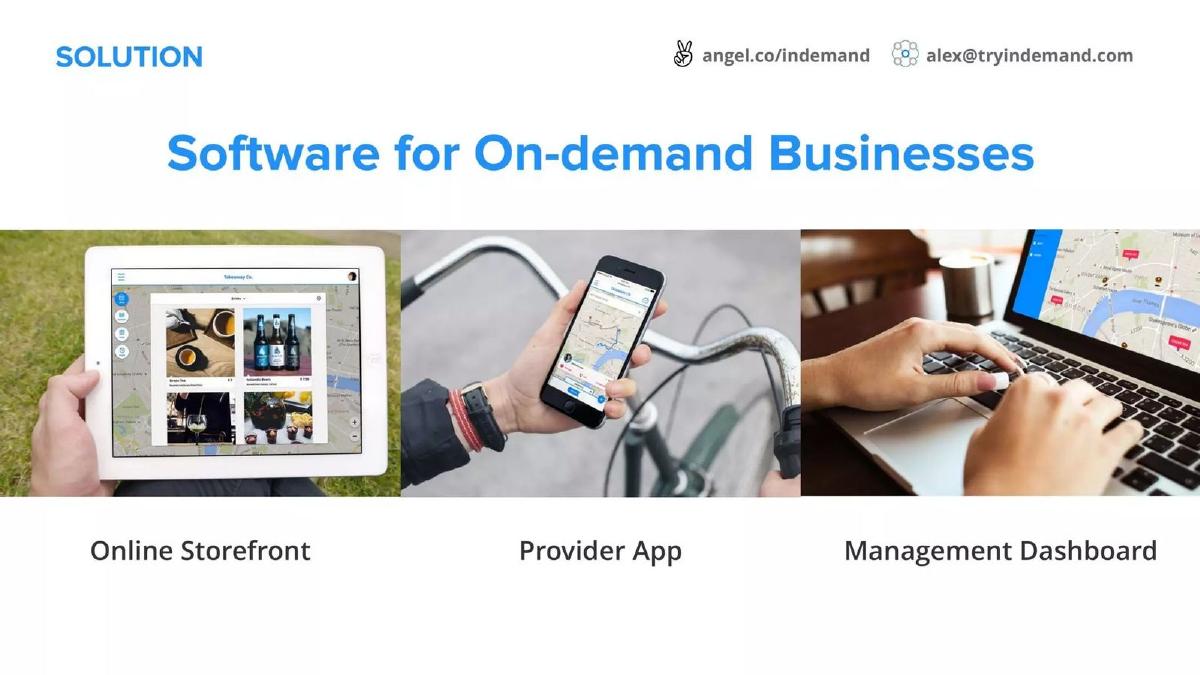
- The product is presented as a three-part ecosystem: Online Storefront, Provider App, and Management Dashboard (Slide 5).
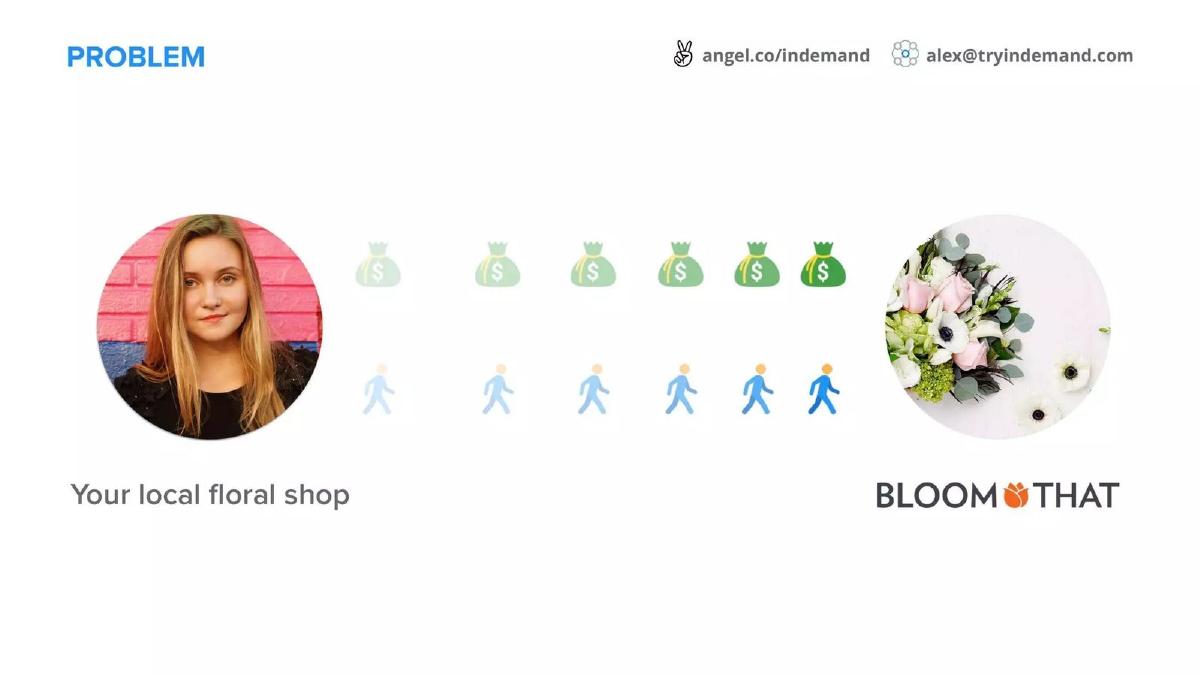
- The 'Problem' is framed as a competitive disadvantage for local shops against venture-backed startups like BloomThat (Slide 3).
- The team slide highlights prior experience with logos from Y Combinator, Apple, and Tifin, but lacks specific job titles or tenures (Slide 6).
- There is a complete absence of financial projections, current revenue, or user growth metrics.
- The deck does not state a specific funding goal or 'ask' within the slides themselves.
- The company raised $125,000 in 2015 according to catalogue data, suggesting this was a pre-seed or early seed bridge.
The 7-Slide Seed Strategy
In the world of startup fundraising, there is a constant tension between providing enough data to satisfy due diligence and keeping a deck concise enough to maintain interest. Indemand’s 2015 seed deck leans heavily into the latter. With only seven slides, it represents a minimalist approach to the 'on-demand' craze of the mid-2010s. At the time, companies like Uber and Instacart were proving the model, and Indemand sought to sell the 'picks and shovels' to the businesses being left behind.
Slide 1: Title and Vision
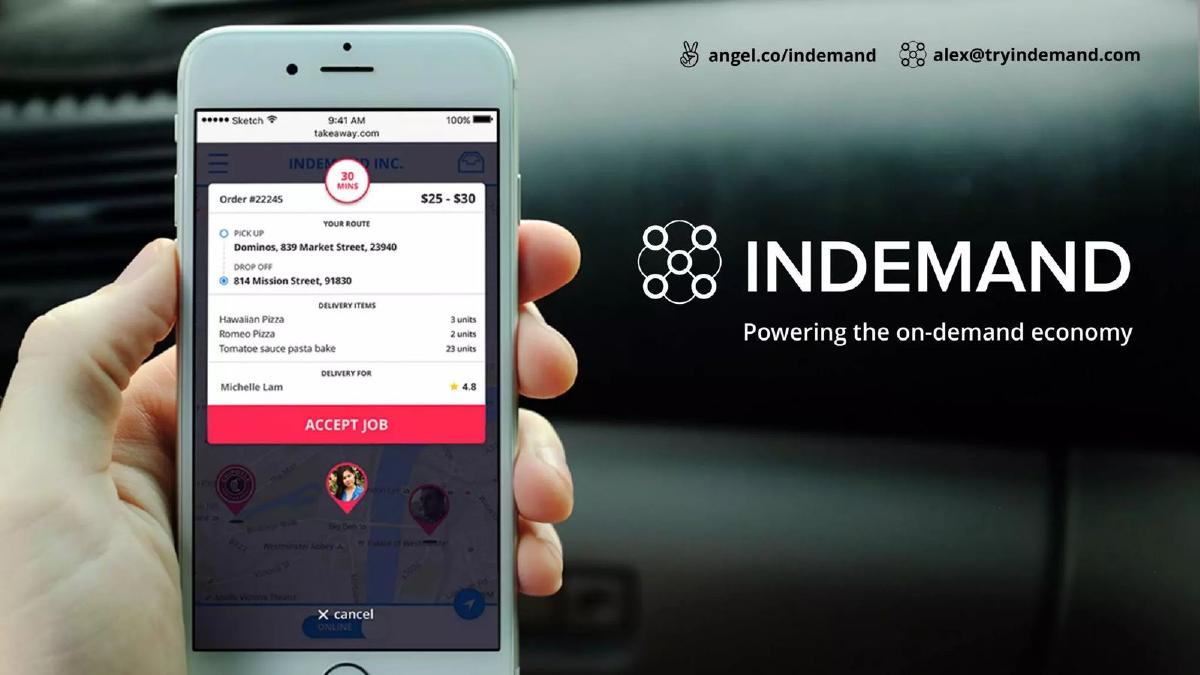
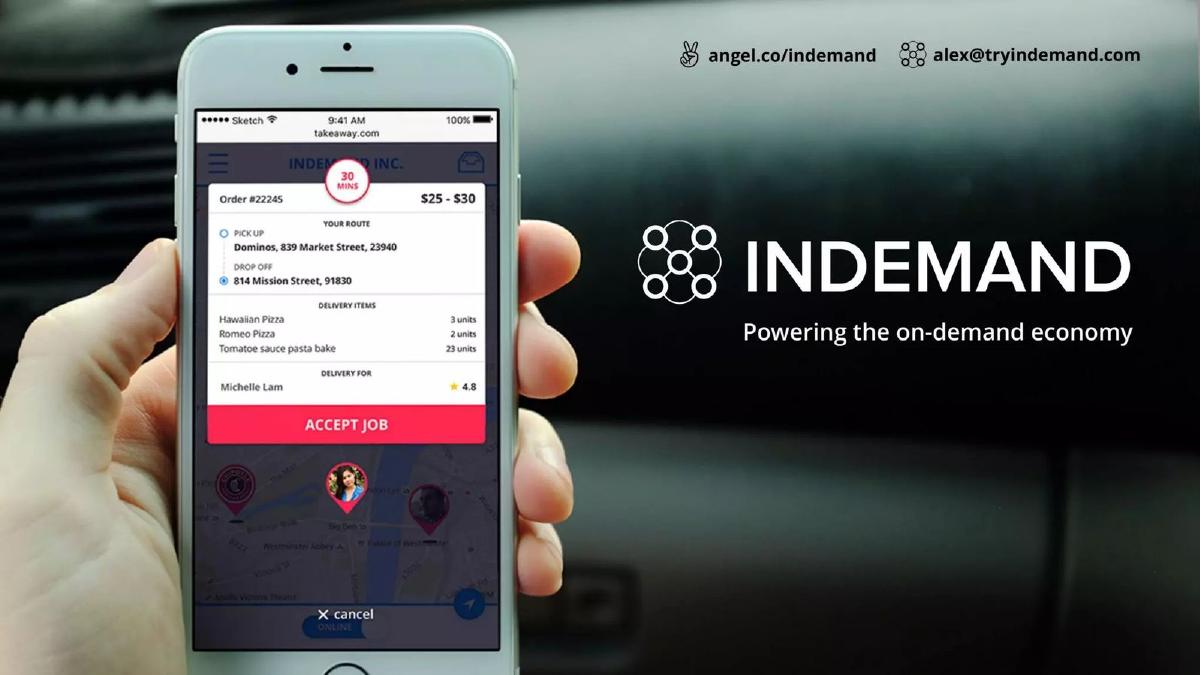
The cover slide sets a professional, tech-forward tone. It features a high-quality photograph of a hand holding an iPhone displaying the Indemand interface. The app shown is a 'Provider App' with a clear 'ACCEPT JOB' button, a route map, and order details for a 'Hawaiian Pizza' and 'Romeo Pizza' totaling '$25 - $30.' The tagline is simple: "Powering the on-demand economy." This immediately tells the investor that Indemand is a B2B infrastructure play, not a consumer-facing delivery service. Contact information for Alex Saidani is prominently displayed in the top right corner.
Slide 2 & 3: The Problem of the Local Merchant
Slide 2 is a purely visual transition, showing a woman in front of a floral display. It establishes the persona of the small business owner. Slide 3 gets into the meat of the problem. It uses a simple infographic to compare 'Your local floral shop' with 'BLOOM THAT.' The graphic shows money bags and customers moving away from the local shop toward the tech-enabled competitor. This slide effectively communicates the 'adapt or die' reality for traditional retail in 2015. It frames Indemand not just as a tool, but as a survival mechanism for the 15 million small businesses in the US.
Slide 4: Market Sizing
The Market slide is exceptionally lean. It features a large blue circle with "15M" and a US flag in the center. Surrounding this central figure are icons for various industries: transportation (taxi), food (burger), floral, beauty (scissors/comb), home services (wrench), and cleaning (vacuum). This slide argues that the on-demand problem isn't limited to groceries or flowers; it is a horizontal issue affecting every service-based small business in America. However, it lacks a 'Dollar' value for the Total Addressable Market (TAM), relying instead on the sheer volume of business entities.
Slide 5: The Three-Pillar Solution
Slide 5 defines exactly what the 'Software for On-demand Businesses' actually is. It breaks the product down into three essential components, each with a corresponding device photo:
Online Storefront: Shown on a tablet, this is the customer-facing menu where users select products (e.g., 'Green Tea' or 'Icelandic Beers'). · Provider App: Shown on a smartphone mounted to a bicycle, this is the tool for the delivery driver to see maps and job details. · Management Dashboard: Shown on a laptop, this allows the business owner to track orders and logistics.
This slide is effective because it demonstrates that Indemand provides an end-to-end ecosystem, not just a single app.
Slide 6: The Team
The team slide features three individuals: Alex Saidani (Founder) , Ann Chan (Product) , and Ipalibo Whyte (Technology) . Below their names is a row of logos intended to build credibility. These include 'give me tap!', the Y Combinator 'Y', a hashtag logo, 'TIFIN', and the Apple 'Developer' logo. While these logos suggest a high pedigree, the slide does not explain the specific roles or achievements the team members had at these organizations. In a deck this short, the team's past success is the primary collateral for the investment.
Slide 7: Closing
The final slide is a simple blue screen repeating the logo, tagline, and contact information. It serves as a backdrop for the Q&A portion of a pitch. Notably, there is no 'Ask' slide. There is no mention of the $125,000 they were seeking, the valuation, or the milestones they intended to hit with the capital.
What Works in This Deck
Visual Clarity: The deck is beautiful. It uses high-resolution imagery and a consistent color palette. For a seed-stage company, looking 'polished' can often substitute for a lack of historical data. It gives the impression that the product itself will be equally well-designed.
Clear Value Proposition: By comparing a local shop to BloomThat, the founders tapped into a very real fear among investors and business owners in 2015: that 'Big Tech' would cannibalize every local mom-and-pop shop. Indemand positioned itself as the 'anti-Amazon' or 'anti-Instacart' for small business.
Product Scope: Showing the three different interfaces (Storefront, App, Dashboard) proves that the founders understand the complexity of logistics. It isn't just a website; it's an operational OS.
What Is Missing
Business Model: This is the most glaring omission. Does Indemand charge a monthly SaaS fee? A percentage of every transaction? A per-delivery fee? Without this, an investor cannot calculate the potential return on investment, regardless of how many millions of businesses exist.
Traction: Even for a $125k raise, investors usually want to see a pilot program, a letter of intent (LOI) from a grocer, or at least some user interview data. This deck is purely theoretical.
The Ask: A pitch deck is a sales tool. Every sales tool needs a call to action. By omitting the 'Ask' slide, the founders missed an opportunity to define the terms of the round and explain how the $125k would provide enough runway to reach the next milestone.
What a Founder Should Copy
The 'Three-Screen' Solution Slide: If you are building a platform that involves multiple stakeholders (e.g., a marketplace with buyers, sellers, and admins), use Slide 5 as a template. It clearly shows that you have thought through the user experience for every participant in your ecosystem.
The Problem Framing: Don't just say 'local shops are slow.' Show a specific, well-funded competitor that is eating their lunch. It creates a sense of urgency (the 'Why Now?') that is essential for a successful pitch.
Minimalism: While this deck goes perhaps too far into the minimalist camp, most founders suffer from the opposite problem: too much text. Indemand proves that you can get an investor's attention with fewer than 50 words per slide.
Final Analysis
Indemand’s deck is a product of its time—the peak of the 'Uber for X' era. It succeeds as a 'teaser' deck designed to get a first meeting, but it lacks the structural integrity required for a lead institutional round. For a $125,000 angel round, the pedigree of the team (linked to YC and Apple) and the clarity of the vision were likely enough to close the gap left by the missing financials. Today's founders should aim for this level of visual polish while ensuring they don't forget to explain how they actually make money.
Frequently asked questions
- How much did Indemand raise with this deck?
- According to catalogue data from 2015, Indemand raised $125,000. This amount is typical for an angel investment or a small seed check during that era, which explains why the deck focuses more on the 'big idea' and team rather than complex financial modeling or established traction metrics.
- What is the core problem Indemand is solving?
- Indemand addresses the 'digitization gap' for local retailers. As shown on Slide 3, local shops (like florists) are losing customers and revenue to tech-enabled competitors like BloomThat. Indemand provides the software infrastructure to help these traditional businesses offer their own on-demand delivery services without building the tech from scratch.
- What are the components of the Indemand product?
- As detailed on Slide 5, the solution is a full-stack SaaS platform consisting of three main interfaces: a customer-facing Online Storefront for taking orders, a Provider App for the delivery personnel to manage 'jobs,' and a Management Dashboard for the business owner to oversee operations.
- Who is the target market for this software?
- While the company description focuses on grocers and supermarkets, Slide 4 suggests a much broader horizontal play. It uses icons representing taxis, restaurants (burgers), florists, hair salons, repair services, and cleaning services, claiming a total market of 15 million US businesses.
- What is missing from the Indemand pitch deck?
- The deck is missing several critical components usually required by VCs: a Business Model slide (how they charge), a Traction slide (current customers/GMV), a Competition slide (beyond one example), and a formal 'Ask' slide detailing how the $125,000 would be spent.