Incluzion is a freelance marketplace specifically designed to connect companies with Black, Latinx, and women professionals. The deck, published around late 2018, positions the startup as a 'valve' for a diverse talent pipeline, addressing the shift toward skills-based hiring over traditional job titles. While the platform was pre-revenue at the time of the deck's creation, it boasted a network of 400 freelancers and a clear three-pronged monetization strategy: transaction fees, managed services, and subscriptions. The competitive analysis is particularly sharp, contrasting Incluzion’s niche…
Key takeaways
- The company defines its target audience as 'Agile Talent' which is described as untitled, untethered, and highly skilled on Slide 4.
- Incluzion positions itself as a 'valve' that connects companies to short-term projects with diverse talent on Slide 11.
- The business model relies on three revenue streams: 10% transaction fees, managed services, and subscription fees as shown on Slide 14.
- At the time of the deck, Incluzion was pre-revenue with 400 freelancers, having launched in October 2018 according to Slide 16.
- The deck highlights a market shift where 'Skills > Job Titles,' citing major corporations like GM and GE as examples on Slide 7.
- Competitive differentiation is based on two binary factors: being 'Diversity Focused' and 'US Focused,' where Incluzion claims a unique position on Slide 16.
- Leadership includes Maxine Cain, who brings 25 years of HR experience and a role on the TAG D&I Society Board of Directors as noted on Slide 19.
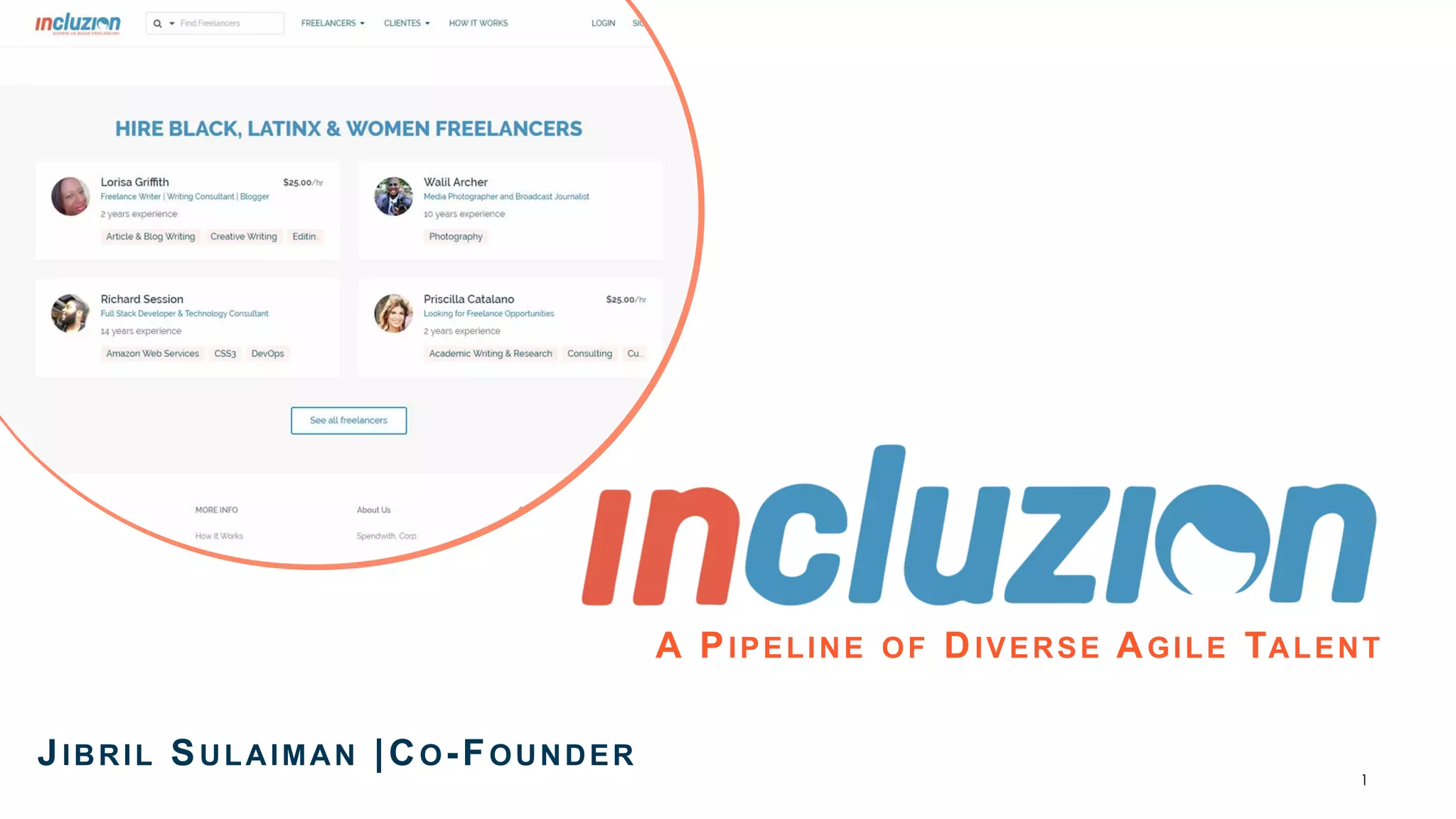
- The platform interface explicitly highlights diverse freelancers with specific hourly rates, such as $25.00/hr for writing and research roles on Slide 1.
Executive Summary: The Niche Marketplace Play
Incluzion enters the crowded freelance marketplace sector with a highly specific wedge: diversity. By focusing on Black, Latinx, and women professionals, the company attempts to solve a corporate pain point that horizontal giants like Upwork are too broad to address effectively. The deck is structured to move from the macro trend of 'agile talent' to the specific solution of a diverse pipeline, backed by a team with deep HR roots.
Slide 1: Title and Vision
The cover slide establishes the brand identity immediately. The tagline, "A Pipeline of Diverse Agile Talent," sets the stage. The visual includes a screenshot of the platform, showing real freelancer profiles like Lorisa Griffith and Priscilla Catalano, both listed at $25.00/hr . This slide identifies Jibril Sulaiman as a Co-Founder, grounding the pitch in a specific leadership presence from the start.
Slide 4: Defining Agile Talent
Slide 4 serves as a definition slide for the company's target supply side. It characterizes 'Agile Talent' using three bullet points: Untitled, Untethered, and Highly Skilled. This is a strategic choice to reframe 'freelancing' as a high-value, professionalized state of work rather than a temporary stopgap. It suggests that the talent on Incluzion is intentionally choosing this model of work.
Slide 7: The Market Shift
This slide addresses the 'Why Now?' question. It claims that "Companies are moving to Agile Model" and uses the logos of GM and GE to provide social proof of enterprise adoption. The central thesis of this slide is "Skills > Job Titles," suggesting that the traditional resume is being replaced by a more fluid assessment of what a worker can actually produce. This justifies the need for a platform that highlights specific skills over corporate pedigree.
Slide 11: The Solution as a Valve
Slide 11 uses a simple diagram to explain Incluzion's role in the ecosystem. It describes the company as "the Valve" in building a diverse pipeline. The stated goal is to "Connect companies looking to hire for short-term projects with diverse agile talent." By using the word 'valve,' the founders imply control and curation, positioning themselves as a quality filter rather than just a directory.
Slide 14: The Revenue Engine
The business model is presented with three distinct icons on Slide 14. The revenue streams are 10% Transactions, Managed Services, and Subscription Fees. This is a standard but robust approach for a marketplace. The 10% take rate is competitive (often lower than Upwork’s sliding scale), while the managed services and subscriptions offer a path to higher-margin enterprise contracts and predictable recurring revenue.
Slide 16: Competitive Landscape
This is arguably the most informative slide in the deck. It compares Incluzion against Upwork, Catalant, and SpareHire. The data points are specific:
Upwork: Launched 1999, $202M Annual Rev, 1.8M Freelancers. · Catalant: Launched 2013, $50M Annual Rev, 20,000 Freelancers. · SpareHire: Launched 2013, $1.4M Annual Rev, 5,000 Freelancers. · Incluzion: Launched Oct. 2018, Pre-Revenue, 400 Freelancers.
The slide concludes that Incluzion is the only player that is both "Diversity Focused" and "US Focused," creating a clear 'Blue Ocean' for the startup.
Slide 19: Leadership and HR Pedigree
The deck introduces Maxine Cain , highlighting her extensive background to build investor confidence. Her credentials include being a Sr. HR Director with 25 years of experience , a member of the TAG D&I Society Board of Directors , and a STEM Consultant/Advocate. This is a critical slide because it moves the project from a 'tech idea' to a 'domain-expert-led venture.' Her background suggests the company has the necessary network to attract both enterprise clients and high-quality diverse talent.
What Incluzion Does Well
The deck excels at narrowing the focus. Many marketplace startups fail by trying to be everything to everyone. Incluzion’s insistence on being 'US Focused' and 'Diversity Focused' (Slide 16) gives them a clear marketing angle that their larger competitors cannot easily replicate without alienating their existing global user bases. The use of the 'Skills > Job Titles' mantra (Slide 7) also aligns well with modern HR trends, making the pitch feel timely and relevant to current corporate struggles.
What is Missing from the Deck
The most glaring omission in the provided slides is the Financial Ask. There is no mention of how much capital is being sought or how it will be deployed to move from 'Pre-Revenue' to a sustainable business. Additionally, while the business model is stated, there are no unit economics —investors would want to see the projected Cost Per Acquisition (CPA) for a new enterprise client versus the Lifetime Value (LTV) of that client’s transaction fees. Finally, the Product Roadmap is absent; it is unclear what features will be built to facilitate the 'Managed Services' or 'Subscription' models mentioned on Slide 14.
Founder Takeaways: Copy These Moves
1. Use a Competitive Matrix with Binary Differentiators: Slide 16 is a masterclass in positioning. By choosing two specific axes (Diversity and US-based), the founders make a pre-revenue company look like a necessary alternative to a $200M revenue giant. Founders should identify the two things their competitors cannot or will not do and make those the pillars of their comparison.
2. Lead with Domain Expertise: The inclusion of Maxine Cain’s 25 years of HR experience (Slide 19) immediately validates the 'Valve' concept. If you are building in a regulated or highly specialized space like HR/Recruiting, your team slide must scream 'Industry Insider.'
3. Define Your Supply Side: Slide 4 doesn't just say 'freelancers'; it defines them as 'Agile Talent' that is 'Untitled' and 'Untethered.' This creates a specific persona that an investor can visualize, making the marketplace feel more curated and premium.
Frequently asked questions
- What is Incluzion's primary value proposition?
- Incluzion acts as a specialized pipeline for 'diverse agile talent.' According to Slide 1 and Slide 11, the platform specifically focuses on hiring Black, Latinx, and women freelancers for short-term projects. It positions itself as a solution for companies that want to increase diversity in their workforce through a flexible, skills-based model rather than traditional full-time hiring.
- How does Incluzion make money?
- The business model outlined on Slide 14 is tripartite. It includes a 10% transaction fee on freelancer engagements, revenue from managed services (likely white-glove talent matching), and recurring subscription fees. This suggests a desire to capture both the low-touch marketplace volume and high-touch enterprise consulting spend.
- Who are Incluzion's main competitors and how does it differentiate?
- Slide 16 lists Upwork, Catalant, and SpareHire as competitors. Incluzion differentiates by being the only one that is both 'Diversity Focused' and 'US Focused.' While Upwork has 1.8 million freelancers and $202M in revenue, Incluzion argues that these giants lack the specific niche focus required by modern D&I initiatives.
- What was the company's traction at the time of the pitch?
- According to the competitive matrix on Slide 16, the company launched in October 2018. At the time of the deck's creation, it was pre-revenue and had onboarded 400 freelancers. This indicates the deck was likely used for a very early pre-seed or seed round to build out the initial marketplace liquidity.
- What is missing from the provided slides?
- The provided slides lack a clear 'Ask' (how much money they are raising and on what terms) and a 'Use of Funds' breakdown. There are also no detailed financial projections or unit economics (CAC/LTV). While the team is introduced, the specific roles of all co-founders beyond Jibril Sulaiman and Maxine Cain are not fully detailed in this selection.