Teowaki is a niche social and communication platform aimed at 'happier development teams.' The deck focuses heavily on the user interface and the specific types of content shared, such as Ruby code snippets and API links. With a public launch in February 2014, the company reported approximately 500 users and one million requests served at a 60ms response time. The team is lean, consisting of two long-term friends, a freelance designer, and an advisor. While the product features are well-documented through screenshots, the deck lacks critical business information, including a clear revenue mod…
Key takeaways
- The platform aims to improve communication for developers by sharing technical information, best practices, and lifehacks (Slide 1).
- Teowaki reported approximately 500 users as of the deck's creation, though it notes not all are active (Slide 10).
- The company was incorporated in London in Summer 2013 and remained bootstrapped through its February 2014 launch (Slide 10).
- Technical performance is highlighted as a metric, citing ~1,000,000 requests served at ~60ms per request (Slide 10).
- The product includes features for sharing code snippets, such as Ruby IP address checks, and managing links within specific teams (Slides 5, 7).
- Integration is suggested through a slide showing logos for GitHub, Trello, Google Drive, and Dropbox, though specific functionality isn't detailed (Slide 8).
- The founding team, Diego Rodríguez and Javier Ramirez, have been friends since 1998, providing a narrative of long-term stability (Slide 9).
- The deck lacks a formal 'Ask' slide, financial projections, or a competitive landscape analysis.
Teowaki Pitch Deck Analysis
Teowaki enters the crowded developer tools space with a focus on the 'human' side of coding—communication, gossip, and shared lifehacks. The deck is heavily product-centric, utilizing screenshots of the web interface to explain the user experience. While it succeeds in showing what the tool does, it leaves significant questions regarding the business's viability and scale.
Slide 1: The Value Proposition
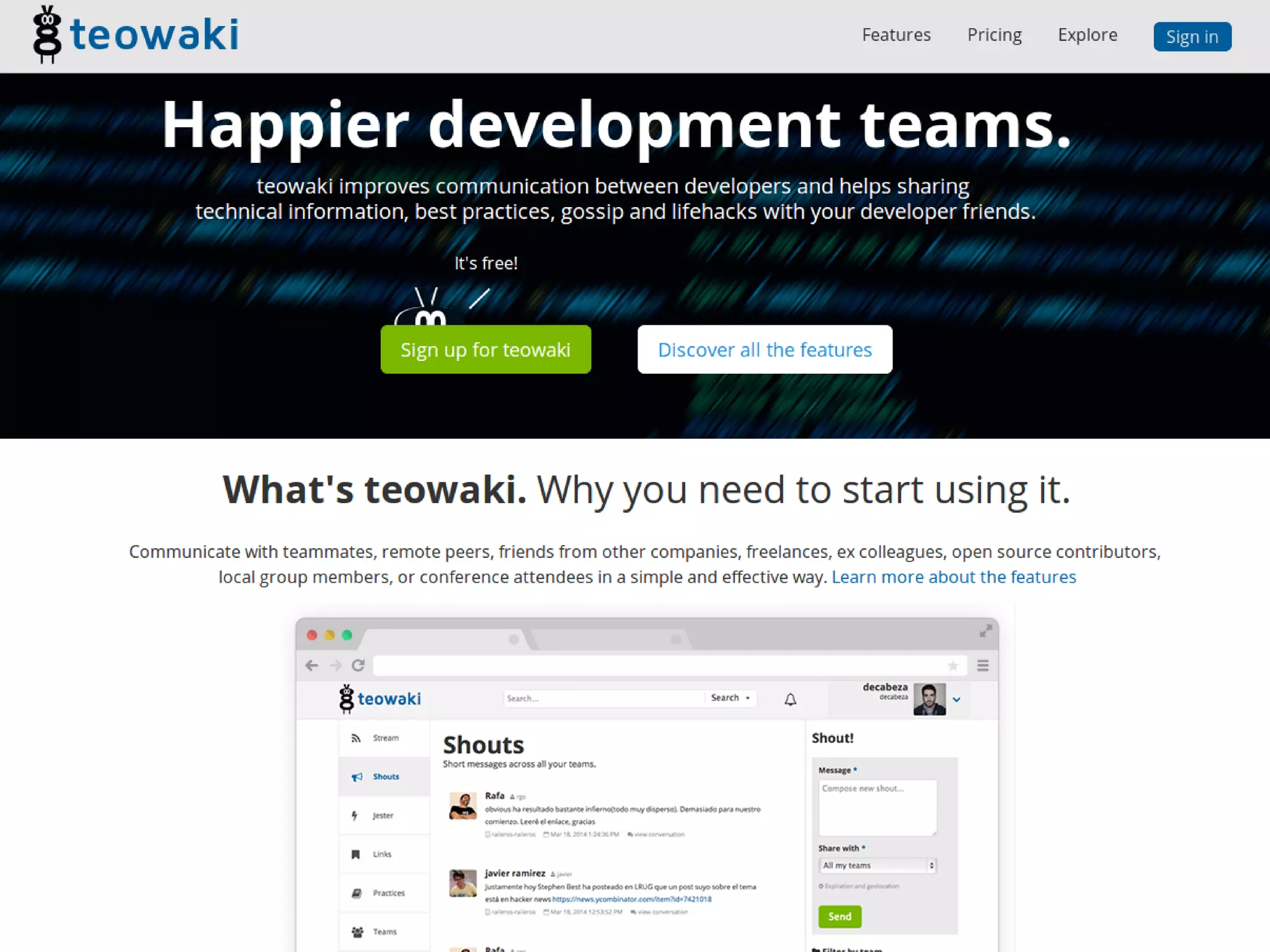
The cover slide establishes the target audience immediately: 'Happier development teams.' It defines the product as a tool to improve communication and share technical information, best practices, and 'gossip.' The inclusion of 'gossip' is a notable choice, suggesting a more informal, social atmosphere than a traditional ticketing system or documentation wiki. The slide also notes 'It's free!' and provides a call to action to 'Sign up for teowaki.'
Slide 2: The 'What' and 'Why'
This slide expands on the target user base, listing teammates, remote peers, freelancers, ex-colleagues, and conference attendees. It positions Teowaki as a versatile network that follows a developer across different professional contexts. A screenshot of the 'Shouts' feature is shown, which appears to be a micro-blogging feed for teams. The interface looks clean, with a sidebar for 'Stream,' 'Shouts,' 'Jester,' 'Links,' 'Practices,' and 'Teams.'
Slides 3 & 4: Contextual Imagery
These slides feature high-resolution photographs of people in professional and educational settings. Slide 3 shows two women interacting with a large touch-screen table, while Slide 4 shows a large, diverse audience in a lecture hall. These images seem intended to evoke the 'community' aspect of the product, though they do not show the software in use. They serve as a visual bridge between the product description and the social nature of the platform.
Slide 5: Technical Content Sharing
This slide focuses on the 'Practices' feature. It displays a specific technical use case: 'Checking the IP addresses in your machine from Ruby.' The screenshot shows code blocks and a 'Fork this practice' button, indicating that the platform supports versioning or collaborative editing of code snippets. This is a direct play for the developer market, mimicking features found in tools like GitHub Gists or Stack Overflow.
Slide 6: User Profiles
The deck shows a profile page for 'javier,' one of the founders. The profile includes links to external sites like GitHub, LinkedIn, Stack Overflow, and Twitter. It also displays the various 'Teams' the user belongs to, such as 'fosdem,' 'raileros,' and 'teowaki.' This slide demonstrates the networking capability of the platform, showing how a single user can manage multiple professional identities and communities in one place.
Slide 7: Link Curation and Management
The 'Links' feature is highlighted here, showing a curated list of resources related to an 'APIs community.' The screenshot displays articles on tokens and CORS proxies. A 'Copy link' dialogue box shows how users can categorize links and assign them to specific teams. This suggests Teowaki aims to be a knowledge repository for teams to save and organize external research.
Slide 8: The Integration Ecosystem
A circular graphic places the Teowaki logo at the center, surrounded by logos for Google Drive, Dropbox, Jenkins, GitHub, Bitbucket, Trello, and Atlassian. This slide implies that Teowaki integrates with the standard developer tech stack. However, the slide lacks text explaining the depth of these integrations—whether they are full API connections or simple link-sharing capabilities.
Slide 9: The Team
The team slide introduces Diego Rodríguez and Javier Ramirez. The primary selling point here is their history: 'The founders are friends since 1998.' This is a common trope in early-stage pitching to signal founder chemistry and reduced 'co-founder divorce' risk. The slide also mentions a freelance UX designer and a business advisor but provides no further details on their identities or contributions.
Slide 10: Traction and Technical Data
The final slide provided contains the most concrete data. Key figures include:
Incorporated: London, Summer 2013 · Funding: No external investors (Bootstrapping) · Launch: February 2014 · User Count: ~500 users (with the caveat 'not all of them active') · Throughput: ~1,000,000 requests served · Latency: ~60ms per request
The focus on request count and latency is highly specific to a developer-led startup, emphasizing technical efficiency over business metrics like CAC (Customer Acquisition Cost) or LTV (Lifetime Value).
What Works
Product Clarity: The deck does an excellent job of showing exactly what the software looks like. By using actual screenshots of the 'Shouts,' 'Links,' and 'Practices' features, the founders remove any ambiguity about what the user is signing up for. The UI appears modern and functional for the time period.
Targeted Messaging: The language used—'lifehacks,' 'Ruby snippets,' 'CORS proxy'—is tailored specifically to the developer community. This shows a deep understanding of the end-user's daily workflow and pain points.
Technical Transparency: Including latency and request metrics (Slide 10) is a smart way to build credibility with technical investors. It proves that the team can build a stable, performant system, even if the user base is still small.
What is Missing
Business Model: There is no mention of how Teowaki intends to generate revenue. While Slide 1 mentions 'It's free!', there is no discussion of a 'freemium' tier, enterprise licensing, or advertising. Investors need to see a path to profitability.
Market Analysis: The deck fails to define the size of the opportunity. There are no slides addressing the Total Addressable Market (TAM) or how Teowaki fits into the broader landscape of developer productivity tools.
Competitive Landscape: In 2014, tools like Slack and HipChat were already gaining significant traction. Teowaki does not explain how it differentiates itself from these giants or from more specialized tools like Stack Overflow for Teams.
The Ask: A pitch deck is a tool for fundraising, yet this deck lacks a clear request. It does not state how much capital is being sought, what milestones that capital will fund, or what the current valuation expectations are.
Founder Takeaways
Show, Don't Just Tell: The use of screenshots to walk through features is a best practice for early-stage product decks. It grounds the vision in reality. Founders should follow this lead but ensure the screenshots are annotated to highlight specific value drivers.
Leverage Founder History: If you have a long history with your co-founder, highlight it. The 'friends since 1998' note (Slide 9) is a strong signal of team stability that investors value during the high-risk seed stage.
Balance Technical and Business Metrics: While 60ms latency is impressive, it shouldn't be the only 'data' slide. Founders must balance technical achievements with business KPIs like month-over-month growth, churn rates, and engagement metrics to appeal to a broader range of investors.
Define the 'Why Now': The deck describes what the product is, but not why it is necessary at this specific moment in time. Adding a 'Problem' slide that highlights the failures of existing communication tools would make the 'Solution' slides much more impactful.
Frequently asked questions
- What is the primary value proposition of Teowaki?
- Teowaki positions itself as a tool for 'happier development teams' by facilitating the sharing of technical knowledge, snippets, and best practices. It aims to bridge the gap between formal documentation and casual chat, allowing developers to communicate with peers, remote colleagues, and open-source contributors in a structured, searchable environment.
- What stage of growth was Teowaki in at the time of this deck?
- The company was in the very early post-launch stage. According to Slide 10, they incorporated in Summer 2013 and had a public launch in February 2014. With roughly 500 users and no external investors, they were operating as a bootstrapped seed-stage startup focused on initial user acquisition and technical stability.
- How does the product handle technical content?
- The product features 'Shouts' for short messages and 'Practices' for sharing code snippets. Slide 5 specifically shows a Ruby code snippet for checking IP addresses, suggesting the platform supports syntax highlighting and technical formatting. It also includes a 'Links' section for curating resources like API documentation and CORS proxies.
- Who are the founders and what is their background?
- The founders are Diego Rodríguez, described as a 'pragmatic developer,' and Javier Ramirez, a 'web developer.' Slide 9 emphasizes their long-term relationship, stating they have been friends since 1998. The team is supported by a freelance UX designer and a business advisor, though no specific names or bios are provided for these roles.
- What critical business information is missing from the deck?
- The deck is missing several standard venture capital requirements. There is no mention of a business model or how the company intends to make money. Furthermore, there is no market size (TAM/SAM/SOM) analysis, no competitive matrix comparing them to tools like Slack or Stack Overflow, and no specific funding request or use of funds.