Immo’s 2022 Series B deck is a masterclass in positioning a capital-intensive real estate business as a high-growth technology platform. By focusing on the fragmentation of the European residential market—valued at over €1.8 trillion annually—Immo argues that institutional capital is currently locked out of the single-unit residential sector due to operational complexity. The deck highlights their proprietary 'risk-return model' and 'Insta Immo' inspection app to demonstrate how they have digitized the sourcing, renovation, and management of properties. With $75M raised, the narrative success…
Key takeaways
- The European residential transaction market is valued at over €1.8 trillion annually, with 7 million transactions occurring each year (Slide 7).
- 69% of home sales fall through due to buyer-related reasons, creating a massive opportunity for a reliable 'iBuyer' solution (Slide 7).
- Immo positions itself as a bridge in the value chain: buying at scale, transforming assets, and renting to residents (Slide 11).
- The company uses a proprietary risk-return model that analyzes tens of thousands of municipalities and millions of data points to identify undervalued markets (Slide 21).
- The 'Insta Immo' inspection app collects over 300 data points per property to remove human bias from the assessment process (Slide 23).
- The deck leverages 'social proof by proxy' by showing billions of dollars in US-based Single Family Rental (SFR) traction from firms like Blackstone and Invesco (Slide 17).
- Immo claims to have created a 'highly profitable business model' and successfully raised multiple levels of capital since their Series A (Slide 19).
- The team slide features 24 individuals, highlighting deep expertise in capital markets, data science, and asset management (Slide 3).
The Series B Narrative: From Property Tech to Institutional Asset Class
Immo’s Series B deck is a sophisticated example of how to pitch a PropTech company that is fundamentally asset-heavy. In the 2022 fundraising environment, the goal was to prove that the company had moved past the 'proof of concept' stage and was ready to become the dominant infrastructure for European residential investment. The deck is structured to first validate the massive market size, then demonstrate the technological 'moat' that allows Immo to manage complexity at scale.
Slide 1: Title and Positioning
The cover slide uses the tagline 'Residential Simplified' and describes Immo as a 'Next Generation Residential Platform.' The imagery of a classic European apartment block immediately grounds the pitch in its specific geographic focus: the dense, urban European residential market, which differs significantly from the US single-family home market.
Slide 3: The Team
The team slide is exceptionally dense, featuring 24 individuals. This is a deliberate choice for a Series B deck. It signals that the company has built out the necessary middle management and specialized departments—ranging from 'Capital Product & Innovation' to 'Data Science & BI' and 'Sustainability & Compliance'—required to handle institutional-grade capital. The presence of roles like 'Head of Asset Services' and 'Country Operations' for both Germany and Spain shows geographic breadth and operational depth.
Slide 5 & 7: The Problem and Market Opportunity
Slide 5 serves as a transition, while Slide 7 delivers the 'shock and awe' metrics. Immo identifies a €1.8 trillion annual transaction volume in Europe across 7 million transactions. The 'pain' is quantified: 69% of sales fall through, and 6-7% is lost to broker commissions. By framing the current process as 'opaque and broken,' Immo positions its 'iBuyer' model not just as a convenience, but as a necessary market correction.
Slide 9: The Renter's Pain Point
Immo doesn't just focus on the seller; they highlight the 'unprofessional rental product' offered by 'unprofessional landlords.' The slide uses unappealing photos of dated bathrooms and kitchens to contrast with the modern, standardized product Immo provides. This slide establishes the demand side of the marketplace: renters are desperate for a 'branded' and 'reliable' housing provider.
Slide 11: The Solution - Bridging the Value Chain
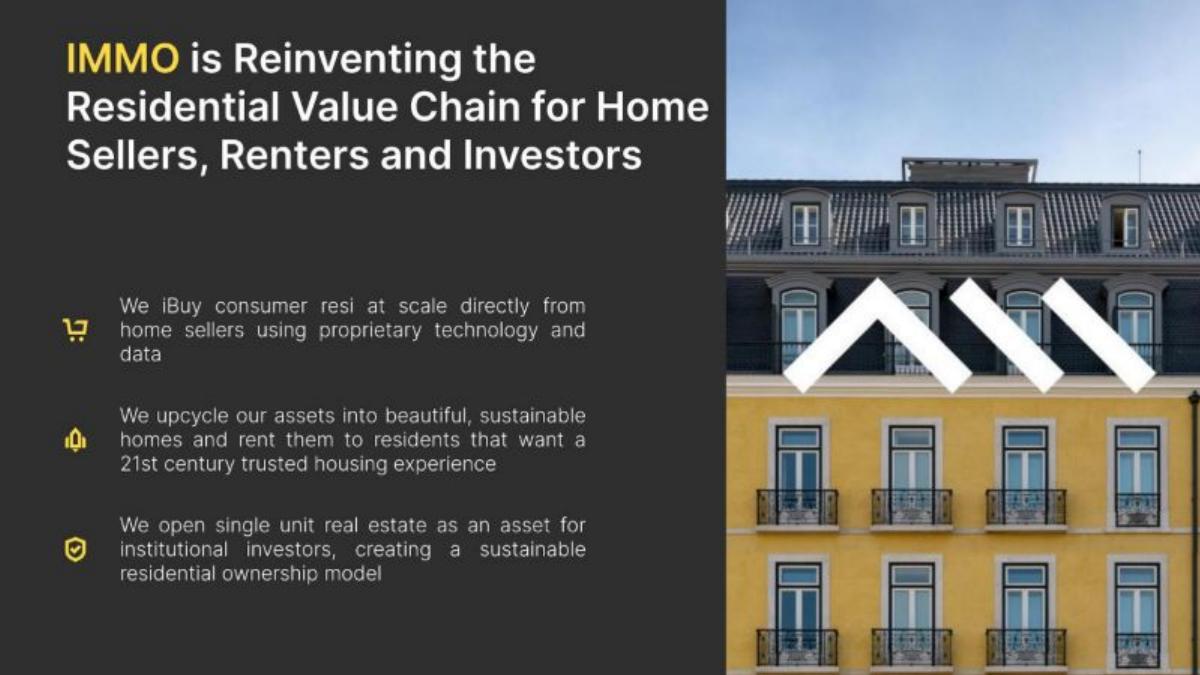
This is the 'how it works' slide. It breaks the business into three clear steps: iBuy (sourcing at scale), Transform (renovating into sustainable homes), and Rent (providing 21st-century housing). Crucially, the bottom of the slide mentions the ultimate goal: unlocking residential exposure for institutional investors seeking stable yields. This connects the operational work (buying and fixing houses) to the financial product (institutional portfolios).
Slide 13: Transformation and Standardization
Slide 13 uses 'before and after' photography to demonstrate the 'Immo home experience.' The text emphasizes a 'highly standardized' and 'digitized' process. For investors, 'standardized' is a keyword—it means the business can scale without costs growing linearly, and it ensures the underlying asset quality is consistent across a portfolio of thousands of units.
Slide 15: The Investor Interface
This slide shows the software side of the business. By displaying dashboards and 'marketing intelligence' maps, Immo reinforces the idea that they are a tech company. They describe their product as 'Transforming residential into a liquid fixed income investment experience.' This is a high-level pitch aimed at the CFOs of pension funds, repositioning real estate as a financial instrument.
Slide 17: US Market Validation
Immo uses a 'look at the US' strategy to validate their model. By showing headlines of Blackstone, Invesco, and Lennar pouring billions into Single Family Rentals (SFR) in the US, they argue that Europe is the 'next frontier.' This creates a sense of urgency and 'FOMO' (fear of missing out) for European investors who don't want to miss a proven global trend.
Slide 19: Post-Series A Achievements
This slide lists five key achievements, including building a 'highly profitable business model' and 'unlocking scalable institutional capital.' While it lacks hard numbers, it serves as a checklist to tell Series B investors that the foundational risks (can we buy? can we fix? can we rent?) have been retired.
Slide 21 & 23: The Tech Moat
These slides dive into the proprietary tools. Slide 21 explains the 'Risk-Adjusted Return Model' that uses millions of data points for 'hyper-local identification' of high-yielding areas. Slide 23 introduces 'Insta Immo,' an inspection app that collects 300+ data points . The mention of 'AI image recognition models' to assess refurb needs is a classic Series B 'future-proofing' statement, suggesting further margin improvements through automation.
Slide 25: The Social Contract
The deck ends on a high-minded note, discussing the 'social fabric.' It addresses the 'Generation Rent' crisis and positions Immo as a way for 'social contract' institutions (like pension funds) to own housing. This ESG (Environmental, Social, and Governance) angle is critical for modern institutional fundraising, as it justifies the 'institutionalization' of the housing market as a win for society, not just for shareholders.
What Works in This Deck
1. The 'Financialization' of Real Estate: Immo successfully pitches the idea that they aren't just a landlord, but a technology layer that turns messy, fragmented real estate into a clean, 'liquid fixed income' asset. This is exactly what Series B/C investors want to hear.
2. Clear Value Chain Positioning: Slide 11 is a perfect summary. It shows exactly where Immo sits between the retail seller and the institutional buyer. It simplifies a very complex business into three icons and three sentences.
3. Use of Proxy Validation: Since the European SFR market was relatively nascent in 2022, using the US market (Slide 17) as a 'crystal ball' for what will happen in Europe is a highly effective way to argue for a massive exit or IPO potential.
What Is Missing
1. Hard Unit Economics: For a Series B deck, the lack of specific margins is notable. Investors would want to see the 'spread'—the difference between the purchase price + renovation cost and the eventual portfolio valuation or rental yield.
2. Cohort Data: There is no mention of how properties bought in 2019 or 2020 are performing compared to 2021. In a managed rental model, showing that occupancy rates and maintenance costs remain stable over time is vital.
3. Regulatory Risk: European real estate is heavily regulated (rent controls, eviction laws). The deck mentions 'Sustainability & Compliance' on the team slide but doesn't explicitly address how the business model survives tightening rent regulations in markets like Berlin or Barcelona.
What Other Founders Should Copy
1. The 'Problem' Quantification: Don't just say the market is big; say why it's broken for the average person. Quantifying the 'fail rate' of home sales (69%) is much more compelling than just saying 'selling a home is hard.'
2. Professionalizing the 'Ugly': If your business involves physical assets, use the 'unprofessional' vs. 'professional' contrast. The photos on Slide 9 and Slide 13 do more work than any amount of text could to explain why a branded housing product is better.
3. The 'Social Contract' Close: If you are operating in a sensitive industry like housing, healthcare, or education, always include a slide on how your scale benefits the broader ecosystem. It helps pre-empt 'vulture capitalist' criticisms and aligns you with the largest pools of institutional capital (ESG funds).
Frequently asked questions
- What is Immo's core business model?
- Immo operates an end-to-end residential platform. They use technology to buy single-unit residential properties directly from sellers at scale, renovate them into 'beautiful, sustainable homes,' and then manage them as rentals. This provides institutional investors with a predictable yield and exposure to a previously inaccessible asset class.
- How does Immo use technology to gain a competitive advantage?
- The deck highlights two main tech pillars: a risk-adjusted return model for market identification and the 'Insta Immo' inspection app. The former analyzes millions of data points to find undervalued areas, while the latter standardizes property assessments with over 300 data points, reducing human bias and automating the renovation cost estimation.
- What market problem is Immo solving for sellers?
- According to slide 7, selling a home is currently 'uncertain and extremely expensive.' They cite that 69% of sales fall through due to buyer issues and that sellers are often hit with 6-7% broker commissions. Immo acts as a professional buyer, providing speed and certainty to the consumer seller.
- Who are the target end-investors for Immo's portfolios?
- Immo targets institutional 'social contract' investors, such as pension funds, annuity providers, life insurers, and endowments. These entities seek long-term, diversified, and stable yields that residential real estate provides but lack the operational infrastructure to manage thousands of individual units themselves.
- What is missing from this pitch deck?
- The provided slides omit specific financial performance metrics, such as current AUM (Assets Under Management), exact unit economics (buy-to-rent margins), or detailed revenue growth charts. While it mentions being 'highly profitable' on slide 19, it does not provide the data to back up that claim in the visible slides.