Illumen Capital's Fund II deck is a masterclass in thematic fund raising, successfully securing $168M by positioning social equity as a driver of financial outperformance rather than a trade-off. The 11-slide presentation focuses heavily on the 'structural problem' of implicit bias in asset management, citing specific research from Stanford SPARQ to validate its approach. Unlike typical venture decks, this fund of funds deck emphasizes a 10-year coaching and training model for underlying managers. While it lacks specific portfolio company logos or detailed past performance metrics, it clearly…
Key takeaways
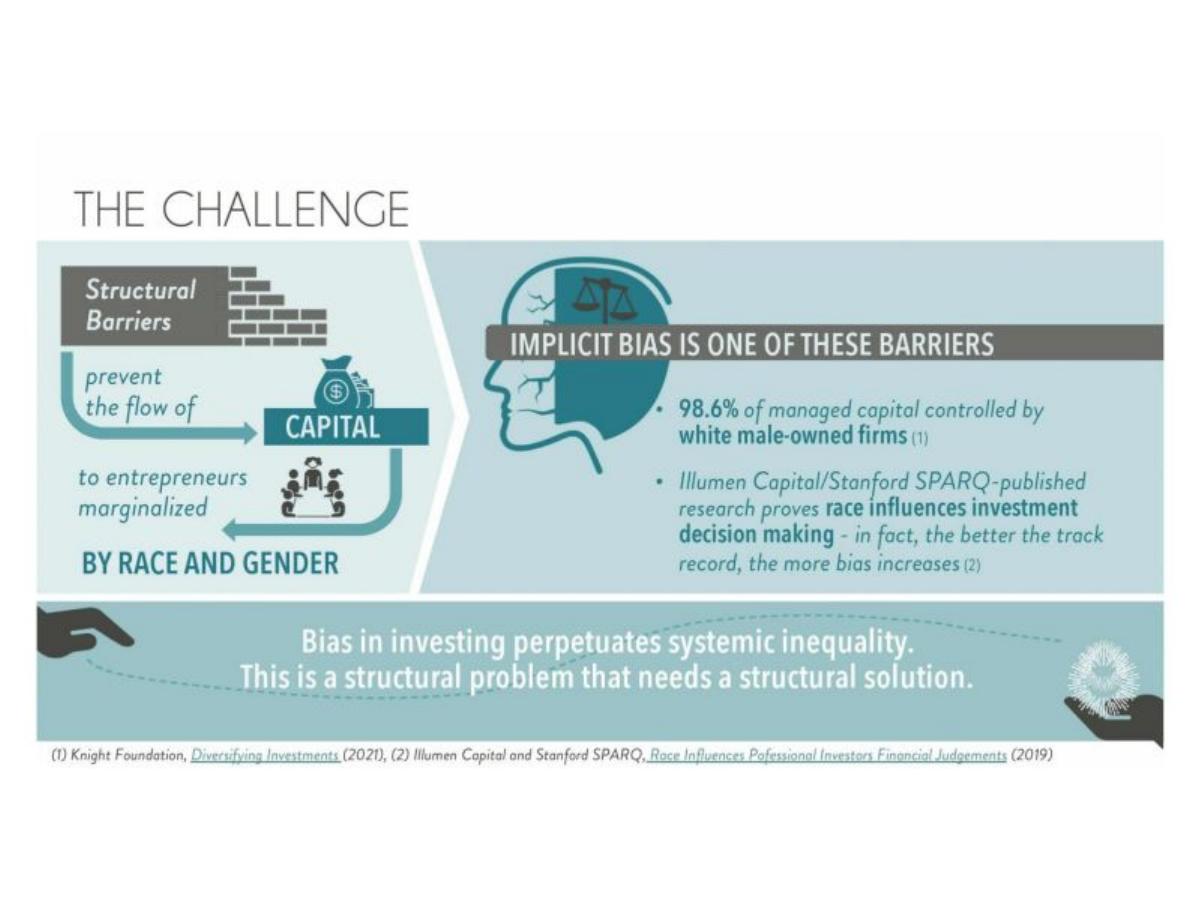
- The deck identifies that 98.6% of managed capital is controlled by white male-owned firms, establishing a clear structural barrier on slide 3.
- Illumen Capital leverages research proving that the better a track record, the more implicit bias increases in investment decision-making, as noted on slide 3.
- Financial justification is provided through McKinsey data showing a 33% increase in likelihood of out-performance for racially diverse companies on slide 4.
- The investment strategy involves a 10-year period of evidence-based training and coaching for fund managers to reduce bias, according to slide 5.
- The fund targets four specific impact sectors: Education, Health & Wellness, Financial Inclusion, and Climate & Sustainability on slide 6.
- The team slide (slide 7) lists eight key members, led by Managing Director Daryn Dodson, providing a comprehensive view of the fund's human capital.
- The fund exceeded its $150 million target, ultimately securing $168 million in commitments as shown on the key terms slide (slide 8).
- The deck explicitly states an aim for 'financial alpha' by reducing bias, positioning impact as a performance lever on slide 5.
The Impact Fund of Funds Narrative
Illumen Capital’s Fund II deck is a concise 11-slide presentation that successfully navigated the difficult environment of 2023 to raise $168 million. As a fund of funds, the challenge is twofold: proving that you can pick winning managers and proving that your oversight adds value beyond what the managers could achieve alone. Illumen solves this by centering their entire narrative on a single, research-backed lever: the reduction of implicit bias.
Slides 1-2: The Mission Statement
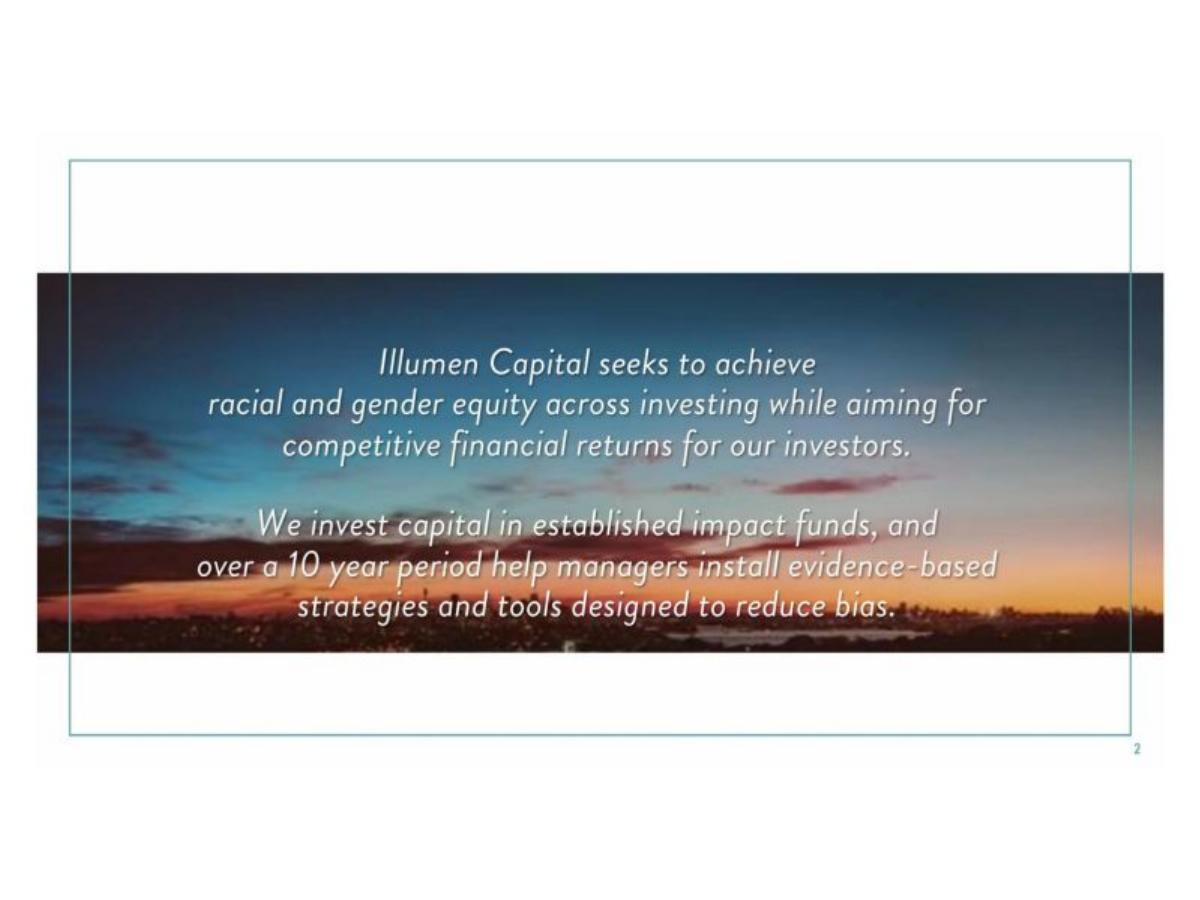
The deck opens with a standard title slide for 'Illumen Capital II, LP' featuring imagery related to their target sectors: wind turbines, laboratory work, and family life. Slide 2 immediately establishes the dual-mandate of the firm. It states that they seek to achieve 'racial and gender equity' while 'aiming for competitive financial returns.' This is a critical framing for LPs (Limited Partners) who may be wary of 'impact first' funds that sacrifice returns. The slide also introduces their 10-year engagement model, which is the core of their operational strategy.
Slide 3: Defining the Structural Problem
This is arguably the most important slide in the deck. It defines 'The Challenge' using a stark statistic: 98.6% of managed capital is controlled by white male-owned firms. By citing the Knight Foundation and their own research with Stanford SPARQ, they move the conversation from a moral argument to a structural market inefficiency. The most provocative claim here is that 'the better the track record, the more bias increases.' This suggests that traditional 'meritocratic' systems are actually reinforcing bias, creating a massive opportunity for a fund that knows how to look elsewhere.
Slide 4: The Market Opportunity
Following the problem, slide 4 presents the 'Market Opportunity' through the lens of financial performance. By citing McKinsey, the deck claims that firms reducing bias see returns up to 7% higher. It also notes a 15x growth in US-based venture funds pursuing equity strategies. This slide serves to prove that the 'impact' market is no longer a niche corner of finance but a rapidly expanding and high-performing asset class.
Slide 5: The Investor Opportunity
Slide 5 acts as the bridge between the market data and Illumen’s specific product. It promises LPs three things: access to a diverse set of top managers, the use of investment power to reduce bias via a 10-year coaching model, and the pursuit of 'financial alpha.' The use of the term 'alpha' is intentional; it signals to institutional investors that this fund is designed to beat the market, not just match it.
Slide 6: Sector Focus
Illumen defines its playground on slide 6. They focus on four sectors: Education , Health & Wellness , Financial Inclusion , and Climate & Sustainability . The use of clear icons and photography helps ground the abstract concept of 'bias reduction' into tangible industries. This provides LPs with a clear understanding of the underlying assets they will be exposed to.
Slide 7: The Team
The team slide is comprehensive, showing eight professionals. It is led by Daryn Dodson (Managing Director). The presence of roles like 'Vice President, Product Development & Impact' and 'Impact Associate' reinforces the firm’s commitment to its bias-reduction methodology. The team appears diverse in both gender and ethnicity, which is essential for a fund whose thesis is built on the value of diversity.
Slide 8: Key Terms and the 'Ask'
Slide 8 provides the hard data for the fund. It shows a Target of $150 million and Commitments of $168 million , indicating an oversubscribed fund. It lists the stage focus as 'Venture, Growth and Private Equity.' Notably, several sections are redacted in this public version of the deck, including 'Commitment Sizes,' 'Fees, Carried Interest,' and 'Geographic Focus.' This is common in fund decks to protect proprietary structures, but for a teardown, it represents a gap in the available unit economics of the fund itself.
Slides 9-11: Closing and Disclaimers
The deck concludes with a logo slide and a very dense, standard legal disclaimer. Slide 10 is particularly important for a fund of funds, as it contains the necessary language regarding the high-risk nature of the investment and the fact that ESG objectives are subject to change. The final slide (Slide 11) is a placeholder from the source library and not part of the original Illumen deck.
What Illumen Capital Does Well
The primary strength of this deck is its academic grounding . By partnering with Stanford SPARQ, Illumen isn't just making a social claim; they are making a psychological and economic one. They successfully frame 'bias' as a 'market friction' that, when removed, releases trapped value. This is a much more compelling pitch to institutional LPs than a purely philanthropic approach.
Furthermore, the clarity of the 10-year model is a strong differentiator. Most funds of funds are passive aggregators. Illumen positions itself as an active consultant to its underlying managers, which justifies their fee layer by providing a service that theoretically improves the performance of the underlying assets.
What is Missing
Specific Portfolio Examples: The deck is entirely theoretical regarding its managers. While it mentions 'top impact fund managers,' it does not name a single one. Even if Fund II was a new raise, including 'Sample Managers' or 'Fund I Highlights' would have provided more concrete evidence of their selection capability.
Fund I Performance: There is no mention of the Internal Rate of Return (IRR) or Multiple on Invested Capital (MOIC) from their first fund. While the $168M raise suggests that Fund I LPs were happy, the lack of even high-level performance data is a notable omission for a second-time fund.
The 'How' of Bias Reduction: The deck mentions 'evidence-based strategies and tools' multiple times but never shows what they look like. A screenshot of a dashboard, a sample training module, or a case study of a manager who changed their process would have made the '10-year coaching' promise feel more real.
Founder Lessons
Lead with the 'Why' of the Market Inefficiency: If you are raising an impact fund, don't just talk about doing good. Talk about the structural reason why the current market is failing to capture value. · Use Third-Party Validation: Citing McKinsey and Stanford adds a layer of institutional credibility that is hard to dismiss, especially when dealing with sensitive topics like racial and gender bias. · Define Your Value-Add Clearly: If you are a middleman (like a fund of funds), you must explain exactly what you do to the capital between the LP and the end company. Illumen’s '10-year coaching' is a perfect example of a clear value-add. · Transparency in Terms: Even with redactions, providing a clear table of 'Key Terms' (Slide 8) shows professional maturity and makes it easy for an LP's due diligence team to quickly categorize the fund.
Frequently asked questions
- What is Illumen Capital's core business model?
- Illumen Capital operates as an impact fund of funds. According to slide 2, they invest capital into established impact funds and then work with those managers over a 10-year period. Their unique value add is providing evidence-based tools and strategies designed to reduce racial and gender bias within those underlying funds' investment processes.
- How does the deck justify the financial return of an impact-focused fund?
- The deck uses third-party data to link diversity to performance. Slide 4 cites a McKinsey study of 1,000 investments showing returns up to 7% higher for firms that reduce bias. It also notes that companies in the top quartile for racial diversity are 33% more likely to outperform on operating margins.
- What specific sectors does Illumen Capital invest in?
- As detailed on slide 6, the fund focuses on four primary pillars: Education, Health & Wellness, Financial Inclusion, and Climate & Sustainability. Slide 8 further clarifies that they invest across various stages, including Venture, Growth, and Private Equity within these sectors.
- What was the outcome of the Fund II raise?
- The fundraising effort was successful, surpassing the original target. Slide 8 indicates a target of $150 million against actual commitments of $168 million. The fund reached its final close in April 2023, as stated in the key terms table.
- What is missing from this pitch deck that a typical investor might expect?
- The deck is light on specific track record data from Fund I. While it mentions 'established impact funds,' it does not list specific names of funds in the current or past portfolio. Additionally, the 'Key Terms' slide (slide 8) has several rows redacted (blacked out), including commitment sizes, fees, and geographic focus.