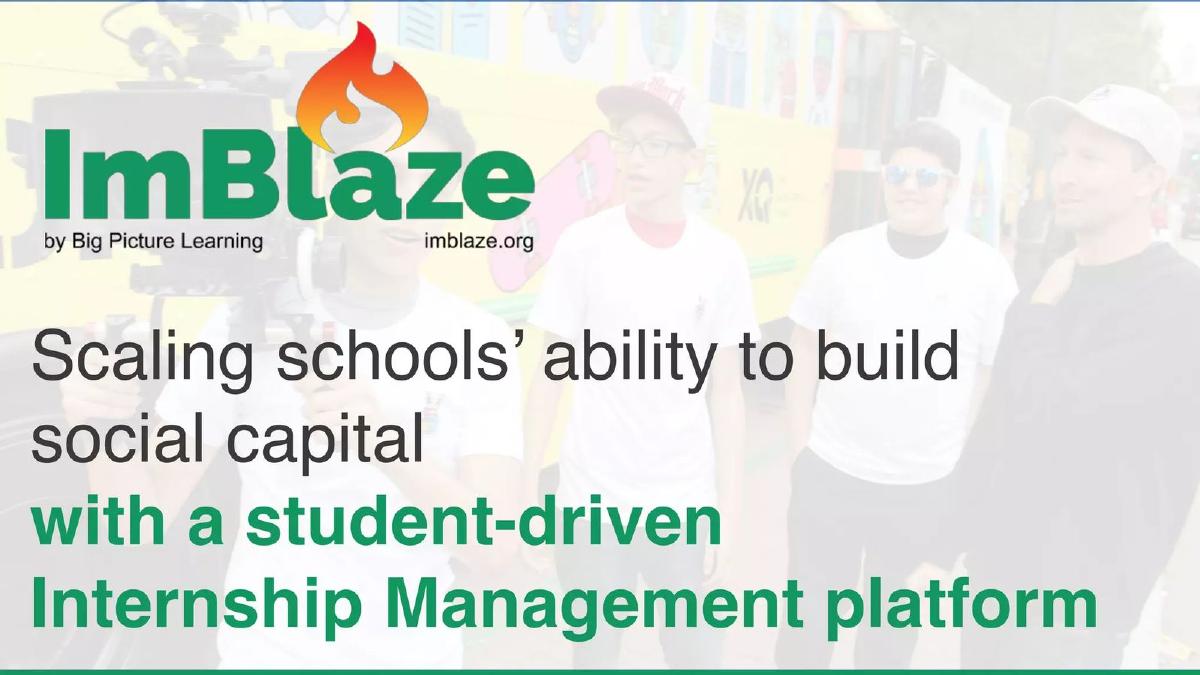
ImBlaze, an initiative by Big Picture Learning, is a platform designed to streamline the complex logistics of high school internship programs. Their deck centers on a specific efficiency claim: reducing the time it takes to arrange a single student internship from 10 hours to just 3 hours. With 14,200 student accounts across 57 schools and organizations in the US and Canada, the company demonstrates early product-market fit. The deck outlines a $4 million funding ask to transition from a school-centric model to a regional/district-level infrastructure, addressing data silos and localized host…
Key takeaways
- The platform claims to reduce the administrative burden of arranging internships by 70%, from 10 hours to 3 hours per student (Slide 7).
- ImBlaze has achieved initial traction with 57 schools/organizations and 14,200 student accounts over 18 months (Slide 9).
- The company is seeking $4 million in new funding, with $500k already committed at the time of the deck's creation (Slide 11).
- Current financial backing includes prominent philanthropic organizations such as the Chan Zuckerberg Initiative and the ECMC Foundation (Slide 10).
- The deck identifies a 'Scale Challenge' where schools currently act as isolated hubs, leading to siloed data and competition for professional networks (Slide 14).
- Future growth strategy involves building a district/regional layer to allow organizations to host their own instances and manage regional opportunities (Slide 15).
- The business model targets a $199k Customer Lifetime Value with a $400 Customer Acquisition Cost (Slide 12).
- The team is led by educators and technologists with significant experience in the Big Picture Learning network (Slide 19).
Executive Summary: Scaling Real-World Learning
ImBlaze, a product of Big Picture Learning, presents a pitch deck focused on the logistics of 'social capital.' The deck argues that while schools have traditionally focused on IQ (what students know) and EQ (how they engage), the future requires FQ—a focus on 'who students know' (Slide 6). The platform serves as a three-sided marketplace for students, schools, and mentors to manage internships. The narrative is driven by a clear pain point: the massive administrative overhead required to run experiential learning programs.
Slides 1-6: The Philosophical Shift
The deck opens with a high-level vision. Slide 1 introduces ImBlaze as an 'Internship Management platform' aimed at building social capital. Slide 2 cites a 'seismic shift' in education, referencing legislative changes like the New Hampshire 'Learn Everywhere' initiative and the UK Apprenticeship Levy as tailwinds for their model.
Slides 3 through 6 use a Venn diagram to illustrate the evolution of school focus. They argue that the intersection of 'What students know,' 'How students engage,' and 'Who students know' is the sweet spot for long-term health, happiness, and career success. This section establishes the 'Why' before diving into the 'How,' positioning the company within a broader educational movement rather than just a software tool.
Slide 7: The Core Problem and Efficiency Metric
Slide 7 is arguably the most important slide in the deck. It quantifies the problem using a quote from a teacher in Seattle. It states that arranging an internship for one student takes an average of 10 hours. For a school with 150 students (30 kids across 5 classrooms), this totals 1,500 hours—time schools simply do not have. ImBlaze claims to reduce this to 3 hours per student. This 70% reduction in administrative friction is a powerful hook for any school administrator or district buyer.
Slides 8-9: The Solution and Traction
Slide 8 provides a product overview. The mobile-first approach allows students to search for internships and log attendance via GPS for safety. Schools manage compliance documents, and mentors provide feedback that can be endorsed on LinkedIn. This creates a closed-loop system for accountability.
Slide 9 showcases traction. Over 18 months, the platform has reached 57 schools/organizations across the US and Canada, supporting 14,200 student accounts and 70,000 internship days. The growth arrow is stylized and lacks a Y-axis, but the raw numbers provide a solid baseline for a specialized EdTech tool.
Slides 10-12: Funding and Unit Economics
Slide 10 lists 'Current Development Funding,' which is dominated by non-profit foundations like the Chan Zuckerberg Initiative and ECMC Foundation. This suggests that the product has been largely R&D funded to date.
Slide 11 outlines the $4 million 'Ask.' The company has $500k committed and plans to use the remainder to validate B2D (Business to District) sales, expand internationally, and upgrade their tech stack. Interestingly, they project reaching 100 schools and $400k in revenue by Year 3. Given they are already at 57 schools, this revenue target seems conservative or suggests a low price point per school.
Slide 12 introduces unit economics. The $199k LTV (Lifetime Value) against a $400 CAC (Customer Acquisition Cost) is an extraordinary ratio, though the deck does not explain the math behind these figures. A 97.5% renewal rate indicates very high product stickiness once a school adopts the system.
Slides 13-18: The Scale Challenge
A significant portion of the deck (six slides) is dedicated to the 'Scale Challenge.' This is a sophisticated move that anticipates investor concerns about the limitations of a school-by-school sales model. Slide 14 explains that the current model creates 'siloed data' where schools compete for the same professional networks. Slides 15-18 detail the transition to a 'Future Multi-Org ImBlaze Model.' This involves building a regional layer where a district or regional organization can curate opportunities and host their own data instances to comply with local privacy rules. This transition from a single-tenant to a multi-tenant, regional architecture is presented as the primary technical hurdle the new funding will solve.
Slides 19-21: Team and Closing
Slide 19 introduces the team. The leadership is deeply rooted in Big Picture Learning, a well-known non-profit in the innovative education space. Andrew Frishman (Harvard Ed.Ld.) and Elliot Washor (BPL Co-Founder) provide significant domain authority. However, the deck notes they are still 'building' capacity in engineering, sales, and biz dev, which explains the focus of the $4M raise. The deck concludes with a simple thank you and contact information.
What Works Well
The 10-hour vs. 3-hour comparison: Quantifying the administrative burden makes the value proposition immediate and tangible. · Addressing the 'Scale Challenge': Most EdTech decks ignore the difficulty of scaling past individual 'innovator' schools. ImBlaze spends significant time explaining how they will move to a district/regional model. · High Renewal Rates: The 97.5% subscription renewal rate (Slide 12) is a strong indicator of product-market fit and user satisfaction. · Social Capital Narrative: By framing the tool around 'Social Capital' rather than just 'Internship Tracking,' they tap into a high-level priority for modern educators.
What Is Missing
Revenue Breakdown: While Slide 11 mentions a $400k revenue target for 100 schools, it doesn't clarify the current revenue or the specific pricing model (per student vs. per school). · Competitor Analysis: There is no mention of other internship management tools or general-purpose school management systems that might offer similar features. · LTV/CAC Justification: The $199k LTV vs. $400 CAC is a massive gap. Without knowing the average contract value or the churn assumptions, these numbers feel like placeholders. · Detailed Financial Projections: Beyond the Year 3 revenue target, there are no details on burn rate, path to profitability, or how the $4M will be allocated across the specific months of the runway.
Founder Takeaways
Quantify the 'Status Quo' pain: Like ImBlaze, find the specific number of hours your target customer is wasting on the problem you solve. Use that as your anchor metric. · Show, don't just tell, the architecture: The diagrams on Slides 15 and 17 effectively communicate a complex technical shift (from school-hub to regional-hub) that words alone might struggle to explain. · Leverage your pedigree: ImBlaze leans heavily on its association with Big Picture Learning. If your startup is an offshoot of a respected institution, make that clear to borrow their credibility. · Be honest about 'Capacity Building': If you are raising money to hire, be specific about which departments are currently understaffed, as shown on Slide 19.
Frequently asked questions
- What is the primary value proposition of ImBlaze?
- The primary value proposition is efficiency and social capital. According to Slide 7, it takes a school an average of 10 hours to arrange one internship. ImBlaze reduces this to 3 hours. By automating search, attendance, and compliance, the platform allows schools to scale their internship programs and help students build professional networks (social capital) that were previously difficult to manage at scale.
- How much money is ImBlaze raising and what for?
- ImBlaze is raising $4 million, with $500k already committed (Slide 11). The funds are earmarked for three main areas: expanding into new customer segments (B2D, international schools, corporate clients), upgrading the tech stack (mobile apps for teachers, regional platforms, new hosting), and increasing staff capacity in engineering, sales, and business development.
- Who are the current investors or backers?
- The deck lists several high-profile philanthropic and educational foundations as current development funders on Slide 10. These include the ECMC Foundation, the Chan Zuckerberg Initiative (CZ), New Profit, The Orchard Foundation, and the WISE Accelerator (an initiative of the Qatar Foundation). Slide 11 also mentions Harbor Freight Tools for Schools as a previous supporter.
- What are the key metrics reported in the deck?
- Slide 12 highlights four key metrics: 2,500 target schools (implied goal), a $199k Customer Lifetime Value (LTV), a $400 Cost to Acquire Customers (CAC), and a 97.5% subscription renewal rate. Slide 9 reports current traction of 57 schools/organizations, 14,200 student accounts, and 70,000 student internship days recorded over an 18-month period.
- What is the 'Scale Challenge' mentioned in the deck?
- The 'Scale Challenge' (Slides 13-18) refers to the limitations of the current school-by-school model. Currently, schools act as isolated hubs, which leads to siloed data and schools competing for the same local professional networks. ImBlaze plans to solve this by building a regional/district layer that enables larger organizations to coordinate opportunities across multiple schools and host their own data instances.