Impossible Foods presents a concise, 10-slide deck that prioritizes brand identity and market scale over granular financial modeling. The narrative centers on a $1.4 trillion global meat market and the company's proprietary 'Heme' technology, which they claim is the secret to replicating meat flavor. While the deck successfully showcases impressive distribution—citing presence in over 70,000 stores and 40,000 restaurants—it is notably light on specific team credentials, unit economics, and competitive analysis. The 'Ask' slide remains a placeholder, suggesting this version was intended for br…
Key takeaways
- The deck targets a massive $1.4T global meat market, citing a 70% demand growth projection by 2050 (Slide 6).
- Proprietary technology is the core moat, specifically 'Heme' which is described as a patented process with defensible IP (Slide 8).
- Environmental impact is a primary value proposition, claiming 90% less land and 80% less water usage compared to traditional meat (Slide 2).
- Distribution is the primary metric of success, with the company reporting presence in 70,000+ retail stores and 40,000+ restaurants (Slide 7).
- Product versatility is highlighted through three core categories: Burgers (21g protein), Grounds (0mg cholesterol), and Meatballs (Slide 5).
- The business model is diversified across retail grocery, foodservice partnerships, and direct-to-doorstep subscription boxes (Slide 7).
- The deck omits a team slide entirely, failing to mention founder Pat Brown or the scientific leadership behind the IP.
- There is no specific funding amount requested, with the final slide using a '$X' placeholder for the raise (Slide 10).
The Brand-First Approach to Food Tech
The Impossible Foods pitch deck is a study in high-contrast visual storytelling. It avoids the cluttered, data-heavy layouts typical of biotech or food-science startups, opting instead for a bold, consumer-facing aesthetic. The deck functions more as a brand manifesto than a technical white paper, which is a strategic choice for a company whose success depends as much on cultural adoption as it does on molecular engineering.
Slides 1-2: The Hook and the Value Proposition
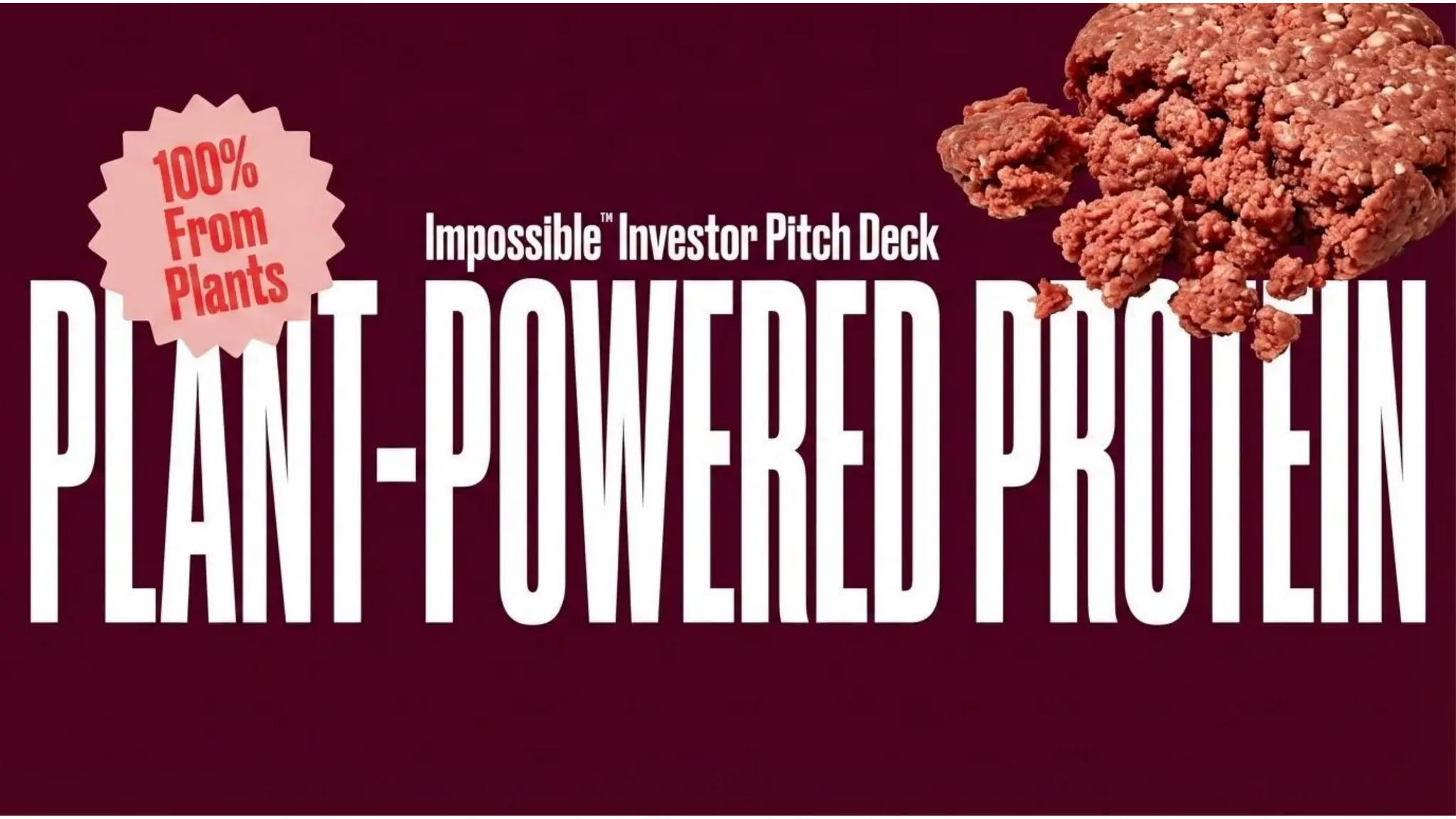
Slide 1 introduces the company with the tagline "Plant-Powered Protein" and a high-resolution image of a raw-looking plant-based patty. The "100% From Plants" badge is prominent, immediately addressing the core product identity. Slide 2, titled "Meat. Made Better.", establishes the dual value proposition: flavor and sustainability. It explicitly lists replacements for "beef, chicken, and pork" and provides the first hard metrics of the deck: 90% less land and 80% less water usage. By leading with these figures, the company frames the environmental benefit not as a secondary feature, but as a core efficiency of the production model.
Slides 3-4: Problem and Solution
Slide 3 uses a bright red background to signal urgency, stating "The World Loves Meat." It identifies three problems: ecosystem destruction, rising global demand, and a shift in consumer preference toward sustainability. This slide is effective because it acknowledges that meat consumption is increasing, rather than suggesting the world will simply stop eating meat. Slide 4 presents the solution: "Plant-based meat that tastes like the real thing." This is the first mention of "Heme," the company's proprietary ingredient, which is visually linked to images of meatballs, grounds, and patties. The focus here is entirely on sensory equivalence—the idea that the consumer doesn't have to sacrifice taste for the environment.
Slide 5: Product Portfolio and Nutrition
Slide 5 breaks down the product line into three categories: Burgers, Grounds, and Meatballs. Each is accompanied by a specific nutritional or dietary claim. The Burger is highlighted for having "21g Protein," the Grounds for "0mg Cholesterol," and the Meatballs for being "100% Plant-Based." This slide serves to prove product versatility, showing that the underlying technology can be adapted to various formats found in a traditional butcher shop.
Slide 6: Market Size and Macro Trends
The deck moves to the "Big Ask" context on Slide 6, citing a "$1.4T Global Meat Market." This is a massive Total Addressable Market (TAM) figure. To justify the scale, the company provides three supporting data points: 70% demand growth by 2050, 10x faster adoption of alternative meats, and 40% of consumers seeking low-carbon foods. These metrics are designed to show that the market is not just large, but actively shifting in a direction that favors Impossible Foods' specific technology.
Slide 7: Revenue Streams and Distribution
Slide 7, "How We Make Money," is perhaps the most important slide for demonstrating traction. It lists three channels: Retail Grocery (70k+ stores), Foodservice Partnerships (40k+ restaurants), and Subscription Boxes (Direct to Doorstep). The inclusion of specific store and restaurant counts (70,000 and 40,000 respectively) provides a sense of scale that moves the company out of the "experimental startup" phase and into the "market leader" phase. It shows that the supply chain and sales operations are already functioning at a global level.
Slide 8: The Science of Heme
Slide 8 dives into the "Secret Ingredient." It defines Heme as the element that creates the flavor of meat and emphasizes that it is sourced from plants, scalable, and sustainable. Crucially, it mentions a "Patented process with defensible IP." For investors, this is the "moat" slide. It explains why a generic competitor cannot simply replicate the Impossible Burger—they lack the legal right to use the specific Heme-production process that gives the product its meat-like characteristics.
Slides 9-10: Traction and The Ask
Slide 9, "The Movement is Already Here," summarizes the company's momentum. It repeats the restaurant count (though here it says 30,000+, which contradicts the 40,000+ on Slide 7, suggesting this deck may have been updated at different times) and mentions "Millions of Units Sold." The final slide, Slide 10, is the closing statement: "The Future of Meat is Plant-Based." It includes a placeholder for the funding round: "Raising $X to scale manufacturing, expand distribution, and accelerate R&D."
What Works in This Deck
Visual Consistency: The use of deep maroon and bright red creates a "meaty" aesthetic that reinforces the product's goal of replicating animal protein. · Simplicity: The deck avoids technical jargon. Even the explanation of Heme is kept to three bullet points, making the science accessible to a generalist investor. · Scale Metrics: Citing 70,000+ stores is a powerful way to demonstrate that the product has passed the "proof of concept" stage and is now a matter of scaling existing success. · Clear Value Prop: The environmental metrics (90% less land, 80% less water) are easy to remember and repeat, making the "why now" argument very clear.
What Is Missing
The Team: There is no team slide. In a high-stakes food-tech raise, the scientific pedigree of the founders and the operational experience of the executive team are critical. The omission of Pat Brown (a Stanford professor) is a missed opportunity to build credibility. · Financials: There are no mentions of revenue, margins, or burn rate. While "millions of units sold" is a good headline, investors need to know if the company is actually profitable on a per-unit basis, especially given the high costs of biotech manufacturing. · Competition: The deck ignores the existence of Beyond Meat or traditional meat giants (like Tyson or Cargill) who have launched their own plant-based lines. A competitive matrix or a "Why We Win" slide against specific rivals is absent. · The Ask: The use of "$X" on the final slide indicates this is a template or a broad-reach deck. A serious pitch usually requires a specific dollar amount and a breakdown of how those funds will be allocated (e.g., 40% to manufacturing, 30% to R&D).
What Founders Should Copy
The "Secret Ingredient" Framing: Impossible Foods doesn't just say they have a good recipe; they say they have a "patented process" for a "secret ingredient." Founders should frame their core technology as a unique, defensible asset rather than just a better version of an existing product. · Macro-Trend Alignment: Slide 6 does an excellent job of aligning the company's growth with global trends (population growth and carbon reduction). This makes the company's success seem inevitable rather than lucky. · Distribution as Validation: Instead of showing a long list of features, the deck shows a long list of places where you can buy the product. For hardware or CPG startups, showing retail footprints is the ultimate form of validation.
Frequently asked questions
- What is the primary technological advantage claimed by Impossible Foods?
- The company centers its competitive advantage on 'Heme.' According to Slide 8, Heme is the 'secret ingredient' that creates the flavor of meat. The deck emphasizes that this is sourced from plants and protected by a patented process with defensible IP, positioning it as a barrier to entry for competitors attempting to replicate the taste of animal protein.
- How does Impossible Foods define its market opportunity?
- Impossible Foods defines its opportunity through the $1.4 trillion global meat market. Slide 6 highlights three key tailwinds: a 70% growth in meat demand by 2050, a 10x faster adoption rate for alternative meats, and the fact that 40% of consumers are actively seeking low-carbon food options.
- What are the company's main distribution channels?
- The company utilizes a three-pronged distribution strategy shown on Slide 7. This includes Retail Grocery (70,000+ stores), Foodservice Partnerships (40,000+ restaurants), and a Direct-to-Doorstep subscription model. Slide 9 further reinforces this by stating they have sold 'millions of units' across major retail chains.
- What critical investor information is missing from this deck?
- This deck is missing several standard components: a Team slide, a detailed Competitor slide, and specific Financials/Unit Economics. Most notably, Slide 10 contains a placeholder for the funding ask ('Raising $X'), and there is no mention of the current burn rate, revenue figures, or valuation expectations.
- What are the nutritional and environmental claims made in the slides?
- Environmentally, Slide 2 claims the products use 90% less land and 80% less water than animal meat. Nutritionally, Slide 5 highlights that their burgers contain 21g of protein and their ground meat products contain 0mg of cholesterol, while remaining 100% plant-based.