Leclere Taverns' deck is ten slides, dated 1 October 2015, raising £100,000 for 20% of a proposed group of English country pubs beginning with one un-opened site, the Drovers. It is a small-business investment deck poured into a startup slide template, and the seams show: the 'Business Model (Top 1-3 Sources of Revenue)' slide lists three premises instead of three revenue streams, and no cost, margin, rent, lease term or break-even figure appears anywhere in the file. Its numbers also disagree with each other — slide 5 puts the first pub at £518,400 a year while slide 9's chart starts Year 1…
Key takeaways
- Leclere Taverns' 10-slide deck, dated 1 October 2015, is a small-business investment deck for a single English country pub — the Drovers — seeking £100,000 for 20% of the equity, which prices the company at £500,000 before it has opened or traded.
- The deck's two financial slides contradict each other: the business model slide states £518,400 of revenue for the first pub, while the five-year growth chart shows Year 1 at £400,000, and nothing reconciles them.
- The claimed 'unique kitchen formula' is credited with a 20% year-on-year sales increase, but the deck's own chart grows 20%, then 8.3%, then 77%, then 52% — only one of four years matches the claim.
- The strongest fact in the deck — that the local committee has already chosen the founders as 'preferred operator' of the proposed site — appears once, third in a list, on slide 6, when it is the single most persuasive answer to why these founders at this pub.
- The 'Business Model (Top 1-3 Sources of Revenue)' slide lists three premises rather than three revenue streams: no food-versus-drink split, no average spend per head, no gross margin, no labour cost, no rent and no lease terms appear anywhere in the ten slides.
- The only traction in the entire deck is stated in the past tense in a single bullet on slide 3 — 'has been able to achieve a 20% year on year increase in sales' — with no venue, period, baseline or figure attached to it.
- Market size is presented as £108m of regional tourist spending and 87,000 residents within a 20-mile radius. Neither is addressable revenue for one village pub, and the deck never builds revenue bottom-up from seats, covers and average spend.
- The ask leaves three questions unanswered: whether the £30,000 already committed sits inside or outside the £100,000, how a £100,000 raise funds a stated goal of four to six pubs by Year 5, and whether the investment qualifies for SEIS or EIS relief — a material omission for a 2015 UK angel round.
What this deck actually is
Ten slides, 1600 x 1000 points , assembled with pdftk 2.02 and dated 1 October 2015 , last modified 5 October 2015 — the file was published to SlideShare days later. The cover carries a hand-drawn sketch of an English country pub, the Leclere Taverns wordmark with an artichoke mark, and the line EST. 2015 .
Classify it correctly before judging it. This is not a technology startup deck and it should not be read like one. It is a small-business investment deck for a single rural pub — the Drovers, described throughout as "the proposed site" — with a stated intention to grow into a group of three to five. The structure is textbook startup-template: Problem, Solution, Market Size, Business Model, What Sets Us Apart, Competition Advantage, Team, 5 Year Sales Growth, Investment. Ten slides, one ask, no appendix.
And that is the first useful lesson in the file. The founders took a Silicon Valley slide order and poured a Dorset gastropub into it. Some of it fits surprisingly well. Some of it produces the strangest slide in the deck: a "Business Model (Top 1-3 Sources of Revenue)" page whose three sources of revenue are pub one, pub two and pub three .
The underlying business is legible and it is not a bad one. A career chef with Michelin training and ten years running country pubs, a commercial co-founder, three advisors who run serious restaurants, and a village site where the local committee has already named them preferred operator. £100,000 for 20%. What this teardown is about is how much of that strength the deck manages to throw away in ten slides.
Slide-by-slide walkthrough
Slide 1 — Cover
Logo with artichoke, "LECLERE TAVERNS", "EST. 2015", and a pen-and-ink sketch of the Drovers Inn. No tagline, no one-line description of the business, no date on the slide, no contact detail.
The sketch is a genuinely good decision: it is warm, it is specific, it makes the reader picture a building rather than a brand. What is missing is the sentence. A cover slide has one job beyond identification — to tell a stranger what the business is in under ten words. "Leclere Taverns" plus an artichoke tells a reader nothing; a hospitality investor receiving this by email cannot tell from slide 1 whether it is a restaurant group, a food brand, or a farm. One line — "A group of fresh-food country pubs in the South West, starting with the Drovers" — would have cost nothing and framed everything after it.
Slide 2 — Problem
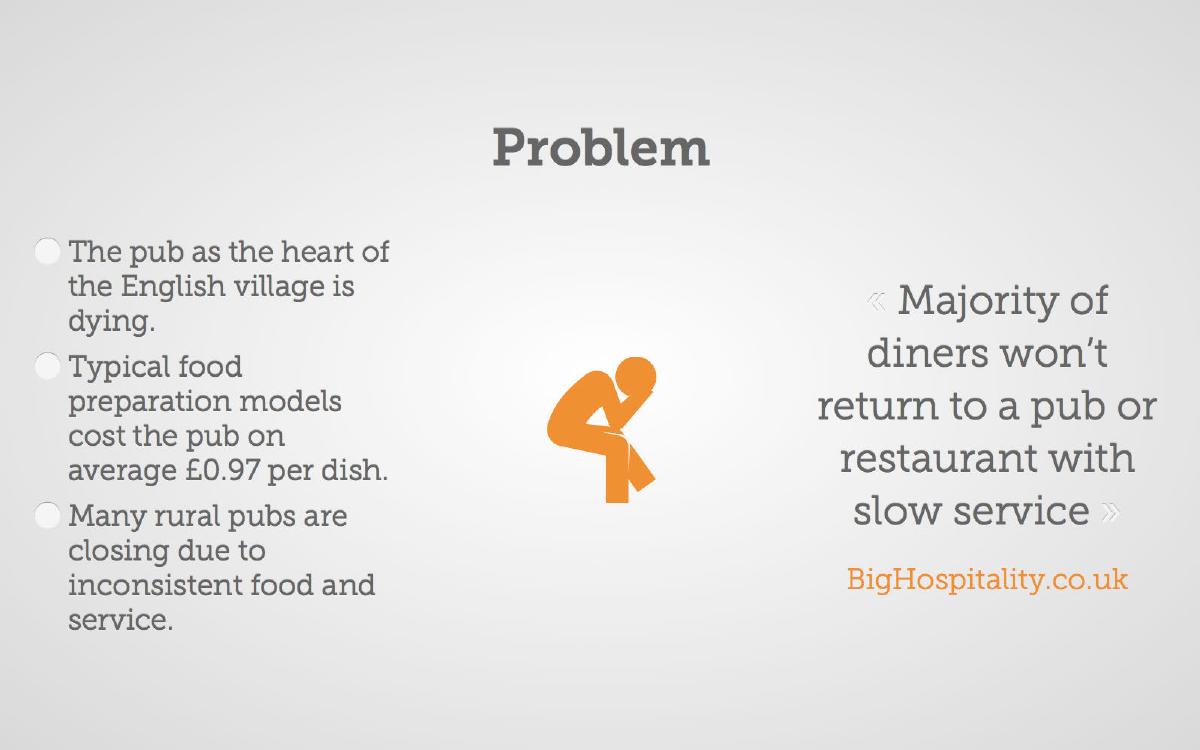
Three bullets and a pull quote. "The pub as the heart of the English village is dying." "Typical food preparation models cost the pub on average £0.97 per dish." "Many rural pubs are closing due to inconsistent food and service." Then, attributed to BigHospitality.co.uk: "Majority of diners won't return to a pub or restaurant with slow service."
The first and third bullets are the real problem, and both are true and well chosen. UK rural pub closures were an established, widely reported story in 2015, and "inconsistent food and service" is the operator's honest diagnosis rather than the usual abstraction.
The second bullet is the one that will stop a reader cold. "£0.97 per dish" — cost of what, exactly? Waste? Labour? Gross food cost? Against what basket, at what average selling price, measured where and by whom? A £0.97 unit cost sounds low enough to be a rounding error and specific enough to look researched, which is the worst combination: it invites a question the deck cannot answer. It also becomes load-bearing three slides later, when the differentiator turns out to be saving 50p of it.
One more structural miss: the problem is described entirely from the pub's side. Nowhere does the deck say what the diner in this specific village currently does on a Friday night, where they drive to, and what they spend. That is the problem the money is being raised to solve, and it is the version an investor buys.
Slide 3 — Solution
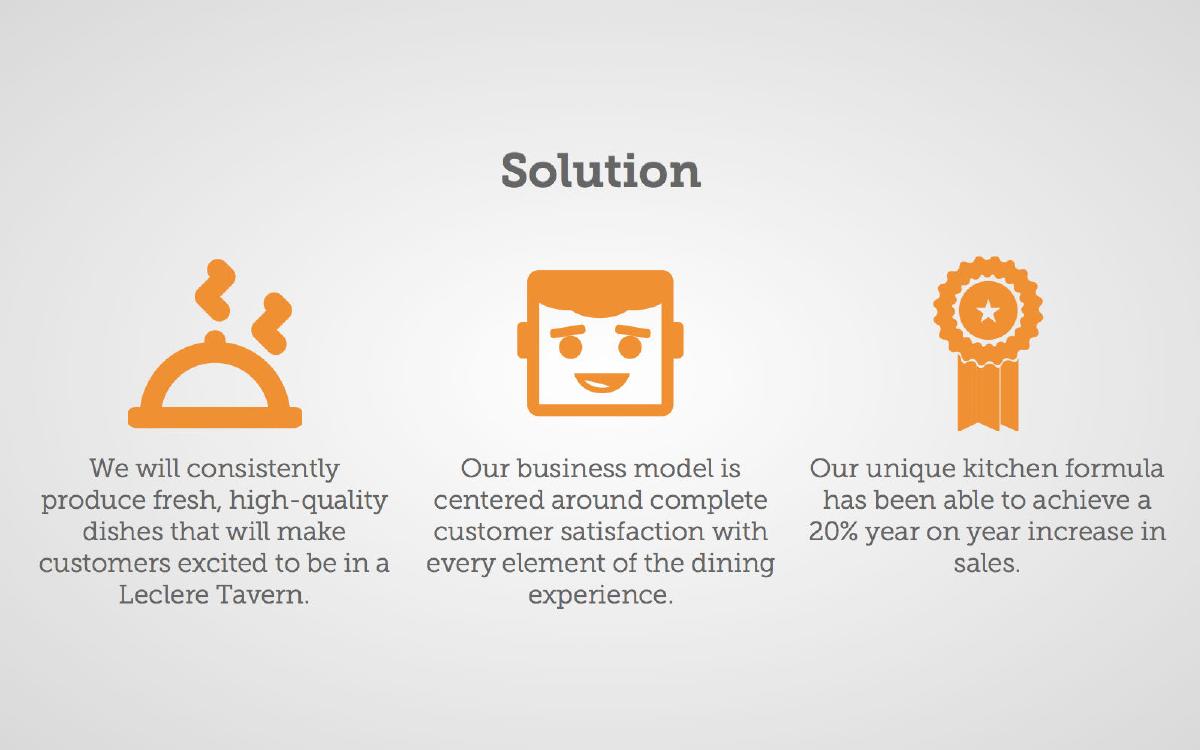
Three icons, three claims. Consistently produce fresh high-quality dishes; a business model centred on complete customer satisfaction; and — the sentence that changes the whole document — "Our unique kitchen formula has been able to achieve a 20% year on year increase in sales."
Read that tense again. "Has been able to achieve." Past perfect. Somewhere, this kitchen formula has already produced 20% year-on-year sales growth, presumably in one of the Dorset country pubs the founding chef ran for a decade. That is traction , in a deck that otherwise has none — and it is stated in a subordinate clause on a solution slide, with no venue named, no period given, no baseline, and no way for a reader to tell whether it means £40,000 or £400,000.
This is the single largest unforced error in the deck. An operator with a track record of growing a real pub's sales by a fifth is a fundamentally different investment from two people with a plan, and the difference is worth more than every other slide combined. It needed its own page: the venue, the years, the covers, the average spend, the before-and-after. Instead it is a bullet, and because the rest of the deck never returns to it, a sceptical reader files it as marketing rather than evidence.
"Complete customer satisfaction with every element of the dining experience" is the opposite problem: a sentence that could appear in any hospitality deck ever written. And the phrase "unique kitchen formula" is used twice without ever being described. If the formula is genuinely proprietary — batch prep, menu engineering, a supplier structure, a yield discipline — say enough to make it credible. If it is not describable, it is not a differentiator, it is a claim.
Slide 4 — Market Size
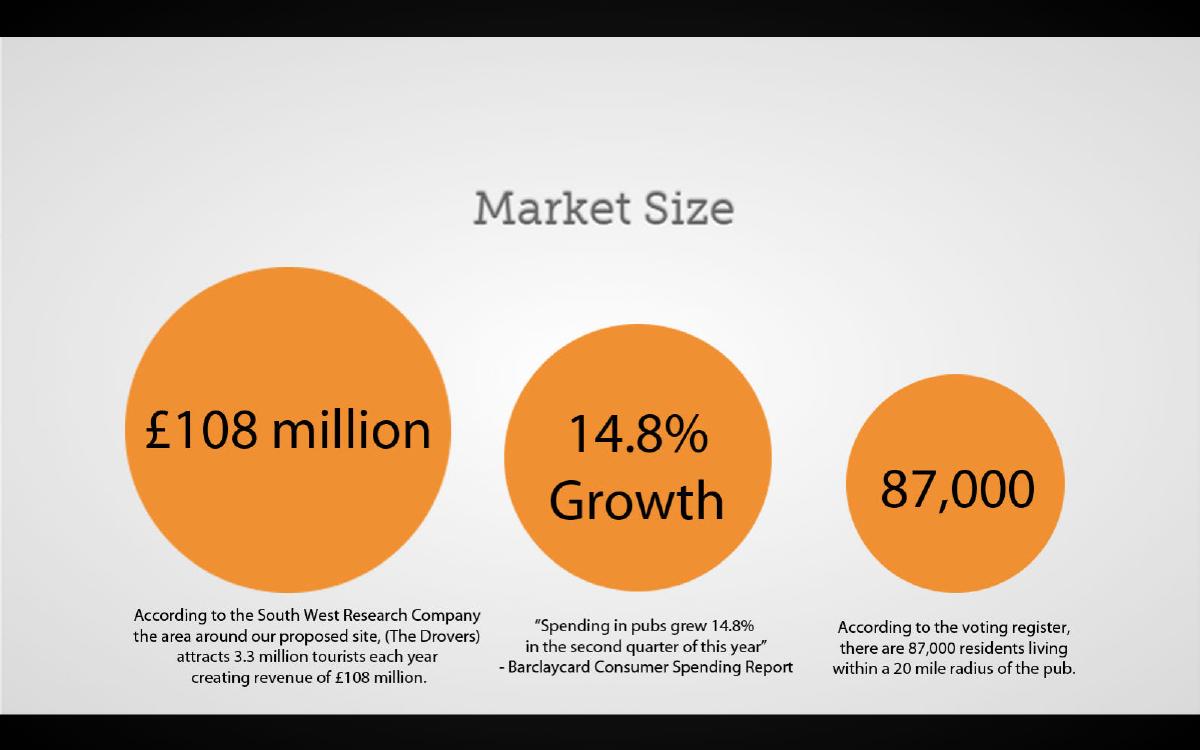
Two big numbers with sources. £108 million : per the South West Research Company, the area around the proposed site attracts 3.3 million tourists a year generating £108m of revenue. 87,000 : residents within a 20-mile radius, per the voting register. Plus a Barclaycard Consumer Spending Report quote — pub spending grew 14.8% in the second quarter.
Credit where it is due: this is a sourced market slide with named institutions, which puts it ahead of most seed decks in any sector. Using the electoral roll for catchment population is a genuinely resourceful move by a founder without a research budget.
The problem is that neither number is the market for this pub, and the gap is enormous.
£108m is regional tourist spending on everything — hotels, fuel, attractions, retail, every other pub. A single village pub's share of it is a rounding error, and presenting it as market size invites the exact "so what percentage do you get?" question that has no good answer. · 87,000 residents within 20 miles is not a catchment. Twenty miles of Dorset lanes is a 35-45 minute drive each way, past every other pub in the county. The honest and far more persuasive number is smaller: households within a 10-minute drive, the villages that would treat this as their local, and the actual number of covers the building seats. · Neither number is converted into revenue. A pub's market sizing is arithmetic anyone can check: seats x covers per day x average spend x trading days, plus wet sales. The deck asserts £518,400 of revenue two slides later without ever building it.
The Barclaycard quote has the opposite flaw to the rest of the slide: it is a single quarter of national spending growth, quoted with no year, in a document that will be read for years.
Slide 5 — Business Model (Top 1-3 Sources of Revenue)
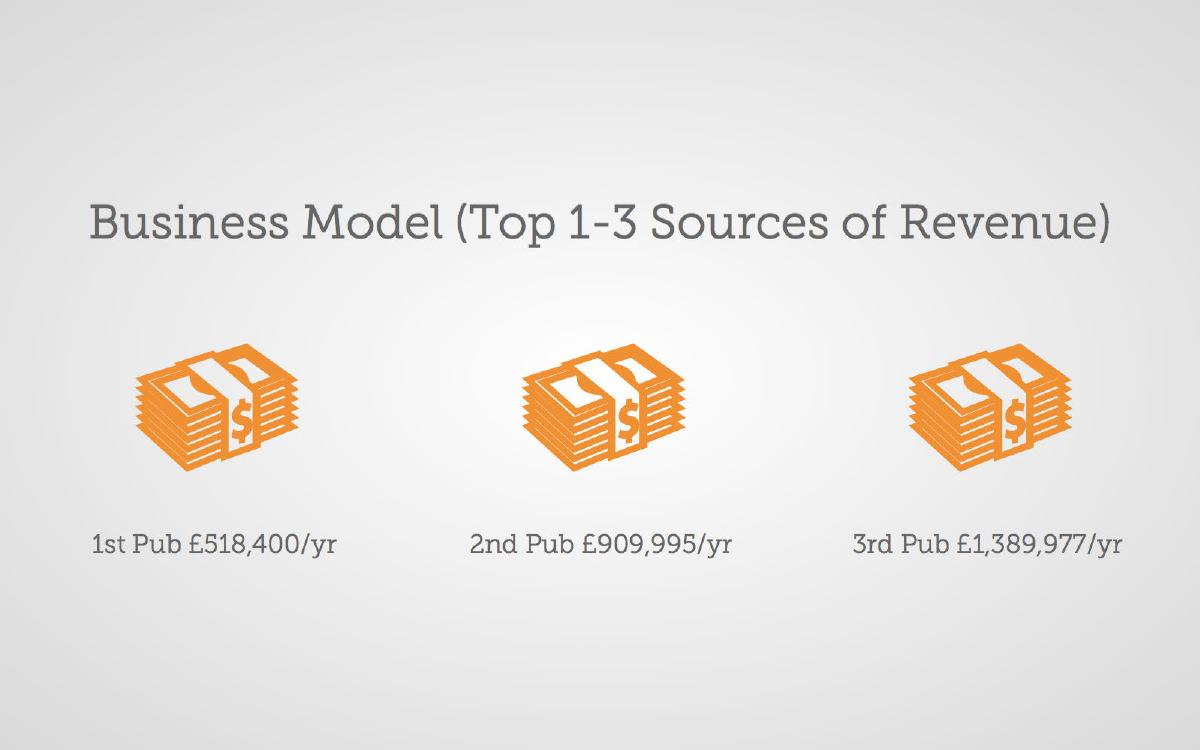
Three identical stacks-of-cash icons. 1st Pub £518,400/yr. 2nd Pub £909,995/yr. 3rd Pub £1,389,977/yr. Nothing else on the slide.
This is the most instructive slide in the deck, because it fails in a way that is extremely common and almost never noticed by the person who made it: the founders answered the template's question instead of the reader's. The heading asks for the top one to three sources of revenue. The correct answer for a gastropub is food, drink, and events or rooms , with a split, a margin and an average spend per head. The answer given is a list of premises — three of which do not exist, one of which has not opened.
Everything a business-model slide exists to establish is absent. No food-versus-wet split. No average spend per head. No gross margin. No cost of goods, no labour percentage, no rent or lease terms — for a pub, the rent and the tie are frequently the whole investment case. No covers assumption. No seasonality, in a business whose demand is dominated by summer tourism, which the previous slide has just told us about.
Then there is the arithmetic. Those three figures appear to be cumulative group revenue rather than per-pub sales — £518,400, then £909,995, then £1,389,977, each roughly the previous plus a further pub — but the slide labels them per-pub and never says. Read literally, three pubs total £2.8m; the growth chart four slides later peaks at £1.4m. Two numbers on the same deck cannot both be the group's revenue. And the figures carry a false precision — £909,995 and £1,389,977 are stated to the pound for pubs with no address, no lease and no opening date, which signals a spreadsheet that grew a decimal place rather than a forecast anyone stress-tested.
A small, telling detail: the money icons are dollar bills , in a deck denominated entirely in pounds, for a business in rural England. It is the kind of thing that costs nothing to fix and quietly tells a careful reader how much of the deck was assembled from a template.
Slide 6 — What Sets Us Apart
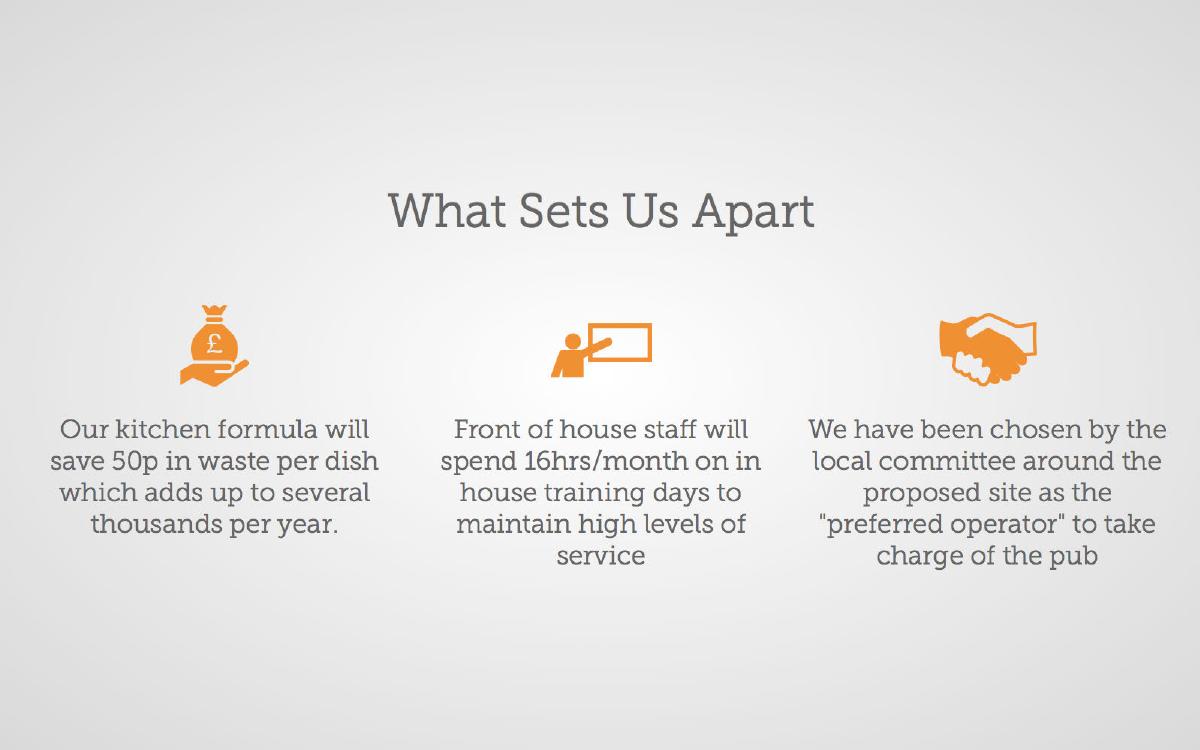
Three differentiators. The kitchen formula "will save 50p in waste per dish which adds up to several thousands per year." Front-of-house staff will spend "16hrs/month on in house training days." And: the founders have been chosen by the local committee around the proposed site as the "preferred operator" to take charge of the pub.
The third bullet is the best fact in the entire deck and it is third out of three, on slide 6, in the same weight as an item about training hours. Preferred operator status means the community has already chosen them over other bidders. It de-risks site acquisition, it is verifiable by a phone call, it is competitive proof from a disinterested party, and it is the answer to the hardest question in any single-site hospitality deal: why you, at this site, instead of someone else. It belongs on slide 1, in the first ten seconds, with the committee named and the date given.
The 50p claim, meanwhile, is where the £0.97 problem statement comes home. If typical preparation costs £0.97 per dish and the formula saves 50p of it, the deck is claiming a 52% reduction in the relevant cost line — an extraordinary operational result, presented in a bullet, with no mechanism given and no venue where it has been observed. Either it is real, in which case it deserves a worked example with volumes and an annual figure ("50p x 32,000 covers = £16,000/yr"), or it is an estimate, in which case "several thousands per year" is the tell: nobody who has measured a saving describes it as "several thousands."
The training bullet is the most credible of the three because it is a commitment rather than a claim, and it is specific. Sixteen hours a month of front-of-house training is a real, checkable operating standard. It is also expensive, and the cost of it appears in no model anywhere in the deck.
Slide 7 — Competition Advantage
Three photographs — a plated dish, a waiter with a bottle of wine, a full pub table — under three lines: highest standard of fresh local dishes "unlike the low quality 'pub grub' of our competitors"; greater emphasis on customer satisfaction via the monthly training days; and regular pub events providing "the much needed entertainment and community inclusion."
No competitor is named. This is a single-site rural business, which means the competitive set is knowable to the last pub: every venue within a 15-minute drive, what each charges, what each is good at, which nights they are full. That table would have been the most persuasive slide in the deck and it is the one slide a chef who has run pubs in the county could produce from memory in an hour.
Instead the slide characterises the entire competitive field as "low quality pub grub" — a claim that reads as dismissive rather than analytical, and one that a local investor is likely to be able to disprove by naming a good pub eight miles away. The events line is the strongest idea on the slide and is left completely undeveloped: which events, how often, what they cost to run, what they add to a Tuesday.
It also repeats slide 6. Training days appear on both, and "fresh, high-quality dishes" appears on slide 3 as well. In a ten-slide deck, three pages spending their strength on the same two ideas is the space where competition, unit economics and the founder's actual track record should have gone.
Slide 8 — Team and Advisors
Two founders with photographs. Patrick Davy : 20 years as a professional chef in the UK and Australia, trained initially in a Michelin-starred restaurant in London, the last ten years running country pubs in Dorset. Neil Marshall : university educated, 15 years in sales and marketing with emphasis on social media, customer service is his passion — and, in a second line, "Head of Finance - Corporate Display Advertising at eBay."
Three advisors, all photographed: Jack Davy (brother), senior manager at Hawksmoor Spitalfields; Liam Davy (brother), director at Foxlow; Peter Davy (father), 40 years in international business, finance and financial control.
This is the deck's strongest asset and it arrives on slide 8 of 10. A Michelin-trained chef with a decade of country-pub P&L, advised by operators from two of the better-known London steak restaurant groups, with a finance-experienced family member on call, is a genuinely credible team for exactly this business. The relationships are also disclosed honestly — "(Brother)", "(Father)" — which is the right call, and better than the common alternative of implying arm's-length advisors.
Two problems. First, the advisor bench being entirely one family is a legitimate diligence question and the deck does not pre-empt it. Three relatives are a support network; what is missing is one independent name — a landlord, a supplier, a former employer, an accountant — that a stranger can call.
Second, the Neil Marshall bio contradicts itself. Fifteen years in sales and marketing with an emphasis on social media, and Head of Finance for a business unit at eBay, are two different careers, presented in two adjacent sentences with no connecting tissue. Whichever is the load-bearing credential should lead; as written, a reader is left unsure which one to believe, which devalues both. The typos in the same block — "runningcountry", "expericene" — do not help; on a slide asking for £100,000, they are the cheapest possible thing to fix.
Slide 9 — 5 Year Sales Growth Chart
A single orange area chart. Year 1: 400,000. Year 2: 480,000. Year 3: 520,000. Year 4: 920,000. Year 5: 1,400,000. No axis label, no currency symbol, no title beyond "5 Year Sales Growth Chart", no footnote.
It contradicts slide 5. The business model slide says the first pub does £518,400 a year; the chart says Year 1 is £400,000. One of the two is wrong, or they measure different things, and nothing in the deck says which. · It contradicts slide 3. The "unique kitchen formula" is credited with 20% year-on-year sales growth. The chart's own growth rates are +20%, then +8.3% , then +77%, then +52%. Only one of the four years matches the claim. · The Year 3 to Year 4 hinge is unexplained. Sales jump 77% between two years with no stated cause. Presumably it is pub two opening — but the chart carries no annotation, and an unexplained hockey stick is the single most familiar red flag in seed-stage forecasting. · It is sales, not profit. There is no cost line, no EBITDA, no cash flow, no break-even point anywhere in the ten slides. For a pub — a business defined by rent, wages, wet margin and seasonality — turnover alone tells an investor nothing about whether they get their money back. The number that matters, and is entirely absent, is what an investor's 20% is worth in distributions or exit.
Slide 10 — Investment
Two figures. £100,000 investment needed , in exchange for 20% of the equity . £30,000 already committed. One line of use of funds: the money sets up the first pub, with the goal of adding "a minimum of 3 more premises with the possibilty of 5 pubs by the end of year 5."
The ask is clear, which is more than many decks manage, and disclosing the £30,000 already raised is exactly right — commitment from someone else is the strongest de-risking signal a first-time raise has. But three questions go unanswered and each is a deal-blocker.
The valuation is asserted, not derived. £100,000 for 20% prices Leclere Taverns at £500,000 before a single pint has been poured, on a site the company does not yet operate. That may well be defensible — preferred operator status, a chef with a track record and a fitted business plan are worth something — but the deck never attempts the argument, and an unargued valuation is the fastest route to a counteroffer. · Is the £30,000 inside or outside the £100,000? The slide does not say, so a reader cannot tell whether £70,000 or £100,000 remains available. That single missing word decides whether the reader is early or late. · £100,000 does not open four to five pubs. The slide sets a Year 5 goal of four to six premises off a first-pub fit-out budget. Either later sites are funded from cash flow — in which case say so, with the arithmetic — or there are further rounds coming, which dilutes the person reading this slide. Silence on that point is the difference between an ambitious plan and an unbudgeted one.
Also missing: the instrument (ordinary shares? preference? loan note?), whether SEIS or EIS relief is available — in the UK in 2015 that was worth a great deal to precisely this investor, and its absence from a £100,000 ask aimed at British angels is a striking omission — what the investor's money specifically buys line by line, and what the exit or distribution path looks like.
What this deck does better than most startup pitch decks
It cites its sources. The South West Research Company, the electoral register, the Barclaycard Consumer Spending Report, BigHospitality — four named sources across ten slides. Most seed decks manage none. · It asks clearly. Amount, equity, and money already committed, all on one slide with no hedging. A reader knows exactly what is being proposed. · The team is real and relevant. Twenty years of professional kitchens, ten running country pubs in the same county as the site, advised by people who operate restaurants at scale. This is not a team assembled to fit an idea. · Preferred operator status is a genuine, verifiable competitive fact — third-party validation from the community that controls the site, which is worth more than any adjective on slide 7. · It discloses the family relationships. "(Brother)", "(Brother)", "(Father)" — honest labelling where obfuscation was available and would have been noticed later. · It is ten slides. The discipline is right; the allocation is what is wrong. · The cover sketch does real work. A hand-drawn building makes a physical business feel physical, which a stock photo of a pint never would.
Where this deck would fail in an investor meeting
The two financial slides contradict each other. £518,400 for pub one on slide 5; £400,000 for Year 1 on slide 9. Whichever is right, the deck has told a reader that its numbers are not reconciled. · The claimed 20% growth rate does not match the deck's own chart in three of its four years. · There is no cost line anywhere. No rent, no wages, no cost of goods, no margin, no break-even, no profit. Turnover-only forecasting in a hospitality business is the omission of the thing being invested in. · The lease is never mentioned. Freehold or leasehold, tied or free of tie, rent, term, premium, condition of the building — for a pub, these terms often are the deal, and the deck is silent on all of them. · Market size is regional tourism spend, not addressable revenue. £108m and 87,000 residents are context, presented as market. · No competitor is named in a business whose competitive set is a knowable list of nearby pubs. · The best fact in the deck is buried. Preferred operator status appears once, third in a list, on slide 6. · The only traction in the deck is stated in the past tense with no evidence. "Has been able to achieve a 20% year on year increase in sales" — where, when, from what base? · The valuation is unargued. £500,000 pre-opening, with no comparable, no asset base and no method shown. · The expansion goal is unfunded. Four to six pubs by Year 5, on a £100,000 raise, with no bridge from one to the other. · Presentation errors on a money slide. Dollar icons on sterling figures, two typos in the team bios, and per-pound precision on pubs that do not exist.
Single-site hospitality deck vs. the startup template it borrowed
Slide What the startup template asks for What a pub investor actually needs What this deck delivered
Problem A large, growing pain What this village's diners do now, and what they spend elsewhere National pub decline plus an unexplained £0.97
Solution Product and why it wins The menu, the price point, the service standard, the proof it worked before Three adjectives and one buried traction claim
Market TAM / SAM / SOM Covers x average spend x trading days, plus a 10-minute drive-time catchment £108m of regional tourism and a 20-mile radius
Business model Revenue streams Food/wet split, gross margin, labour %, rent, seasonality Three premises listed as three revenue sources
Differentiation Moat The site, the operator, the licence, the community mandate 50p of waste, training hours, and the site mandate listed last
Competition Competitive landscape Every venue within 15 minutes, with price and occupancy "Low quality pub grub" and no names
Team Why these founders Exactly this, and it is strong Delivered — on slide 8 of 10
Financials 5-year projection P&L to EBITDA, break-even month, cash low point, investor return A sales line with no axis label
The ask Amount and use of funds Amount, instrument, EIS/SEIS status, line-item use, path to distributions £100k for 20%, one sentence of use
How you would rebuild this deck
Put preferred operator status on slide 1. "Chosen by the local committee as preferred operator of the Drovers" is the sentence that earns the next nine slides. Name the committee, give the date. · Promote the 20% to its own slide with evidence. The venue, the years, the covers, the average spend, and the before-and-after revenue. This converts the deck from a plan into a repeat performance, which is a different asset class to an investor. · Rebuild market size bottom-up. Seats, covers per service, average spend per head, trading days, wet-to-food ratio — arriving at the revenue figure the deck currently just asserts. Keep the tourism data as seasonality context, not as the market. · Replace the "three pubs" business-model slide with actual unit economics for one pub. Food and drink split, gross margin, labour cost, rent, covers to break even. One profitable pub proves a group; three unbuilt pubs prove nothing. · Add the lease slide the deck is missing. Tenure, rent, term, tie status, condition, fit-out cost and who pays for it. For a pub deal, this is not detail — it is the deal. · Show profit, not just sales. Five years of revenue, gross margin, EBITDA, break-even month and cash low point, with a line stating what the investor's 20% receives and when. · Reconcile every number once. One revenue figure for Year 1, one growth rate, one definition of what the chart is measuring, with the currency labelled. · Name the competition. Five pubs within fifteen minutes, with mains price, food offer and busiest nights — and one honest sentence on what each does better. · Quantify the 50p. Multiply the saving by real annual covers, show the mechanism in one line, and drop "several thousands." · Finish the ask. State whether the £30,000 sits inside the £100,000, name the instrument, confirm SEIS/EIS eligibility, break the use of funds into line items, and either fund the four-pub goal or reframe it as ambition rather than plan. · Fix the small things. Sterling icons, two typos, a date on the cover, and a contact line. Ten minutes of work on a document asking for six figures.
The transferable lesson
Leclere Taverns had three assets most first-time founders would trade a year for: a decade of operating experience in the exact business being proposed, a community that had already picked them over other bidders, and a claimed 20% year-on-year sales improvement from a method they had already run. The deck contains all three. It gives them, in order, slide 8, one third of slide 6, and one bullet on slide 3 — while spending three of its ten slides restating that the food will be fresh and the service will be good.
That is the failure mode worth taking away, because it is almost never a failure of substance. It is a failure of ordering . Founders bury proof and lead with intention, because the intention feels like the pitch and the proof feels like context. It is the other way around. Everything you have already done goes first, in the largest type, with the checkable detail attached; everything you intend to do goes after it, priced.
Run the test on your own deck. For each slide, write down the strongest verifiable fact it contains and where on the page it sits. If your best fact is a sub-bullet on slide 6 and your first three slides are adjectives, you do not need a better business — you need to turn the deck upside down.
Frequently asked questions
- What is the Leclere Taverns pitch deck?
- It is a 10-slide investment deck dated 1 October 2015 for Leclere Taverns, a proposed group of fresh-food English country pubs starting with a single site called the Drovers. It follows the standard startup slide order — problem, solution, market, business model, differentiation, competition, team, five-year growth, ask — and seeks £100,000 in exchange for 20% of the equity, with £30,000 stated as already committed.
- Is a pub or restaurant pitch deck different from a startup pitch deck?
- The slide order can be similar, but the evidence is not. A hospitality investor needs unit economics for one site — seats, covers per service, average spend per head, food-versus-drink split, gross margin, labour percentage — plus the lease terms, the fit-out cost and the break-even month. Leclere Taverns borrowed the startup template faithfully and, in doing so, filled its business model slide with three premises rather than three revenue streams.
- What is the biggest weakness in the Leclere Taverns deck?
- There is no cost line anywhere in ten slides. No rent, no wages, no cost of goods, no gross margin, no break-even point and no profit — only turnover. For a pub, where rent, wet margin, wages and seasonality decide whether the business survives, a sales-only forecast tells an investor nothing about whether their £100,000 comes back. A close second is that the two financial slides state different Year 1 revenue figures.
- Which slides should founders copy from this deck?
- Two habits, rather than two slides. First, the market slide names its sources — the South West Research Company, the electoral register, Barclaycard — which is rarer than it should be at seed stage. Second, the team slide labels the advisors as '(Brother)' and '(Father)' rather than implying independence, which is the right call and reads as confidence rather than weakness.
- How should a small business value itself in a pitch deck?
- Show the method, not just the number. Leclere Taverns asks for £100,000 for 20%, implying a £500,000 valuation for a pub that has not opened, and never argues for it. A defensible version cites comparable sale multiples for similar venues, the value of the operating agreement and preferred-operator position, forecast EBITDA with the multiple applied, and what the investor's stake receives in distributions or on exit.
- What should a five-year financial slide contain?
- At minimum: labelled axes with a currency, revenue and gross margin, EBITDA, a break-even month, the cash low point, and an annotation explaining any step change. Leclere Taverns' chart shows an unlabelled sales line jumping 77% between Year 3 and Year 4 with no stated cause — almost certainly a second pub opening, but an unexplained hockey stick is the most familiar red flag in early-stage forecasting.