Leafly’s October 2021 SPAC pitch deck presents a mature marketplace business model built on the foundation of consumer education and regulatory compliance. With a stated valuation of $532 million, the deck highlights a massive top-of-funnel advantage, citing 125 million annual visitors. The core strategy revolves around a four-stage market maturity flywheel where Leafly capitalizes on state-level legalization to drive retail account growth and increased monetization. Financials show a high-margin business (88% gross margin) transitioning from a content site to a transactional hub, with retail…
Key takeaways
- Leafly positions compliance as its primary competitive advantage, ensuring all THC brands and retailers on the platform are state-licensed (Slide 13).
- The company utilizes a four-stage market maturity model to explain how it captures value as states move from illegal to fully implemented legalization (Slide 19).
- Leafly claims a massive audience reach, citing 125 million annual visitors as the primary driver for retailer and brand value (Slide 31).
- The business model is highly efficient with a projected gross margin of 88% for 2022 (Slide 43).
- Leafly is shifting toward a transactional model, with 'Order-Enabled Accounts' projected to rise from 9.9% in 2018 to 63.5% by 2024 (Slide 37).
- The platform acts as a media authority, noting its reporting on the vaping crisis was cited by the CDC, The New York Times, and NBC News (Slide 25).
- Revenue is diversified between Retail Revenue ($52.3M projected for 2022) and Brands Revenue ($13.1M projected for 2022) (Slide 43).
- The roadmap focuses on supply-side platform investments, including POS and menu integrations to deepen the moat with retailers (Slide 31).
Introduction and Market Positioning
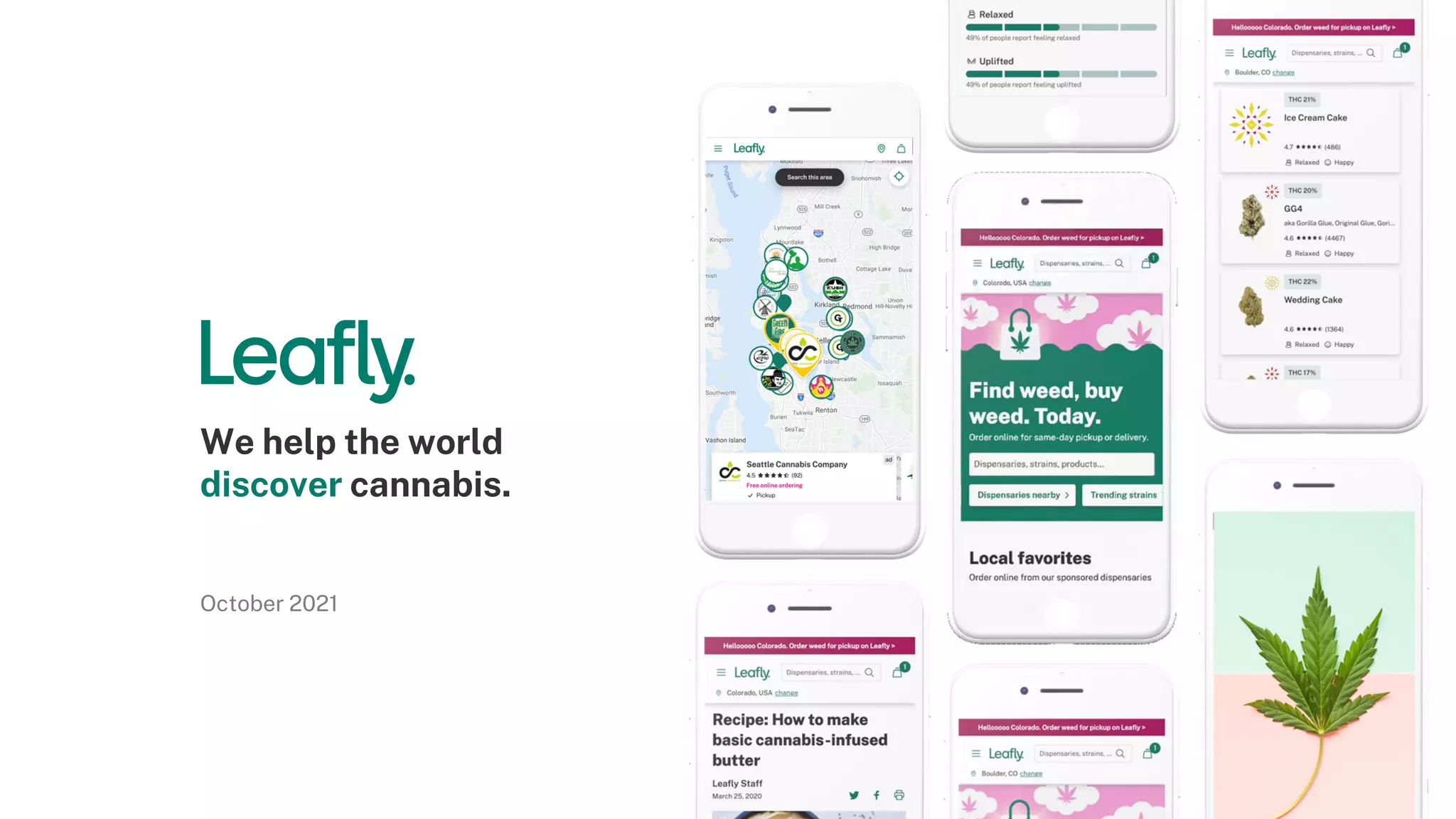
The Leafly SPAC pitch deck, dated October 2021, represents a pivotal moment for the company as it sought to go public at a $532 million valuation. Unlike early-stage startup decks that focus on problem-solution dynamics, this late-stage deck focuses on scale, regulatory moats, and the 'flywheel' effect of state-level legalization. The cover slide (Slide 1) establishes a clear, consumer-facing mission: "We help the world discover cannabis," supported by a collage of mobile interface shots that emphasize the product's utility as a discovery and ordering tool.
Section I: Leafly and Market Overview
Slide 2 serves as a formal transition into the first major section of the deck. This section is designed to establish Leafly's dominance in the cannabis information and commerce space. The narrative here is one of maturity and trust, which is critical in a sector often plagued by regulatory uncertainty and 'grey market' competitors.
Compliance as a Competitive Advantage
On Slide 13, Leafly makes a strong case for compliance being its primary defensive moat. The slide, titled "Compliance creates an advantage and protects our community," outlines a three-pronged focus: extensive vetting of retailers, ensuring all THC brands are state-licensed, and eliminating untested products from the platform. By highlighting a specific license number (#414065) in a mobile mockup, Leafly demonstrates the granular level of verification it provides. This is not just a legal necessity; it is presented as a 'Marketplace Benefit' that protects consumers and helps retailers structure their marketing within legal bounds.
The Legalization Flywheel
Slide 19 is perhaps the most important strategic slide in the deck. It visualizes how Leafly capitalizes on the 'Market Maturity' of different states. The process is broken into four stages:
Stage 1: Consumers join Leafly even before legalization for education. · Stage 2: Greenfield states legalize, and existing states add new licenses. · Stage 3: Retailers seek out Leafly as an established channel; supply aggregation begins. · Stage 4: Increased supply density forces competition, accelerating Leafly's value proposition as a monetization engine.
This model suggests that Leafly's growth is tied to the inevitable march of legalization, making it a macro-play on the entire industry rather than a bet on a single brand or product.
Authority and Media Influence
Slide 25 reinforces Leafly's position as the 'trusted voice' of the industry. It highlights the company's investigative reporting on the 2019 vaping crisis, noting that its work was cited by the CDC, The New York Times, and NBC News. The slide claims 2 million views for this specific content. By positioning itself as a journalistic authority, Leafly differentiates itself from pure-play e-commerce competitors, suggesting that its top-of-funnel traffic is organic and high-intent.
Product Roadmap and Monetization
Slide 31 outlines the future of the platform, focusing on three areas: Personalized Discovery, Supply Side Platform Investments, and Increased Monetization. The company cites 125 million annual visitors as the engine driving value. The roadmap includes technical integrations like POS (Point of Sale) and menu syncing, which are essential for moving from a directory model to a fully integrated transactional marketplace. The mention of 'Auction bidding for merchandising units' indicates a move toward a high-margin advertising model similar to Amazon or Instacart.
Key Business Drivers
Slide 37 provides a deep dive into the unit economics and growth levers from 2018 through 2024 projections. Several key trends emerge:
Retail Accounts: Projected to grow from 1,752 in 2018 to 10,635 in 2024. · Order-Enabled Accounts: A massive shift from 9.9% in 2018 to a projected 63.5% in 2024, signaling the transition to a transaction-first platform. · Shoppers: Growth from 48,000 in 2018 to a projected 6.3 million by 2024. · AOV (Average Order Value): Remarkably stable, hovering between $89 and $102.
This stability in AOV suggests that Leafly's growth is not dependent on getting people to spend more per trip, but rather on increasing the frequency and volume of transactions across a larger user base.
Financial Discussion and Revenue Bridge
Slide 43 details the 2021 and 2022 financial estimates. The company reports a very high gross margin of 88.5% (as of June '21), which is typical for a software-heavy marketplace but impressive for the cannabis sector. However, the operating income shows a widening loss, moving from a $1.8 million loss in mid-2021 to a projected $29.5 million loss in 2022. The 'Revenue Bridge' explains that the jump from $43 million to $65.3 million in total revenue is driven primarily by new retail accounts ($9.5M) and better monetization of existing ones ($8.5M).
What Works in This Deck
1. The Maturity Model: Using a four-stage maturity model (Slide 19) is a brilliant way to explain a complex regulatory environment to investors. It turns a risk (legalization timelines) into a predictable growth engine.
2. Authority as a Moat: By citing the CDC and The New York Times (Slide 25), Leafly proves it has a level of brand equity that competitors cannot easily buy. This 'trust' factor is a powerful counter-argument to the 'commodity' nature of cannabis retail.
3. Clear Monetization Path: The transition from 9.9% to 63.5% order-enabled accounts (Slide 37) shows a clear, data-backed evolution of the business model from a directory to a marketplace.
What Is Missing
1. Competitive Landscape: The provided slides do not include a competitor comparison. While Leafly claims to be the 'epicenter,' investors would likely want to see how they stack up against Weedmaps or Dutchie in terms of market share and take rates.
2. Unit Economics (CAC/LTV): While the deck shows AOV and purchase frequency, it omits Customer Acquisition Cost (CAC) and Lifetime Value (LTV). For a marketplace spending heavily on operating expenses (Slide 43), understanding the efficiency of that spend is crucial.
3. Team Slide: The provided selection lacks a team slide. In a SPAC transaction, the experience of the executive team in navigating public markets and regulatory hurdles is a primary concern for investors.
What a Founder Should Copy
1. The 'Revenue Bridge' Visualization: Slide 43's revenue bridge is an excellent way to show exactly where growth is coming from. It prevents the 'black box' revenue projection problem by breaking down the dollar amounts attributed to new vs. existing customers.
2. Compliance as a Feature: If you operate in a regulated industry, don't just list compliance in the 'risks' section. Follow Leafly's lead (Slide 13) and frame it as a competitive advantage that protects the customer and the brand.
3. Data-Heavy Key Drivers: Slide 37 is a masterclass in showing historical performance alongside future projections. It uses six different metrics to give a holistic view of how the business actually functions, rather than just showing a single 'up and to the right' revenue chart.
Frequently asked questions
- What is Leafly's primary value proposition to investors?
- Leafly positions itself as the 'trusted voice' and the epicenter of consumer interest in the cannabis industry. By combining a massive content-driven audience (125 million annual visitors) with a strictly compliant marketplace that only allows licensed retailers, Leafly argues it has built a defensible moat that scales automatically as more states legalize cannabis.
- How does Leafly plan to grow its revenue according to the deck?
- Revenue growth is driven by two main levers: increasing the number of retail accounts and improving the monetization of those accounts. Slide 43 shows a 'Revenue Bridge' where $8.5 million of growth comes from better monetization of existing accounts, while $9.5 million comes from newly added accounts, supported by a shift toward order-enabled features.
- What role does compliance play in their business strategy?
- Compliance is treated as a product feature. Slide 13 explains that by vetting all retailers and ensuring no unlicensed suppliers are on the platform, Leafly protects consumers from untested products. This 'clean' marketplace approach is designed to attract risk-averse consumers and maintain high-quality brand associations that illicit marketplaces cannot replicate.
- What are the key metrics Leafly uses to track business health?
- The deck tracks Retail Accounts, the percentage of Order-Enabled Accounts, monthly Shoppers, Purchase Frequency, and Average Order Value (AOV). Notably, Slide 37 shows that while AOV remains relatively flat (around $97-$102), the growth is driven by the volume of shoppers and the conversion of retailers to order-enabled status.
- Is Leafly profitable according to these slides?
- No. While the company boasts high gross margins of 88%, Slide 43 shows significant operating losses. For 2021E, the operating loss was projected at $15.0 million, and for 2022E, that loss was expected to widen to $29.5 million as the company increased operating expenses from $53 million to $87 million to fund growth.