Leafly’s 2021 SPAC presentation is a comprehensive 55-slide document (19 slides analyzed here) that positions the company as the essential infrastructure for the legal cannabis market. The deck emphasizes a 'compliance-first' approach to protect its community and marketplace, leveraging a massive content library to drive 125 million annual visitors. Key highlights include a detailed four-stage market maturity model that explains how Leafly capitalizes on state-by-state legalization and a robust financial section projecting a 51.9% revenue increase for 2022. While the deck lacks a traditional…
Key takeaways
- Leafly identifies a total addressable market of $19 billion for 2020, with projections reaching $100 billion by 2030 as illicit markets transition to legal ones (Slide 10).
- The company uses a four-stage 'Market Maturity' model to demonstrate how supply density and consumer demand create a flywheel effect as states progress through legalization (Slide 19).
- Compliance is framed as a core competitive advantage, with a vetting process that ensures only licensed retailers and tested products are listed (Slide 13).
- Marketplace efficiency is highlighted by the fact that 46% of shoppers order on their first visit and 50%+ of retailers see their first order within one week of activation (Slide 16).
- Leafly positions itself as a 'trusted voice,' citing appearances in The New York Times and NBC's Today Show to validate its authority during industry crises like the vaping health scare (Slide 25).
- The product roadmap focuses on three pillars: Personalized Discovery, Supply-side platform investments, and Increased monetization through auction bidding (Slide 31).
- Financial projections show a jump from $43.0 million in 2021E revenue to $65.3 million in 2022E, driven by improved monetization of existing accounts (Slide 43).
- Benchmarking analysis places Leafly's 88.1% average gross margin significantly above the 75.3% median of a peer group including DoorDash, Etsy, and Fiverr (Slide 46).
Introduction and Market Context
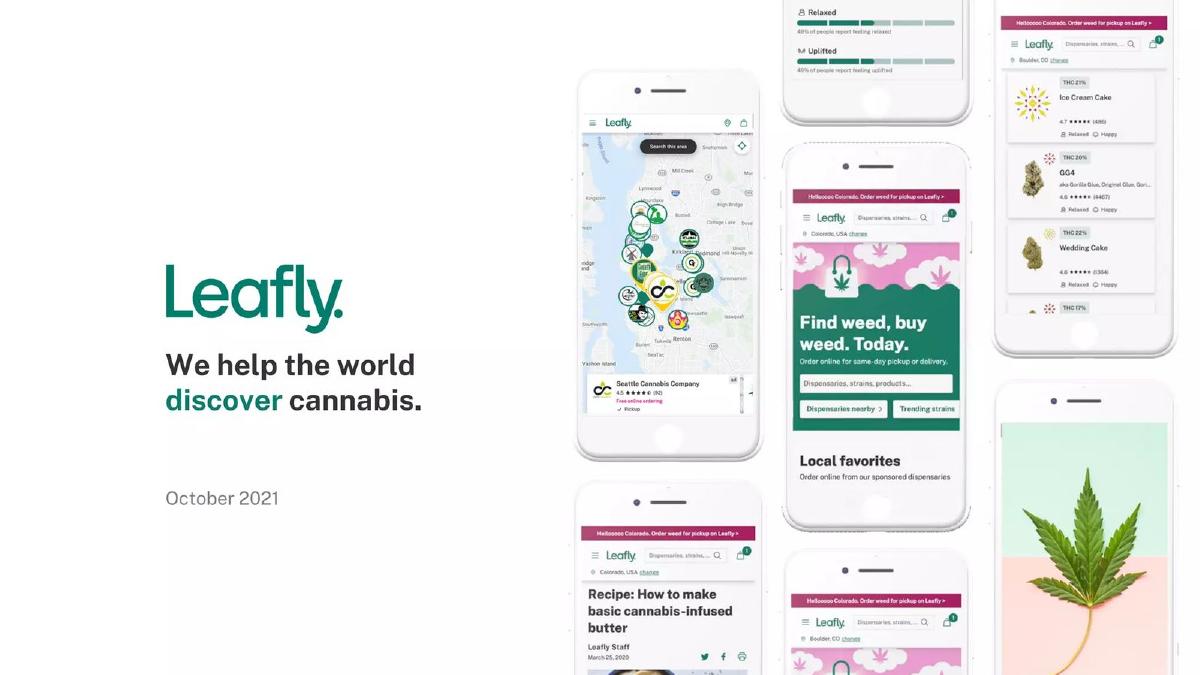
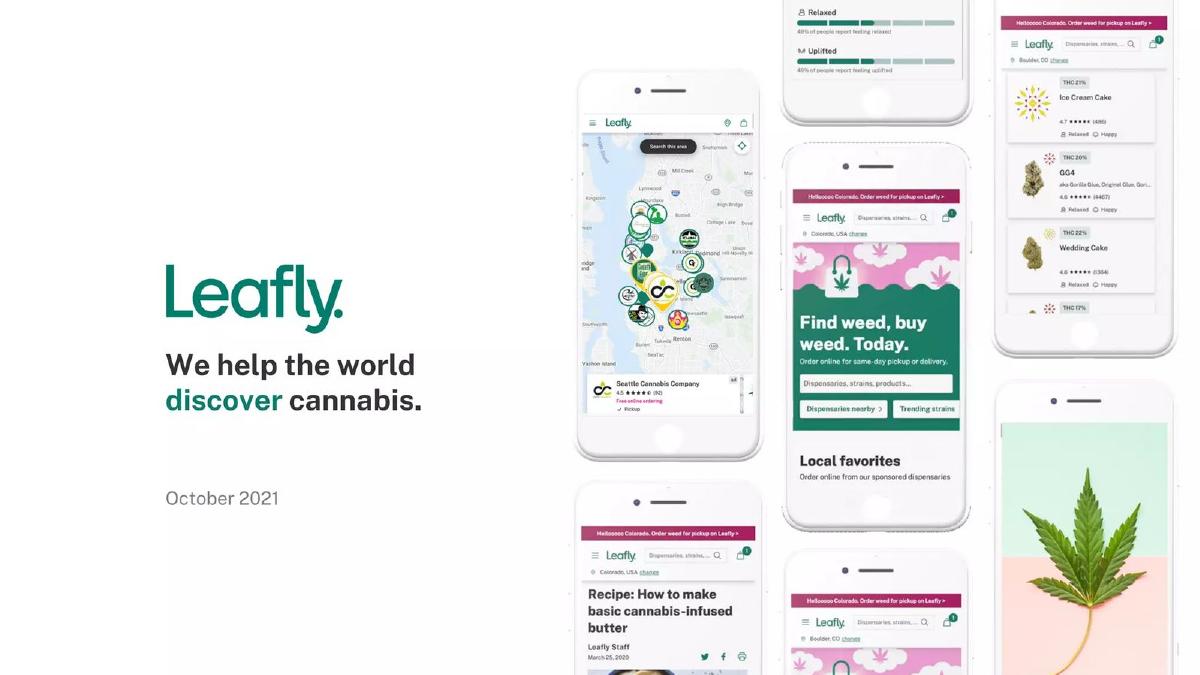
Leafly’s October 2021 pitch deck is a sophisticated document designed for a SPAC (Special Purpose Acquisition Company) audience. It moves beyond the basic 'problem/solution' framework typical of early-stage startups and instead focuses on market maturity, regulatory moats, and scalable unit economics. The cover slide (Slide 1) establishes a clean, consumer-tech aesthetic with the tagline: "We help the world discover cannabis."
Section I: Leafly & Market Overview
Slide 10, titled "Legal cannabis access is beyond the tipping point," is the core of the market thesis. It visualizes the transition from illicit to legal markets. In 2020, the legal market was valued at $19B against an illicit market of $42B. By 2030, Leafly projects a $100B total market, with $70B being legal. This slide also defines their 2020 footprint: $420MM in GMV (Gross Merchandise Value) from 1.5MM shoppers, representing a fraction of the $7B serviceable market. The message is clear: as legality expands, Leafly’s share grows automatically.
Section II: Compliance and Marketplace Dynamics
Slide 13 addresses the 'elephant in the room' for cannabis investors: regulation. Leafly frames compliance not as a burden, but as a competitive advantage. They highlight an "Extensive vetting process" that ensures no unlicensed suppliers or untested products reach the platform. This protects the brand and creates a 'fair marketplace' where licensed retailers aren't competing with the black market on the same app.
Slide 16 provides the 'North Star' metrics for their marketplace efficiency. The company claims a +295% increase in shoppers and a +338% increase in orders from 2019 to 2020. Two specific stats stand out for investors: 46% of shoppers order on their first visit, and over 50% of retailers see their first order within one week of joining. These figures suggest a high intent user base and a rapid time-to-value for B2B customers.
Slide 19 introduces the "Market Maturity" model. This is perhaps the most important strategic slide in the deck. It breaks legalization into four stages: Consumers on Leafly before legalization (Stage 1), Greenfield states legalizing (Stage 2), Retailers seeking Leafly as an established channel (Stage 3), and Increased supply density forcing suppliers to compete for customers (Stage 4). This model explains why Leafly is a 'flywheel' business; the more mature a market becomes, the more essential Leafly’s advertising and monetization tools become for retailers trying to stand out.
Section III: Content & Community
Slide 25 focuses on Leafly’s role as a "trusted voice." By highlighting their coverage of the 'Vaping Crisis' and citations by the CDC and The New York Times, they position themselves as the 'Adult in the Room.' The slide mentions an audience of 2MM views for specific investigative content, emphasizing that they are a media powerhouse that feeds their marketplace, reducing customer acquisition costs (CAC).
Section IV: Product Vision
Slide 31 outlines the product roadmap, divided into three pillars: Personalized Discovery Experience (focusing on curation and loyalty), Supply side platform investments (POS and menu integrations), and Increased monetization (ROI dashboards and auction bidding). This shows a transition from a simple directory to a deep-tech stack integrated into the retailer's operations.
Slide 34 illustrates the "proprietary personalization engine." It shows how Leafly uses science to find strains with similar terpenes and effects, helping users answer the question: "what product is right for me?" This is a classic 'personalization at scale' play, similar to Netflix or Spotify, but for a highly complex chemical product.
Section V: Financials and Benchmarking
The financial section (Slides 37-46) is dense and transparent. Slide 37 shows that Average Order Value (AOV) has remained stable around $98-$102 from 2020 to 2024E, while the number of shoppers is expected to scale from 1.9 million to over 6.3 million. This indicates that growth is driven by volume and market expansion rather than squeezing more money out of individual transactions.
Slide 40 reveals the historical financials. Revenue grew from $21.9M in 2018 to a projected $43.0M in 2021. Notably, Gross Margins have remained incredibly high, hovering between 86.4% and 91.3%. However, the company also shows significant operating losses, peaking at a projected ($30.9M) in 2019 and ($15.0M) in 2021, which is typical for a high-growth company investing in its platform ahead of a public listing.
Slide 43 provides a "Revenue Bridge" for the 2022 projection of $65.3M. The bridge shows that $8.5M of the growth comes from increased monetization of existing accounts, while $9.5M comes from newly added accounts. This balanced growth profile is a positive signal for sustainability.
Slide 46 is the 'valuation' slide. Leafly compares its 88.1% Gross Margin to a peer group. They beat out every named competitor except Weedmaps (93.8%). By placing themselves alongside DoorDash, Etsy, and Fiverr, they are telling investors to value them as a high-margin tech platform, not a low-margin cannabis company.
What Leafly Does Well
Market Education: The four-stage maturity model (Slide 19) is a brilliant way to explain a complex regulatory environment to investors who may not know the cannabis industry. · Metric Transparency: The deck doesn't hide the illicit market; it uses it as a benchmark for future growth. · Benchmarking: By comparing themselves to Etsy and DoorDash, they successfully shift the narrative away from 'weed' and toward 'marketplace SaaS.' · Compliance as a Moat: They turn a regulatory headache into a reason for their existence, which builds trust with institutional investors.
What is Missing from the Deck
Team Slide: In the 19 slides provided, there is no mention of the executive team or their background. For a SPAC deal, the 'jockey' is often as important as the 'horse.' · Unit Economics (CAC/LTV): While they mention high margins and visitor counts, they don't explicitly state the Cost Per Acquisition (CAC) or the Lifetime Value (LTV) of a retail account. · Competitive Landscape: Aside from a brief mention of Weedmaps in the benchmarking slide, there is no detailed competitive matrix explaining how they win against direct rivals. · The 'Ask': The specific terms of the SPAC merger and the intended use of the $162M are not detailed in this selection of slides.
Founder Takeaways: What to Copy
Use a Maturity Model: If you are in a new or regulated industry, create a slide like Slide 19 that shows how your business evolves as the market matures. It gives investors a sense of 'inevitability.' · Lead with Gross Margins: If your margins are above 80%, make that a central pillar of your valuation argument. It proves you are a software business, not a service business. · Bridge Your Growth: Don't just show a bigger bar for next year. Use a 'Revenue Bridge' (Slide 43) to show exactly where that new money is coming from (new vs. existing customers). · Own the Crisis: If your industry has had a PR crisis, show how your company was the 'trusted voice' during that time (Slide 25). It proves you have a brand that can survive volatility.
Frequently asked questions
- How does Leafly define its market opportunity?
- Leafly views the cannabis market through the lens of legalization. On Slide 10, they show a 2020 legal market of $19 billion and an illicit market of $42 billion. They project that by 2030, the total market will hit $100 billion, with $70 billion of that being legal. Their strategy is to be the primary digital gateway as consumers transition from illicit to legal channels.
- What is Leafly's primary business model according to the deck?
- Leafly operates as a B2B SaaS and marketplace hybrid. Slide 40 breaks down revenue into 'Retail Revenue' and 'Brands Revenue.' Retail revenue is the larger share ($34.3M projected for 2021), generated by dispensaries paying for platform access and ordering tools. Brands revenue ($8.7M projected for 2021) comes from digital merchandising and advertising services for cannabis product manufacturers.
- How does the company handle the legal risks of the cannabis industry?
- Leafly leans into compliance as a moat. Slide 13 details an 'extensive vetting process' to ensure all retailers are state-licensed. However, Slide 52 provides a stark 'Risk Factors Summary,' admitting that federal law enforcement could still target their clients under the Controlled Substances Act and that their business is entirely dependent on the continued trend of state-level legalization.
- What are the key growth drivers identified for 2022?
- Growth is expected to come from three areas: increasing the number of retail accounts (projected to grow from 4,888 to 6,277), improving the monetization of those accounts through new ad serving technology, and increasing the percentage of 'order-enabled' accounts, which is projected to reach 59.9% in 2022 (Slide 37 and 43).
- How does Leafly compare to other tech marketplaces?
- On Slide 46, Leafly benchmarks itself against 'high-growth' peers. While its revenue growth (34.0%) is slightly below the median (39.5%), its gross margins are a standout feature. At 88.1%, Leafly’s margins are higher than those of DoorDash (53.1%), Etsy (73.6%), and Pinterest (77.0%), positioning it as a highly efficient software-driven business.