Leafly’s 2021 SPAC deck is a masterclass in demonstrating how a content-first approach can capture a highly regulated market. By positioning themselves as the 'trusted voice' of cannabis, Leafly built an SEO engine that ranks #399 in the U.S., significantly outperforming competitors like Weedmaps in organic search. The deck details a robust B2B SaaS model where 55% of legal retailers are already on the platform, paying between $99 and $35,000 per month. While the financials show significant historical losses—including a $30.9M operating loss in 2019—the narrative focuses on the 'flywheel' eff…
Key takeaways
- Leafly claims a dominant SEO position, ranking #399 in the U.S., well ahead of competitor Weedmaps at #811 (Slide 24).
- The business model is heavily B2B-focused, with 55% of all legal cannabis retailers in the U.S. currently on the platform (Slide 38).
- Monetization is tiered, with Retailer Pro subscriptions starting at $199/month and advertising packages reaching up to $35,000/month (Slide 17).
- The company projects the total addressable market to grow from $61B in 2020 to $100B by 2030 as illicit sales transition to legal markets (Slide 10).
- Historical financials reveal high gross margins of 88.2% but persistent operating losses, including a projected $15M loss for 2021 (Slide 40).
- The 'flywheel' is anchored by 125M annual visitors who consume content and then convert into shoppers for the 4,420 active retail accounts (Slides 29, 31, 38).
- The SPAC transaction summary sets a pro forma enterprise value of $388.4M based on a 9.0x multiple of 2021E revenue (Slide 45).
- Leafly highlights its 'Strain of the Year' (Runtz) as a market-moving event that increased search volume by 64% and orders by 140% (Slide 26).
The Leafly SPAC Teardown: Content is the Gateway to Commerce
In October 2021, Leafly presented this 48-slide deck to investors to facilitate its merger with Merida Merger Corp. I, a Special Purpose Acquisition Company (SPAC). The goal was to take the cannabis information giant public with a $388.4M enterprise value. This deck is a textbook example of how to pitch a marketplace that relies on organic search dominance rather than brute-force marketing spend.
Slides 1-5: The Setup and Legal Guardrails
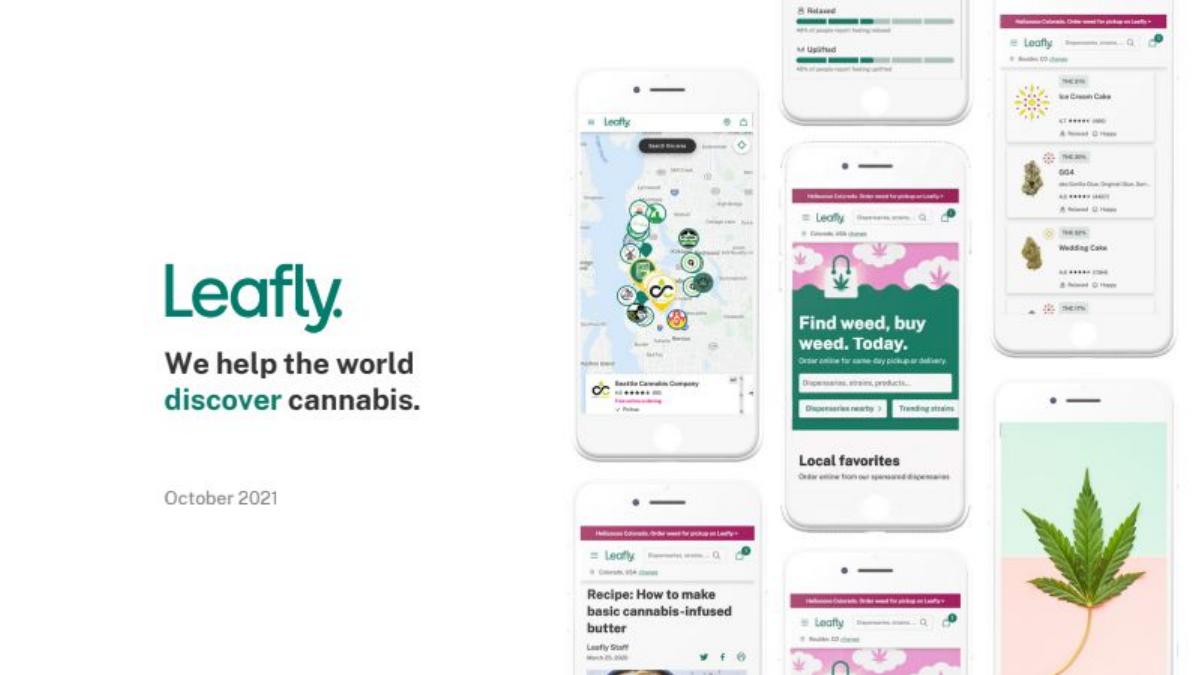
The deck opens with a simple mission statement: "We help the world discover cannabis." The title slide (Slide 1) uses a clean, modern aesthetic with smartphone mockups showing the app's interface, emphasizing their mobile-first consumer experience. However, because this is a SPAC transaction for a public listing, it is immediately followed by three slides of dense legal disclaimers (Slides 2, 3, and 5). These cover forward-looking statements and the inherent risks of the cannabis industry, which remains federally illegal in the United States. For founders, this is a reminder that the more regulated your industry, the more your "legal" slides will overshadow your "vision" slides in a formal fundraise.
Slide 8: The Management Team
Leafly highlights a leadership team with deep roots in traditional tech and legal sectors. CEO Yoko Miyashita is featured with her background as General Counsel at Getty Images and Perkins Coie. The slide lists logos from Amazon, Nordstrom, Bank of America, and Time Inc., signaling to investors that while the product is cannabis, the management is institutional. This is a strategic move to de-risk the investment for institutional SPAC investors who may be wary of the "wild west" reputation of the cannabis industry.
Slides 10-12: Market Opportunity and Challenges
The market slide (Slide 10) presents a compelling narrative of the transition from illicit to legal markets. They estimate the Total Addressable Market (TAM) will grow from $61B in 2020 to $100B by 2030. Crucially, they break this down into a "Serviceable Market" of $7B (representing digital sales) and note that Leafly’s current gross merchandise value (GMV) share is $420M. Slide 12 outlines the "unique challenges" of the industry: fragmented state-by-state regulations, consumer confusion over products (strains and terpenes), and the inability of retailers to use traditional advertising channels like Facebook or Google. Leafly positions itself as the solution to all three.
Slide 14: Social Impact and Advocacy
Leafly dedicates a full slide to its commitment to a "fair, equitable and inclusive cannabis market." This includes their work on decriminalization and their "Seeds of Change" report. In the cannabis sector, social equity is not just a PR move; it is often a regulatory requirement and a core concern for the consumer base. Including this early in the deck demonstrates that the company understands the political and social fabric of its industry.
Slide 17: The Revenue Model
This is one of the most important slides for any B2B SaaS founder. Leafly breaks down its monetization into three tiers:
Retailer Standard: $99/month for basic listings and menu management (~30% of retailers). · Retailer Pro: $199/month for deals, insights, and ad platform access (~70% of retailers). · Platform Amplification: A la carte advertising up to $35,000/month for map markers and carousels.
The slide also notes that brands (non-retailers) pay $199/month plus campaign fees ranging from $1,000 to over $100,000. This tiered approach shows a clear path for upselling small dispensaries into high-value advertising partners.
Slides 19-21: The Legalization Flywheel
Slide 19 explains how Leafly grows as states legalize. They describe a four-stage process where they attract consumers even before a state is legal (Stage 1). As the market matures and supply density increases (Stage 4), retailers are forced to compete for Leafly's shoppers, which increases Leafly's monetization potential. Slide 21 applies this to the East Coast, claiming that Leafly wins 45.33% of cannabis keyword searches in New York, compared to 24.07% for their closest competitor, Weedmaps.
Slides 24-29: SEO Dominance and the Flywheel
Leafly’s "moat" is its content. Slide 24 shows their U.S. website rank at 399, which is significantly higher than Weedmaps (811), Dutchie (26,786), and even mainstream sites like Redfin (543). Slide 26 highlights their "Strain of the Year" (Runtz) as a case study in market influence, claiming the announcement drove a 140% increase in orders for that strain. This all feeds into the "accelerating flywheel" on Slide 29: content attracts shoppers, shoppers attract retailers, and retailers provide the data and revenue to create more content.
Slides 31-38: Product Roadmap and Supply-Side Growth
The roadmap (Slide 31) focuses on three areas: personalized discovery for consumers, supply-side platform investments (POS and menu integrations), and increased monetization through ROI dashboards and auction bidding. Slide 38 provides the proof of execution: active accounts grew from 1,592 in Q1 2018 to 4,420 in Q2 2021. They explicitly state that 55% of legal retailers are now on the Leafly platform.
Slides 40-42: Historical and Projected Financials
The financials show a classic high-growth, high-burn profile. Slide 40 reveals that while revenue grew from $21.9M in 2018 to a projected $43.0M in 2021, the company has remained unprofitable. Operating losses were $30.9M in 2019 and are projected to be $15.0M in 2021. However, the gross margins are exceptionally high, hovering around 88%. This suggests that the core business is efficient, but the company is spending heavily on Sales & Marketing and Product Development (Slide 42) to capture market share during the legalization wave.
Slides 45-47: Transaction Summary and Benchmarking
The deal terms (Slide 45) value Leafly at 9.0x 2021E revenue. Slide 47 provides a benchmarking analysis, comparing this 9.0x multiple to other marketplaces like Etsy (13.5x), Fiverr (25.3x), and DoorDash (14.9x). By showing that Leafly is priced at a discount to other high-growth marketplaces, they make a "value" argument to potential investors.
Slide 50: The Legalization Map
The deck concludes with a map showing Leafly's ubiquity. They are active in all 50 states and order-enabled in 32. This visual reinforces the scale of their footprint and the "land grab" they have already completed in the North American market.
What Leafly Does Well
1. Quantifying the Moat: Most companies claim to have a "brand," but Leafly proves it with SEO rankings and search share data. Comparing their U.S. rank (399) directly against competitors (811) is a powerful way to demonstrate a lower cost of customer acquisition.
2. Clear Monetization Tiers: The breakdown of the $99 vs. $199 vs. $35,000 spend levels makes the business model easy to understand. It shows that they have a "land and expand" strategy for retailers.
3. The Maturity Model: Explaining how they benefit from the progression of legalization (the four stages) helps investors understand that their growth isn't just a one-time spike when a state goes legal, but a long-term monetization play as markets become more competitive.
What is Missing
1. Unit Economics (CAC/LTV): While they show high gross margins and total revenue, the deck lacks a specific breakdown of Customer Acquisition Cost (CAC) and Lifetime Value (LTV) for their retail accounts. Given the high sales and marketing spend, this is a notable omission.
2. Churn Rates: With 4,420 active accounts, investors would want to know how many retailers leave the platform each year. In a rapidly shifting regulatory environment, churn is a critical metric for SaaS health.
3. Detailed Use of Proceeds: Slide 45 mentions "Cash to Balance Sheet" of $150M, but it doesn't specify exactly how that money will be spent beyond general categories like "Product Development" and "Sales and Marketing."
Founder's Playbook: What to Copy
1. The "Trusted Voice" Narrative: If your business relies on content, don't just say you have a blog. Show how your content moves the market. Leafly’s "Strain of the Year" slide is a perfect example of proving influence.
2. Benchmarking Against Non-Competitors: Leafly doesn't just compare itself to other cannabis companies; it compares its valuation multiples to Etsy and DoorDash. This helps investors see the company as a "tech marketplace" rather than just a "cannabis company," which usually leads to higher valuation multiples.
3. Visualizing the Flywheel: The circular diagram on Slide 29 is a great way to show how different parts of the business (Content, Shoppers, Retailers) reinforce each other. Every marketplace deck should have a version of this slide.
4. Addressing the Illicit Market: If you are in a disruptive industry, acknowledge the incumbent (in this case, the illicit market). Showing the transition from "Illicit" to "Legal" as your primary growth driver is a grounded, realistic way to present a TAM.
Frequently asked questions
- How does Leafly make money?
- Leafly operates a B2B SaaS and advertising model. Retailers pay for 'Standard' ($99/mo) or 'Pro' ($199/mo) subscriptions to list their menus and access e-commerce tools. Additional revenue is generated through 'Platform Amplification,' where retailers pay up to $35,000/month for map markers and carousels, and brands pay between $1,000 and $100,000+ for CPM-based advertising (Slide 17).
- What is Leafly's competitive advantage according to the deck?
- The primary advantage is their 'content-first' approach and SEO dominance. Leafly ranks significantly higher than its peers (U.S. rank 399) and claims to win 45.33% of common cannabis keyword searches in New York compared to Weedmaps' 24.07%. This organic traffic allows them to acquire users at a lower cost than competitors who rely on paid acquisition (Slides 21, 24).
- What are the biggest risks identified in the presentation?
- The deck includes extensive risk disclosures required for public offerings. Key risks include the federal illegality of cannabis in the U.S., potential changes in search engine algorithms (Google/Yahoo/Bing) that could decrease traffic, and the company's history of net losses and inability to guarantee future profitability (Slides 52, 54).
- How does the legalization of new states impact Leafly's growth?
- Leafly uses a four-stage maturity model. They attract consumers even before legalization (Stage 1). As states legalize and add licenses (Stages 2-3), retailers seek out Leafly as an established channel. By Stage 4, high supply density forces retailers to compete for Leafly’s shoppers, driving higher monetization through advertising (Slide 19).
- What was the valuation and structure of the SPAC deal?
- The transaction valued Leafly at a $388.4M pro forma enterprise value. This was based on an illustrative $10.00 share price and 53.8M shares outstanding. The deal included $130M from the MCMJ Cash in Trust and a $31.5M private bridge round, with existing Leafly shareholders rolling over 100% of their equity (Slide 45).