Ledgy’s Series B deck is exceptionally lean, consisting of only 8 slides that prioritize market timing and traction over granular operational detail. The narrative centers on the 'democratization of ownership' and a business model that leverages network effects between companies, employees, and investors. With a 10x MRR growth rate in a single year and a 20% month-over-month average in Q1 2021, the deck presents a high-velocity growth story. The inclusion of high-profile European scaleups like Wefox and Bitpanda as customers provides social proof that offsets the lack of a traditional team or…
Key takeaways
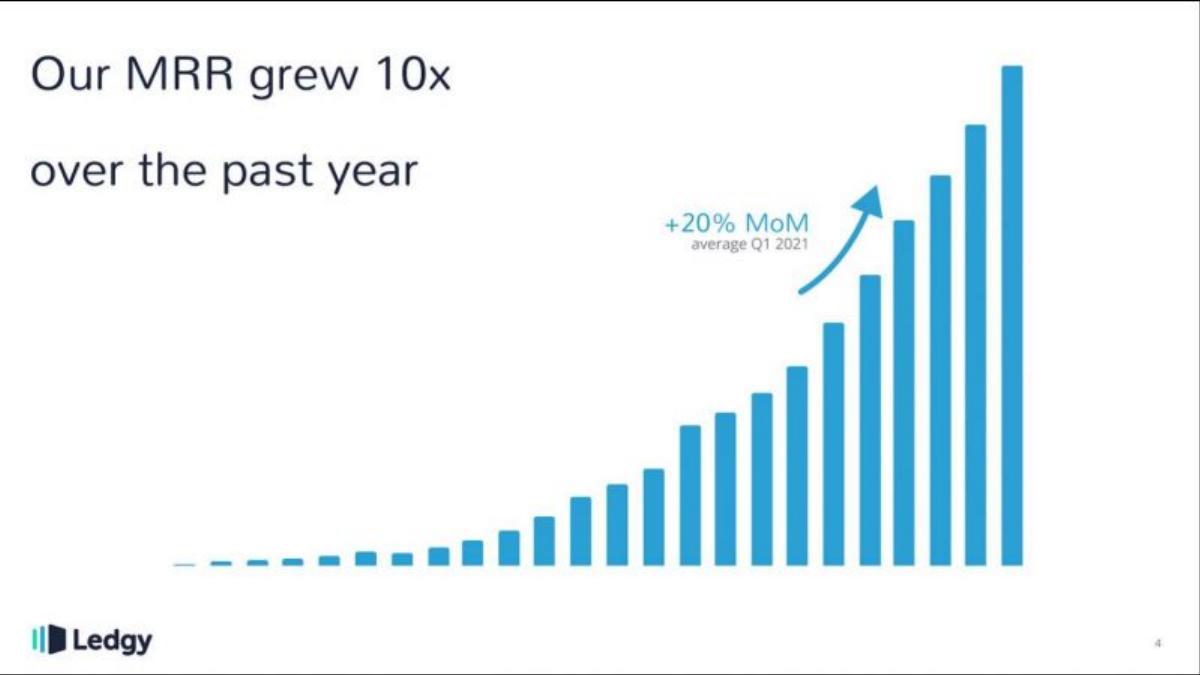
- The deck reports a 10x growth in Monthly Recurring Revenue (MRR) over the year preceding the raise (Slide 6).
- Ledgy achieved an average of +20% Month-over-Month (MoM) growth during Q1 2021 (Slide 6).
- The business model utilizes a 'Launch' tier that is free for early-stage companies to seed the ecosystem (Slide 3).
- Network effects are explicitly illustrated through a loop where companies invite investors, who then onboard their entire portfolios (Slide 3).
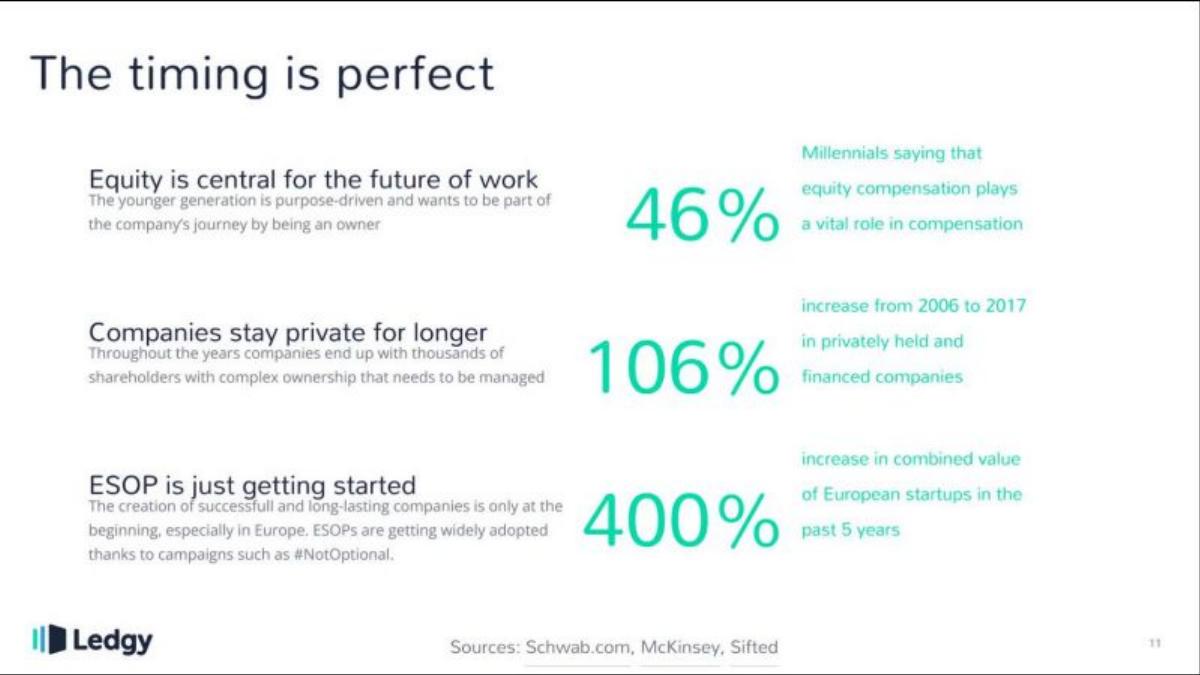
- Market timing is supported by a 400% increase in the combined value of European startups over the last five years (Slide 4).
- The product is positioned as a multi-sided platform serving three distinct user groups: Companies, Investors, and Employees (Slide 2).
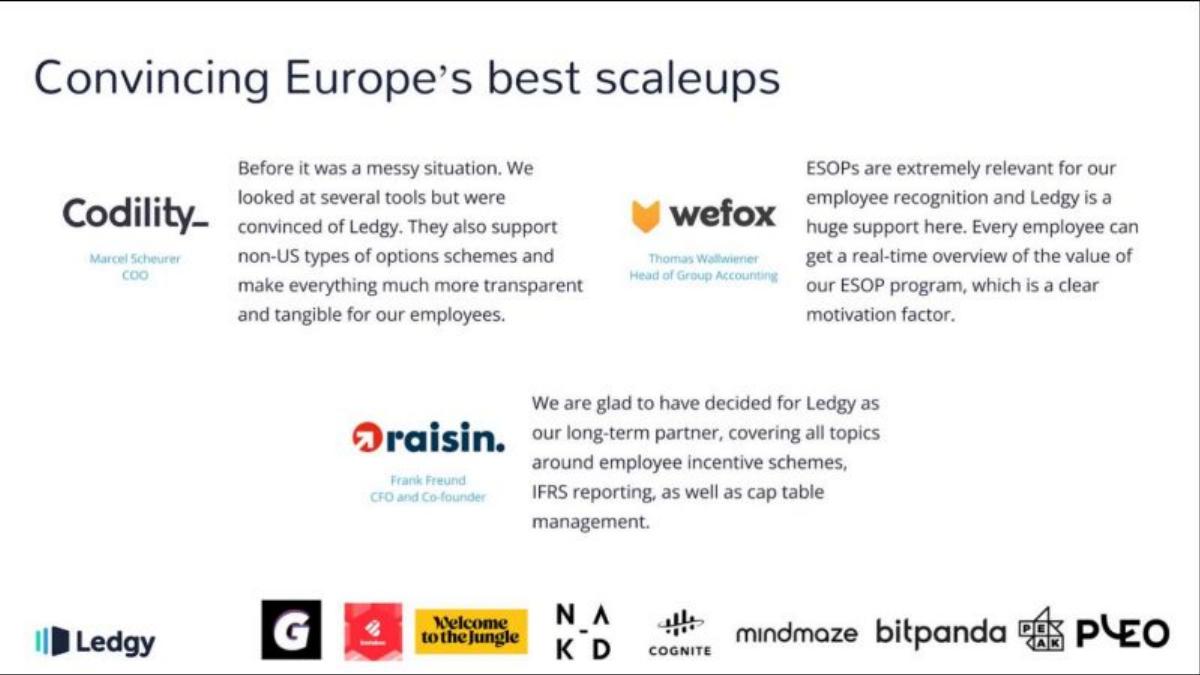
- Customer testimonials from COO and CFO-level executives at Codility, Wefox, and Raisin validate the enterprise-grade utility (Slide 5).
- The deck completely omits a team slide, a competition slide, and a specific use-of-funds breakdown.
The Power of Brevity in a Series B Narrative
Ledgy’s Series B deck is a notable departure from the standard 20-slide venture deck. At only 8 slides, it functions more as a high-level summary of momentum than a granular operational manual. For a company raising €22M from the likes of NEA and Sequoia, this brevity suggests a high degree of existing investor familiarity or a growth story so compelling that it requires little window dressing. The deck focuses almost exclusively on three pillars: the product's multi-sided nature, the inherent network effects of the business model, and a vertical growth chart that speaks for itself.
Slide 1: The Vision Statement
The title slide introduces Ledgy with the tagline: "Fast, simple equity, for international teams." This immediately identifies the core value proposition (simplicity) and the target market (international scaleups). By emphasizing "international," Ledgy differentiates itself from US-centric competitors, positioning itself as the primary solution for the fragmented European regulatory landscape.
Slide 2: The Multi-Sided Platform
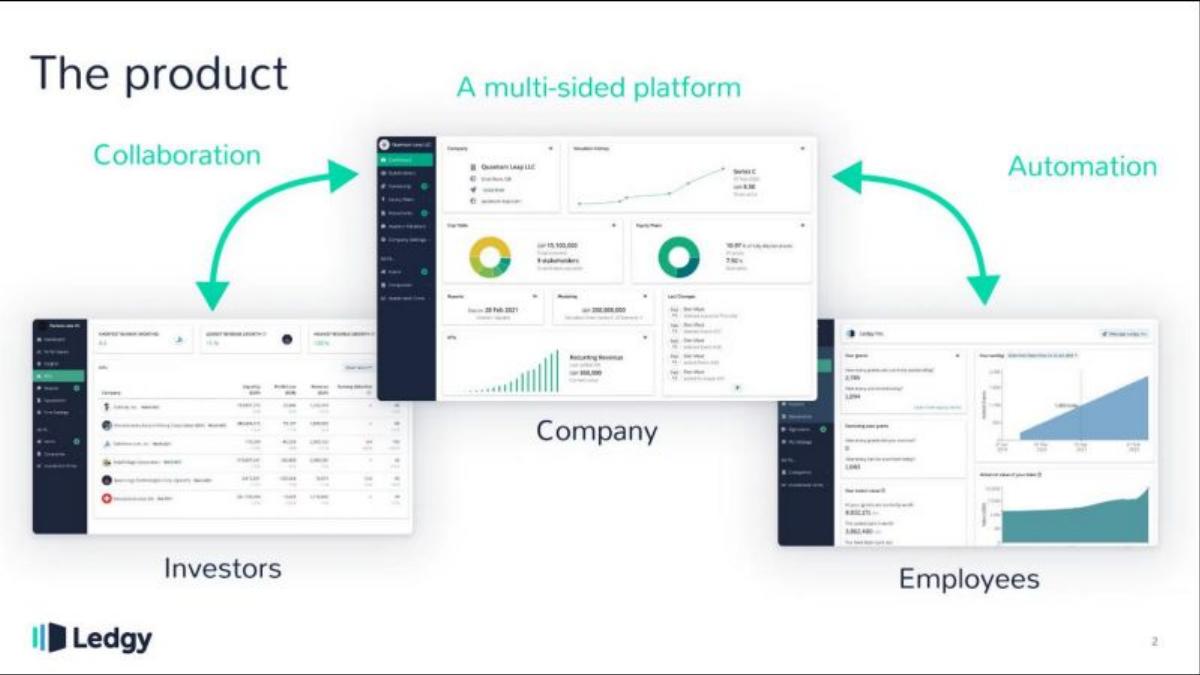
Slide 2, titled "The product," uses three dashboard mockups to illustrate how the platform serves a tripartite ecosystem. It labels itself as "A multi-sided platform" that connects:
Company: The central hub for cap table management. · Investors: Focused on "Collaboration" and portfolio visibility. · Employees: Focused on "Automation" and real-time visibility into their share ownership.
This slide is critical because it moves the perception of Ledgy from a mere accounting tool to a piece of financial infrastructure that sits at the center of the startup ecosystem.
Slide 3: The Engine of Growth
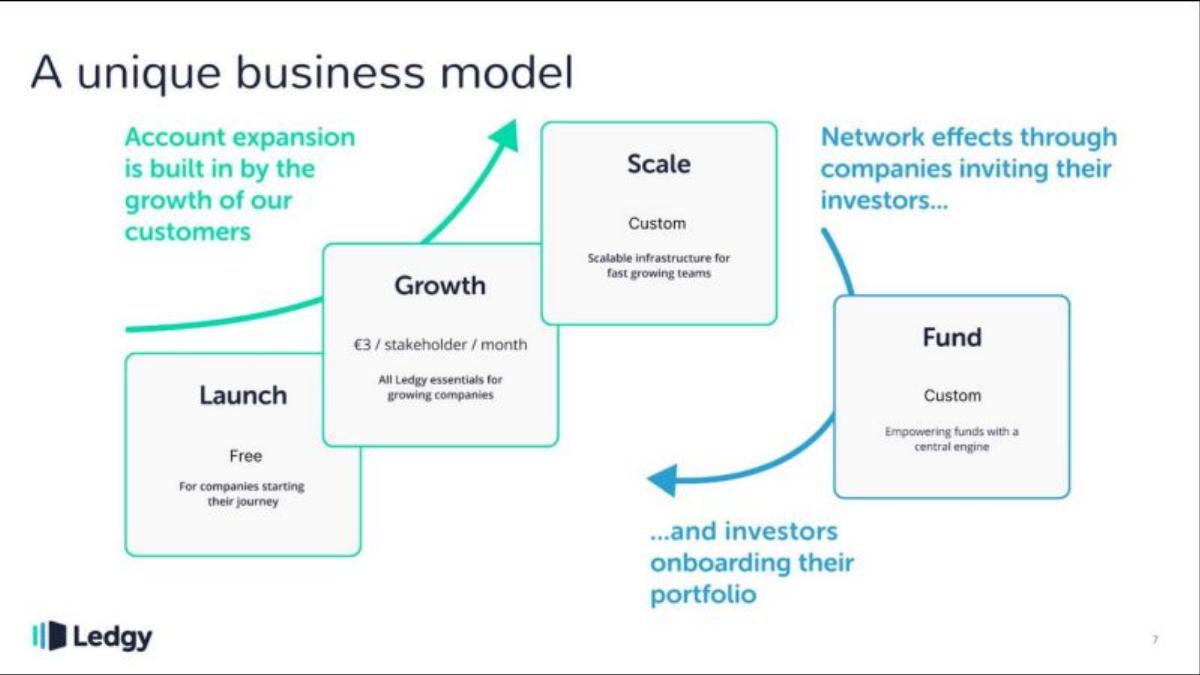
Under the heading "A unique business model," Slide 3 explains how Ledgy scales. It outlines a four-stage pricing strategy:
Launch: Free for companies starting their journey. · Growth: €3 / stakeholder / month for essentials. · Scale: Custom pricing for scalable infrastructure. · Fund: Custom pricing for funds using the platform as a "central engine."
The most important element here is the visualization of "Network effects." Arrows show companies inviting their investors, and investors onboarding their entire portfolios. This creates a low-cost acquisition loop that is highly attractive to Series B investors looking for efficient growth.
Slide 4: Macro Timing and Market Validation
Slide 4, "The timing is perfect," provides the "Why Now?" argument using three data points sourced from Schwab.com, McKinsey, and Sifted:
46%: Millennials stating equity compensation plays a vital role in compensation. · 106%: Increase in privately held and financed companies from 2006 to 2017, meaning companies stay private longer. · 400%: Increase in the combined value of European startups in the past 5 years.
This slide frames Ledgy as an inevitable beneficiary of the maturing European tech ecosystem.
Slide 5: Social Proof and Enterprise Readiness
The slide titled "Convincing Europe’s best scaleups" serves as the deck's primary validation. It features logos and testimonials from high-growth companies. Marcel Scheurer (COO of Codility) notes the support for "non-US types of options schemes," while Thomas Wallwiener (Head of Group Accounting at Wefox) highlights "real-time overview" as a motivation factor. Other logos include Raisin, Bitpanda, Pleo, and Cognite. This list proves that Ledgy can handle the complexity of companies with hundreds or thousands of employees across different jurisdictions.
Slide 6: The Traction Chart
Slide 6 is the most impactful slide in the deck. It contains a single bar chart with the headline: "Our MRR grew 10x over the past year." An annotation highlights an "average +20% MoM" growth rate for Q1 2021. The chart shows a classic hockey-stick trajectory. In a Series B deck, this slide often does 80% of the work; if the growth is this consistent and aggressive, the specific mechanics of the product become secondary to the evidence of market demand.
Slide 7: The Mission
Slide 7, "Our mission," provides a philosophical anchor: "Ledgy democratizes ownership to help companies fulfill their mission as a team." The visual of wind turbines and a person walking suggests a focus on sustainability and long-term impact, aligning the company with the "purpose-driven" generation mentioned in the timing slide.
Slide 8: External Resource Link
The final slide is a promotional slide for the source of the deck, bestpitchdeck.com, and does not contain company-specific information.
What Works in This Deck
The Traction-First Approach: By putting the 10x MRR growth (Slide 6) and the network effect loop (Slide 3) front and center, Ledgy proves it has found a repeatable growth lever. Investors at the Series B stage are looking for a machine where they can inject capital to accelerate an existing process, and this deck demonstrates that machine clearly.
Focus on the Ecosystem: Most cap table tools pitch to the CFO. Ledgy pitches to the entire ecosystem. By showing the product's value to employees and investors (Slide 2), they justify a higher valuation based on the platform's stickiness and the data it captures.
Regional Specialization: The mention of "non-US types of options schemes" on Slide 5 is a subtle but powerful competitive moat. It signals that Ledgy understands the legal complexity of Europe, a major pain point for US-based incumbents like Carta when they try to expand internationally.
What Is Missing
The Team: There is no team slide in this 8-slide sequence. While the founders are likely well-known in the European ecosystem, a Series B deck usually highlights the executive hires (VP Sales, VP Engineering) who will help the company scale to Series C.
Competition: The deck does not mention competitors. In the equity management space, competition is fierce (Carta, Capdesk, Eqvista). Omitting this suggests Ledgy is confident in its dominant position in Europe or its unique "Fund"-led acquisition model.
The Ask and Use of Funds: There is no slide detailing how much is being raised or how the money will be spent. While the catalogue facts state the round was €22M, the deck itself leaves the financial requirements to the verbal pitch or a separate data room.
What a Founder Should Copy
The Network Effect Visualization: Slide 3 is a perfect example of how to explain a complex B2B2B growth loop. If your product has a built-in mechanism where one customer brings in another, you must visualize it as a cycle, not just a list of features.
The 'Timing' Slide Structure: Slide 4 is a masterclass in using third-party data to create a sense of urgency. It doesn't just say "the market is big"; it says "the market is changing in these three specific ways that make us necessary right now."
Clean, Minimalist Design: The deck uses a consistent color palette, high-quality mockups, and very little text. This forces the audience to listen to the presenter rather than reading the slides, which is the hallmark of a confident fundraiser.
Frequently asked questions
- How much did Ledgy raise with this deck?
- According to the catalogue facts, Ledgy raised €22M in a Series B round in 2022. The round was led by New Enterprise Associates (NEA) and included participation from Sequoia Capital, Speedinvest, and several other venture capital firms and angel investors.
- What is Ledgy's core business model?
- As shown on Slide 3, Ledgy uses a tiered SaaS model. It offers a 'Launch' tier for free, a 'Growth' tier at €3 per stakeholder per month, and 'Scale' and 'Fund' tiers with custom pricing. The model relies on network effects where companies invite their investors, who then bring their other portfolio companies onto the platform.
- Who are Ledgy's primary customers?
- The deck highlights several prominent European scaleups as customers on Slide 5, including Wefox, Raisin, Bitpanda, Pleo, and Codility. The platform is designed to serve the needs of company management, their employees, and their venture capital investors simultaneously.
- What market trends does the deck use to justify the investment?
- Slide 4 identifies three key trends: 46% of millennials view equity as a vital part of compensation, companies are staying private 106% longer (based on data from 2006-2017), and the value of European startups has grown by 400% in the last five years, increasing the demand for ESOP management.
- Is there a team slide in the Ledgy pitch deck?
- No, the 8-slide version of the deck provided does not include a team slide. This is unusual for a pitch deck but suggests that at the Series B stage, the company's traction (10x MRR growth) and the reputation of its existing backers were sufficient to carry the narrative.