The Lenovo × Motorola acquisition deck serves as a masterclass in strategic M&A communication. Facing a rapidly growing global smartphone market, Lenovo utilized this 10-slide presentation to justify a $2.91 billion purchase of a legacy brand that had struggled under Google's ownership. The deck emphasizes the 'Winning Combination' of Lenovo’s operational efficiency and Motorola’s brand equity in North and Latin America. By highlighting a combined worldwide market share of 5.4% and a portfolio of over 2,000 patents, Lenovo framed the deal as the essential 'Attack' phase of its 'Protect and At…
Key takeaways
- The total consideration for the acquisition was US$2.91 billion, comprising cash, stock, and a three-year interest-free promissory note (Slide 3).
- Lenovo identified itself as the #1 PC vendor globally and the #4 smartphone player globally prior to the deal (Slide 2).
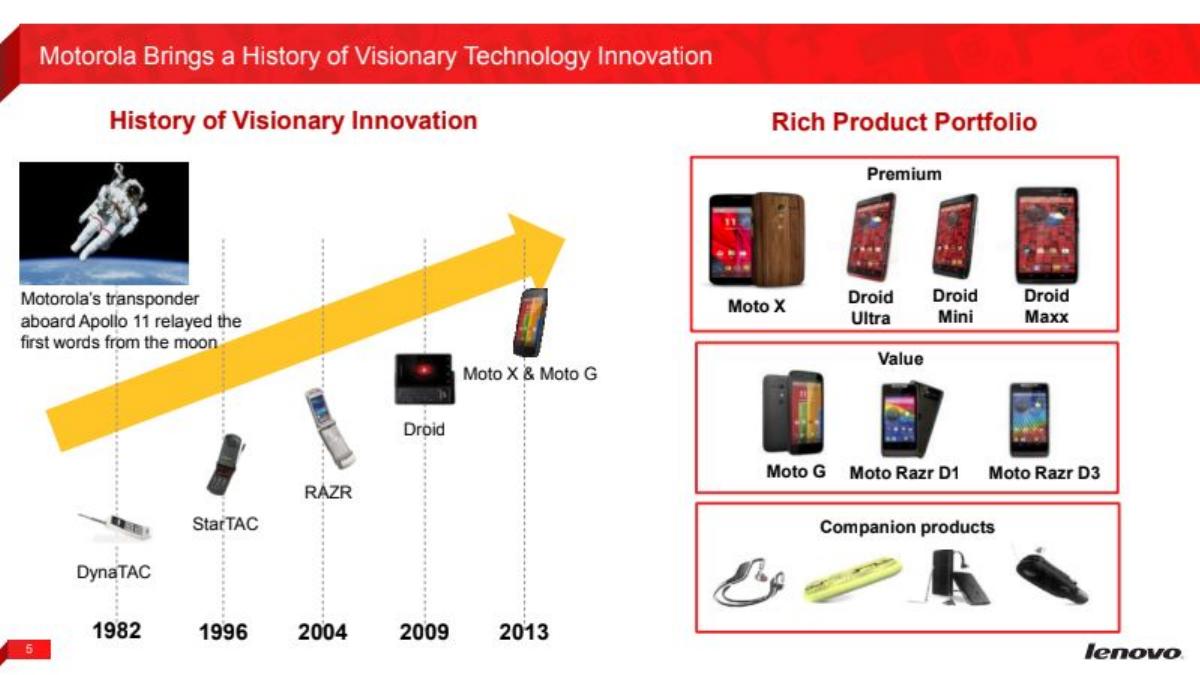
- Motorola brought a history of innovation dating back to 1982 with the DynaTAC and the Apollo 11 transponder (Slide 5).
- The deal included the acquisition of over 2,000 patents and a license to a broader rich portfolio of mobile patents (Slide 3).
- Geographic synergy was a primary driver, with Motorola holding 8.0% market share in LATAM and Lenovo holding 11.8% in the PRC (Slide 7).
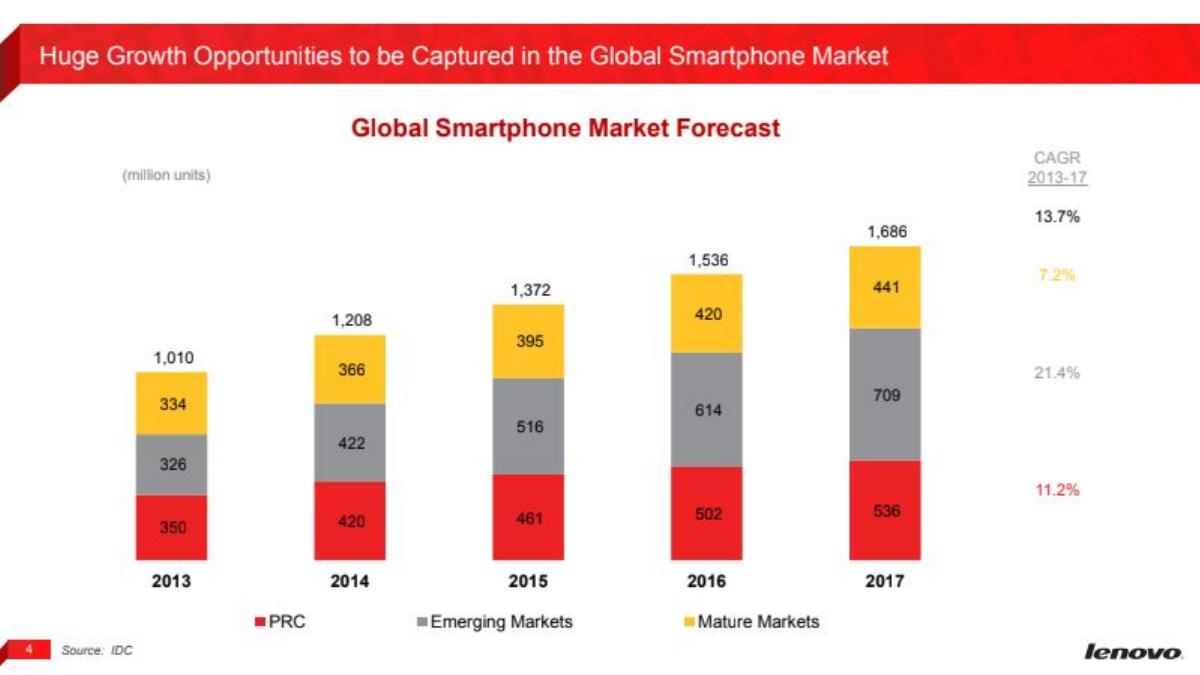
- The global smartphone market was forecasted to grow at a 13.7% CAGR from 2013 to 2017 (Slide 4).
- The acquisition was specifically aligned with Lenovo’s 'Protect and Attack' strategy, targeting the 'Mobile Internet and Digital Home' segment (Slide 8).
- The transaction involved approximately 3,500 technical and other resources across 33 global locations (Slide 3).
The Strategic Logic of a $2.9 Billion Hand-Me-Down
In 2014, the technology world was captivated by a massive divestiture: Google, having bought Motorola Mobility for $12.5 billion just three years prior, was selling it to Lenovo for a fraction of the price—$2.91 billion. This pitch deck, presented by Lenovo CFO Wai Ming Wong, outlines the investor-facing rationale for why this deal made sense for the Chinese hardware giant. It is a clinical, data-driven defense of a high-stakes acquisition.
Slide 1: Title Slide
The deck opens with a formal title: "Investor Conference Call – Acquisition of Motorola Mobility." It is dated January 30, 2014, and attributed to Wai Ming Wong, CFO. The branding is heavy on Lenovo's "For Those Who Do" tagline, signaling that this is an execution-focused move rather than a speculative one.
Slide 2: A Winning Combination
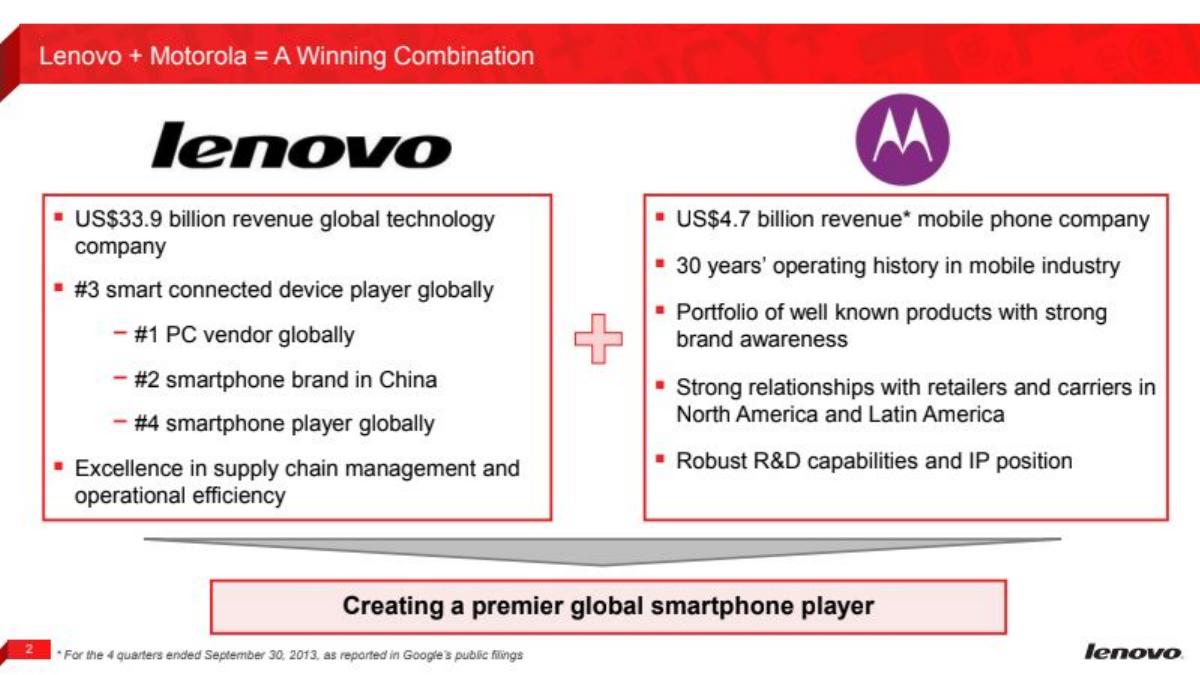
This slide sets the stage by comparing the two entities. Lenovo is presented as a US$33.9 billion revenue powerhouse, the #1 PC vendor globally, and the #4 smartphone player. Motorola is described as a US$4.7 billion revenue company with a 30-year history. The slide uses a simple addition graphic: Lenovo's operational efficiency + Motorola's brand awareness and carrier relationships = "A premier global smartphone player." This is the core thesis of the deal: Lenovo has the scale, Motorola has the brand and the Western footprint.
Slide 3: Transaction Summary
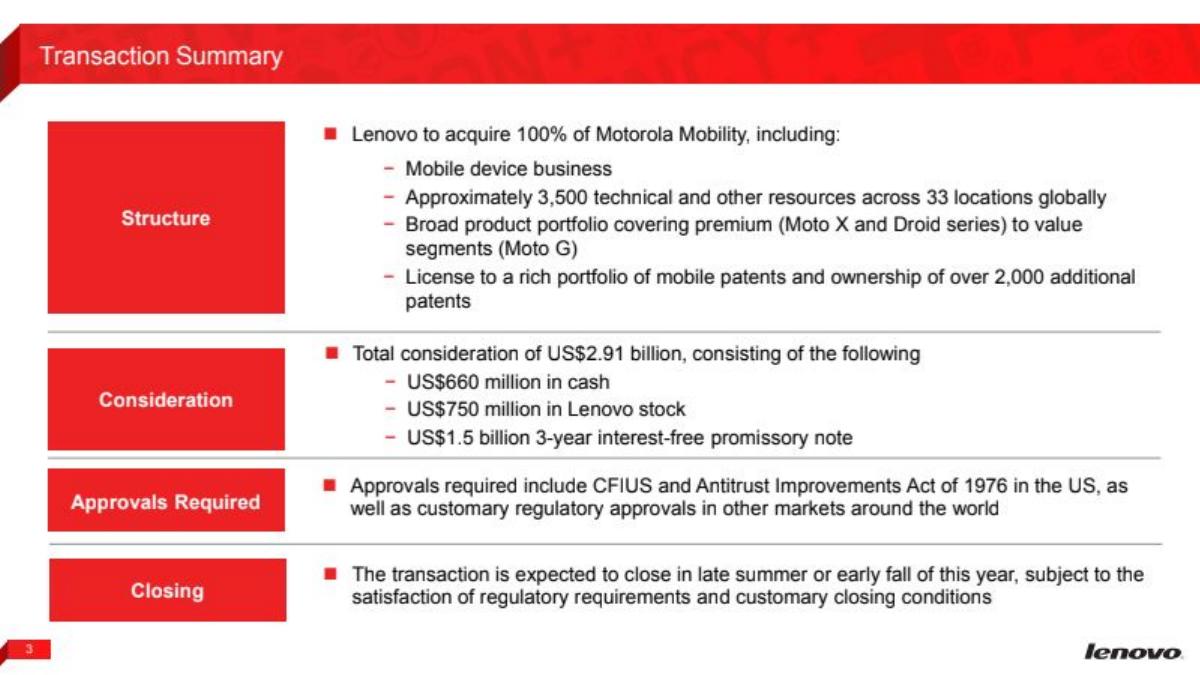
This is the most information-dense slide in the deck. It breaks down the 100% acquisition of Motorola Mobility, including 3,500 employees across 33 locations. The consideration of US$2.91 billion is clearly delineated: US$660M in cash, US$750M in stock, and a US$1.5B promissory note. It also addresses the intellectual property, noting that Lenovo gets 2,000 patents and a license for many more. This slide is crucial for transparency, showing exactly how Lenovo intended to pay for the growth.
Slide 4: Global Smartphone Market Forecast
To justify the spend, Lenovo points to the market opportunity. Using IDC data, the slide forecasts a rise from 1.01 billion units in 2013 to 1.68 billion units in 2017. It breaks this down by region, showing that while Mature Markets are growing slowly (7.2% CAGR), Emerging Markets are exploding at 21.4%. This justifies the acquisition of a brand that has strong roots in both the US (Mature) and Latin America (Emerging).
Slide 5: History of Visionary Innovation
This slide is a "brand equity" play. It traces Motorola’s history from the 1982 DynaTAC to the 2013 Moto X. It even mentions the Apollo 11 transponder. The right side of the slide categorizes the current portfolio into "Premium" (Moto X, Droid), "Value" (Moto G), and "Companion products." This demonstrates that Motorola isn't just a legacy name; it has a modern, tiered product line that fits into Lenovo’s existing manufacturing capabilities.
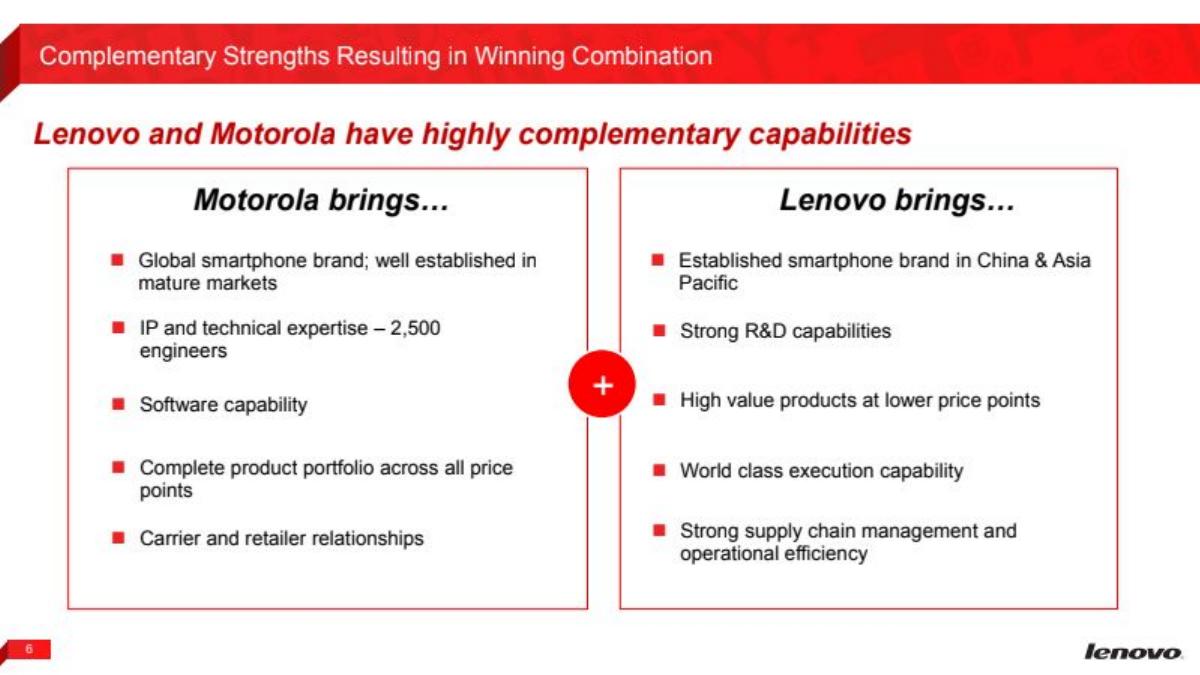
Slide 6: Complementary Capabilities
This slide uses a side-by-side comparison to show why the two companies need each other. Motorola brings "Software capability" and "Carrier and retailer relationships," while Lenovo brings "World class execution capability" and "High value products at lower price points." It’s a classic M&A slide designed to show that there is little overlap and significant synergy.
Slide 7: Immediate Global Footprint
This is the "Map Slide." It visualizes market share by shipment. Lenovo is dominant in the PRC (11.8%) but invisible in the Americas. Motorola holds 3.5% in North America and a significant 8.0% in Latin America. The combined worldwide market share is stated as 5.4%. This map makes the geographic logic of the deal undeniable: Lenovo is buying its way into the Western Hemisphere.
Slide 8: Reaching Strategic Goals
Lenovo introduces its "Protect and Attack" framework. They "Protect" their lead in China and PCs to fund their "Attack" on Smartphones and Enterprise Systems. The Motorola acquisition is highlighted with a red dashed box as the primary driver for the "Mobile Internet and Digital Home" attack. This slide connects the specific transaction to the broader corporate strategy, reassuring investors that this isn't a random purchase but a calculated step in a long-term plan.
Slide 9: Conclusion
The deck concludes with a "Thank You" slide featuring the word in multiple languages, reinforcing Lenovo's identity as a global, multicultural corporation.
What Lenovo Did Well
Clear Financial Breakdown: Slide 3 leaves no ambiguity about the price or the payment structure. In M&A, clarity on the "how" is as important as the "why." · Geographic Visualization: Slide 7 is the strongest argument in the deck. By showing the red (Lenovo) and blue (Motorola) regions, they prove that the two companies are almost perfectly non-overlapping. · Strategic Alignment: By placing the deal within the "Protect and Attack" framework on Slide 8, the management shows that they are following a pre-existing roadmap rather than reacting to market whims.
What Was Missing
Profitability Path: While revenue and market share are mentioned, there is no mention of Motorola's burn rate or a specific timeline for when the acquisition would become accretive to earnings. Given that Motorola was losing money under Google, this was a significant omission. · Integration Plan: The deck mentions 3,500 employees but doesn't detail how the two distinct cultures (Silicon Valley/Chicago vs. Beijing) would be integrated to avoid talent churn. · Competitive Response: There is no slide addressing how competitors like Samsung or Apple might react to this consolidation, or how Lenovo would maintain Motorola's carrier relationships post-acquisition.
What Founders Can Copy
The "Complementary Strengths" Slide: If you are pitching a partnership or an acquisition, use Slide 6's format. Clearly state what you bring vs. what they bring. It simplifies the value proposition. · Market Segmentation: Slide 4 doesn't just say "the market is big." It breaks it down by PRC, Emerging, and Mature markets. Founders should always segment their TAM/SAM/SOM to show they understand where the actual growth is coming from. · The Use of Third-Party Data: By citing IDC on Slides 4 and 7, Lenovo adds an layer of objective credibility to their claims. Founders should always use recognized industry sources to back up their market size projections.
Frequently asked questions
- How was the $2.91 billion purchase price structured?
- According to Slide 3, the consideration was split into three parts: US$660 million in cash, US$750 million in Lenovo stock, and a US$1.5 billion three-year interest-free promissory note. This structure allowed Lenovo to complete a multi-billion dollar acquisition without an immediate, massive cash outlay, leveraging its own equity and future debt.
- What happened to Motorola's patent portfolio in this deal?
- Slide 3 specifies that Lenovo acquired 100% of Motorola Mobility, which included ownership of over 2,000 additional patents. Crucially, it also included a 'license to a rich portfolio of mobile patents.' This allowed Google to retain the bulk of the patents it originally acquired for $12.5 billion, while giving Lenovo the legal protection needed to operate globally.
- Why did Lenovo want Motorola if the brand was struggling?
- Slide 6 and Slide 7 highlight 'Complementary Strengths.' Lenovo had a dominant position in China (11.8% share) but almost no presence in North America or Latin America. Motorola provided an immediate 3.5% share in NA and 8.0% in LATAM, along with established relationships with carriers and retailers that Lenovo lacked.
- What was the 'Protect and Attack' strategy mentioned in the deck?
- Slide 8 defines this as Lenovo's overarching corporate framework. 'Protect' referred to their core profit pools like the China market and Commercial PCs. 'Attack' referred to growth areas where they wanted to gain ground, specifically 'Mobile Internet and Digital Home (Smartphones)' and 'Enterprise Systems.' The Motorola acquisition was the primary engine for the smartphone 'Attack.'
- What were the expected growth rates for the smartphone market at the time?
- Slide 4 shows a Global Smartphone Market Forecast with a total CAGR of 13.7% from 2013 to 2017. The most aggressive growth was expected in 'Emerging Markets' at 21.4%, while the 'PRC' (China) was expected to grow at 11.2% and 'Mature Markets' at 7.2%.