Lets works is an Indian freelance marketplace that positions itself as a more localized, hands-on alternative to global giants like Upwork and Fiverr. The 2022 deck outlines a clear evolution from a small team receiving its first order in January 2019 to a platform that served over 500 clients and verified 2,000+ vendors by December 2021. The startup emphasizes 'Indian Business Know-How' and 'Intermediary Assistance' as its primary competitive moats. While the deck provides strong historical revenue milestones—reaching 15 lakhs in total revenue by the end of 2021—it lacks a specific 'Ask' sli…
Key takeaways
- The company defines itself as an 'online organized marketplace for freelancing projects' specifically for the Indian market (Slide 2).
- Market validation is based on a 46% increase in new Indian freelancers during Q1-Q2 2020 (Slide 3).
- The platform claims a competitive advantage by offering 'Intermediary Assistance' and 'Audio & Video Support' which competitors like Upwork and Fiverr lack (Slide 5).
- Historical traction shows a pivot in June 2020 toward connecting businesses with freelancers, following an initial start in 2019 (Slide 6).
- Revenue grew from 4 lakhs in December 2019 to 15 lakhs by December 2021 (Slide 6).
- The team is composed of eight members with backgrounds in CS, Design, and Commerce, though no specific 'Founder' or 'CEO' title is assigned to the individuals shown (Slide 7).
- Post-funding projections estimate reaching 8,550,000 INR in quarterly revenue by the 5th quarter (Slide 8).
- The deck omits a specific funding amount requested and does not detail the current burn rate or valuation (Slide 8).
Executive Summary: The Localized Freelance Play
The Lets works pitch deck from 2022 is a study in hyper-local market positioning. While the global freelance market is dominated by behemoths, Lets works argues that the Indian market requires a more hands-on, managed approach. The deck transitions from a mission-driven opening to a data-backed traction report, showing a clear evolution from a service-based start to a scalable marketplace model. However, the deck relies heavily on historical revenue milestones and lacks the granular unit economics typically required for a Series A or late-Seed round.
Slide 1: Title and Mission
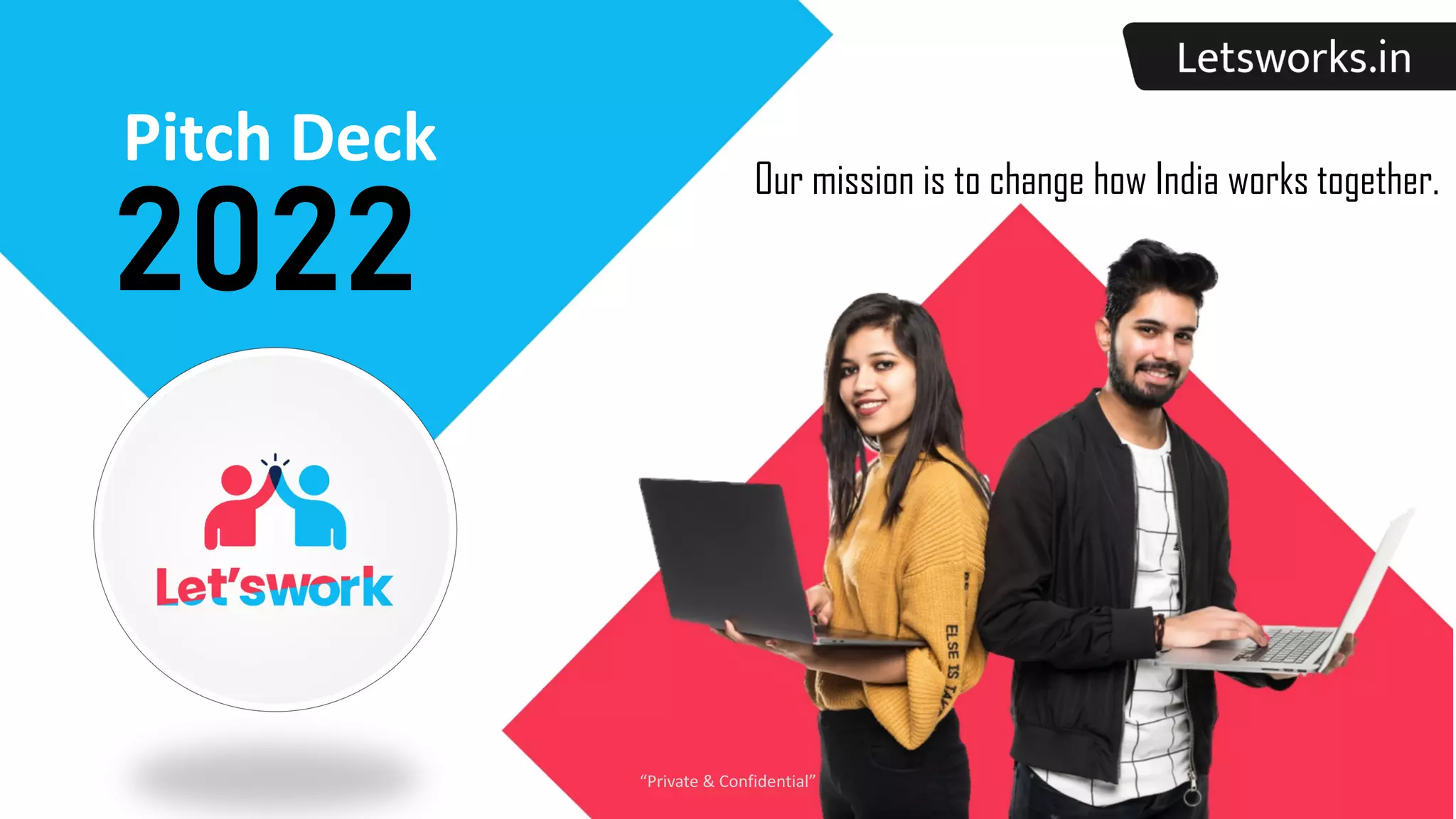
The cover slide establishes the brand identity with a clean logo featuring two figures high-fiving, signaling collaboration. The mission statement, "Our mission is to change how India works together," immediately narrows the geographic focus to India. The inclusion of "Private & Confidential" and the "2022" date stamp suggests this was a live document used for active fundraising during that year.
Slide 2: The Solution
Slide 2 defines the product as an "online organized marketplace for freelancing projects and connecting platform between content creator and brands." The visual includes a mobile app mockup showing categories like Graphic Designer (100+ Experts), Photographers (200+ Experts), Web Developer (150+ Experts), and Video Editor (250+ Experts). The value proposition is split into four pillars: saving money for hirers, making money for providers, creating entrepreneurs, and contributing to national growth.
Slide 3: Market Validation
This slide uses external data to justify the timing of the venture. It cites India Today for the fact that India saw a 46 percent increase in new freelancers from Q1 to Q2 2020. It also references IBEF , stating India has 15 million freelancers who contribute to 40% of total freelance job offers worldwide. The slide successfully argues that the 'Startup Culture' in India is increasingly reliant on cost-effective, low-risk domain experts.
Slide 4: Stakeholder Benefits
The deck divides benefits between 'For Business' and 'For Freelancers.' For businesses, the focus is on transparency, speed, and "End-to-End Project Execution Assistance." For freelancers, the most compelling point is "No bidding / negotiation to win projects," which addresses a major pain point on platforms like Upwork where the 'race to the bottom' on pricing is a common complaint. This suggests Lets works acts as a curator or matchmaker rather than a blind bidding floor.
Slide 5: Competitor Analysis
The competitive matrix compares Lets works against Upwork, Agencies, Fiverr, and Pepper Content. The company claims a 'Yes' across all categories: Indian Business Know-How, Intermediary Assistance, Audio & Video Support, Verified Freelancers, and Fair Pricing. Notably, it marks Upwork and Fiverr as lacking 'Indian Business Know-How' and 'Intermediary Assistance.' This slide reinforces the 'Managed Marketplace' strategy as their primary differentiator.
Slide 6: Go-To-Market and Traction
This is the strongest slide in the deck, providing a chronological timeline of growth. In 2019 , they received their first order and reached 4 lakhs in revenue. In 2020 , they pivoted to the marketplace model and doubled revenue to 8 lakhs. By 2021 , they reached 15 lakhs in revenue , served 500+ clients, and verified 2,000+ vendors. The mention of a co-founder leaving in July 2021 is a rare moment of transparency in a pitch deck, though it is not explained further.
Slide 7: Our Team
The team slide lists eight individuals. Deepak Tewatia is listed as Head of Technology with a B.Tech and MBA. The rest of the team is balanced between technical roles (Back-End, Front-End, Graphic Design) and operational roles (Client Management, Accounts, Relationship Manager). The educational background is heavily centered on Delhi University. One notable omission is the lack of a clear 'CEO' or 'Founder' title, which may leave investors wondering who holds the ultimate decision-making authority.
Slide 8: Post-funding Status
The final slide in this selection shows projections for a 15-month runway. The growth targets are aggressive: revenue is projected to grow from 1,530,000 INR in Q1 to 8,550,000 INR in Q5 . Similarly, the freelancer base is expected to scale from 5,500 to 46,500. While these numbers show ambition, the slide does not explain the underlying assumptions or the specific marketing spend required to achieve this 5x revenue growth.
What Works in This Deck
The Traction Timeline (Slide 6) is the highlight. It shows a company that has been operational for three years, survived a pivot, and maintained a steady upward revenue trajectory. Investors value 'grittiness,' and showing the progression from a first order in a rental office to 15 lakhs in revenue demonstrates execution capability. The Competitive Matrix (Slide 5) also does a good job of identifying a specific niche—intermediary assistance—that global platforms often ignore because it is difficult to scale without local operations.
What Is Missing
The most significant omission in these eight slides is the Ask . There is no mention of how much capital is being raised, the valuation, or the specific allocation of funds (e.g., 40% Marketing, 30% Product, etc.). Additionally, there is no slide dedicated to Unit Economics . For a marketplace, investors need to see the Take Rate (commission), Customer Acquisition Cost (CAC), and Lifetime Value (LTV). Without these, the revenue projections on Slide 8 are just numbers without a roadmap. Finally, the Problem Slide is missing from this selection; while the solution is clear, the specific 'pain' felt by Indian businesses that justifies a managed marketplace over a self-service one could be more explicitly stated.
Founder's Playbook: What to Copy
Localized Positioning: If you are entering a crowded global market, copy the way Lets works identifies specific regional needs (like 'Intermediary Assistance') that global players can't easily replicate. · Transparent Traction: Don't just show a graph going up. Show the milestones (first order, first lakh, first office). It builds a narrative of a real business rather than just a software project. · Dual-Sided Value: Clearly separating the benefits for both sides of the marketplace (Slide 4) is essential for any platform business. · Source Attribution: Using reputable sources like IBEF and India Today for market validation (Slide 3) adds immediate credibility to your claims about market size.
Frequently asked questions
- What is the primary value proposition of Lets works?
- Lets works positions itself as a localized intermediary that simplifies the freelancing process for Indian businesses. Unlike self-service global platforms, it offers 'Intermediary Assistance' and 'Personal Support' for both businesses and freelancers. For businesses, this means end-to-end project execution assistance; for freelancers, it means no bidding or negotiation is required to win projects, as the platform manages the deal flow.
- How has the company's revenue trended over time?
- According to Slide 6, the company generated its first 1 lakh in revenue in April 2019. By December 2019, it reached 4 lakhs. Despite the pandemic, they completed 8 lakhs in revenue by December 2020. Growth accelerated in 2021, reaching a cumulative 15 lakhs in revenue by December of that year, alongside a milestone of 2,000+ verified vendors.
- Who are the main competitors identified in the deck?
- The deck identifies Upwork, Fiverr, Pepper Content, and traditional agencies as competitors. Lets works differentiates itself by claiming 'Indian Business Know-How' and 'Intermediary Assistance,' features it asserts are missing from Upwork and Fiverr. It also highlights 'Audio & Video Support' as a unique feature not offered by any of the listed competitors.
- What does the team structure look like?
- The team slide (Slide 7) features eight professionals. The technical side is led by Deepak Tewatia (Head of Technology) supported by a Back-End Developer and a Front-End Designer. The business side includes Client Management, Accounts, and a Relationship Manager. Most team members hold degrees from Delhi University or have B.Tech backgrounds, with graduation dates ranging from 2012 to 2019.
- What are the financial projections after raising funds?
- Slide 8 outlines a 15-month runway projection. It forecasts a steep growth curve, starting at 1,530,000 INR in revenue with 5,500 freelancers in the first quarter, and scaling to 8,550,000 INR in revenue with 46,500 registered freelancers by the fifth quarter. These figures are noted as 'Approx. Figures' and assume the successful deployment of new capital.