The Levels pitch deck from August 2020 is a masterclass in demonstrating product-market fit through qualitative and quantitative social proof. With 16 slides, the deck spends nearly a third of its real estate on Twitter DMs, public tweets, and podcast appearances to prove that their metabolic fitness platform is a 'logical extension' of the health stack. The company highlights a waitlist that grew from 10k in May to over 28k by August 2020 (Slide 3) and a beta program with over 1,000 paying customers (Slide 11). While it lacks traditional competitive matrices or detailed unit economics, it co…
Key takeaways
- The deck relies heavily on social proof, using four slides (Slides 2, 3, 4, 5) to showcase customer demand and results.
- Waitlist growth is a primary traction metric, increasing from 10,000 to 28,000 people in just three months (Slide 3).
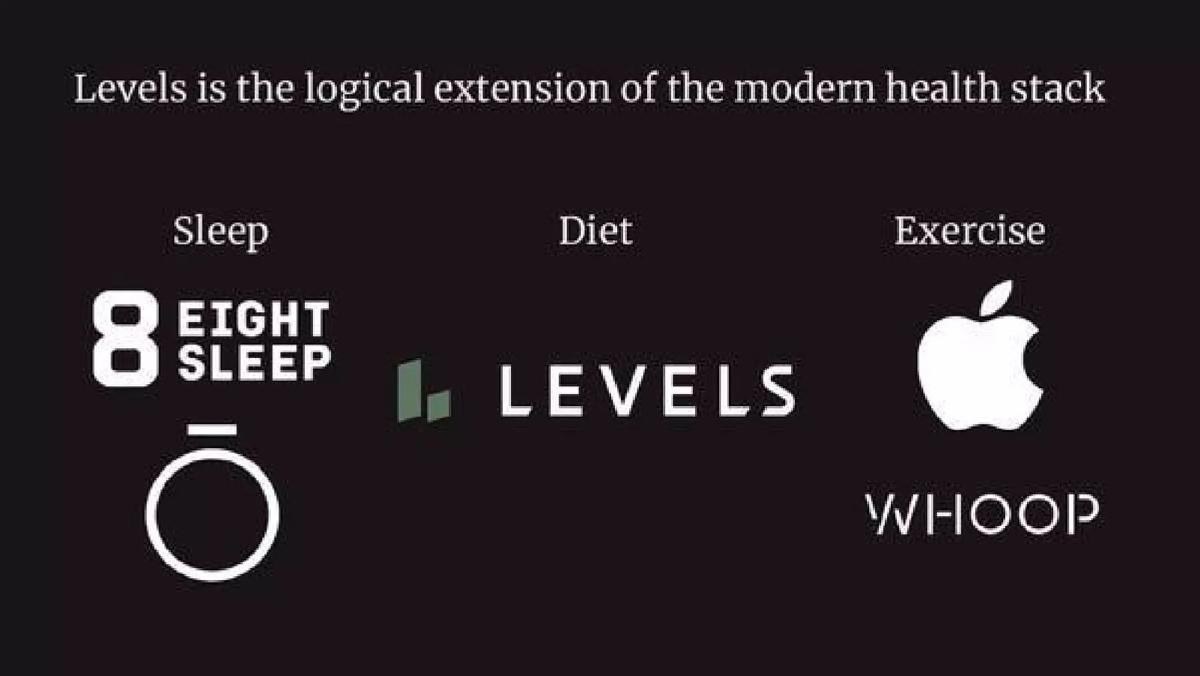
- Levels positions itself as the 'Diet' component of a health stack alongside Eight Sleep, Oura, Apple, and Whoop (Slide 6).
- The initial business model is a high-ticket entry point: a $399 one-month program followed by a $199/month optional subscription (Slide 10).
- The company claims a 60% gross margin and a physician network covering 96% of the US population (Slide 11).
- Development velocity is highlighted by 500+ releases since January 2020, demonstrating a fast-moving engineering culture (Slide 13).
- Organic search traffic grew significantly, with July 2020 seeing 10,341 visitors, representing 23.9% of total traffic (Slide 15).
- The funding ask was specifically for $5M-$8M to kick off clinical research and reach profitability (Slide 16).
The Levels Pitch Deck: Selling the 'Missing Link' of Health
The Levels deck from August 2020 is an interesting artifact of a company that understood the power of narrative and social proof over raw financial spreadsheets. At the time of this deck, Levels was positioning itself at the intersection of biohacking and mainstream wellness. The deck is less about 'how the technology works' and more about 'look how much people want this.'
Introduction and Social Proof (Slides 1-5)
Slide 1 is a minimalist title slide featuring the Levels logo and the date, August 2020. It sets a professional, high-end tone that persists throughout the deck.
Slide 2 , titled 'Daily Twitter DMs,' is a collage of messages from users begging for beta access. This is a bold choice for a second slide. Instead of defining the problem, Levels shows that the problem is so acute that people are reaching out via social media to find a solution. One DM specifically mentions being 'obsessed with data and tweaking my diet' despite not being diabetic.
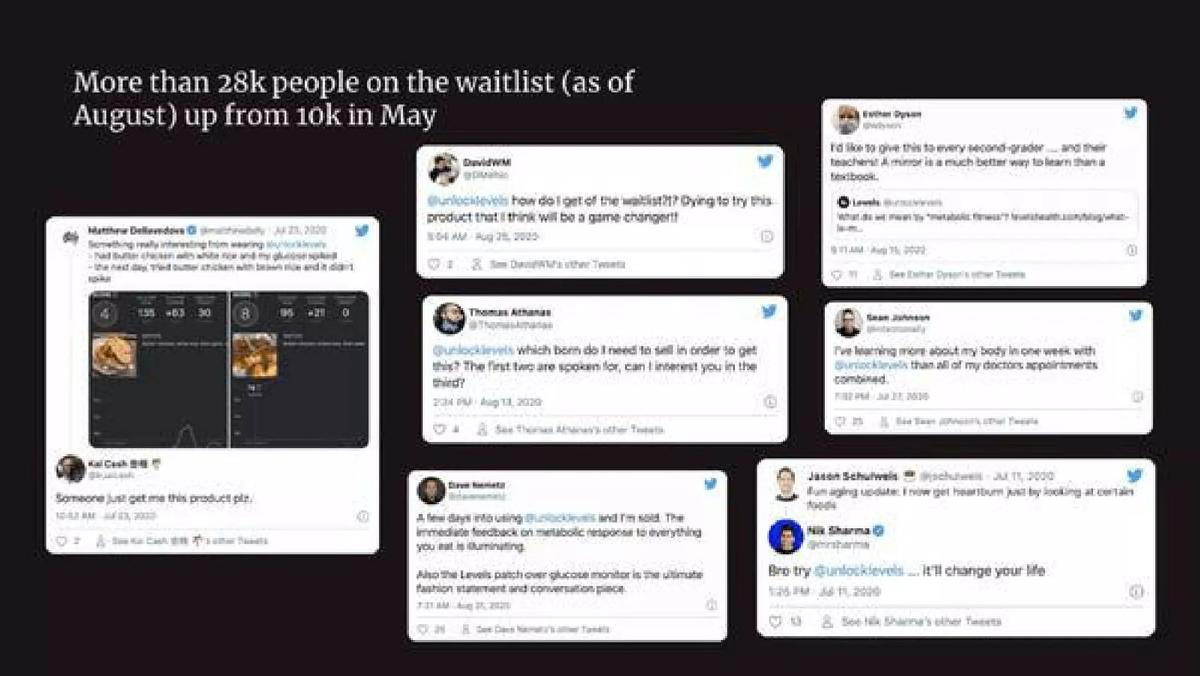
Slide 3 quantifies this demand. It states there are more than 28k people on the waitlist as of August, up from 10k in May. This 180% growth in three months provides the 'velocity' that VCs look for. The slide also includes tweets from notable figures like Esther Dyson and professional athletes like Matthew Dellavedova, further validating the product's appeal across different high-performance segments.
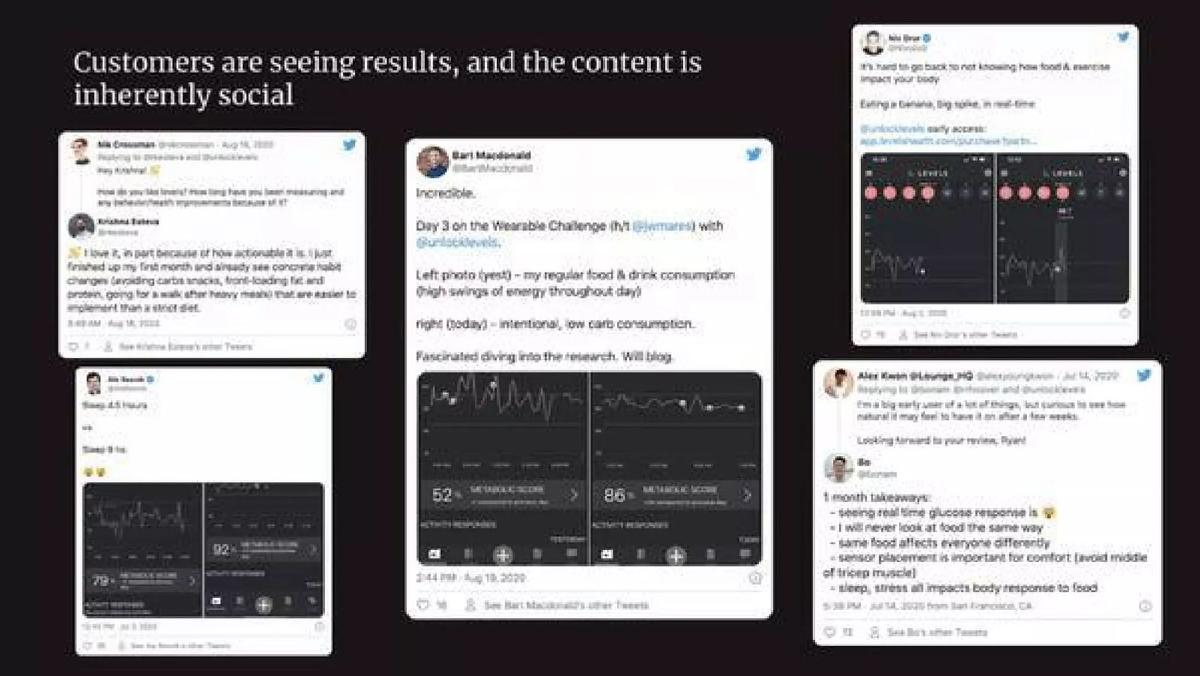
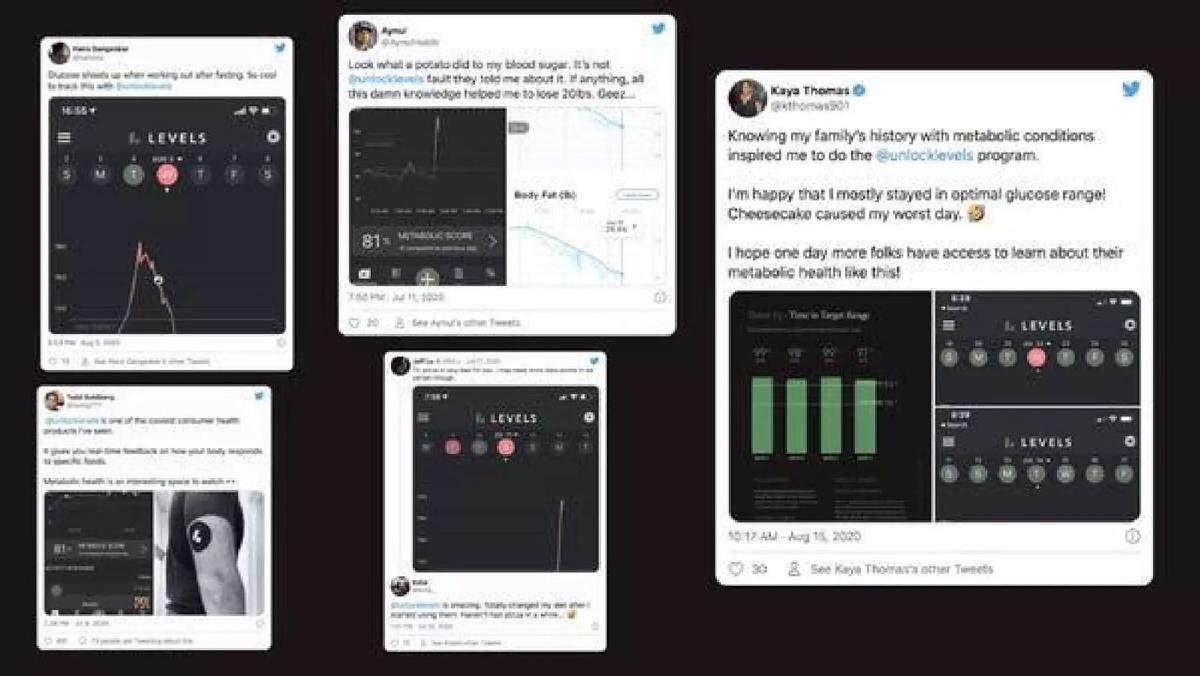
Slides 4 and 5 continue the social proof theme, showing 'Customers are seeing results.' These slides feature screenshots of the app's interface—specifically metabolic scores and glucose graphs—shared by users on Twitter. This demonstrates that the product is 'inherently social,' a key growth lever for consumer health tech. Users are shown correlating specific foods (like Nutella or potatoes) to glucose spikes, which illustrates the product's utility without needing a dense technical explanation.
Market Positioning and Strategy (Slides 6-9)
Slide 6 is perhaps the most important strategic slide in the deck. It positions Levels as the 'logical extension of the modern health stack.' By placing their logo alongside Eight Sleep and Oura (Sleep) and Apple and Whoop (Exercise), Levels claims the 'Diet' category. This framing suggests that a health-conscious consumer's toolkit is incomplete without metabolic tracking.
Slide 7 reinforces this by showing tweets from users who already include Levels in their 'Health Stack' lists. This isn't just a company claim; it is a user-validated reality.
Slide 8 addresses the market size. Levels notes that CGM technology has historically been for diabetics, but they are targeting the 'much larger market of healthy people.' They cite massive figures: $600B in metabolic medical costs by 2030 and a $536B preventive wellness market. This slide successfully transitions the deck from 'cool app for biohackers' to 'massive healthcare opportunity.'
Slide 9 outlines the go-to-market strategy: 'Establish brand leadership with high-margin biohacker-types and move down market later.' The timeline moves from Biohackers and 'Data nerds' in 2020 to 'Mainstream fitness' in 2021, and finally 'Mainstream health and wellness' in 2022+. This 'Tesla-style' strategy (starting expensive/niche and moving to mass market) is a proven path for hardware-enabled startups.
Business Model and Traction (Slides 10-11)
Slide 10 details the pricing. The current program is $399 for one month, with an optional $199/month subscription thereafter. The slide admits the subscription rate is only 10-20% and is not the current focus. This honesty is refreshing; it shows the founders are focused on the initial experience and hardware logistics before trying to optimize recurring revenue.
Slide 11 provides the hard metrics. They have over 1,000 paying customers and a 60% gross margin. Crucially, they mention a 'Physician network covering 96% of the US population,' which explains how they handle the medical prescriptions required for CGM hardware. They also highlight 'Negligible ad spend,' averaging less than $2,000 per week, which emphasizes the organic nature of their growth.
Team and Execution (Slides 12-15)
Slide 12 introduces the five co-founders. The pedigree is high: SpaceX, Google, Stanford Medicine, and Y Combinator. Having a medical doctor (Casey Means, MD) as a co-founder is vital for a company operating in the metabolic health space to ensure clinical credibility.
Slide 13 focuses on 'Rapid development velocity.' They claim 500+ releases since January 2020. The slide shows a grid of various app screens and data visualizations, suggesting a product that is deep and data-rich.
Slide 14 is a 'logo cloud' of over 50 podcasts the founders appeared on in 90 days. This explains the 'negligible ad spend' mentioned earlier—the founders used a 'podcast tour' strategy to build the waitlist for free.
Slide 15 shows the results of their content strategy. Organic search traffic grew from 664 visitors in April to over 10,000 in July. The slide includes a testimonial calling their blog 'pure gold' and 'almost the best possible marketing for your service.'
The Ask (Slide 16)
Slide 16 concludes with the raise: $5M-$8M. The goals are clear: clinical research, team building, a deterministic marketing funnel, and a path to profitability. It is a standard but well-justified list of objectives for a Series A round.
What Works in the Levels Deck
The primary strength of this deck is its momentum . By the time an investor reaches the 'Ask' on Slide 16, they have seen evidence of massive unpaid demand, high-velocity shipping, and a team with top-tier credentials. The use of social proof is relentless. By showing actual DMs and tweets, the founders move the conversation from 'we think people want this' to 'we can't keep up with the people who want this.' The Health Stack positioning on Slide 6 is also brilliant; it makes the product feel like an inevitable part of a larger trend rather than a standalone gadget.
What is Missing from the Levels Deck
There are several traditional slides missing from this deck. There is no competitive analysis . While they mention Oura and Whoop as partners in a 'stack,' they don't address other CGM startups or how they will defend against hardware manufacturers like Dexcom or Abbott moving into the consumer space. There is also no detailed financial projection or unit economics beyond a single mention of a 60% gross margin. Finally, the deck is light on the technical 'how it works' —it assumes the investor understands what a CGM is and how the data is transmitted to the phone.
What a Founder Should Copy
Founders should emulate the 'Waitlist as Traction' strategy if they are in a pre-launch or early-beta phase. Levels didn't wait for $10M in ARR to raise; they used the rate of change in their waitlist to prove demand. Additionally, the 'Modern Health Stack' slide is a perfect example of how to use 'category adjacency' to make your product feel essential. If you can show that your product fits perfectly between two other billion-dollar companies, you've already won half the battle of positioning.
Frequently asked questions
- What was the primary traction metric used by Levels?
- Levels focused on waitlist velocity and paying beta users. According to Slide 11, they had over 1,000 paying customers and a waitlist exceeding 28,000 people by August 2020. They also highlighted their organic growth, noting that they spent less than $2,000 per week on advertising while seeing a significant rise in organic search traffic, which reached 23.9% of total traffic in July 2020 (Slide 15).
- How did Levels justify their market size?
- On Slide 8, Levels identifies four massive overlapping markets: $600B in expected medical costs for metabolic dysfunction by 2030, $536B in preventive wellness spending, a $58B wearables market, and a $51.5B global blood testing market. They frame their opportunity as bringing continuous glucose monitoring (CGM) technology, previously reserved for diabetics, to the much larger market of healthy individuals.
- What was the initial pricing and business model?
- Slide 10 outlines a two-tier model. The entry point is a one-month program priced at $399. Following this, customers can opt into a subscription for $199 per month. Interestingly, the deck notes that the subscription rate was between 10% and 20% at the time, and they were not yet 'actively pushing' the subscription features like leaderboards or social competition.
- Who were the founders and what was their background?
- The team consisted of five co-founders: Sam Corcos, Josh Clemente, Casey Means (MD), David Finner, and Andrew Conner. Their collective experience includes high-profile organizations such as SpaceX, Google, Stanford Health Care, and Y Combinator. This multidisciplinary mix of medical expertise and consumer software engineering was a key pillar of their credibility (Slide 12).
- What was the specific purpose of the $5M-$8M raise?
- According to Slide 16, the funds were intended for five specific goals: kicking off clinical research within the quarter, building out the team, establishing a 'deterministic' marketing funnel, reaching profitability, and providing runway to integrate with next-generation hardware. This shows a balance between scientific validation and commercial scaling.