Hack Fund V, an initiative by Hackers / Founders, aims to disrupt the traditional venture capital model by offering a publicly-traded fund focused on global technology companies. The deck argues that the current VC landscape is hampered by a lack of liquidity, with $300B waiting for exits. By creating a tradable vehicle, Hack Fund V intends to allow investors to buy and sell shares instantly, reflecting real-time company performance. The fund targets startups that are post-product, revenue-generating, and projected to earn at least $100k within a year. With a heavy emphasis on its 'Portfolio…
Key takeaways
- The fund positions itself as a publicly-traded Silicon Valley venture fund investing in global technology (Slide 1).
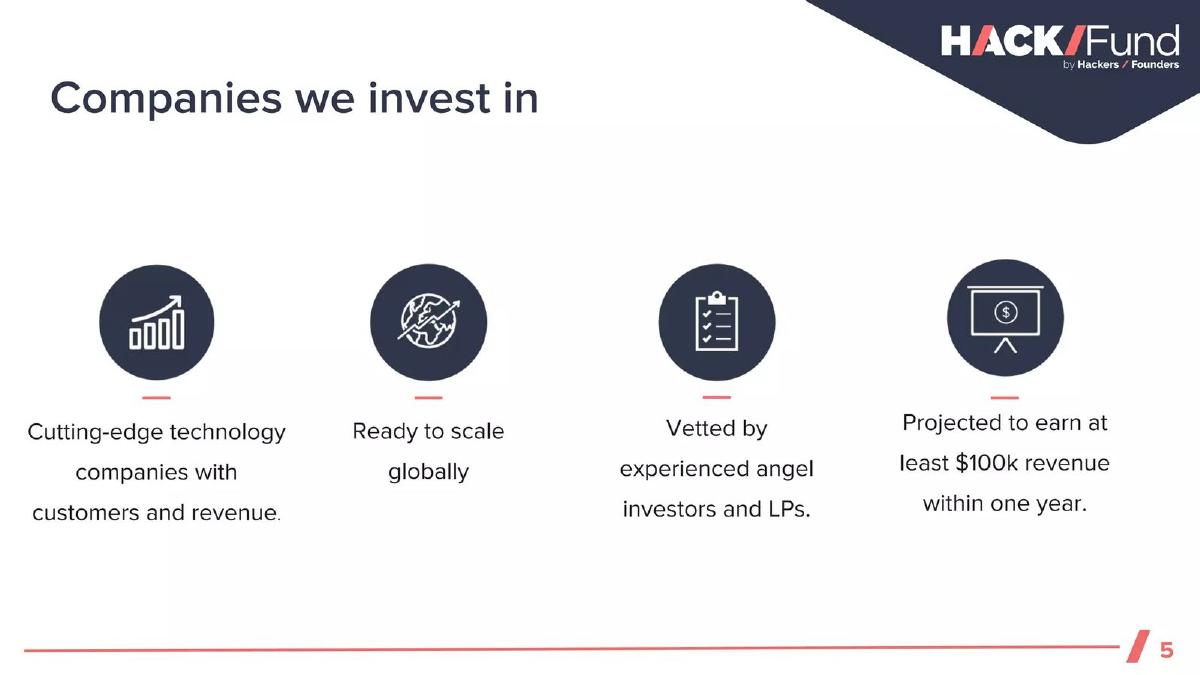
- Investment criteria include cutting-edge tech with existing customers, global scalability, and a projection of at least $100k revenue within one year (Slide 5).
- The core problem addressed is the lack of liquidity in venture capital, citing $300B currently 'frozen' waiting for exits (Slide 19).
- The fund utilizes a massive network of 32 'Portfolio Review Experts' from organizations like Google, Microsoft, and various VC firms to vet deals (Slide 25).
- A featured portfolio startup, Etips, is highlighted as having 1.5M monthly active users and being 24-36 months from IPO readiness (Slide 13).
- The track record includes 8 acquired startups, with notable exits to Cisco (Synata), Facebook (Pieceable), and Vista Equity Partners (Fiverun) (Slide 29).
- Testimonials from Vodafone, TechCrunch, and The Wall Street Journal validate the 'liquid venture' concept (Slide 33).
- The deck omits specific fund size targets, management fee structures, and the specific exchange where the fund is or will be traded.
Hack Fund V: The Liquidity Play for Global Venture
Hack Fund V, managed by the Hackers / Founders organization, presents a deck that is less about a specific technology and more about a structural innovation in finance. By positioning itself as a 'publicly-traded Silicon Valley venture fund,' it attempts to bridge the gap between the high-growth potential of startups and the liquidity of public markets. The deck is structured to move from the high-level vision of global reach to the granular details of their vetting process and historical performance.
Slide 1: The Global Vision
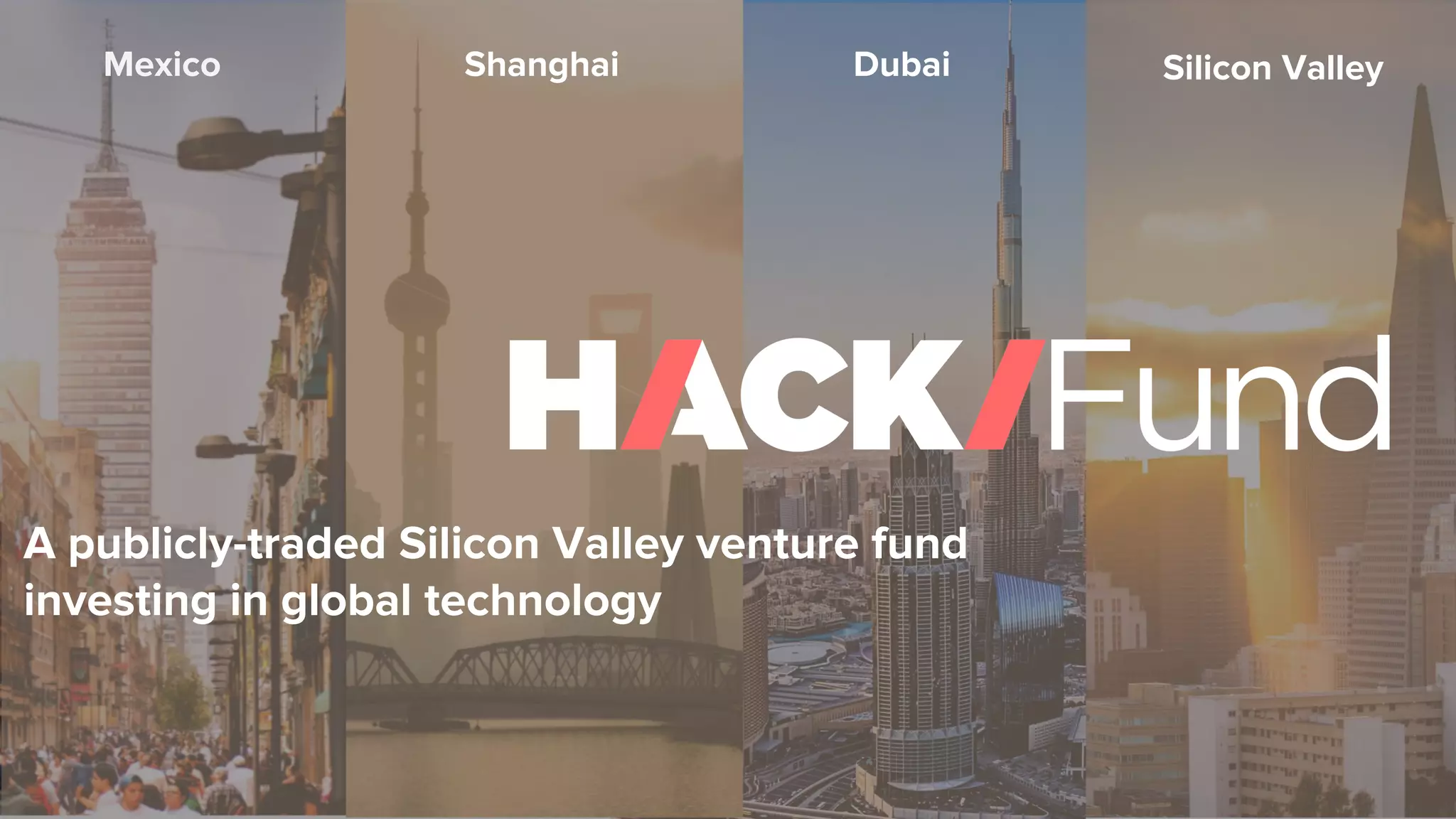
The title slide establishes the fund's identity immediately: 'A publicly-traded Silicon Valley venture fund investing in global technology.' The background imagery features four key hubs—Mexico, Shanghai, Dubai, and Silicon Valley—signaling that while the fund is rooted in California, its mandate is international. This sets the stage for a narrative about capturing value in emerging markets using Silicon Valley expertise.
Slide 5: Investment Criteria
Slide 5 defines the 'Companies we invest in.' The fund uses four pillars: cutting-edge technology with customers and revenue, global scalability, vetting by experienced angels/LPs, and a specific financial benchmark of being 'Projected to earn at least $100k revenue within one year.' This revenue requirement is a critical filter; it tells LPs that the fund is not taking 'garage-stage' risks but is looking for validated business models.
Slide 7: The Selection Philosophy
Titled 'Choosing Top Companies,' this slide emphasizes a 'proven portfolio selection process.' It reiterates the focus on post-product, revenue-generating companies. The key takeaway here is the mention of a 'broad selection of experts,' which serves as a lead-in to the fund's massive advisory network shown later in the deck. It frames the fund not as a small group of pickers, but as a platform for collective intelligence.
Slide 13: Portfolio Deep Dive - Etips
The deck uses Etips as a 'Featured Portfolio Startup' to demonstrate their ideal target. Etips is described as the 'Largest publisher of mobile travel apps' with a global team (Switzerland, Argentina, Philippines, India, Mexico) and a recent move to Silicon Valley. Key metrics provided include 1.5M monthly active users and an oversubscribed $400k friends & family round. Most importantly for a liquidity-focused fund, it notes 'IPO readiness - 24-36 months,' giving investors a timeline for potential returns.
Slide 17: Contact and Transparency
The contact slide is unusually placed in the middle of this selection (Slide 17). It lists Jonathan Nelson, Laura Nelson, and Torrance Carroll. It also points toward 'Fund Documents,' a Medium blog, and a Telegram chat. The inclusion of a Telegram chat is a nod to the modern, perhaps crypto-adjacent or retail-heavy investor base that a publicly-traded fund might attract.
Slide 19: The Macro Problem - The Liquidity Freeze
Slide 19 identifies the fundamental problem the fund aims to solve. Using a visual of money frozen in an ice cube, it states: 'Venture capital has $300B waiting for liquidity.' This is the 'Why' behind the publicly-traded structure. It argues that the traditional VC model is broken because capital is locked up for too long, and Hack Fund V is the thaw.
Slide 25: The Expert Network
This is perhaps the most visually dense slide in the deck, featuring 32 headshots of 'Portfolio Review Experts.' The list includes notable names like Derek Anderson (Startup Grind), Will Bunker (Match.com), and Monique Woodard (Black Founders). By listing experts from Google, Microsoft, and various VC firms (Susa Ventures, Shasta Ventures), the fund borrows credibility. The message is clear: even if you don't know the GPs, you know the people helping them pick the winners.
Slide 29: The Exit Track Record
A fund is only as good as its exits. Slide 29 lists eight 'Acquired Startups.' The data is specific: Synata acquired by Cisco (2016), Pieceable acquired by Facebook (2012), and Tripping.com acquired by HomeToGo (2019). This slide proves that the Hackers / Founders ecosystem has successfully navigated the full lifecycle of a startup investment multiple times across different sectors (search engines, recruiting tech, travel).
Slide 33: Third-Party Validation
The deck concludes its narrative with 'Testimonials' from Vodafone, TechCrunch, and The Wall Street Journal. The WSJ quote is particularly relevant to the fund's core mission, noting that the vehicle 'could provide more opportunity to invest in startup companies globally.' These quotes serve to validate that the 'liquid venture' concept isn't just a founder's theory but a recognized industry trend.
What Hack Fund V Does Well
The deck excels at problem identification . By citing the $300B liquidity gap on Slide 19, they move the conversation from 'we are just another fund' to 'we are a solution to a systemic financial bottleneck.' This is a powerful hook for institutional and retail investors alike who are weary of 10-year lockups.
The social proof is also exceptionally strong. Slide 25 (Experts) and Slide 29 (Exits) work in tandem to show that the fund has both the brains to pick winners and the connections to exit them. Listing specific dates and acquirers for their exits adds a level of transparency that is often missing from fund decks that merely list 'portfolio companies' without stating their status.
What is Missing from the Hack Fund V Deck
The most glaring omission is the specifics of the public vehicle . While the deck mentions being 'publicly-traded' multiple times, it does not specify which exchange (e.g., NASDAQ, OTC, or a digital asset exchange) the fund operates on. For an investor, the mechanics of how they buy and sell shares are just as important as the startups the fund invests in.
Furthermore, there is no mention of unit economics or fund terms . Typical fund decks include management fees (e.g., 2%) and carried interest (e.g., 20%). Because this is a publicly-traded vehicle, these fees might be structured differently, but they are not disclosed in these slides. There is also no 'Ask' slide in this selection, leaving the total fund size target unknown.
What Founders and Fund Managers Should Copy
1. Use a 'Featured Startup' to tell the story: Instead of just listing 50 logos, Slide 13 gives a deep dive into Etips. This allows the fund to show, rather than tell, what their due diligence looks like and what kind of growth they prioritize.
2. Quantify the macro problem: The '$300B waiting for liquidity' stat on Slide 19 is a 'sticky' number. It gives the pitch a sense of urgency and scale. Managers should always look for a single, massive number that represents the inefficiency they are fixing.
3. Leverage the 'Expert Network' visual: If you have a large advisory board, don't just list their names in a small font. The grid of headshots on Slide 25 is overwhelming in a good way—it suggests a level of institutional support that makes the fund feel 'too big to fail' or at least 'too well-connected to miss.'
Final Thoughts
Hack Fund V is a pitch for a new kind of financial product. It successfully uses the reputation of Silicon Valley (the 'Hackers / Founders' brand) to sell a global investment strategy. While it lacks some of the technical financial details in this slide selection, it builds a compelling narrative around the 'thawing' of frozen venture capital.
Frequently asked questions
- What is the primary value proposition of Hack Fund V?
- The primary value proposition is liquidity. Traditional venture capital requires investors to wait 7-10 years for a return. Hack Fund V uses a publicly-traded vehicle, allowing investors to trade their positions more freely. This is intended to solve the problem of the $300B in venture capital currently waiting for liquidity events, as stated on slide 19.
- What stage of companies does the fund target?
- The fund targets 'post-product, revenue-generating companies' (Slide 7). Specifically, they look for startups that are projected to earn at least $100k in revenue within one year of investment and are ready to scale globally (Slide 5). This suggests a late-seed to Series A focus, prioritizing commercial traction over pure R&D.
- How does the fund select its investments?
- Selection is driven by a 'broad selection of experts' across their network (Slide 7). The deck showcases a list of 32 'Portfolio Review Experts' (Slide 25) including founders of Startup Grind and partners at various VC firms. This network-heavy approach is designed to provide deep due diligence across different geographies and technical sectors.
- What is the fund's historical track record?
- The deck lists eight successful exits (Slide 29). These include Synata (acquired by Cisco), Fiverun (Vista Equity Partners), CodeEval (HireVue), Access Invest (NCIT), Cameralends (KitSplit), Pieceable (Facebook), Vidcaster (undisclosed), and Tripping.com (HomeToGo). These exits span from 2012 to 2019, demonstrating a multi-year history of identifying acquirable assets.
- Who are the key people behind the fund?
- While the deck lists 32 experts, the contact slide (Slide 17) identifies three primary individuals: Jonathan Nelson, Laura Nelson, and Torrance Carroll. Jonathan Nelson is the founder of Hackers / Founders, the organization behind the fund. The deck relies heavily on the collective reputation of its expert network rather than detailed biographies of the GP team.