Hale's 15-slide pre-seed deck is a masterclass in focused problem-solving for an underserved medical niche. By positioning chronic pelvic pain not just as a physical ailment but as a driver of mental health issues—affecting 73% of patients with anxiety and depression (Slide 3)—Hale creates a compelling case for a digital therapy intervention. The deck successfully balances clinical necessity with early-stage business viability, showcasing 60 paying beta users and a 62% 30-day retention rate (Slide 8). While it lacks a specific financial 'ask' slide, the clear roadmap toward CE mark certificat…
Key takeaways
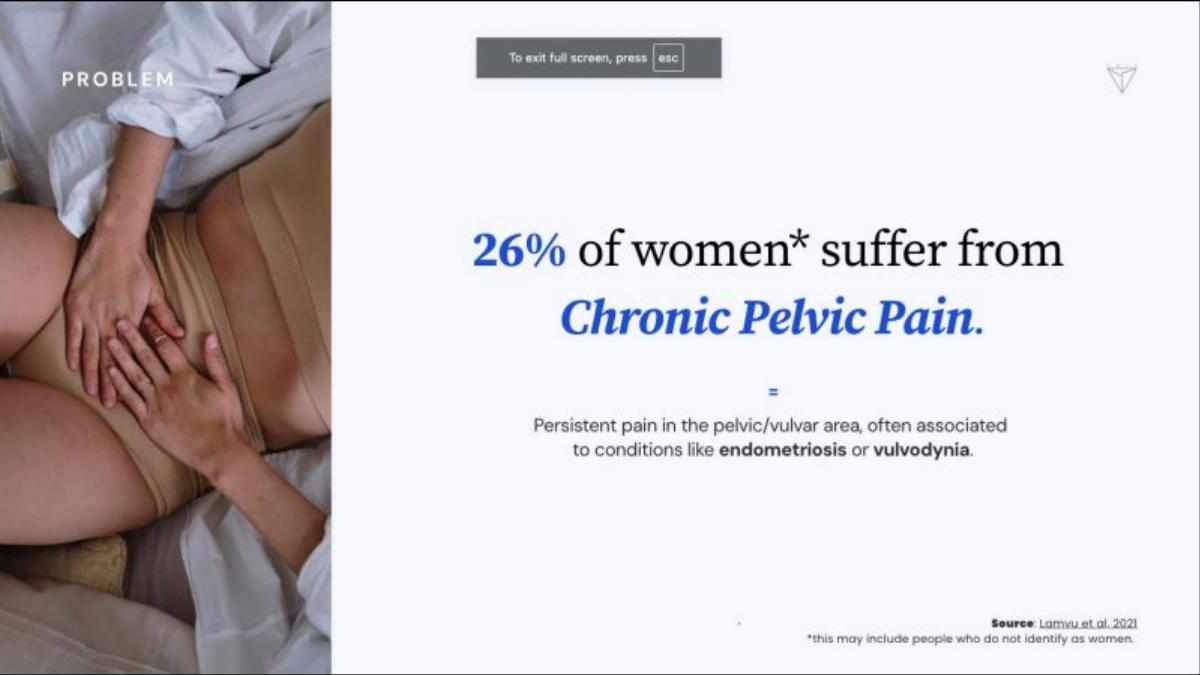
- The problem is quantified by a high prevalence rate, with 26% of women suffering from chronic pelvic pain (Slide 2).
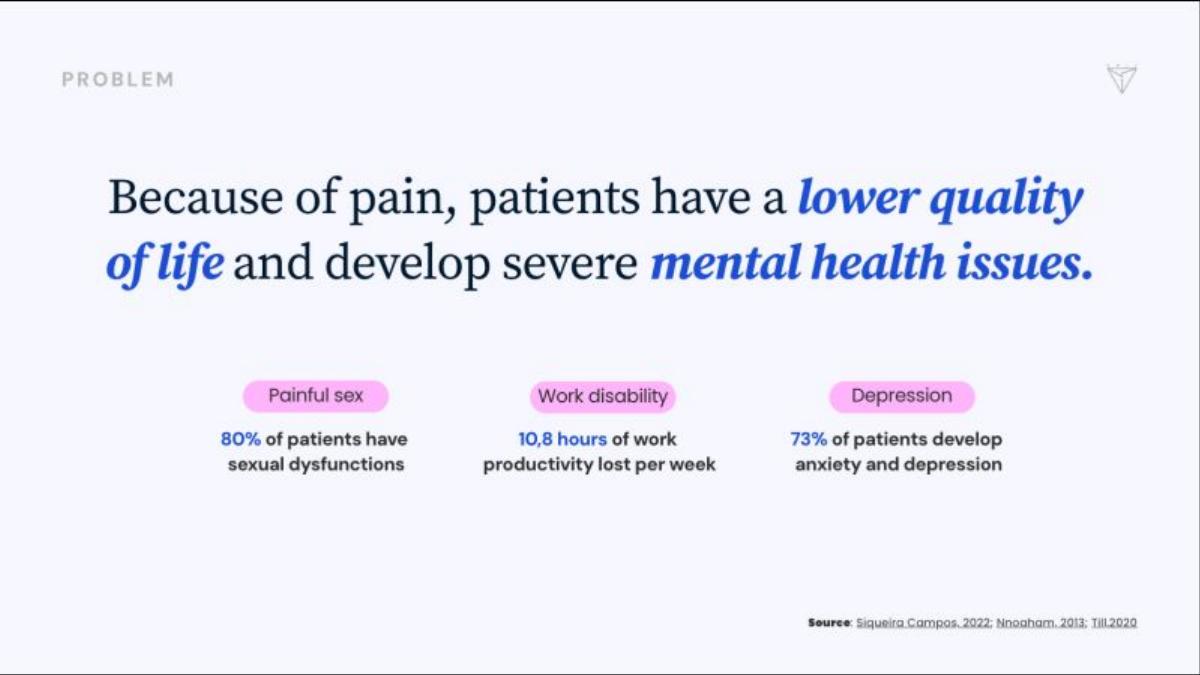
- Secondary impacts are highlighted to expand the addressable market, noting that 80% of patients experience sexual dysfunction (Slide 3).
- Product-market fit is supported by a 62% 30-day retention rate, which exceeds the stated market benchmark of 44% (Slide 8).
- The business model relies on B2C subscriptions ranging from €19 to €89, positioned as 10x cheaper than traditional therapy (Slide 7).
- Hale claims a first-mover advantage by being the only competitor specifically targeting chronic pelvic pain with in-app community support (Slide 11).
- The market size is framed as a €45B global opportunity, with a specific €878M target in Italy and the DACH region by 2027 (Slide 10).
- The team includes specialized advisors, such as a clinical psychotherapist from King's College London and a sexologist from the University of Sydney (Slide 12).
- Early traction was achieved with zero spend on paid marketing, relying instead on a 10K-member free community (Slide 8).
Hale Pitch Deck Teardown: Solving the Silent Epidemic of Pelvic Pain
Hale entered the 2023 fundraising market with a specific focus on a medical condition that is often overlooked by generalist health platforms: chronic pelvic pain. Their pre-seed deck, which secured €350K, is a lean, 15-slide presentation that prioritizes patient outcomes and early community traction over complex financial modeling. By framing the solution as 'mental health for chronic pelvic pain,' the founders successfully bridged the gap between physical therapy and digital wellness.
Slide 1: Title and Positioning
The deck opens with a minimalist blue slide. The logo is a stylized triangle, and the sub-headline is direct: 'Personalized mental health for chronic pelvic pain.' This immediately narrows the focus. It is not just a 'women's health' app; it is a mental health intervention for a specific physiological trigger. The slide includes the date (February 2023) and a direct contact email for the CEO, Gaia Salizzoni.
Slides 2-3: The Problem and Its Cascading Effects
Slide 2 leads with a staggering statistic: '26% of women suffer from Chronic Pelvic Pain.' It defines the condition as persistent pain in the pelvic/vulvar area, specifically mentioning endometriosis and vulvodynia. This is a crucial move for a pre-seed deck—it validates the clinical existence of the problem using a cited source (Lamvu et al., 2021).
Slide 3 takes the problem further by detailing the 'lower quality of life' associated with the pain. It lists three key metrics: 80% of patients have sexual dysfunctions, 10.8 hours of work productivity are lost per week, and 73% of patients develop anxiety and depression. By including work disability and mental health, Hale expands the problem from a private health issue to an economic and psychological one, increasing the perceived value of a solution.
Slides 4-5: Vision and Solution
Slide 4 is a simple vision statement: 'We want to improve patients' quality of life, starting from their mental & sexual health.' Slide 5 then defines Hale as a 'digital therapy platform.' A small badge in the corner notes that they were named 'Best Social Enterprise 2022' by the European Investment Bank, providing immediate third-party credibility to the 'Solution' slide.
Slide 6: How It Works
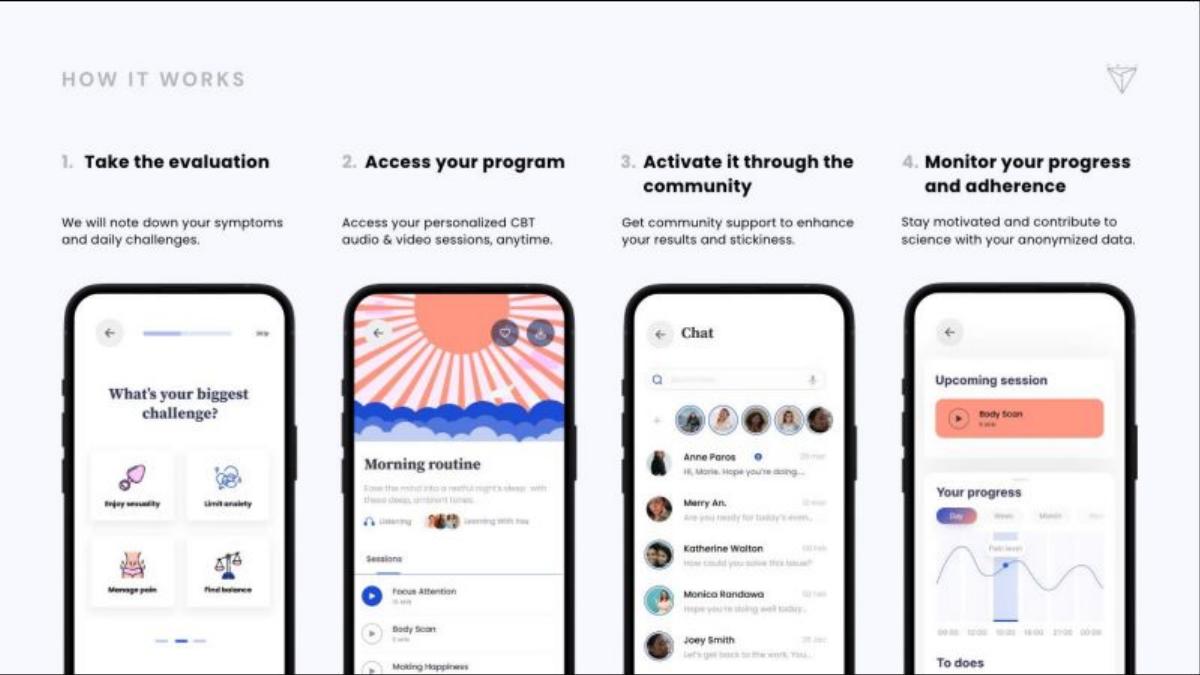
This slide uses four mobile mockups to illustrate the user journey: 1. Take the evaluation, 2. Access your program (personalized CBT audio/video), 3. Activate it through the community, and 4. Monitor progress. The inclusion of 'anonymized data' in the fourth step hints at a future data play, though it isn't explicitly detailed as a revenue stream elsewhere in the deck.
Slide 7: Revenue Model
Hale presents a clear B2C subscription strategy. The pricing is transparent: €19 for one month, €49 for three months, and €89 for six months. The most effective part of this slide is the comparison: 'Up to 10x cheaper than traditional psychological therapy (€150/session).' This justifies the subscription cost by framing it as a massive saving for the patient. The slide also mentions that insurance will be a future sales channel, signaling a move toward B2B2C.
Slides 8-9: Traction and User Proof
Slide 8 is the 'meat' of the deck for investors. It lists 60 paying beta users and a 62% 30-day retention rate. The fact that they achieved this with '€0 spent on paid marketing' while building a 10K-member free community is a strong signal of organic demand and 'stickiness.'
Slide 9 provides qualitative data. It uses radar charts to show progress across eight dimensions (Self-esteem, Social support, etc.) from Week 0 to Week 8. While the sample size for these charts isn't specified, the visual expansion of the 'blue' area (Week 8) over the 'red' area (Week 0) is a powerful way to visualize recovery.
Slide 10: Market Size
The market slide uses the standard TAM/SAM/SOM circles. The TAM is €45B worldwide. The SAM is €4B in Europe. The SOM (Serviceable Obtainable Market) is €878M, specifically targeting Italy and the DACH region before 2027. This shows a realistic, phased approach to scaling rather than claiming they will capture the global market on day one.
Slide 11: Competitive Landscape
Hale uses a feature-comparison grid against competitors like HelloBetter, Pathways, Curable, and Cara Care. They differentiate themselves by being the only ones 'Specific on chronic pelvic pain' and offering 'In-App community support.' Interestingly, they admit to lacking a 'Tele-medicine feature' that Cara Care and traditional psychologists possess, which adds a layer of honesty to the comparison.
Slide 12: The Team
The team slide highlights three founders: Gaia Salizzoni (CEO), Vittoria Brolis (COO), and Daniel Gjorgjiev (CTO). Their backgrounds include innovation management, economics, and IT, with previous experience at companies like Deloitte and NeN. The inclusion of two specialized advisors—a clinical psychotherapist and a sexologist—is vital for a health-tech startup to prove they are 'backed by science,' as the slide header claims.
Slide 13: Roadmap
The roadmap covers 2023 and looks forward to 2024. Key milestones include an 'App is live' and 'Clinical study' in Q2 2023, followed by a 'Full market launch' in Italy in Q3. The 2024 outlook is focused on regulatory hurdles (CE mark) and geographic expansion (DACH market). This gives investors a clear timeline for when the next value-inflection points will occur.
Slides 14-15: Closing and Appendix
Slide 14 is a simple call to action: 'Let's revolutionize pain-care, together.' Slide 15 is a promotional slide for the platform where the deck was hosted and is not part of the Hale presentation.
What Works in the Hale Deck
Specific Problem Definition: Many health-tech decks fail by being too broad. Hale wins by focusing exclusively on chronic pelvic pain and its mental health fallout. This makes their '10x cheaper' claim against traditional therapy much more believable because the therapy they are replacing is highly specialized and expensive.
Zero-CAC Traction: Investors love to see organic growth. The fact that Hale built a 10,000-person community and converted 60 of them to paying beta users without spending a cent on ads (Slide 8) proves there is a 'pull' from the market. It suggests that when they do eventually turn on paid marketing, their unit economics could be very attractive.
Visualizing Efficacy: The radar charts on Slide 9 are an excellent way to show 'improvement' in a non-binary way. Chronic pain management isn't about a 'cure'; it's about improving various facets of life. These charts reflect that reality better than a simple bar graph of 'pain levels.'
What is Missing from the Hale Deck
The Ask: The most significant omission is a specific 'Ask' slide. While the catalogue listing tells us they raised €350K, the deck itself does not state how much they are looking for, the valuation, or how the funds will be allocated (e.g., % to engineering, % to clinical trials). For a fundraising deck, this is a major oversight.
Unit Economics: While we see the subscription prices, there is no mention of the LTV (Lifetime Value) or the expected CAC (Customer Acquisition Cost) once they move beyond their initial community. For a B2C subscription business, these metrics are the primary drivers of long-term viability.
Clinical Study Details: Slide 13 mentions a 'Clinical study' in Q2 2023, but the deck provides no details on the methodology, the partners involved, or the expected outcomes. In healthcare, the strength of your clinical validation is often your biggest moat.
Founder Takeaways: What to Copy
Quantify the 'Shadow' Problem: Don't just talk about the primary ailment. Like Hale, show how that ailment leads to work loss, depression, and social issues (Slide 3). This increases the size of the problem you are solving. · Benchmark Your Retention: If you have retention data, don't just state it—compare it to a market benchmark (Slide 8). A 62% retention rate is good, but knowing it's 18% higher than the industry average makes it 'venture-scale' good. · Use a Phased SOM: Don't just give a giant global number. Break your SOM down by geography and timeline (Slide 10). It shows you have a go-to-market strategy, not just a spreadsheet. · Leverage Advisors for Credibility: If your founding team isn't composed of doctors, your advisor panel must be. Hale's inclusion of a psychotherapist and a sexologist (Slide 12) offsets the fact that the founders come from business and tech backgrounds.
Frequently asked questions
- What is Hale's primary value proposition?
- Hale positions itself as a digital therapy platform that addresses the mental and sexual health consequences of chronic pelvic pain. According to Slide 5, the goal is to reduce the impact of these conditions on daily life through personalized Cognitive Behavioral Therapy (CBT) programs, community support, and progress monitoring.
- How does Hale plan to generate revenue?
- The company currently utilizes a B2C subscription model. As shown on Slide 7, they offer three tiers: 1 month for €19, 3 months for €49, and 6 months for €89. The deck also notes that insurance providers are intended to become sales channels in the future.
- What evidence of product efficacy does the deck provide?
- Slide 9 features radar charts comparing 'Week 0' to 'Week 8' for beta testers. These charts show self-reported improvements across eight categories, including pain management, body image, anxiety management, and sexual satisfaction. The deck also cites a 9.2/10 user rating on Slide 8.
- Who are the key investors in this round?
- According to the catalogue listing, the €350K round was led by Vento, with participation from B Heroes, Delirus Capital, StartupGym, Moonstone Fund, and Catalisi. Notable angels include Luca Foschini (Evidation Health) and Francesco Zaccariello (eFarma).
- What are the next major milestones for the company?
- Per the roadmap on Slide 13, Hale aimed for a full market launch in Italy by Q3 2023 and 1.5K paying users by Q4 2023. Their 2024 outlook includes obtaining a CE mark certification and expanding into the DACH market (Germany, Austria, Switzerland).