Hand me is a logistics startup targeting the hyper-local delivery market, specifically focusing on small and medium-sized stores that cannot afford the high cost of owning and maintaining their own delivery fleets. The deck identifies a clear pain point—the barrier to entry for local commerce—and proposes a solution using auto-rickshaws (illustrated on slide 3) to bridge the gap between stores and homes. Based in Kochi, the company explores two potential revenue streams: a variable commission model or a fixed commission model. While the deck is visually clean, it lacks critical investor data,…
Key takeaways
- The primary problem identified is the high cost of ownership and maintenance for small stores attempting to start delivery services (Slide 2).
- The solution involves a middle-man delivery service connecting residential homes to local retail storefronts (Slide 3).
- The deck specifies Kochi as the target geographic market, though it does not provide data on why this city was chosen (Slide 4).
- The business model is undecided between a 'Variable commission model' and a 'Fixed commission model' (Slide 5).
- Visual communication relies on simple iconography, such as an auto-rickshaw, to represent the logistics component (Slide 3).
- The deck completely omits a team slide, failing to establish founder credibility or technical capability.
- There is no mention of current traction, user numbers, or revenue generated to date.
- The deck lacks a 'The Ask' slide, leaving potential investors unaware of the funding goal or use of proceeds.
The Concept: Lowering the Barrier to Local Delivery
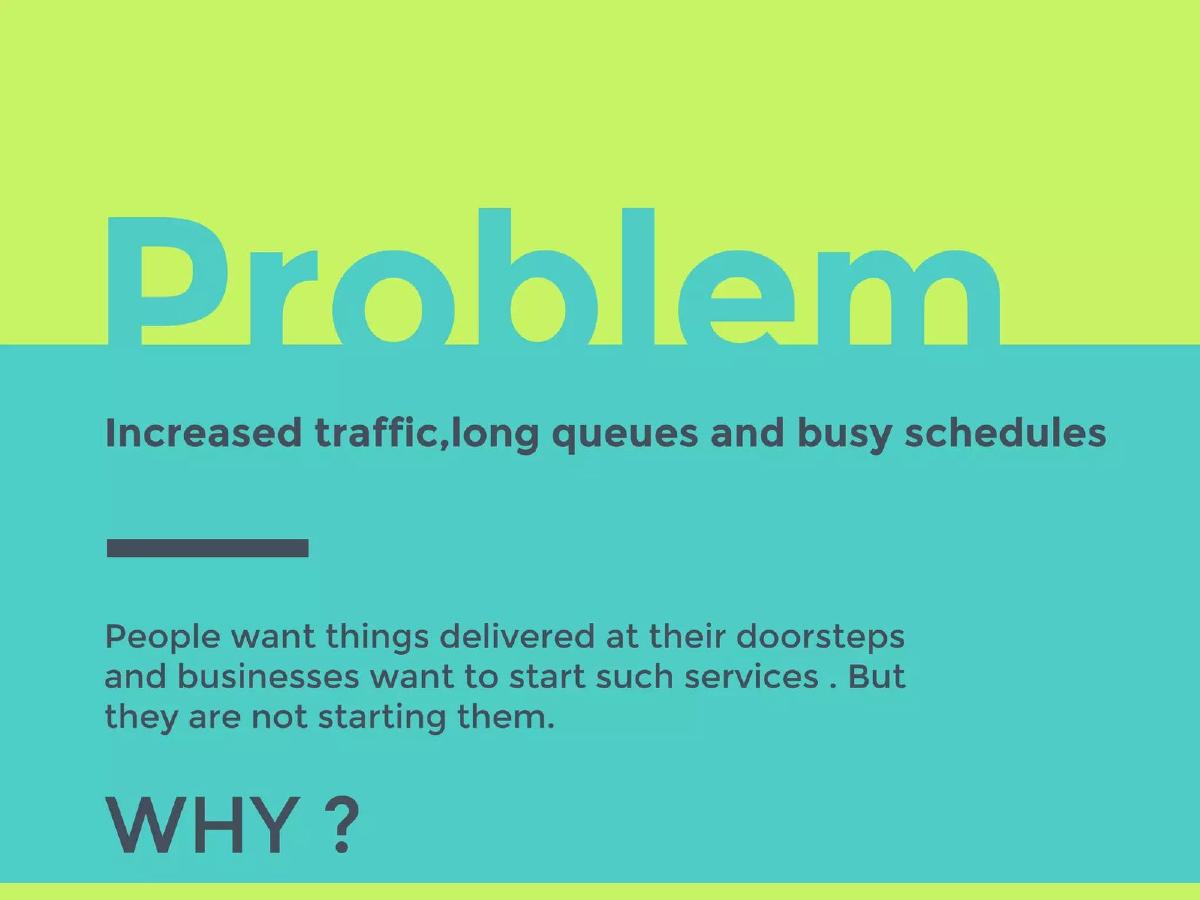
Hand me is a logistics concept aimed at the hyper-local market. The deck is brief, consisting of 11 slides (6 of which are analyzed here), and follows a minimalist aesthetic. It focuses heavily on the 'why' and the 'how' of the delivery process rather than the financial or competitive mechanics of the business. The core premise is that small businesses are being left behind in the delivery economy because the cost of maintaining a fleet is prohibitive.
Slide 1: Title Slide
The title slide is minimalist, featuring the brand name handMe in a dark sans-serif font against a bright lime-green background. A single teal underline sits beneath the name. There is no tagline, no date, and no presenter name. While clean, it misses an opportunity to immediately define the sector (e.g., 'Hyper-local delivery for Kochi').
Slide 2: The Reason (Problem)
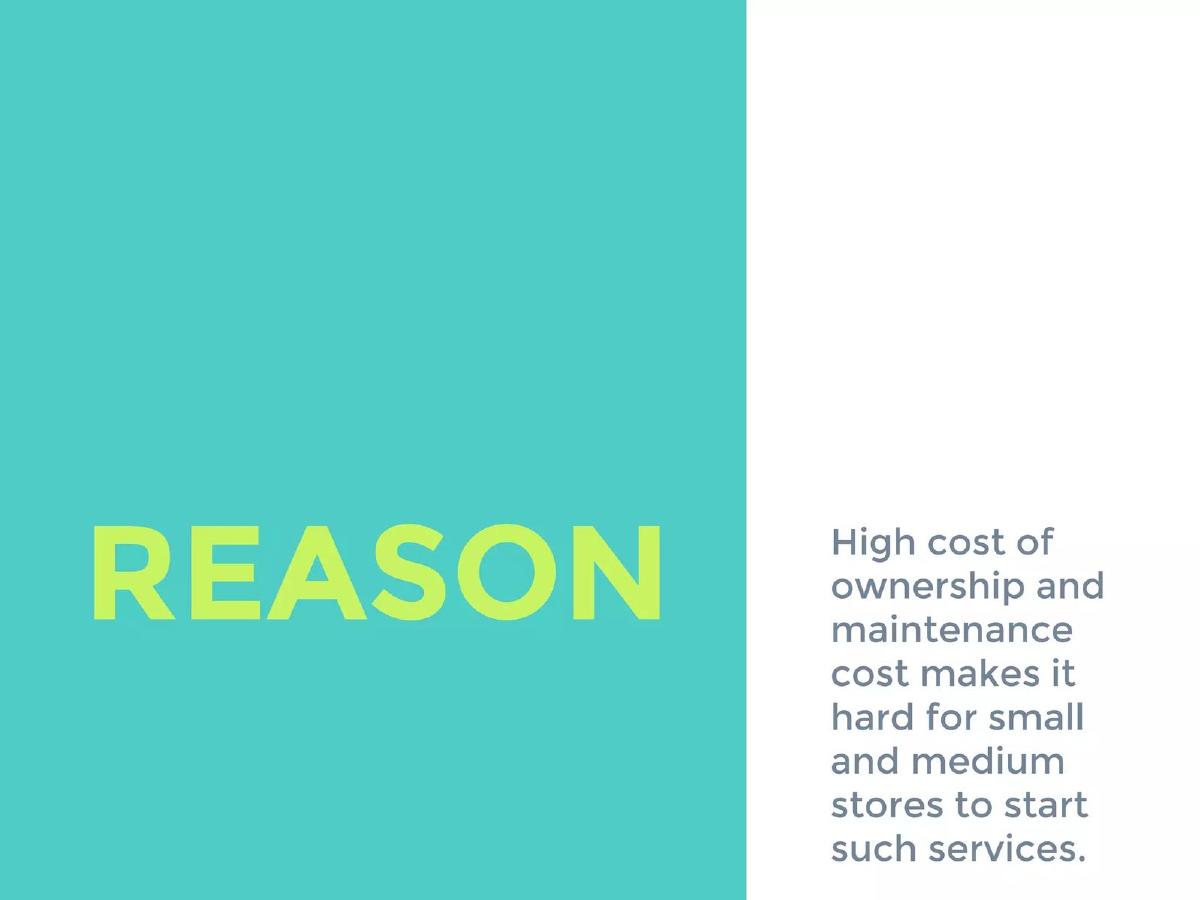
Slide 2 identifies the market friction. It states: "High cost of ownership and maintenance cost makes it hard for small and medium stores to start such services." This is a classic 'pain point' slide. It correctly identifies that for a small mom-and-pop shop, hiring a full-time driver and purchasing a vehicle is a significant financial risk. By framing the problem as a 'cost of ownership' issue, Hand me positions itself as an operational expense (OpEx) solution rather than a capital expense (CapEx) burden for the merchant.
Slide 3: The Solution
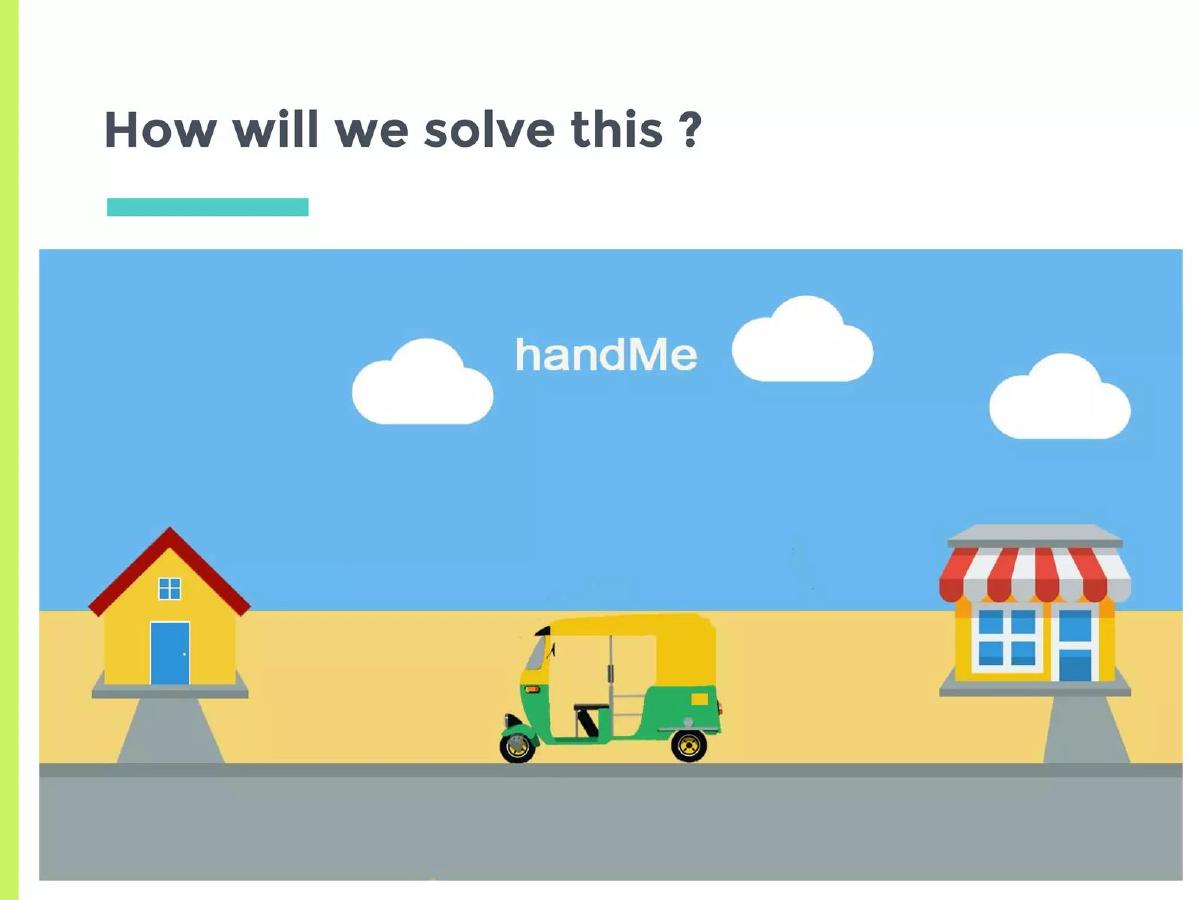
Titled "How will we solve this?" , this slide uses a simple vector illustration. It shows a yellow house on the left and a red-and-white striped storefront on the right. In the center is an auto-rickshaw, a common mode of transport in India, labeled with the handMe logo. This slide effectively communicates the three-sided nature of the marketplace: the consumer, the merchant, and the logistics provider. The choice of an auto-rickshaw suggests a focus on the Indian market and implies a low-cost, high-maneuverability fleet strategy.
Slide 4: Market Focus
Slide 4 asks two questions: "Why Kochi? Why handME?" . In a full presentation, this would likely be the 'Market' slide. However, in the provided slides, there is no data to answer these questions. A successful teardown must note that without the accompanying talk track or additional slides, the rationale for choosing Kochi—a city with specific geographic and economic nuances—is left entirely to the imagination of the investor.
Slide 5: Business Model
This slide presents a fork in the road. It lists two options: "Variable commission model OR Fixed commission model." For an investor, this is a red flag for a seed-stage deck. While it is acceptable to be testing models, a pitch deck usually argues for a specific, high-conviction path to profitability. A variable model (percentage of basket size) aligns the startup with the store's success, while a fixed model (flat fee per drop) provides more predictable revenue regardless of what is being delivered. The deck does not commit to either.
Slide 6: Contact and Conclusion
The final slide is a "Thanks!" slide with a call to action: "Any questions?" . It provides a GitHub link (github.com/ahumblenerd) and a Gmail address. The presence of a GitHub link suggests that the founder is likely a developer and that there may be a functional codebase or MVP (Minimum Viable Product) available for review. However, the use of a generic Gmail address rather than a company domain can sometimes signal a lack of professional infrastructure to institutional investors.
What Works in This Deck
Clarity of Problem: The deck does not hide behind jargon. It clearly states that delivery is too expensive for small shops. · Visual Simplicity: The slides are not cluttered. The use of high-contrast colors and simple illustrations makes the 'story' easy to follow at a glance. · Geographic Specificity: By naming Kochi, the founder avoids the trap of claiming they will 'disrupt global logistics' on day one, showing a focus on a manageable launch market.
What is Missing
Market Size: There is no mention of the Total Addressable Market (TAM). How many small stores are in Kochi? What is the average daily delivery volume? · Competition: The hyper-local delivery space in India is crowded with players like Dunzo, Swiggy Genie, and Zepto. The deck fails to explain how Hand me competes with these giants. · Team: Investors invest in people. This deck provides zero information about the founders' experience in logistics, technology, or the local Kochi market. · Traction: Even if the company is pre-revenue, data on pilot programs, signed Letters of Intent (LOIs) from store owners, or app downloads should be present. · The Ask: The deck never mentions how much money is being raised or what that money will be used for (e.g., 'Raising $100k for fleet acquisition and app launch').
Founder Recommendations
If a founder were to use this deck as a template, they should significantly expand the middle section. A minimalist design is great for a stage presentation, but a deck sent via email needs to stand on its own. Specifically:
Commit to a Model: Instead of saying 'Model A or Model B,' pick the one that fits the Kochi market best and explain why. · Add a Team Slide: Even if you are a solo founder, highlight your technical skills (link the GitHub) and your local knowledge of the logistics landscape. · Define the Unit Economics: Logistics is a game of margins. A slide showing the cost per delivery versus the commission earned is essential to prove the business can eventually become profitable. · Include a Roadmap: Show what happens after Kochi. Is the goal to expand to other Tier-2 cities in Kerala, or to dominate one specific neighborhood first?
Frequently asked questions
- What is the core value proposition of Hand me?
- Hand me aims to democratize delivery for small and medium-sized retailers. By providing a shared delivery infrastructure, they remove the capital expenditure and operational overhead required for a small shop to maintain its own vehicles and drivers. This allows local stores to compete with larger e-commerce platforms by offering home delivery without the 'high cost of ownership' cited on slide 2.
- What geographic market does Hand me target?
- The deck explicitly mentions Kochi on slide 4. Kochi is a major port city in the Indian state of Kerala. While the slide asks 'Why Kochi?', the provided materials do not include the supporting data or market characteristics that justify this selection, such as population density, smartphone penetration, or the current state of local retail.
- How does Hand me plan to make money?
- According to slide 5, the company is considering two primary revenue paths: a variable commission model, where they likely take a percentage of the order value, or a fixed commission model, which would involve a flat fee per delivery. The deck does not indicate which model is preferred or if they intend to test both simultaneously.
- What is missing from this pitch deck?
- This deck is missing several fundamental components required for a professional fundraise. There is no market sizing (TAM/SAM/SOM), no competitive landscape, no roadmap, and no financial projections. Most importantly, there is no team slide to show who is building the product and no 'Ask' slide to define the investment terms.
- What stage of development is Hand me in?
- Based on the lack of metrics and the indecision regarding the business model on slide 5, the company appears to be in the very early ideation or pre-seed stage. The use of a personal Gmail address and a GitHub link on the final slide suggests a solo founder or a small technical team in the earliest phases of building a prototype.