The Handshake pitch deck, dated May 15, 2015, introduces a 'Highschool LinkedIn' as a web and mobile O2O skills marketplace. It presents a solution for students to sign up with school emails and connect based on interests and skills. The deck differentiates itself from 'foreign direct competitors' like Facebook and LinkedIn, and 'local direct competitors' such as EchoBond and WeMJob. Financial projections are provided through an income statement for a 'Bootstrap Scenario' from 2015 to 2019. The management team consists of three individuals with marketing, business development, and sales backg…
Key takeaways
- The deck introduces Handshake as 'The Highschool LinkedIn' and a 'Web and mobile O2O platform' on slide 1, dated 05/15/2015.
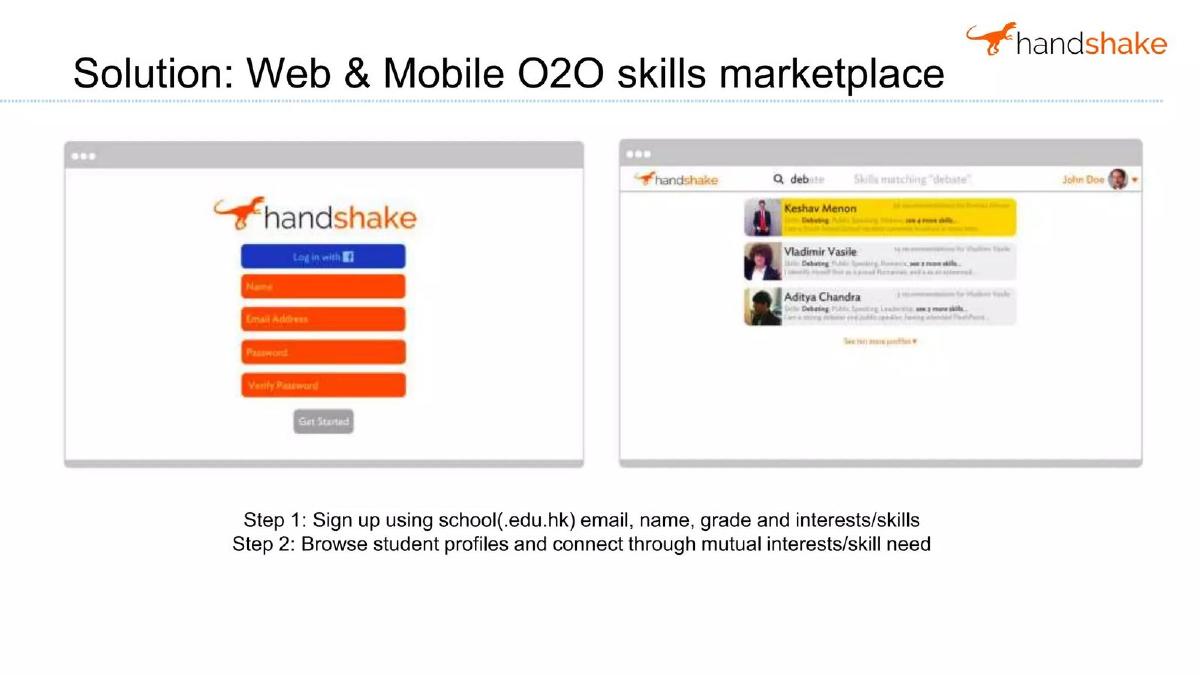
- Slide 2, titled 'Solution: Web & Mobile O2O skills marketplace', shows mockups of a sign-up page and a profile browsing interface, detailing a two-step user process.
- Competitive analysis is split into 'Foreign direct competitors' (slide 3) like Facebook and LinkedIn, and 'Local direct competitors' (slide 4) including EchoBond and hkd50.com.
- An 'Income Statement (Bootstrap Scenario)' on slide 5 projects Total Revenue from 0 in 2015 to 300,000 in 2019, and Gross Profit from -2,580 in 2015 to 175,760 in 2019.
- The 'Management team' (slide 6) consists of Arthur Lam (Marketing), Anant Majumdar (Business Development), and Neil Slighton (Sales), with brief experience summaries.
- A 'Board of Advisors' (slide 7) is presented with Timothy Yu, Arup Majumdar, and Lucien Wang, highlighting their academic and professional backgrounds.
- Slide 8, 'Funding Expenditures', uses a pie chart to show allocations: Sales (46%), Marketing and Advertising (36%), Operational Expenses (9%), Product Development/Technology (7%), and People (2%).
- The deck does not explicitly state a funding ask or the amount of capital being sought.
Handshake Pitch Deck Teardown
This teardown analyzes the Handshake pitch deck, which proposes a 'Highschool LinkedIn' concept. The deck, dated May 15, 2015, outlines a web and mobile O2O skills marketplace, details its competitive landscape, and includes financial projections and team information. The analysis focuses strictly on the content presented across the eight provided slides, identifying both strengths and omissions relevant to a fundraising context.
Slide 1: Title Slide
The first slide introduces the company with its logo, an orange dinosaur-like figure next to the word 'handshake', with 'shake' also in orange. Below the logo, the text states, 'The Highschool LinkedIn' and 'Web and mobile O2O platform'. The date '05/15/2015' is prominently displayed at the bottom center of the slide. This slide serves as a clear, concise introduction to the company's core offering and target audience, immediately framing Handshake as a specialized social professional network for high school students.
Slide 2: Solution
Titled 'Solution: Web & Mobile O2O skills marketplace', this slide presents two graphical mockups of the Handshake platform interface. The left mockup shows a sign-up screen with fields for 'Name', 'Email Address', 'Password', and 'Verify Password', along with a 'Log in with f' (Facebook) option and a 'Get Started' button. The right mockup displays a profile browsing interface, showing user profiles with names like 'Kenhav Menon', 'Vladimir Vasile', and 'Aditya Chandra', each with brief descriptions and skill recommendations. Below these mockups, two steps are outlined: 'Step 1: Sign up using school(.edu.hk) email, name, grade and interests/skills' and 'Step 2: Browse student profiles and connect through mutual interests/skill need'. This slide visually explains the user journey and the platform's core functionality, emphasizing the school email requirement for verification and the skill-matching aspect.
Slide 3: Foreign direct competitors
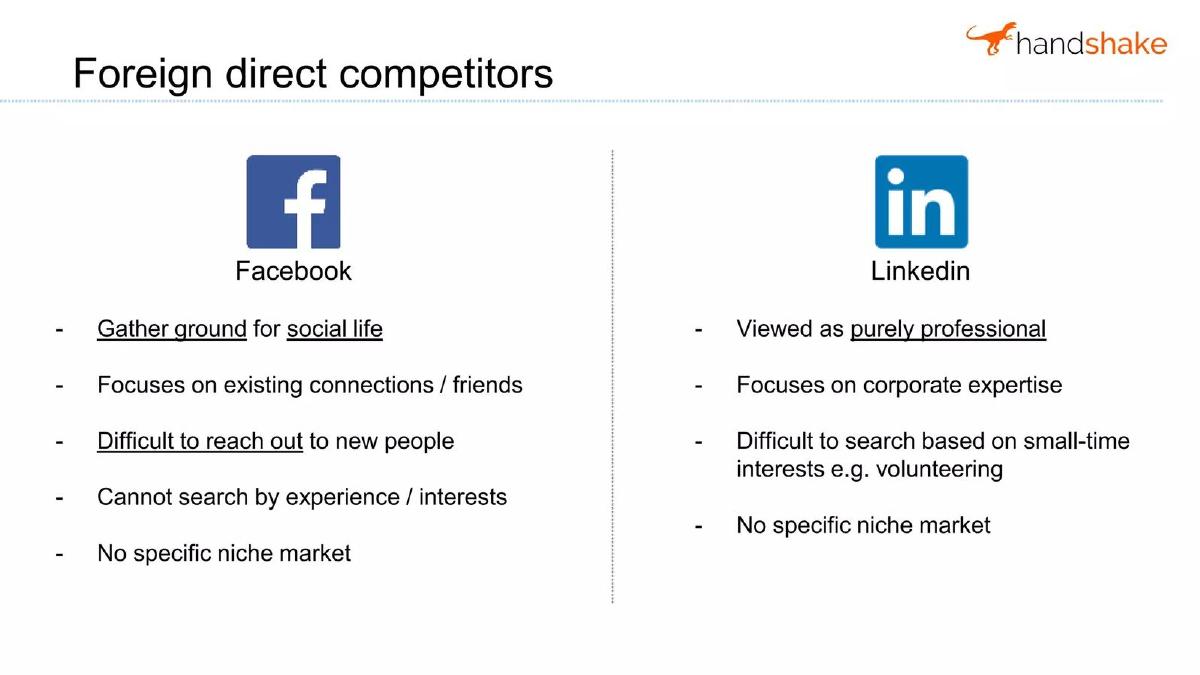
This slide, titled 'Foreign direct competitors', compares Handshake against two established platforms: Facebook and LinkedIn. Each competitor is represented by its logo and name, followed by a bulleted list of characteristics. For Facebook, the points are: 'Gather ground for social life', 'Focuses on existing connections / friends', 'Difficult to reach out to new people', 'Cannot search by experience / interests', and 'No specific niche market'. For LinkedIn, the points are: 'Viewed as purely professional', 'Focuses on corporate expertise', 'Difficult to search based on small-time interests e.g. volunteering', and 'No specific niche market'. The slide aims to position Handshake by highlighting the limitations of these broad platforms for the specific high school O2O skills marketplace it targets.
Slide 4: Local direct competitors
Following the analysis of foreign competitors, this slide, 'Local direct competitors', presents four entities: EchoBond, HKGOLDEN.com, hkd50.com, and WeMJob. Each competitor is shown with its logo and name, followed by a bulleted list of attributes. EchoBond is described as 'Still in product development', 'No specific target market', 'Unproven inactive user base', and 'Co-founders have left the startup'. HKGOLDEN.com is characterized as 'Mainly for news/blogs', 'Entirely Chinese based', and 'Little secondary school interests collaboration'. hkd50.com is noted as 'Purely services exchange', 'Not exclusively secondary students', and 'Does not promote face to face and cross school collaboration'. WeMJob is described as 'Purely services exchange', 'Not exclusively secondary students', and 'Does not promote face to face and cross school collaboration'. This slide demonstrates an awareness of the local market landscape and attempts to differentiate Handshake by pointing out the weaknesses or different focuses of these regional players.
Slide 5: Income Statement (Bootstrap Scenario)
This slide presents an 'Income Statement (Bootstrap Scenario)' with financial projections from 2015 to 2019. The table includes rows for 'Total Revenue', 'Expenses', 'Server space[13]', 'Domain registrar[15]', 'Programmer wages[12]', 'Support staff wages[12]', 'Advertising costs (sponsoring events, Facebook, traditional channels)', 'Online backup of computer data[13]', 'SSL certification[14]', and 'Gross Profit'. Key figures include Total Revenue growing from 0 in 2015 to 300,000 in 2019, and Gross Profit moving from -2,580 in 2015 to 175,760 in 2019. Expenses are detailed, showing an increase from 10,580 in 2015 to 74,240 in 2019. Footnotes [12] through [15] provide references for some of the cost estimations, linking to external sources like the Hong Kong Labor Department and Jive Software. This slide provides a detailed, albeit bootstrapped, financial outlook for the company's early years.
Slide 6: Management team
The 'Management team' slide features three individuals with their photographs and names. Arthur Lam is listed with 'Marketing' as his role, and his experience includes 'Knoala Shanghai - Marketing' and 'WWD Hong Kong - BD/Social Media'. Anant Majumdar is listed with 'Business Development' as his role, and his experience includes 'Lensational - BD/Program Dev.' and 'Chairman, Hong Kong Model UN'. Neil Slighton is listed with 'Sales' as his role, and his experience includes 'China Forensics League - Top 3 speakers' and 'China Cup (Debate) - Team representative'. This slide introduces the core team members and provides brief highlights of their relevant skills and experiences.
Slide 7: Board of Advisors
This slide, titled 'Board of Advisors', presents three individuals with their photographs and names. Timothy Yu is listed with 'BSc HKU, Risk Management, Finance', 'Founder and CEO of APPEDU (Holding) Limited (tech startup)', and 'President of HKU Alumni Entrepreneurs Club (HKUAEC)'. Arup Majumdar is listed with 'IIT Kanpur (BSc)', 'IIM Ahmedabad (MBA)', and 'Multinational corporate marketing and business development expertise'. Lucien Wang is listed with 'University of Pennsylvania - Wharton (BBA, Finance Candidate)', and 'Finalist in various university pitch competitions, member of Wharton Finance Club and Wharton Consulting'. This slide aims to lend credibility and expertise to the venture through the association with these advisors.
Slide 8: Funding Expenditures
The final provided slide is titled 'Funding Expenditures' and displays a pie chart. The chart illustrates the allocation of funds across five categories, each represented by a different color and percentage. The categories and their respective percentages are: 'Sales' (46%), 'Marketing and Advertising' (36%), 'Operational Expenses' (9%), 'Product Development/Technology' (7%), and 'People' (2%). This slide visually communicates how the company intends to utilize funding, prioritizing sales and marketing efforts.
What Works Well
The Handshake pitch deck effectively communicates its core concept and target market from the outset. The title slide (slide 1) immediately positions the company as 'The Highschool LinkedIn' and an 'O2O platform', which is a clear and easily digestible value proposition. The inclusion of the date '05/15/2015' provides crucial context regarding the deck's vintage, allowing investors to understand the market conditions and technological landscape at the time of the pitch.
The 'Solution' slide (slide 2) is strong in its visual representation. The mockups of the platform's interface provide a tangible sense of the product, demonstrating the sign-up process and the profile browsing functionality. The two-step explanation of user engagement, particularly the emphasis on school email verification and skill-based connections, clearly articulates the platform's mechanics and its unique selling points for the high school demographic. This visual and textual clarity helps investors quickly grasp what the product does and how it works.
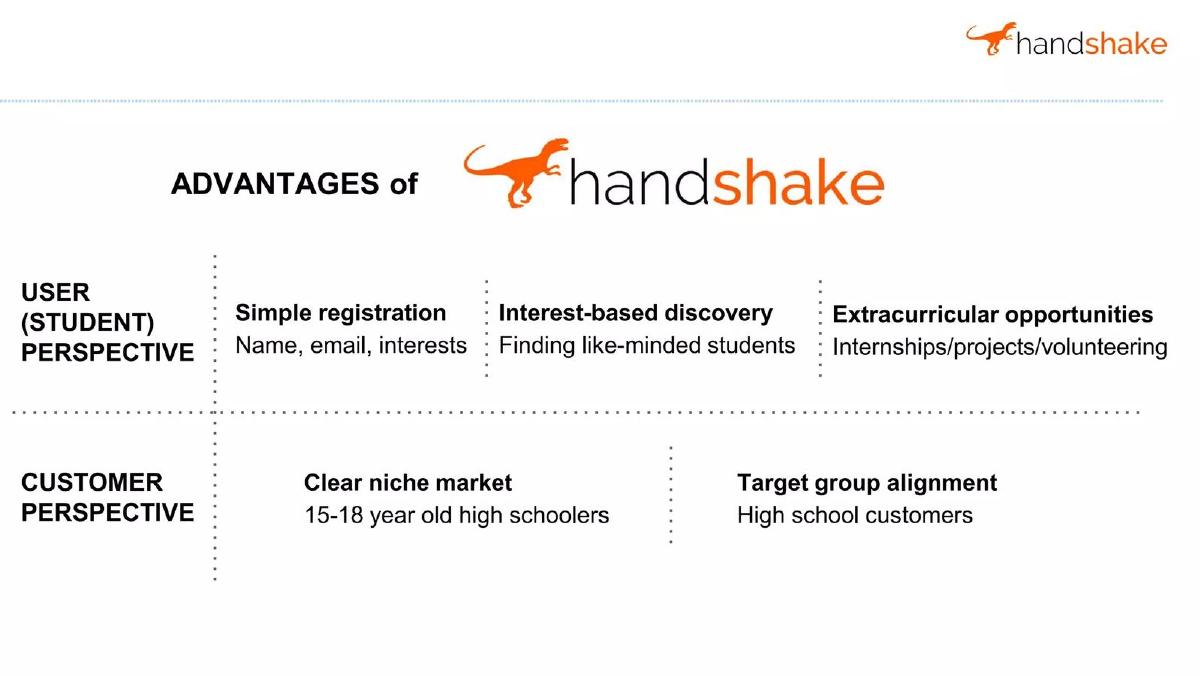
The competitive analysis (slides 3 and 4) is thorough in its segmentation, distinguishing between 'Foreign direct competitors' and 'Local direct competitors'. By explicitly listing the limitations of giants like Facebook and LinkedIn for a high school skills marketplace, Handshake effectively carves out its niche. The detailed breakdown of local competitors, including their specific weaknesses or different focuses, demonstrates a good understanding of the immediate market landscape. This level of competitive insight suggests the founders have done their homework and can articulate their differentiation.
The 'Income Statement (Bootstrap Scenario)' (slide 5) is commendable for its level of detail and transparency. Providing a five-year projection with specific line items for various expenses, even under a bootstrapped scenario, shows a thoughtful approach to financial planning. The inclusion of footnotes referencing the sources for cost estimations adds a layer of credibility to these projections. While a bootstrapped scenario might not reflect aggressive growth, it provides a realistic baseline for financial performance and demonstrates cost consciousness.
The 'Management team' (slide 6) and 'Board of Advisors' (slide 7) slides are well-structured. They present the key individuals with their photographs, roles, and concise summaries of relevant experience. For a startup, especially one targeting a specific demographic like high school students, demonstrating a capable team and experienced advisors is crucial. The advisors' backgrounds in finance, tech startups, and corporate marketing add significant weight, suggesting a network of support and guidance beyond the founding team.
What Is Missing
A significant omission from the provided slides is a clear 'ask'. There is no slide or explicit statement detailing the amount of funding Handshake is seeking, nor the specific terms of that investment. While slide 8, 'Funding Expenditures', illustrates how funds would be allocated, it does not specify the total sum required to cover these expenditures. This absence leaves a critical gap for potential investors, who need to know the investment opportunity's size and structure.
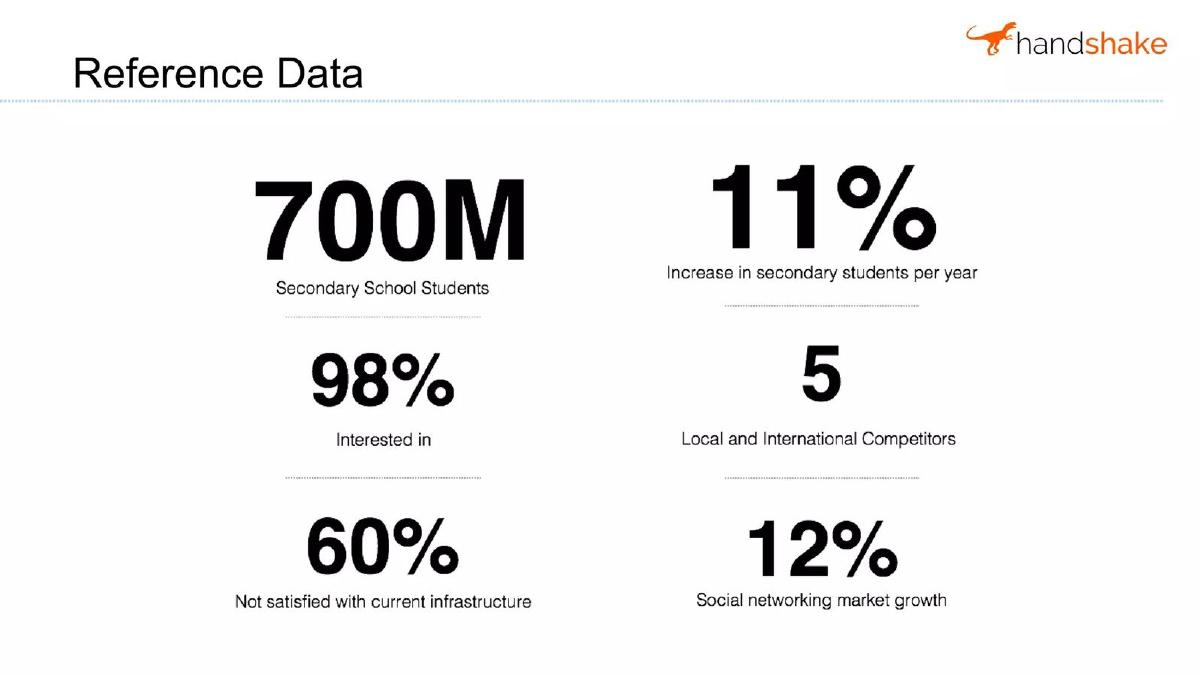
The deck also lacks a dedicated slide or section on market size and opportunity. While the concept of 'Highschool LinkedIn' implies a large addressable market, the deck does not quantify this. There are no figures for the number of high school students, the potential for O2O skills exchanges, or the overall market value for such a platform. Understanding the scale of the opportunity is fundamental for investors to assess the potential return on their investment.
Similarly, a detailed business model is not explicitly laid out. While the income statement (slide 5) shows 'Total Revenue', it does not explain how this revenue will be generated. Will it be through subscriptions, advertising, transaction fees, or a combination? A clear articulation of the revenue streams and pricing strategy would provide much-needed clarity on the company's path to profitability and scalability.
The deck does not include any information on traction or key performance indicators (KPIs). For a company pitching in 2015, even early metrics such as user sign-ups, engagement rates, or pilot program results would be valuable. Without any data points on user adoption or platform activity, investors are left to evaluate the concept purely on its potential, which can be a harder sell.
Finally, there is no discussion of the long-term vision or exit strategy. While early-stage companies might not have a definitive exit plan, outlining potential growth trajectories, future product developments, or strategic partnerships can paint a more complete picture of the company's ambition and potential for investor returns. The deck focuses heavily on the immediate solution and early financial projections but less on the broader strategic outlook.
What a Founder Should Copy
Founders should emulate Handshake's clear and concise problem/solution framing. The immediate identification of the company as 'The Highschool LinkedIn' (slide 1) is an excellent example of simplifying a complex idea into an easily understandable and relatable concept. This approach helps investors quickly grasp the core value proposition without needing extensive explanation.
The visual presentation of the product solution (slide 2) with mockups is highly effective. Showing rather than just telling how the platform works, including the user journey and key features, makes the product tangible and helps investors visualize its potential. Founders should prioritize clear, clean mockups or screenshots that highlight the most important aspects of their user experience.
The detailed competitive analysis (slides 3 and 4), segmented into 'Foreign' and 'Local' competitors, is a strong practice. Articulating specific weaknesses of existing solutions, even large incumbents, demonstrates a deep understanding of the market and how the new venture differentiates itself. This level of competitive intelligence helps build confidence that the founders know their landscape and have a viable strategy to compete.
The inclusion of a detailed 'Income Statement (Bootstrap Scenario)' (slide 5) with specific line items and references is also a valuable element to copy. While the numbers themselves are projections, the granularity shows a thoughtful approach to financial planning and cost management. Even for early-stage companies, demonstrating an understanding of operational costs and potential revenue streams, however nascent, is crucial for investor confidence.
Lastly, the clear presentation of the 'Management team' (slide 6) and 'Board of Advisors' (slide 7) with photos, roles, and concise experience summaries is a best practice. Investors invest in people as much as ideas, so showcasing a capable team and credible advisors is paramount. Founders should ensure these slides highlight relevant experiences that directly contribute to the success of the venture.
Frequently asked questions
- What is the core concept of Handshake as presented in this pitch deck?
- Handshake is presented as 'The Highschool LinkedIn' and a 'Web and mobile O2O platform' (slide 1). The solution aims to be an O2O skills marketplace where high school students can sign up with school emails, create profiles, and connect through mutual interests and skills (slide 2).
- How does Handshake differentiate itself from competitors?
- The deck distinguishes Handshake from 'Foreign direct competitors' like Facebook and LinkedIn by highlighting their limitations for a high school skills marketplace (slide 3). It also lists 'Local direct competitors' such as EchoBond and WeMJob, detailing their specific shortcomings or niche focus (slide 4).
- What financial projections are included in the deck?
- Slide 5 provides an 'Income Statement (Bootstrap Scenario)' covering 2015-2019. It projects Total Revenue growing from 0 in 2015 to 300,000 in 2019, and Gross Profit increasing from -2,580 in 2015 to 175,760 in 2019, alongside detailed expense categories.
- Who comprises the Handshake team and advisory board?
- The 'Management team' (slide 6) includes Arthur Lam (Marketing), Anant Majumdar (Business Development), and Neil Slighton (Sales). The 'Board of Advisors' (slide 7) features Timothy Yu, Arup Majumdar, and Lucien Wang, each with relevant professional or academic experience.
- Does the deck specify a funding ask or how the funds will be used?
- The deck does not explicitly state a funding ask or the total amount of capital being sought. However, slide 8, 'Funding Expenditures', uses a pie chart to illustrate how hypothetical funds would be allocated across categories like Sales (46%), Marketing and Advertising (36%), and Product Development/Technology (7%).